Part 1
My name is Emily Higgins, and at twenty-eight years old, I can still remember the exact sound of the door closing behind the people who were supposed to love me. It was a soft click, almost gentle, but to me it sounded like the final lock on a cage.
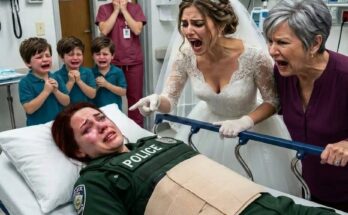
Before I became Dr. Emily Davidson, before I stood on a graduation stage while hundreds of people watched my biological mother turn pale with shame, I was just a scared thirteen-year-old girl in a paper hospital gown. I was small for my age, my feet dangling from an examination table, trying to understand why everyone in the room looked like my life had suddenly become an inconvenience.
The room was 314 at St. Jude’s Medical Center, and it smelled like antiseptic and fake flowers from an air freshener plugged into the wall. Dr. Robert Lawson sat across from my parents with a tablet in his hand, speaking in that careful voice adults use when they are trying not to frighten children.
“It is acute lymphoblastic leukemia,” he said, looking at me first before turning back to my parents. “It is the most common type of childhood cancer, but it is also one of the most treatable.”
My mother, Karen, sat stiffly near the window with her purse clutched on her lap, staring at the wall as if my diagnosis had been painted there. My father, Thomas, stood with his arms crossed, his jaw tight, while my sixteen-year-old sister Megan tapped at her phone like this was all an annoying delay in her day.
“With aggressive chemotherapy,” Dr. Lawson continued, “Emily’s survival rate is around eighty-five to ninety percent. Those are very good odds.”
For one foolish second, I waited for my mother to reach for my hand. I waited for my father to ask what came next, how soon we could start, whether I would hurt, whether I would live.
Instead, my father asked, “How much?”
Dr. Lawson blinked as if he had not heard him correctly. “The full treatment protocol usually lasts two to three years, and with your insurance, your out-of-pocket responsibility may be somewhere between sixty and one hundred thousand dollars.”
My father let out a cold, sharp laugh that made my stomach twist. “You’re telling me we have to pay a hundred grand because she got sick?”
“Thomas, please,” my mother whispered, but she still did not look at me. Her voice carried embarrassment, not concern, as if my cancer had become a scene she wished I had not caused.
Dr. Lawson leaned forward, his expression tightening. “There are financial assistance programs, payment plans, and state resources available, but the most important thing right now is that Emily begins treatment immediately.”
“Megan is applying to colleges next year,” my father said, ignoring him completely. “Stanford, Harvard, maybe Yale. We’ve saved since she was born, and we are not wiping out her future over this.”
The silence after that sentence was so heavy I could feel it pressing on my chest. I looked at Megan, hoping she would say something, anything, but she only glanced up from her phone with a bored expression before looking down again.
“We have one hundred and eighty thousand dollars in the college fund,” my father said, turning his eyes on me for the first time. “That money is for your sister’s education, not medical bills.”
My throat closed. “Dad,” I whispered, but the word came out broken and small.
“There are other options,” Dr. Lawson said, and now his voice had a hard edge beneath the calm. “Emily is a child, and she needs treatment, not a financial debate in front of her.”
My mother finally spoke clearly. “We are not taking charity. What would people in our neighborhood think if they found out we were on welfare?”
I stared at her because I honestly thought I had misunderstood. My mother was worried about the neighbors while I was sitting in front of her with cancer in my blood.
“What exactly are you suggesting?” Dr. Lawson asked.
My father looked at me the way a businessman might look at a bad investment. “She can become a ward of the state, can’t she? Then Medicaid covers everything, and it does not touch our finances.”
For a moment, I could not make the words fit together in my mind. Ward of the state sounded like something from another person’s nightmare, not something my own father would say while standing three feet away from me.
“You cannot be serious,” Dr. Lawson said, rising halfway out of his chair.
“We have another daughter to think about,” my mother said quickly, almost angrily. “Megan has a real future ahead of her, and we cannot let this destroy everything we have built.”
“I’m your daughter too,” I said, tears slipping down my cheeks before I could stop them.
My father’s face hardened. “Megan has potential. She is brilliant, focused, extraordinary. You have always been average, Emily, and we are not sacrificing a promising future for an average one.”
Something inside me split open then, something deeper than fear and sharper than pain. Cancer had frightened me, but my father’s words made me feel like I had already disappeared.
Dr. Lawson stood completely, his chair scraping loudly against the floor. “I am going to ask you to leave this room now while I speak to Emily privately.”
“We are her parents,” my mother snapped, suddenly offended.
“Leave,” Dr. Lawson said, his voice cold as steel, “or I will call security and social services this second.”
They left without touching me, without hugging me, without telling me they loved me. Megan followed them into the hallway with her phone still in her hand, and the door closed behind all three of them with that terrible, final click.
The moment they were gone, I started sobbing so hard I could barely breathe. I folded over on the examination table, clutching the ugly paper gown against my chest, feeling more abandoned than I had ever known a human being could feel.
Dr. Lawson pulled his chair close and waited until my breathing slowed. Then he handed me a box of tissues and looked me directly in the eyes.
“Emily, listen to me carefully,” he said. “What they just said is not okay, and I am not going to let them throw you away.”
I wiped my face with shaking hands. “But they don’t want me.”
His expression softened, but his voice stayed firm. “Then we will find people who do. You have cancer, and the road ahead will be hard, but you are not going to walk it alone.”
Within an hour, a social worker named Susan Myers came into the room with a clipboard and kind, tired eyes. Within two hours, I was admitted to the pediatric oncology ward, and within three hours, my parents had signed emergency custody papers that gave the state temporary responsibility for me.
They did not come back to say goodbye.
That night was the darkest night of my life. Machines beeped beside my bed, clear bags of fluid hung from metal hooks, and the hallway outside my room glowed with a soft, lonely light.
I was not even thinking about dying anymore. I was thinking that if I did die, maybe my parents would only be relieved that the bill had stopped growing.
Then Laura Davidson walked into my room.
She was thirty-four, with dark curly hair tied back in a practical ponytail and warm brown eyes that seemed to notice everything. She wore blue scrubs, comfortable sneakers, and the kind of smile that did not feel practiced.
“Hey there, Emily,” she said gently, checking the monitors beside my bed. “I’m Laura, and I’m going to be your night nurse.”
I turned my face toward the window because I did not want another adult seeing me cry. “I feel terrible.”
Laura did not correct me or tell me to be brave. She pulled a chair beside my bed, sat down, and gave me her full attention like I was not a burden, not a problem, not a bad investment.
“I heard what happened today,” she said quietly. “And I am so sorry.”
Those simple words broke me all over again. I cried into the thin hospital blanket while Laura handed me tissues, staying beside me without rushing me, without pretending there was some cheerful lesson hidden inside what my parents had done.
When I finally calmed down, she leaned closer. “I won’t lie to you, Emily. Treatment is going to be hard, but you are tougher than cancer, and you are tougher than people who failed you.”
“You don’t even know me,” I whispered.
“Not yet,” Laura said. “But I’m going to.”
Later that night, after her rounds, she came back with a deck of cards and a small packet of crackers she claimed were “technically hospital treasure.” We played until nearly two in the morning, and for the first time since Dr. Lawson said leukemia, I forgot to be terrified for more than five minutes.
Laura told me about her fat cat named Waffles, her small house fifteen minutes from the hospital, and her obsession with mystery podcasts. She told me her little brother had survived leukemia years earlier, and that watching him suffer had made her want to become the kind of nurse who stayed when things got ugly.
Over the next month, chemotherapy stole my strength, my appetite, and eventually my hair. But every night, Laura came back with clean blankets, bad jokes, card games, and a fierce tenderness I had never received from the woman who gave birth to me.
My parents never visited. Not once.
And on the twenty-eighth day, when Dr. Lawson told me I was responding beautifully and could move into outpatient care, Susan explained that they had found a foster placement for me. Laura, who was supposed to be off duty but was still standing beside my bed, looked at Susan and said, “I want to take her.”
The room went still.
“I want to foster Emily,” Laura repeated, her voice steady. “I’m already state-approved, and I know exactly what her medical needs are.”
Susan warned her that it would be a massive commitment, but Laura did not flinch. Then she turned to me with those warm brown eyes and asked softly, “Only if you want to come home with me.”
For the first time in weeks, I felt something inside me rise that was not fear.
“Yes,” I whispered. “Please.
Part 2
The paperwork took one more week, but Laura treated those seven days like we were already family. She brought me photos of her house, asked whether I liked lavender or pale blue better, and talked about “your room” so naturally that I almost cried every time she said it.
On November 15th, exactly one month after my diagnosis, Laura drove me away from St. Jude’s Medical Center in her old silver sedan. I sat in the passenger seat with one small bag on my lap, holding everything I owned, while the hospital disappeared in the side mirror like the end of one life and the beginning of another.
Her house on Maple Street was small, warm, and ordinary in the most beautiful way. There were flowerpots on the porch, wind chimes by the door, and a fat orange cat named Waffles watching me from the hallway like he was deciding whether I deserved to live there.
“This is your room,” Laura said softly, opening a door upstairs.
I stepped inside and froze. The walls were painted lavender, my favorite color, a detail I had mentioned only once while half-asleep in the hospital, and there was a new bed with a purple comforter, a white desk by the window, and a bookshelf already filled with novels.
On the desk sat a framed photo of Laura and me from the hospital, both of us smiling even though my face was pale and swollen from treatment. Under the frame was a handwritten note that said, Welcome home, Emily.
I turned around, trying to say thank you, but my voice broke before the words came out. Laura simply opened her arms, and I walked into them like I had been walking toward that hug my entire life.
“You are safe now,” she whispered into my hair. “This is your home, and I am not going anywhere.”
Those words became the foundation I stood on for the next two years. Chemotherapy did not become easier just because I had someone who loved me, but it became survivable because Laura refused to let me suffer alone.
She drove me to every appointment, sat beside me through every infusion, and held a cold cloth to my forehead when the nausea made me shake on the bathroom floor. When I was too weak to speak, she understood what I needed from the movement of my eyes.
There were days when my bones ached so badly that I wished I could crawl out of my own body. There were nights when I woke from nightmares, convinced my parents had come back only to abandon me again, and Laura would sit beside my bed until my breathing slowed.
“You’re here,” she would say gently, brushing sweat-damp hair from my forehead. “You’re home, baby, and nobody is sending you away.”
My biological parents never called. They never visited, never sent a card, never asked Dr. Lawson if I was alive, and eventually Susan told me they had surrendered all parental rights permanently.
I thought hearing that would destroy me, but by then I had already begun to understand the truth. Losing people who never truly loved you is not the same as losing family, even if it hurts exactly like grief.
Six months after I moved in, Laura sat across from me at the kitchen table with a nervous expression that made my stomach drop. I thought she was tired of the hospital bills, the sleepless nights, the fragile girl who came with medicines, appointments, and too much pain.
“Emily,” she said, taking both my hands, “I want to ask you something very important.”
I braced myself so hard my fingers went cold. I had learned too young that adults could smile kindly before breaking your heart.
“I want to adopt you,” Laura said, her voice trembling. “Not temporarily, not because the state assigned you to me, but forever, because you are my daughter in every way that matters.”
For a few seconds, I could only stare at her. Then I nodded so fast that tears fell off my chin, and Laura came around the table to hold me while Waffles screamed from the floor as if he also deserved an opinion.
Four months later, on my fourteenth birthday, I became Emily Davidson. Laura threw a small party with her closest friends, a few kids from the hospital support group, and Dr. Lawson, who cried when the judge signed the final adoption order.
That night, Laura gave me a delicate silver necklace with our initials intertwined. As she fastened it around my neck, she said, “You are mine now, forever and always.”
I wore that necklace through every remaining treatment. When the chemo made me sick, when my hair fell out, when my skin looked gray and my reflection scared me, I touched those initials and remembered I belonged to someone.
By the time I turned fifteen, active treatment had finally ended, though regular checkups still ruled my life. I was physically weaker than other kids my age, emotionally bruised in places no scan could show, and academically behind from missing so much school.
Laura did not pretend it was easy, but she also did not let me believe I was broken. She enrolled me in an advanced online curriculum, found a private tutor, and sat with me at the kitchen table every evening after long hospital shifts.
“You have been fighting for your life,” she told me when I cried over algebra. “That does not make you stupid, Emily. It makes you a survivor who is catching up.”
Some nights she was so exhausted she fell asleep over my textbooks, her cheek pressed against pages of biology notes. I would cover her shoulders with a blanket and feel a strange mix of guilt and love so sharp it nearly hurt.
“Why are you doing all this?” I asked once. “You work all day, then come home and work on me.”
Laura lifted her head, her eyes tired but fierce. “Because your father called you average, and I refuse to let that be the last word spoken over your future.”
That sentence changed something in me. I stopped studying just to catch up and started studying like I was building a door out of the room my parents had locked me in.
By sixteen, I was back on grade level. By seventeen, I was ahead, taking college-level science classes, reading medical journals I barely understood, and asking Dr. Lawson questions that made him smile with surprise.
Laura made sure my life was not only about survival and school. She took me to museums, small-town festivals, concerts in the park, and therapy appointments where I slowly learned that abandonment was something done to me, not something caused by me.
On my eighteenth birthday, Dr. Lawson gave me the news that I had dreamed of for years. I had reached the five-year all-clear, and the cancer was unlikely to return.
Laura took me to our favorite Italian restaurant that night, and over pasta and breadsticks, she pushed a small box across the table. Inside was a silver ring set with both of our birthstones side by side.
“You are legally an adult now,” she said, wiping her eyes. “But you are still my daughter, whether you are eighteen or eighty.”
I slid the ring onto my finger immediately. “You’re still my mom,” I said, and for the first time, that word felt whole in my mouth.
During my senior year, Duke University became my impossible dream. I wanted pre-med, then medical school, then pediatric oncology, because I wanted to become the kind of person Dr. Lawson and Laura had been for me.
Duke was expensive enough to make me feel selfish for even applying. But when I told Laura, she only dried her hands on a kitchen towel and said, “Then that is exactly where you are going.”
In March, the acceptance letter arrived with a scholarship that made us scream, cry, and dance around the kitchen while Waffles fled under the couch in terror. Laura held the letter like it was holy, and I knew she was seeing every sleepless night, every medical bill, every sacrifice reflected back at her.
That night, I looked at the woman who had chosen me when I had nothing to offer but fear and illness. I promised myself that one day, the whole world would know exactly who saved me.
Part 3
Duke University felt enormous when I first arrived, not just because of the campus, but because every building seemed to ask whether I truly belonged there. I carried my bags into my dorm with Laura beside me, trying to act brave while my stomach twisted with the old fear that someone would realize I was just the abandoned sick girl pretending to be extraordinary.
Laura noticed, of course, because Laura noticed everything. She helped me make the bed, arranged my textbooks on the desk, then took my face gently between her hands and said, “Emily Davidson, you earned every inch of this place.”
I wanted to believe her, so I worked like belief was something I could build through repetition. Organic chemistry, cellular biology, physics labs, endless exams, and late nights under fluorescent library lights became the new treatment plan for my future.
Pre-med was brutal, and there were nights when I called Laura from a quiet corner of the dorm hallway, crying because everyone around me seemed smarter, richer, and more certain. She always answered, even after twelve-hour shifts at the hospital, and she always said the same thing.
“You beat cancer,” she would remind me. “You survived being thrown away, and you are still here, still fighting, still becoming exactly who you were meant to be.”
By sophomore year, I had found my rhythm. I volunteered in pediatric oncology research, shadowed physicians, and discovered that the smell of hospital antiseptic no longer only reminded me of fear, but also of the people who had saved me.
Every time I saw a bald child clutching a blanket in an infusion chair, I saw thirteen-year-old me. Every time I watched a parent sit beside a hospital bed for hours, holding a small hand through pain, I understood again what my biological parents had refused to become.
During Christmas break that year, I came home and noticed Laura looked thinner. Her cheeks were sharper, her eyes more tired, and she moved around the kitchen with the careful patience of someone whose body was begging for rest.
“Are you okay?” I asked while she stirred soup at the stove.
“I’m fine, honey,” she said too quickly. “Just picking up a few extra shifts to help with your books and lab fees.”
I later learned from one of her friends that “a few extra shifts” meant fifty to sixty hours a week. Laura was working herself nearly hollow so I would never have to choose between studying and surviving.
When I confronted her, she did not apologize. She simply poured me a bowl of soup and said, “You had enough stolen from you already, Emily, and I refuse to let money steal anything else.”
That was Laura’s love language. She did not make dramatic speeches every day, but she showed up, paid bills, packed care packages, mailed handwritten notes, and carried my future like it was something sacred.
By junior year, I was near the top of my class. By senior year, I was applying to medical schools with a transcript so strong that even I sometimes stared at it in disbelief.
The acceptance to Duke University School of Medicine came on an ordinary afternoon while rain tapped against my apartment window. I opened the email, read the first line, then screamed so loudly that my roommate thought something terrible had happened.
I called Laura with shaking hands. “Mom,” I said, because by then that was who she was, completely and without hesitation. “I got in.”
For a moment, there was only silence. Then Laura sobbed so hard I could barely understand her, laughing and crying at the same time as she said, “My girl is going to be Dr. Davidson.”
Medical school made undergraduate pre-med look gentle. The pressure was relentless, the hours were punishing, and the clinical rotations stripped away whatever innocence I had left about illness and death.
But I loved it. I loved the science, the responsibility, the sacred trust of standing beside people in the worst moments of their lives and choosing not to look away.
I chose pediatric oncology because my past had never really left me. Instead of running from that hospital room, I decided to walk back into rooms just like it for the rest of my life and become the adult I once needed.
Laura came to every milestone she could. She cried at my white coat ceremony, clapped until her hands turned red at my research presentation, and stood in the front row on match day when I learned I would continue my training in pediatric oncology.
Through all those years, Karen, Thomas, and Megan remained ghosts. No calls, no birthday cards, no apologies, no attempt to know whether the child they abandoned had survived.
I told myself I did not care, and most days, that was true. But sometimes, late at night, I wondered whether they ever spoke my name, or whether they had erased me so completely that even guilt could not find me.
Then April of my fourth year arrived, and with it came news that made me sit down hard on the edge of my bed. I had been selected as valedictorian of my medical school class.
Out of one hundred and twenty brilliant students, I had earned the highest academic standing, the strongest clinical evaluations, and a research record that made my professors proud. I would deliver the student address at commencement.
When I called Laura, I barely got the words out before she screamed. “Valedictorian?” she cried. “Emily, baby, do you understand what this means?”
I did understand. It meant every hospital night, every tutoring session, every shift Laura worked until her feet ached, every cruel word my father had spoken over me had failed.
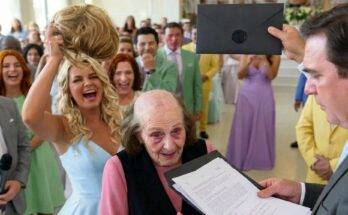
Graduation was set for May 20th, and Laura treated it like a national holiday. She bought a new dress, requested time off months in advance, and invited the patchwork family we had built from nurses, friends, neighbors, and people who had loved us when blood relatives did not.
Two weeks before commencement, an email from the university events coordinator appeared in my inbox. Because I was valedictorian, I was allowed additional reserved seating, and I had already submitted Laura’s name along with six people who had become my real family.
The coordinator’s message was polite, professional, and completely devastating. Karen and Thomas Higgins had contacted the university claiming to be my legal parents and asking for reserved seats near the front.
I stared at the screen until the words blurred. Fifteen years of silence, and now they wanted seats.
My hands trembled as I called Laura. “Mom,” I said, my voice tight. “They want to come to my graduation.”
Laura was quiet for a long moment. “How do you feel about that?”
“I don’t know,” I admitted. “Part of me wants them nowhere near me, but another part wants them to see exactly what I became without them.”
Laura exhaled softly. “It is your day, Emily, and I will support whatever you choose. But if you want my honest opinion, let them come and let them see what they threw away.”
That night, I sat alone with my laptop open and thought about thirteen-year-old me on that examination table. I thought about my father calling me average, my mother choosing reputation over love, and Megan walking out without looking back.
Then I typed one sentence to the coordinator. “Yes, please add them to the reserved section.”
I did not tell Laura what I was planning to say in my speech. She thought I was writing about medicine, perseverance, and our responsibility to patients, and I was, but there was a truth underneath those words that had waited fifteen years to be spoken aloud.
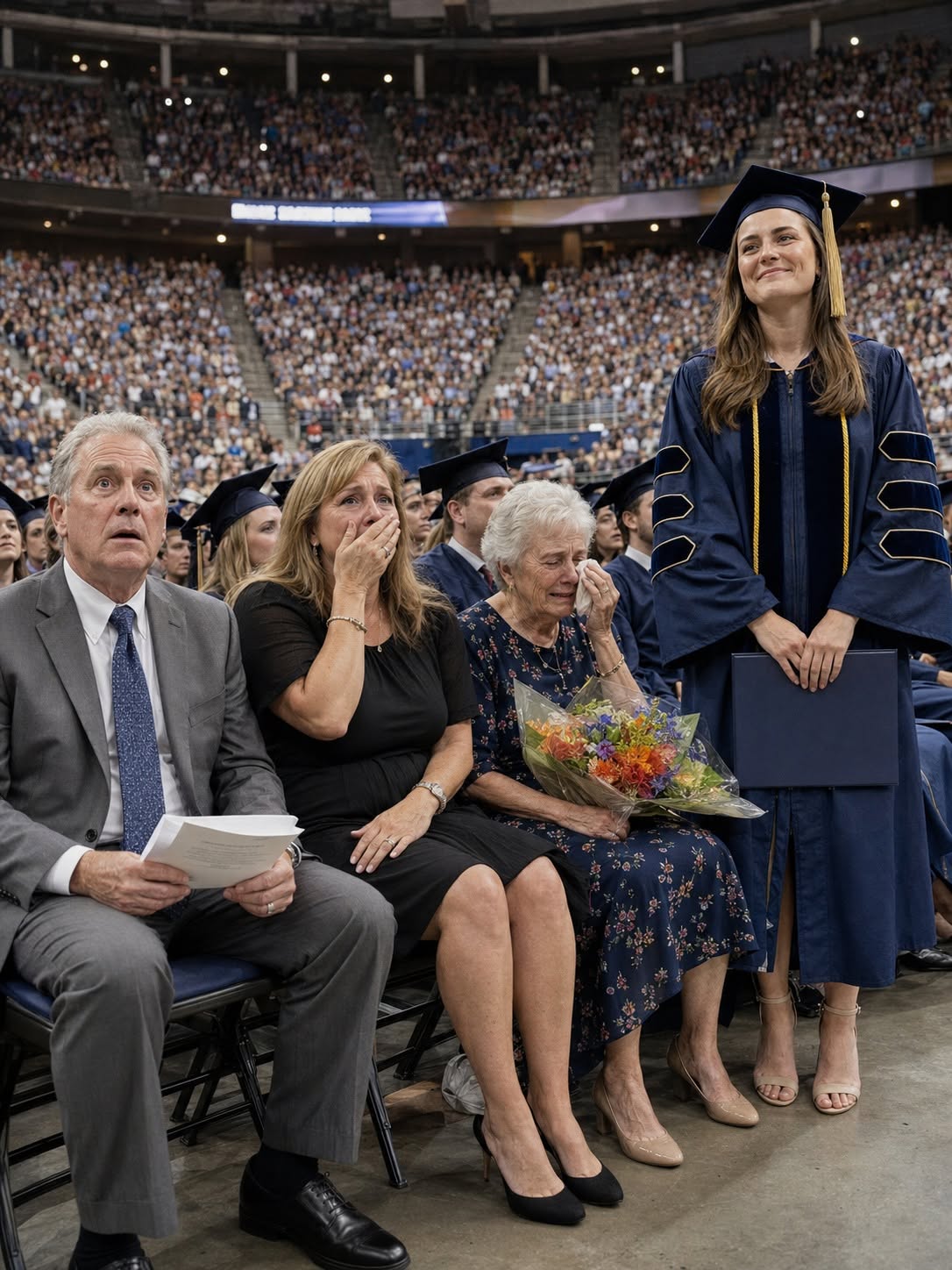
On May 20th, the arena was packed with thousands of people. I stood in line with my classmates wearing my white coat, honor cords, Laura’s necklace, and the silver ring with our birthstones pressed against my skin.
As we marched inside, I saw Laura first. She was already crying, holding flowers in her lap, looking at me with so much pride that it nearly took my breath away.
Then I saw them.
Karen and Thomas Higgins sat stiffly two seats away from my real family, older and smaller than the monsters in my memory. They scanned the program with confused faces, searching for Emily Higgins, not yet understanding that the daughter they had abandoned had become Emily Davidson.
When the dean stepped to the podium and announced the class valedictorian, the arena quieted. “Ladies and gentlemen,” he said, smiling proudly, “please welcome Dr. Emily Davidson.”
I rose from my seat and started walking toward the stage. Behind the bright lights, I saw my biological mother’s hand freeze halfway to her mouth, and my father’s face drain of color as recognition finally struck them.
They knew.
And now everyone was about to know.
Part 4
I climbed the steps to the stage with my heart pounding so hard I could feel it in my throat. The lights were bright, the arena was silent, and somewhere in the front rows, the two people who once decided I was not worth saving were finally looking at me.
I adjusted the microphone and forced myself to breathe. Then I looked over the sea of caps, white coats, proud families, and tearful faces, and I began with the words I had practiced a hundred times but had never spoken without shaking.
“Thank you, Dean Morrison,” I said clearly. “To our faculty, our families, our friends, and my fellow graduates, congratulations. We made it.”
Applause rose and rolled through the arena, but I barely heard it. My eyes found Laura in the front row, already crying with one hand pressed over her heart, and her face gave me the courage to continue.
“When I was thirteen years old,” I said, “I was diagnosed with acute lymphoblastic leukemia. I remember sitting in a hospital room in a paper gown, terrified, while a doctor explained that I had a good chance of surviving if treatment began quickly.”
The arena grew still. I could feel the attention shifting, deepening, as people realized this was not going to be the usual polished graduation speech about hard work and dreams.
“I also remember the moment I learned that biology does not automatically make someone family,” I continued. “My biological parents looked at the cost of my treatment and decided my life was too expensive.”
A gasp moved through the audience like wind through dry leaves. I did not look at Karen or Thomas yet, because I was not ready to give them even that much power over my voice.
“They said my sister had a future worth protecting,” I said. “They said I was average, that my survival was not worth sacrificing the money they had saved for someone they believed mattered more.”
My hands tightened around the edges of the podium, but my voice stayed steady. Every word felt like taking back a piece of the thirteen-year-old girl they had left behind in room 314.
“They walked out of that hospital room,” I said. “They signed papers, surrendered their rights, and disappeared from my life while chemotherapy began.”
The silence became enormous. I saw people in the reserved section turning their heads, whispering, and slowly understanding exactly who sat two seats away from Laura.
“But that is not the end of my story,” I said, and my voice softened. “Because that same night, a nurse named Laura Davidson walked into my room and treated me like I was not a burden, not a bill, and not a mistake.”
Laura covered her mouth with both hands. Her shoulders shook, and the friends beside her reached out to hold her steady.
“She became my night nurse first,” I continued. “Then she became my protector, my foster mother, my legal mother, and the only parent who ever truly earned that name.”
The audience broke into applause, but I waited until it faded. Laura kept shaking her head as if she could not believe I was saying all this in front of everyone.
“She held my hand through chemotherapy,” I said. “She cleaned up my sickness, sat beside my bed after double shifts, helped me catch up in school, and told me I was brilliant until I finally believed her.”
My throat tightened, but I did not stop. I had spent fifteen years becoming strong enough for this moment, and I owed Laura the truth in front of the world.
“When I told her I wanted to go to Duke, she did not laugh at me,” I said. “She said, ‘Then that is exactly where you are going,’ and somehow she helped make it happen.”
This time, the applause came louder. People were standing now, clapping not for me, but for the woman who had taken a dying, abandoned child into her home and called her daughter.
I removed my graduation cap and held it against my chest. “This degree belongs to Laura Davidson as much as it belongs to me.”
Laura bent forward, crying so hard that one of her friends had to wrap an arm around her waist. I smiled through my tears because I knew she would argue later, but in that moment, even she could not deny what everyone now understood.
“She saved my life twice,” I said. “First, by making sure I survived cancer, and second, by teaching me that I deserved to live fully after surviving it.”
Only then did I turn my eyes toward Karen and Thomas. My mother sat frozen, pale and trembling, while my father stared at the floor with his face twisted in humiliation.
“To my biological parents sitting here today,” I said, and the entire arena seemed to stop breathing. “Thank you for showing me that titles mean nothing without love, and thank you for giving me up so I could find my real mother.”
Karen pressed a hand over her mouth. Thomas did not raise his head, but I saw his shoulders stiffen as the truth he had buried for fifteen years finally became public.
“I am not standing here because of you,” I said. “I am standing here despite you, and because one woman chose me when you walked away.”
I turned back to Laura. “Mom, thank you for every sacrifice, every sleepless night, every appointment, every bill, every hug, and every time you told me I mattered.”
The arena exploded into applause. People rose to their feet in waves, cheering while Laura mouthed, “I love you,” through her tears.
“I love you too,” I mouthed back.
After that, I finished the rest of my speech the way I had planned, speaking about medicine, compassion, responsibility, and the sacred duty to never treat a patient like a number. But the heart of the speech had already been delivered, and everyone in that arena knew it.
When the ceremony ended, the reception hall was crowded with classmates, professors, reporters, and strangers who wanted to hug me. But I only wanted one person, and when Laura finally reached me, we fell into each other’s arms and cried in the middle of everyone.
“You didn’t have to do that,” she whispered against my shoulder. “You didn’t have to give me all the credit.”
“Yes, I did,” I said, holding her tighter. “Because every word was true.”
Across the room, I saw Karen and Thomas standing alone. My mother looked as if she wanted to come toward me, but my father’s anger and the eyes of everyone around them kept them trapped in place.
They left twenty minutes later without speaking to me. At the time, I thought shame had driven them out, but I soon learned the truth was uglier and far more predictable.
Over the next few days, the voicemails began. Karen cried into my phone, saying they had made mistakes, saying Megan could no longer help them, saying they were facing foreclosure and hoped I would call because I was a doctor now.
Thomas emailed next, cold and furious. He said I had humiliated them, said I owed them a conversation, and insisted they had done the best they could under difficult financial circumstances.
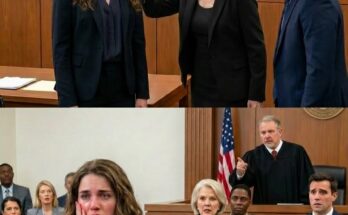
I learned that Megan’s successful life had collapsed after her wealthy husband was convicted in a federal insider trading case. Their house was seized, her career was damaged, and my parents had lost the financial support they had once chosen over me.
They had not come to my graduation because they missed me. They had come because they thought their abandoned daughter might now be useful.
For two weeks, they called, emailed, and sent messages through every account they could find. Every word carried the same hidden demand beneath the fake regret: help us now that the daughter we chose can no longer save us.
On the fifteenth day, I sent one email. “You told me when I was thirteen that you could not afford a sick child, and you decided I was not worth saving.”
My hands were perfectly steady as I wrote the rest. “Laura Davidson is my mother, my family, and my home. I owe you nothing, and you are not to contact me again.”
Then I blocked them everywhere.
Three years have passed since that day. I am now thirty-one years old, completing my pediatric oncology fellowship, walking into hospital rooms where frightened children and devastated parents wait for answers.
Every time I sit beside a young patient, I remember who I was. I remember the girl in the paper gown, and I make sure she lives in the way I treat every child placed in my care.
Laura still calls me every day. She has finally cut back to part-time nursing, though she still insists she is “too young to retire,” and she visits me whenever my schedule gives us even the smallest window.
I heard through someone else that Karen and Thomas lost their house and now live in a small apartment. Megan moved across the country and stopped speaking to them after they kept asking her for money she no longer had.
I felt no joy when I heard it. I felt no guilt either, because consequences are not cruelty when they are earned.
People sometimes ask whether I regret what I said at graduation. They ask whether I think I was too harsh, whether family deserves forgiveness, whether blood should matter more than pain.
My answer is always the same. That speech was not revenge; it was the truth, and sometimes truth only sounds cruel to the people who spent years hiding from it.
Laura taught me that love is not a word, a title, or a shared last name. Love is showing up, staying through the ugly parts, paying the cost without keeping score, and choosing someone every single day.
I am Dr. Emily Davidson. I beat cancer, became a doctor, found my real mother, and built a life beyond the people who told me I was not worth saving.
That is not revenge.
That is justice.
THE END.