Helen’s mouth tightened. “A wife should not provoke her husband.”
Arthur’s head turned slowly toward her.
She went silent.
The first siren reached us from a distance, faint at first, then louder as it cut through the clean, expensive quiet of the neighborhood. Blue and red light began flashing against the front windows, painting the walls in sharp bursts of color. It felt unreal, like the house had become a crime scene in a television drama, except the pain in my face and the emptiness in my body were too real to let me pretend.
Leo tried to stand before the officers came in. Arthur took one step forward, and Leo froze.
“Stay down,” my father said.
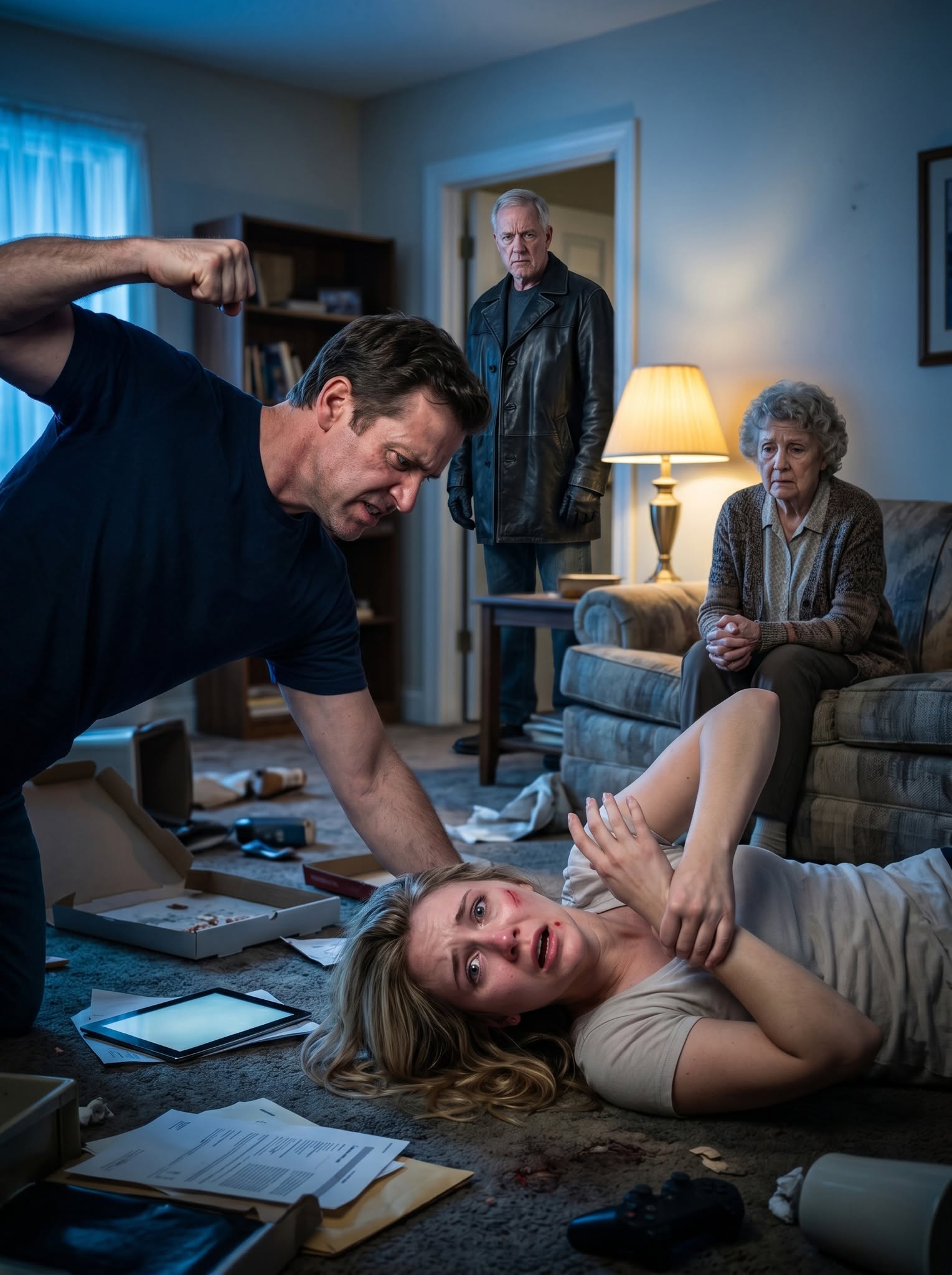
The front door opened with force, and three officers entered with their hands near their holsters. Behind them came two paramedics carrying medical bags, their expressions serious as they took in the broken coffee table, Leo curled on the rug, Helen shaking beside him, and me leaning against the wall in hospital scrubs with blood dried at my mouth.
The lead officer was a broad man with tired eyes and a voice that suggested he had seen too many living rooms turn into battlegrounds. “Who made the call?”
“I did,” I said.
Leo immediately raised his good hand. “Arrest him! That man broke into my house and assaulted me!”
The officer looked at Arthur. “Sir?”
Arthur took out his retired military identification and handed it over without drama. “Arthur Vance. I drove my daughter home from the hospital after a miscarriage. I remained outside until I witnessed her husband strike her and move to strike her again. I intervened to stop further harm.”
Leo laughed bitterly from the floor. “Intervened? He attacked me!”
The officer glanced at my face, then at my scrubs, then at the hospital bracelet still around my wrist. His jaw hardened almost imperceptibly.
“Ma’am,” he said gently, “did your husband hit you?”
I tried to answer, but the words stuck. It was strange how I could survive the slap, the blood, the hospital, and Leo’s cruelty, yet almost break when someone asked me plainly if I had been hurt.
“Yes,” I said at last. “Twice. He was about to hit me again when my father stopped him.”
The officer nodded once. “Do you need medical attention?”
“She does,” Arthur answered before I could minimize it. “She was discharged from the ER after pregnancy loss caused by severe physical stress. She needs to be evaluated again.”
The paramedics came to me then, and one of them, a woman with kind eyes, touched my shoulder lightly before asking permission to check my vitals. That small courtesy almost undid me. After a year of being ordered, criticized, and handled like property, being asked for permission felt like being handed back a piece of my own name.
As she wrapped the blood pressure cuff around my arm, Leo kept talking. He said I had always been unstable. He said I had made up the miscarriage to punish him. He said Arthur had never liked him and had been waiting for an excuse.
Helen backed him up in a trembling voice. “Maya has always been emotional. Pregnancy made her worse. Leo was only trying to calm her down.”
The female paramedic’s eyes flicked toward the swelling on my cheek. The lead officer looked at Helen for a long moment, and his expression made her voice fade away.
“Ma’am,” he said, “calming someone down does not leave a handprint.”
Helen looked away.
An officer asked me if there were medical records from that day. I handed over my discharge papers with shaking fingers. The top page listed the hospital, the emergency treatment, the loss, and the doctor’s instructions for rest and follow-up care. I watched the officer read it, and I saw the atmosphere in the room shift from domestic dispute to documented cruelty.
Arthur had been right. Evidence mattered.
For months, Leo had thrived in private shadows. He had hurt me behind closed doors and smiled in public. But now there were papers, bruises, messages, ignored calls, and witnesses. The walls he had built around his version of the truth were beginning to crack.
When the officers helped Leo up, he snarled through clenched teeth. “You’re making a mistake. My lawyer will destroy her.”
“No,” Arthur said quietly. “He won’t.”
Leo looked at him, and I saw fear return to his face.
The officer turned Leo around. “Leo Whitman, you are being detained pending investigation of domestic assault.”
Helen screamed. Not cried, screamed, as if the universe had committed some unforgivable offense by treating her son like an ordinary man. She grabbed one officer’s sleeve, begging him to stop, saying Leo was successful, respected, important. The officer gently but firmly removed her hand.
“Successful men can still go to jail,” he said.
That sentence stayed with me.
The paramedics guided me outside on unsteady legs. The cold night air touched my bruised face, and I realized half the neighborhood was standing on lawns and porches, watching behind phones and curtains. Helen saw them too, and her face collapsed in a way it never had when I was bleeding.
Her reputation was being carried out in handcuffs with her son.
As they placed me into the ambulance, I looked back toward the house. Arthur stood at the end of the walkway, broad and unmoving beneath the porch light. He was not smiling. There was no triumph in his face, only grief and a terrible, disciplined restraint.
“Dad,” I called weakly.
He came to the ambulance doors.
For a moment, I felt like I was five years old again, waking from a nightmare and reaching for the only person who could make the dark feel less endless.
“I’m scared,” I admitted.
Arthur’s eyes softened. “Good.”
I blinked at him.
“Fear means you understand the battlefield,” he said. “But you are not alone on it anymore.”
The ambulance doors closed before I could answer.
At the hospital, they examined me again. They checked my blood pressure, my jaw, my abdomen, and the places grief had no medical name for. A nurse cleaned the cut inside my mouth with such gentleness that tears slipped down my temples into my hair.
A social worker came in around midnight. She had a folder, a soft sweater, and the calm patience of someone trained to sit beside people on the worst night of their lives. She asked if I had somewhere safe to go.
“My father’s house,” I said.
“Can your husband access it?”
I almost laughed. “No.”
She helped me file paperwork for a protective order. She explained things slowly: photographs of injuries, documentation, victim services, counseling, legal advocacy. Every word felt like a rope thrown into deep water.
Arthur arrived before dawn with a small duffel bag. He had gone back to the house with police supervision and packed what I needed: clothes, identification documents, my laptop, my mother’s necklace, and the framed ultrasound photo I had hidden in my nightstand drawer.
When he handed me the frame, I broke.
I folded over it in the hospital bed, sobbing so hard my whole body hurt. Not delicate crying, not movie tears, but raw, animal grief that tore through every place I had tried to stay strong. Arthur stood beside the bed and placed one hand on the back of my head, shielding me from nothing and everything at once.
“I’m sorry,” I cried. “I’m so sorry.”
“No,” he said, his voice rough. “You do not apologize for surviving.”
I clutched the tiny photo to my chest. “I should have left sooner.”
Arthur sat down then, for the first time all night. The chair looked too small beneath him, but his exhaustion made him seem older than he ever had. “Abusers build cages one bar at a time, Maya. They make sure you blame yourself for not noticing the prison sooner.”
I looked at him through tears.
“You noticed tonight,” he said. “That is enough.”
By sunrise, Leo was still in custody, Helen had called my phone twenty-seven times, and Arthur had already contacted a lawyer named Rebecca Hale. She was a former JAG officer with a voice like polished steel and a reputation for making arrogant men regret underestimating quiet women.
Rebecca spoke to me over the phone before I was discharged. She did not sound shocked by my story. That made me sadder than anything.
“From this moment forward,” she said, “do not answer calls from Leo or Helen. Save every message. Photograph every injury. Keep every medical document. We are going to build a wall of evidence so high he cannot climb over it with money, charm, or lies.”
For the first time in a year, someone described a future in which Leo did not control the ending.
Arthur drove me to his countryside estate that morning. The road out of the suburbs seemed endless, lined with sleeping houses and perfect lawns that hid secrets behind clean windows. I watched them pass and wondered how many women were standing in kitchens right then, swallowing pain because no one had taught them that love should never feel like captivity.
When we reached my father’s property, the sun was rising behind the trees. His house sat on a wide stretch of land bordered by oak woods and open fields. It was not elegant like Leo’s house, but it felt solid, honest, and safe.
Arthur carried my duffel inside and showed me to my old room. He had changed nothing since my mother died: the quilt she made still folded across the bed, the small bookshelf still crowded with my high school novels, the curtains still pale blue. The sight of it hurt and healed me at the same time.
I stood in the doorway, unable to move.
Arthur placed the bag on the floor. “Rest now.”
“What happens next?” I asked.
He looked at me with the solemn patience of a commander preparing a young soldier for a long campaign.
“Next,” he said, “we stop reacting.”
He stepped closer, his shadow falling across the hallway.
“Next, we plan.”
Part 3
For the first three days at my father’s estate, I slept like someone recovering from a war I had never admitted I was fighting. I woke only when my body forced me to eat, drink water, or take the medication the hospital had prescribed. Every time I opened my eyes, I expected to hear Helen rattling a glass downstairs or Leo shouting my name like I was an employee late for duty.
Instead, I heard wind moving through oak trees. I heard the old house settling in the afternoon sun. Sometimes, I heard my father in the kitchen, moving quietly despite his size, making coffee so strong it smelled like survival.
Arthur did not ask me to talk before I was ready. He left food outside my door, checked my blood pressure twice a day, and placed a small bell on my nightstand in case I needed him. It was absurd, almost old-fashioned, but the sight of it made me cry because it was the first time in a year someone had cared whether I could reach help.
On the fourth morning, I found him on the porch cleaning mud from his boots. He looked up once, studied my face, then returned to his work as if my appearing outside in sweatpants and my mother’s old cardigan was a victory he refused to make too loud.
“Coffee?” he asked.
“Tea,” I said.
The corner of his mouth moved almost imperceptibly. “Your mother would approve.”
I sat in the rocking chair beside him and wrapped both hands around the mug he brought me. The fields beyond the porch were silver with frost, and the air was sharp enough to make every breath feel honest. I had spent so long breathing carefully in Leo’s house that normal air felt almost dangerous.
Rebecca Hale arrived that afternoon in a black sedan with a leather briefcase and eyes that missed nothing. She was in her late forties, tall, elegant, and controlled, with dark hair pulled into a low knot and the calm confidence of a woman who had made powerful men stammer under oath.
She sat across from me at the kitchen table while Arthur stood by the window with his arms crossed. Rebecca placed a recorder on the table, then looked at me directly. “Maya, I need your permission to be blunt.”
I nodded.
“Your husband and his mother are going to try to turn you into the problem,” she said. “They will call you unstable, dramatic, vindictive, and emotionally fragile. They will use the miscarriage as both a weapon and a shield.”
My stomach tightened. “How can they use it as a shield?”
“They will say grief made you irrational,” Rebecca answered. “They will claim your father attacked Leo without cause, and that you invented the rest afterward to protect him.”
Arthur’s jaw flexed, but he said nothing.
Rebecca opened her folder and slid several printed pages toward me. They were screenshots of my texts to Leo, call logs, hospital discharge papers, and photos the nurse had taken of my injuries. Seeing my pain turned into evidence made me feel both exposed and strangely powerful.
“They have a story,” Rebecca said. “But we have a timeline.”
That became our weapon.
Over the next week, we built the timeline minute by minute. The first call to Leo when I collapsed. The rejected call. The second call. My call to Arthur. The ambulance intake. The doctor’s notes describing severe physical stress. My message to Leo after the miscarriage, marked as read. The time I returned home. The 911 call. The police report.
Rebecca also asked about the months before that night. At first, I tried to summarize it politely, the way abused people do when they are still embarrassed by someone else’s cruelty. I said Leo had been “difficult,” Helen had been “demanding,” and the housework had been “a lot.”
Rebecca took off her glasses. “Maya, I am not asking you to protect the language.”
So I stopped.
I told her everything. I told her about Leo taking my debit card because he said pregnancy made me irresponsible with money. I told her about Helen weighing the laundry baskets to make sure I had not left towels undone. I told her how they mocked me when I cried, how Leo called me lazy if I sat down, how he said a real mother would sacrifice comfort for her child.
Arthur stood by the window the entire time, his face turned toward the fields. Only once did I see his reflection in the glass, and what I saw there frightened me: not rage, but guilt. My father was blaming himself for not seeing the prison sooner.
After Rebecca left, I found him in the barn, splitting firewood with clean, brutal strokes. Each swing of the ax landed with military precision. Each log cracked open like something being sentenced.
“You didn’t know,” I said from the doorway.
Arthur stopped but did not turn.
“I hid it,” I continued. “I told you I was fine. I smiled on the phone.”
“You are my daughter,” he said. “I should have heard what you weren’t saying.”
I walked into the barn and stood beside the chopping block. “Dad, Leo fooled me first. Don’t punish yourself for believing I was safe when I was trying so hard to sound safe.”
His gloved hands tightened around the ax handle.
Finally, he looked at me. “Your mother would have known.”
That broke my heart more than I expected.
“Maybe,” I whispered. “But she would have forgiven you too.”
For the first time since the night at the house, Arthur looked old. Not weak, never weak, but worn by the terrible weight of loving someone he could not fully protect. He set the ax down, and I stepped forward before either of us could retreat into silence.
He hugged me carefully at first, afraid of my bruises. Then his arms closed around me, and I felt him tremble once. Arthur Vance, who had stood unmoving through war zones and funerals, shook once in the arms of his daughter.
The preliminary hearing came two weeks later.
I wore a navy dress Rebecca chose because she said it made me look composed, not fragile. I hated that we had to think that way, that even my clothing had to become strategy. But when I saw Leo across the courtroom in a cheap suit, his wrist wrapped in a brace, I understood.
He looked smaller than I remembered.
Helen sat behind him wearing pearls and a black coat, dabbing at dry eyes with a handkerchief. She played the grieving mother for the room, but when she caught my gaze, her face hardened with pure hatred. She mouthed one word silently.
Liar.
My hands went cold.
Arthur sat beside me. He did not touch me, but his presence was a wall at my back. Rebecca leaned toward me and murmured, “Do not look at her. Let her perform for people who do not matter.”
The prosecution presented the basics first. The police report. The officer’s statement. The photographs. The hospital records. Leo’s attorney tried to suggest that Arthur had escalated the situation, but the judge interrupted him before he could build momentum.
“Counsel,” the judge said, glancing at the file, “your client allegedly struck a woman who had returned from emergency medical treatment following pregnancy loss. Choose your phrasing carefully.”
Leo’s attorney sat down.
Then came the twist none of us expected.
The prosecutor called the neighbor from across the street, Mrs. Alvarez, a retired school principal who had lived in the cul-de-sac for twenty years. I barely knew her beyond polite waves and Christmas cards Helen had insisted were “too tacky” to display.
Mrs. Alvarez walked to the stand in a gray suit and sensible shoes. She placed her hand on the Bible, swore to tell the truth, and looked directly at Leo with the calm disappointment only a retired principal could weaponize.
She had video.
Her doorbell camera had captured Arthur walking up after me, but it had also captured audio from the open front door. Leo’s shouting. My voice saying I had lost the baby. The first slap. Helen’s voice telling me not to provoke him. The second slap. Then Arthur’s command.
When the audio played in court, I stopped breathing.
Hearing it from outside myself was worse than remembering it. My own voice sounded so small. Leo’s sounded monstrous.
Helen lowered her head, but not from shame. From defeat.
Leo stared at the table as if he could disappear into the wood grain.
The judge revoked his easy release terms and ordered stricter conditions while the felony charges proceeded. Leo’s attorney objected, but his voice had lost force. The story Leo had built was collapsing, and everyone in that courtroom could hear the sound of it.
Outside, reporters waited near the courthouse steps. I had not expected them, but Rebecca had warned me that Leo’s company, his social circle, and Arthur’s military history made the case interesting enough for local attention. I wanted to run back inside.
Rebecca touched my elbow. “You don’t owe them anything.”
But Helen owed me silence, and apparently, even that was too much.
She turned toward the cameras with trembling drama and said, “My son is the real victim here. That woman destroyed our family.”
Something in me went still.
I stepped forward before Rebecca could stop me. The cameras turned. Helen’s eyes widened, because she was used to me shrinking whenever she raised her voice.
“My baby died,” I said, my voice shaking but clear. “I came home from the hospital, and your son hit me because dinner wasn’t ready.”
The sidewalk went silent.
I looked at Helen, not the reporters. “You watched.”
Her face crumpled, not from remorse, but from the horror of being seen.
I turned away before she could answer. Arthur opened the car door for me, and as I slid inside, my whole body began to shake. Not with fear this time, but with the violent release of finally telling the truth in public.
That night, Helen left eleven voicemails.
Rebecca told me not to listen, but I did. Maybe some wounded part of me still wanted to know if guilt had finally found her. It had not.
In the first message, she called me cruel. In the second, ungrateful. By the fifth, she was crying that Leo’s job had suspended him. By the eighth, she said I should think about what prison would do to a man like him.
In the last message, her voice turned cold.
“You think your father can protect you forever,” she said. “But men like Arthur Vance have enemies too.”
I played that message for Arthur.
He listened once, expressionless.
Then he asked me to send it to Rebecca.
“Are you worried?” I asked.
Arthur handed the phone back. “No.”
“Why?”
He looked toward the dark window, where our reflections stood side by side.
“Because threats are useful,” he said. “They reveal desperation.”
The next morning, Rebecca filed for an expanded protective order against both Leo and Helen. She also filed for divorce, emergency financial relief, and a civil claim tied to coercive control, medical harm, and intentional infliction of emotional distress. The legal language was cold, but beneath it lived every tear I had swallowed in that house.
For the first time, the battlefield was not their living room.
It was paper, testimony, evidence, and consequence.
And this time, I was not alone on the floor.
Part 4
The war did not end with one court hearing. It stretched through weeks of filings, interviews, medical evaluations, witness statements, and nights when I woke up gasping because, in my dreams, I was still on that living room floor waiting for Leo’s fist to fall.
Rebecca warned me that justice was not a thunderclap. It was paperwork, patience, and the discipline to keep telling the truth even when the other side tried to exhaust you into silence.
Leo’s attorney fought hard at first. He painted Arthur as violent, me as unstable, and Leo as a stressed husband overwhelmed by a difficult pregnancy and a domineering father-in-law. But every argument they made ran into the same wall: the doorbell audio, the hospital records, the ignored messages, the photographs, and Helen’s own voice telling me not to provoke him.
The day Leo accepted the plea deal, I sat in the courtroom with my hands folded in my lap. He did not look at me when the judge read the charges, and somehow that cowardice hurt less than his hatred. I realized I no longer needed him to understand what he had done in order for me to be free of it.
He pleaded guilty to felony domestic assault and related charges tied to the severity of my injuries and the medical condition I had been in when he attacked me. His voice shook when he answered the judge, not with remorse, but with terror at finally losing control of the story.
When the sentence came down, Helen made a sound like something breaking. Seven years. Not forever, not enough to bring back my child, not enough to erase the year I had spent shrinking inside my own marriage, but enough to prove that what happened to me had a name and a consequence.
Leo turned once as the bailiff led him away. His eyes found mine, searching for the old Maya, the woman who would cry for him, plead for mercy, apologize for making things difficult. But that woman had died somewhere between the emergency room and the slap in the foyer.
I looked back at him without hatred.
That was the moment I knew I had survived.
Helen’s punishment came more slowly, but it came with the kind of cruelty she understood best: public humiliation and financial collapse. To pay for lawyers, bonds, consultants, and the desperate campaign to protect Leo’s reputation, she sold the house she had worshiped more than any person inside it.
I did not go to the sale, but Mrs. Alvarez told me the moving truck arrived on a rainy morning. Helen stood in the driveway wearing oversized sunglasses, pretending not to see the neighbors watching from behind curtains. The Brazilian cherry floors she had cared about while I bled were polished beautifully for strangers.
There was something bitterly poetic about that.
Rebecca secured my divorce without allowing Leo to drag me through unnecessary cruelty. The court granted the protective order, divided what little was legally mine, and preserved the medical and police records exactly where they belonged: in the official history, where Leo and Helen could not rewrite them.
When I signed the final papers, my hand did not tremble.
The pen moved across the page smoothly, almost peacefully. I had expected to feel grief, or rage, or some dramatic closing of a door. Instead, I felt space open in my chest, quiet and unfamiliar.
Arthur waited outside Rebecca’s office that day, leaning against his truck with two cups of coffee balanced on the hood. He did not ask how I felt. He simply handed me the coffee and walked beside me to the passenger door.
“Mission complete?” I asked, attempting a smile.
He studied me carefully. “Legal mission, yes.”
“And the rest?”
“The rest takes longer,” he said.
He was right.
Healing was not a straight road. Some mornings, I woke with sunlight on my face and believed I was whole again. Other mornings, I could barely get out of bed because grief had curled around my ribs during the night and tightened before dawn.
I joined a support group at the community center two towns over. The first evening, I sat in the back row and listened to women describe lives that sounded different on the surface but identical underneath. Different houses, different husbands, different insults, same slow theft of self.
When it was my turn, I almost passed. Then I thought of the woman I had been on that floor, blood on my lip, holding a phone in her trembling hand. I owed her a voice.
“My name is Maya,” I said. “I used to think surviving meant staying quiet long enough for the storm to pass.”
No one interrupted me.
I breathed in and continued. “Now I think surviving means telling the truth before the silence becomes a grave.”
After that, I kept going back.
Spring arrived slowly at Arthur’s estate. The frost left the fields, the oak trees filled with green, and the porch became my favorite place in the world. I planted lavender along the steps because my mother had loved it, and because I wanted something living near the house that asked for care without demanding blood.
Arthur pretended not to hover, but he hovered. He checked the locks at night, changed the oil in my car, kept Rebecca’s number taped beside the kitchen phone, and learned how to make chamomile tea even though he believed all tea was “hot grass water.”
One evening, I found him in the nursery he had quietly started converting from an old storage room. There was no crib, no baby clothes, nothing that would make grief unbearable. Just clean walls, open shelves, and a rocking chair he had repaired by hand.
“I thought maybe,” he said, then stopped.
My throat tightened.
He looked almost embarrassed. “Not for now. Not for anything specific. Just… someday, if you want this room to become something else.”
I stepped inside and touched the back of the rocking chair. The wood was warm beneath my palm.
“Maybe it can be a reading room,” I said.
Arthur nodded immediately. “Then it’s a reading room.”
That was how he loved me now. Not by deciding what healing should look like, but by handing me the tools and waiting for my orders.
Six months after the night everything ended, I drove back to the old neighborhood once. I did not tell Arthur until after, because I needed to know I could face it alone. The house no longer belonged to Leo or Helen. A young family had moved in, and there were bicycles near the garage, chalk drawings on the driveway, and a golden retriever sleeping in a patch of sun.
I parked across the street and stared at the front door.
For a moment, I saw myself entering in hospital scrubs. I saw Leo rising from the sofa. I saw Helen’s cold eyes, the flash of his hand, and my father stepping out of the darkness like judgment made flesh.
Then the front door opened, and a little girl ran outside laughing while her mother followed with a lunchbox. The house had become only a house again. Its power over me loosened.
Mrs. Alvarez spotted me from her porch and waved. I almost drove away, but instead I got out.
She hugged me without asking questions. “You look stronger,” she said.
“I am,” I answered, surprised to realize it was true.
Before I left, she handed me a small envelope. Inside was a printed still from her doorbell camera, not of the violence, not of Leo, not of the worst moment. It was a frame from after the police arrived, when Arthur stood on the porch watching the ambulance doors close.
At first, I did not understand why she had saved it.
Then I looked closer.
Through the ambulance window, my face was visible, bruised and pale but turned toward my father. Arthur stood beneath the porch light with his shoulders squared, not as a general, not as a weapon, but as a father who had finally reached his daughter in time.
I cried in my car for twenty minutes.
Not because I was broken.
Because I was not.
That night, I placed the photo on the mantel beside my mother’s picture and the framed ultrasound. The three images hurt together, but they also told the truth together. Love, loss, and rescue can exist in the same room without canceling each other out.
Arthur came in from the kitchen and saw what I had done. He stood quietly for a long time, then rested one hand on my shoulder.
“I couldn’t save the baby,” he said.
I covered his hand with mine. “Neither could I.”
His fingers tightened.
“But you saved me,” I whispered. “And now I have to learn how to save myself too.”
The next morning, I enrolled in online classes to finish the degree I had abandoned after marrying Leo. I chose counseling psychology, partly because pain had made me curious about survival, and partly because I wanted to understand how people found their way back from places they were never supposed to escape.
Rebecca helped me set up a foundation account with the civil settlement funds once they came through. It was not a fortune, but it was enough to begin. We called it The Open Door Fund, for women who needed emergency transportation, legal consultations, and safe places to sleep.
Arthur donated the first large check.
When I protested, he looked offended. “You think I spent thirty years in uniform so cowards could trap women in houses?”
So I let him.
A year after the sentencing, I stood in the community center where I had once barely managed to say my name. This time, I was not sitting in the back row. I was speaking at the front, not as an expert, not as a perfect survivor, but as a woman who had crawled out of the ruins with blood on her mouth and truth in her hands.
“My husband used to tell me strength meant obedience,” I told the room. “My mother-in-law told me endurance made me valuable. But they were wrong.”
The women watched me with tired eyes, hopeful eyes, frightened eyes.
“Strength is not how much pain you can take before you collapse,” I said. “Strength is the moment you decide your life is not a debt you owe to someone else.”
Afterward, a young woman approached me near the coffee table. She had a bruise hidden badly under makeup, and her hands shook around a paper cup.
“My husband says no one will believe me,” she whispered.
I thought of Leo. I thought of Helen. I thought of the slap, the courtroom, the doorbell camera, the steady hand of my father placing my phone back into my palm.
I gave her Rebecca’s card.
“Start with one person,” I said. “Let one person believe you. Then build from there.”
That evening, I returned to Arthur’s estate just before sunset. He was on the porch in his rocking chair, pretending to read a newspaper while clearly watching the driveway. I climbed the steps, sat beside him, and let the quiet settle around us.
For a while, neither of us spoke.
The sky over the fields burned gold and rose, the kind of beautiful that does not ask permission to exist after tragedy. I wrapped my hands around a mug of tea and listened to the wind move through the trees.
“I used to think that house was the end of my story,” I said.
Arthur folded the newspaper. “It was a battlefield.”
I looked at him.
He nodded toward the horizon. “Not the whole war.”
I smiled then, softly and honestly.
He was right. Leo had taken many things from me. Helen had helped him. That house had witnessed the worst night of my life. But they had not taken the part of me that could still rise, still speak, still love, still build something gentle from the wreckage.
I would always grieve my child. Some losses do not close; they become sacred rooms inside you, places you visit with tenderness instead of fear. But grief was no longer the only thing living in me.
There was anger, yes.
There was memory.
But there was also purpose.
And freedom.
As the sun dropped behind the trees, Arthur reached over and squeezed my shoulder. The weight of his hand was steady, warm, and familiar. It no longer felt like rescue alone.
It felt like witness.
I leaned back in the rocking chair and breathed in the clean evening air. For the first time in a long time, I did not feel like a woman escaping a locked room. I felt like a woman standing at an open door, deciding where to go next.
And this time, no one else held the key.
THE END