
[The following]
Bank statements appeared first, clean and undeniable. Then came signatures, transaction records, passport scans, casino ledgers, and photos of Eleanor and Chloe walking through glittering hotel lobbies in Macau with smiles too bright for women who claimed they were always worried about David’s reputation.
A sound moved through the church like wind before a storm.
The board members in the second row began reaching for their phones. A senator who had kissed Eleanor’s cheek twenty minutes earlier turned away from her as if she had become contagious.
Chloe’s hand closed around my wedding ring. The diamond disappeared into her trembling fist, but I saw how her knuckles turned white.
“That is private financial information,” Eleanor snapped. “This is illegal.”
David’s recorded face remained merciless.
“You used my name to open doors,” he continued. “You used my company to hide theft. You used my grief over Dad’s death, my guilt, my loyalty, and every childhood wound you ever gave me as weapons.”
I pressed one hand over my mouth.
I had known David carried pain, but not like this. He had always spoken of Eleanor carefully, like a man handling broken glass in the dark.
“I gave you chances,” he said. “I gave you homes, cars, accounts, silence, and mercy. But mercy is not the same thing as permission.”
Eleanor laughed once, a brittle, ugly sound.
“This is absurd,” she said loudly, turning toward the congregation. “My son was under stress. He was paranoid. His wife poisoned him against his own blood.”
Every eye shifted to me.
For a second, I was back at every gala where Eleanor had smiled at my face while carving me apart behind my back. I remembered the women who asked what school I had attended and then blinked when I said I used to teach middle school, as if I had confessed to stealing the silverware.
David’s voice cut through the room again.
“Sarah knew nothing.”
The words struck me harder than I expected. Not because I doubted my innocence, but because even from beyond death, he was still standing in front of me.
“She asked me to make peace with you,” he said. “She defended you more than you deserved. She believed family could be healed because she came from people who loved without charging interest.”
My throat closed.
Eleanor’s eyes flashed with hatred.
“Do not look at her,” David said, and the timing was so perfect that Eleanor actually flinched. “Look at me, Mother. This was my investigation. My decision. My final act as your son.”
Sterling nodded once toward the two men behind him.
One of them moved silently to the side aisle. The other positioned himself near the main doors, his jacket shifting just enough for me to glimpse the shape of something official at his belt.
My pulse quickened.
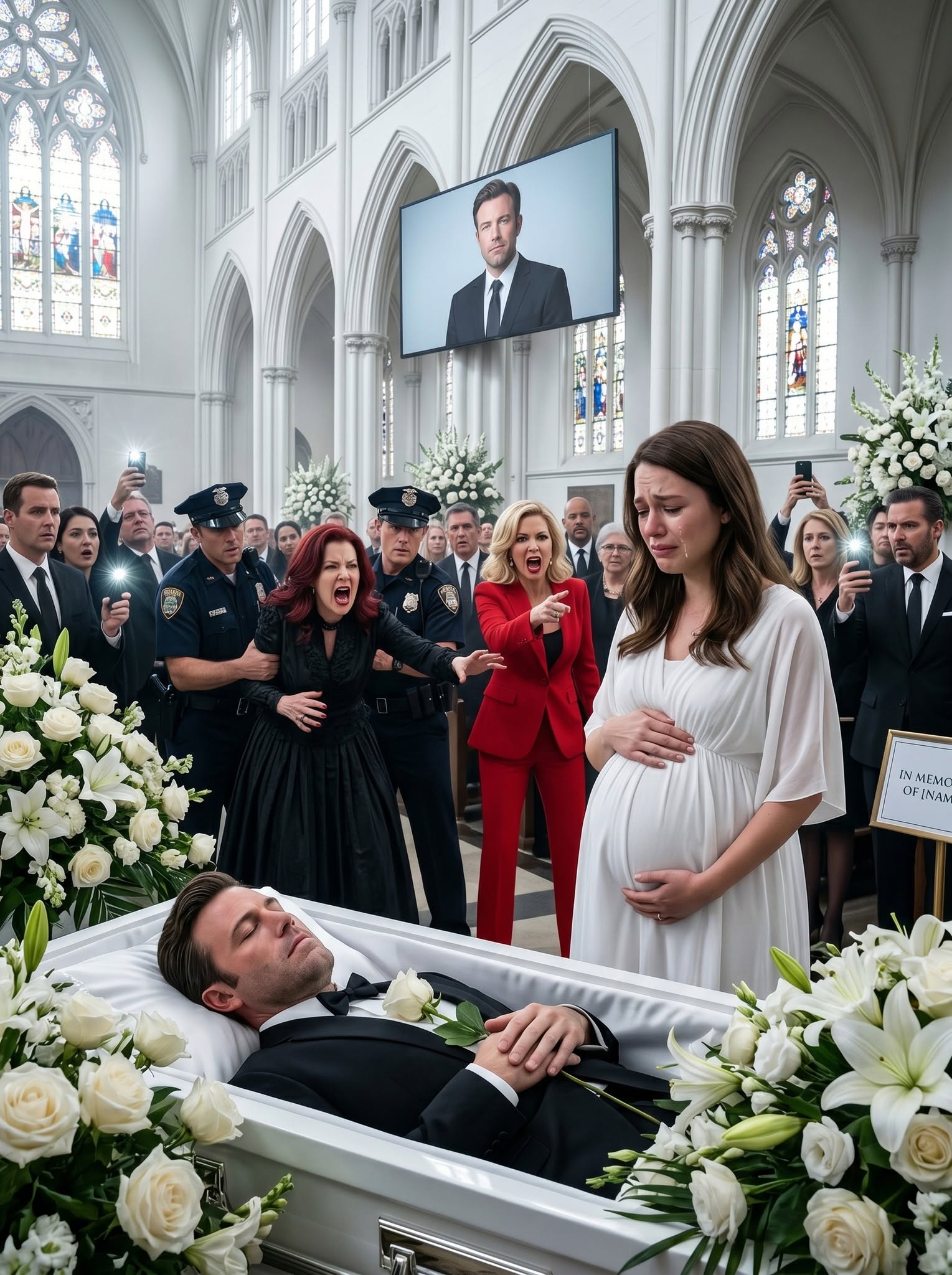
David’s face disappeared for a second, replaced by a video clip from a private office. Eleanor sat at a polished desk, her veil gone, her expression cold and irritated.
Chloe sat beside her, sipping champagne.
“We just need time,” Chloe said in the video. “Once the baby comes, it gets complicated.”
My blood went cold.
On the screen, Eleanor tapped her fingers against the desk. “The baby only matters if David recognizes it. A test can say anything if the right doctor signs it.”
A horrified murmur spread through the cathedral.
My eyes dropped to the crumpled paternity paper on the casket. The lie had been prepared before David was even in the ground.
Chloe shook her head on the video. “And Sarah?”
Eleanor smiled.
“She is soft,” she said. “Soft women break beautifully in public.”
The room turned toward me again, but this time the eyes were different. Pity, shock, shame—everything Eleanor had wanted directed at me now reflected back at her.
My injured finger throbbed. The blood had dried in a thin red line where my wedding ring should have been.
On the screen, David returned.
“That forged paternity test was delivered to Sterling’s office yesterday by a frightened medical assistant who thought she was helping a grieving family,” he said. “She is now cooperating with federal investigators.”
Chloe made a small choking sound.
Eleanor turned on her. “Be quiet.”
But Chloe was already unraveling. Her sunglasses slipped down her nose, revealing eyes wide with panic.
“Mom,” she whispered. “You said that part was clean.”
The words were soft, but the cathedral heard them.
Eleanor’s head snapped toward her daughter.
David’s voice dropped lower.
“And now,” he said, “we come to the reason these doors are locked.”
My baby kicked so hard I winced.
Sterling glanced at me, and for the first time since he had entered, his face softened. It was only a fraction of a second, but it was enough to tell me David had trusted him with more than money.
The screen changed to footage from our private garage.
The timestamp glowed in the corner.
02:14 AM.
Three days before the crash.
The image was gray, grainy, and horrifyingly clear. Eleanor appeared from the left side of the frame wearing a dark coat and gloves, moving toward David’s Aston Martin with the calm confidence of a woman who believed the world would always clean up after her.
A collective gasp rose from the pews.
She crouched near the front wheel. Something metallic flashed in her hand.
I could not breathe.
The cathedral blurred, and suddenly I was not standing near a casket anymore. I was back in our bedroom four mornings ago, hearing the doorbell, seeing the officers, understanding from their faces before they spoke that the life inside me would never know the father who had already loved him.
On the screen, Eleanor reached beneath the car.
David’s recorded voice filled the cathedral.
“You thought brake fluid tampering was elegant because it would look like an accident.”
Someone screamed.
I did not know if it was me.
“You thought a cliff road would erase the evidence. You thought grief would make Sarah weak, pregnancy would make her helpless, and public shame would make her disappear.”
The footage zoomed in. Eleanor’s face turned toward the camera for one second, clear enough that no lawyer in the world could save her from it.
David’s voice became almost calm.
“You murdered me for an inheritance I had already moved into an irrevocable trust for my wife and son.”
Eleanor’s body folded as if someone had cut the strings holding her upright.
“No,” she whispered.
The two men beside Sterling stepped forward and opened their jackets.
Police badges caught the projector light.
The taller detective spoke with brutal clarity.
“Eleanor Vance, you are under arrest for the premeditated murder of David Vance.”
The first click of the handcuffs sounded like justice finding its voice.
Eleanor screamed.
She did not scream like a grieving mother, or a betrayed woman, or even a frightened criminal. She screamed like a queen watching her throne burn while everyone she once controlled finally saw the bones beneath her crown.
“This is a lie!” she shrieked. “He made this! She made him do this!”
Her finger stabbed toward me.
I stood still.
For the first time since David died, I did not lower my eyes.
The detectives seized Eleanor’s arms. She thrashed, kicking so wildly one heel flew off and struck the side of a pew.
Chloe backed away until her shoulders hit the altar steps. She looked at the stolen ring in her palm as if it had become hot enough to burn through skin.
David’s image remained above us, silent now, watching the ruin he had prepared.
I turned to Chloe.
My legs were shaking, my heart was broken, and my husband was still dead. But beneath all of that, something else had awakened.
I walked toward her slowly.
She started crying before I said a word.
“Sarah,” she whispered. “I didn’t know she would actually—”
“My ring,” I said.
My voice surprised even me.
It was not loud. It did not tremble. It had the same quiet finality David used when he had already made a decision.
Chloe looked at Eleanor, but Eleanor was too busy screaming at the detectives to save anyone now.
“My ring,” I repeated.
Chloe’s face crumpled. With shaking fingers, she placed the diamond into my bleeding hand.
The metal was warm from her fear.
I slid it back onto my finger, biting down against the pain as it passed over the torn skin. The sting grounded me, reminded me that I was alive, that David’s son was alive, that the women who had tried to erase us had failed.
As the detectives dragged Eleanor down the aisle, she twisted around with a face so distorted by hatred I barely recognized her as human.
“I will rot in hell before I let that bastard child keep my money!” she screamed. “You hear me, Sarah? You are never safe!”
Her voice bounced against the stone walls.
Then the doors opened.
Cameras flashed. Reporters shouted. Socialites lifted their phones, capturing the downfall of the woman who had turned my husband’s funeral into a battlefield and lost.
I stood beside David’s casket with my hand on my stomach and my ring back on my finger.
Attorney Sterling approached me quietly.
“David prepared more,” he said.
I looked up at him, exhausted and hollow.
“More?”
His expression darkened.
“The trust is secure. The estate is secure. You and the baby are protected.” He paused, choosing every word carefully. “But Eleanor was not acting alone in every matter.”
A chill moved through me.
Behind us, David’s face still glowed on the screen. His final message had destroyed his mother, exposed his sister, and saved my son’s future.
But as Sterling helped me away from the casket, I understood something with terrible clarity.
David had secured the fortress.
That did not mean the war was over.
Part 3
The days after the funeral did not feel real.
There were headlines, police statements, legal briefings, and strangers outside the estate gates shouting my name as if grief had made me public property. I moved through all of it like a woman underwater, one hand always resting on my stomach, one ear always waiting for David’s voice to come from another room.
Attorney Sterling became the only steady thing in my world.
He arrived every morning in the same charcoal suits, carrying folders thick enough to crush a weaker woman’s future. He never pitied me, and for that I trusted him more than anyone.
“David prepared for every predictable attack,” he told me one gray afternoon in the library. “The trust cannot be broken. Eleanor cannot touch it. Chloe cannot touch it. No board member, creditor, distant relative, or opportunistic claimant can touch it.”
I sat in David’s chair, wrapped in one of his sweaters, staring at the rain streaking down the windows.
“And the unpredictable attacks?” I asked.
Sterling’s silence answered before his mouth did.
“We strengthen the walls,” he said.
So we did.
Security teams came and went. Locks changed, guards rotated, cameras blinked awake in corners I had never noticed, and every employee who entered the house was reviewed as if they were stepping into the White House.
Yet no amount of security could make the nursery feel peaceful.
I would stand in the doorway at night, looking at the pale blue walls David and I had painted together. He had gotten paint on his nose, laughed when I cried over assembling the crib wrong, and promised our son would grow up in a house where love was louder than ambition.
Then I would remember Eleanor’s scream.
You are never safe.
Three weeks before my due date, Chloe called.
Sterling advised me not to answer, but I did anyway. Some broken part of me needed to hear whether shame had changed her.
It had not.
“Sarah,” she whispered, her voice thin and ragged. “I need help.”
I stood in the nursery, staring at the empty crib.
“You need a lawyer,” I said.
“I need money.”
The old Chloe surfaced beneath the tears, desperate but still entitled, ruined but still certain someone else should pay for her ruin.
“My accounts are frozen,” she said. “They’re saying I helped with the foundation. They’re saying I knew about the test.”
“You did know.”
“I didn’t know about the brakes.”
That sentence dropped between us like a dead animal.
I closed my eyes.
“You knew enough.”
She began crying harder. “Mom made everything sound temporary. She said once you were gone, David would forgive us eventually. She said no one was supposed to die.”
“No one was supposed to die?” I repeated.
My voice was so calm it frightened even me.
Chloe breathed shakily into the phone. “Please. I can testify. I can tell them things.”
“Then tell them.”
“For protection,” she said quickly. “For a deal.”
I looked at the crib David had built with his own hands.
“Do it for the first decent reason in your life,” I said. “Not for a deal.”
Then I hung up.
Two days later, Chloe turned state’s evidence against her mother.
The media called it a betrayal. I called it survival wearing borrowed clothes.
Eleanor’s trial began before my son was born, but I did not attend every day. Sterling sent summaries, and sometimes I read them, sometimes I left them unopened because I had already seen enough cruelty to last me several lifetimes.
The evidence was worse than the cathedral had revealed.
There were messages, payments, threats, surveillance clips, and a mechanic who cried on the witness stand while admitting he had been paid to disable part of David’s car. Eleanor stared through all of it with a face carved from ice.
When prosecutors played David’s final recording, the courtroom reportedly went silent.
Eleanor did not cry for her son.
She only looked angry that death had not made him obedient.
I gave birth on a stormy night in Manhattan.
The hospital room smelled of antiseptic and rain, and for sixteen hours, pain tore through my body like the world demanding payment for every loss I had survived. Sterling waited outside with two guards, and when my son finally screamed his way into the world, I broke completely.
They placed him on my chest, warm and furious and alive.
He had David’s dark hair.
I named him David Jr.
For the first time since my husband’s death, I cried without shame. Not because I was broken, but because something sacred had survived the fire.
When Sterling entered later, his eyes softened at the sight of the baby.
“David would have been proud,” he said.
I looked down at my son’s tiny face.
“No,” I whispered. “He is proud.”
Eleanor was sentenced six months later.
Life in prison without parole.
Chloe avoided prison by testifying, but the cost was everything she valued. The Vance name no longer opened doors for her; it closed them.
Her friends vanished. Her invitations disappeared. Her frozen accounts became public humiliation, and the same women who had laughed at her cruelty now crossed restaurants to avoid her table.
I did not celebrate.
I had learned that revenge was too small for what David had left me.
Instead, I went to work.
At first, the board treated me like a grieving widow warming David’s chair until someone more suitable could take it. They spoke slowly around me, softened their voices, and watched my baby monitor on the conference table as if motherhood had weakened my mind.
They learned quickly.
David had left more than money. He had left manuals, strategy notes, private recordings, and long letters explaining not only what he had built, but why he had built it.
I studied at midnight while David Jr. slept against my chest. I learned acquisitions with spit-up on my blouse, reviewed patent portfolios between feedings, and memorized board histories while rocking my son through colic.
Every time I felt too tired to continue, I heard Eleanor’s voice.
You are never safe.
Then I heard David’s.
The fortress is secured.
By the end of the year, I no longer sat quietly at the board table.
I led it.
“The Apex merger moves forward,” I said during one meeting, sliding the signed approval across the mahogany table. “But we pivot the AI division toward healthcare. David believed technology should protect the vulnerable, not just impress the wealthy.”
An older board member cleared his throat. “That is a significant shift, Sarah.”
I looked at him until he stopped smiling.
“My husband built this company by seeing ten years ahead,” I said. “I intend to honor him by doing the same.”
No one questioned me after that.
For a while, I believed the worst had passed.
I bought a new estate in the Hamptons, one with better sightlines, stronger security, and a nursery that faced the ocean instead of the road. I told myself fresh walls could hold a fresh life.
On the night I moved in, rain battered the windows while David Jr. slept upstairs.
I sat by the fireplace in my study, sorting through forwarded mail. Most of it was legal paperwork, charity invitations, and condolence notes that arrived months too late.
Then I saw the envelope.
It was dirty, crumpled, and stamped with the state penitentiary’s insignia.
Eleanor.
My hand went cold.
I did not open it.
There was nothing she could say that I needed to carry inside me. No apology would be real, no threat would be new, and no curse could reach further than the love David had built around us.
I threw the envelope into the fire.
The flames caught quickly, curling the edges black.
For one brief second, I felt victorious.
Then the envelope flipped over in the draft.
On the back, drawn in charcoal with chilling precision, was my son’s nursery window.
Not the old nursery.
The new one.
The second-floor window of a house whose address was classified, guarded, sealed behind shell companies and legal walls even Sterling had called excessive.
I stood so fast the chair crashed behind me.
The baby monitor crackled.
For one terrible second, there was only static.
Then my son began to cry.
I ran.
I do not remember crossing the hall or taking the stairs. I only remember bursting into the nursery and finding David Jr. alive in his crib, red-faced and furious, his tiny fists punching the air.
The window was locked.
The curtains were still.
The guards found no breach, no footprints, no camera malfunction, no sign anyone had entered the property.
But the drawing existed.
Someone had seen that window.
Someone connected to Eleanor had reached through the walls of my fortress and touched the one place I was most afraid to lose.
Sterling arrived before midnight.
He stood in my study holding the half-burned envelope with metal tweezers, his face darker than I had ever seen it.
“This was not mailed from the prison directly,” he said.
I held David Jr. against my chest, refusing to put him down.
“What does that mean?”
“It means someone handled it after it left Eleanor.”
The room seemed to shrink.
“Someone outside,” I said.
Sterling nodded.
For five years after that night, I lived with locks inside my locks.
There were investigations, security sweeps, private intelligence reports, names that surfaced and disappeared, old associates of Eleanor’s who suddenly claimed innocence or ignorance or distance. Nothing ever became solid enough to arrest, but nothing ever became harmless enough to forget.
Eventually, fear became routine.
Then routine became life.
David Jr. grew.
He was bright, stubborn, fearless, and heartbreakingly like his father. He asked questions about everything, took apart toys to see how they worked, and once told a security guard that “Mommy says doors are only safe if smart people check them twice.”
I laughed that day until I cried.
By the time he turned five, I had almost convinced myself the shadow had passed.
Almost.
One crisp autumn afternoon in Manhattan, I took him to a bakery in Tribeca. He came out clutching a chocolate croissant, his cheeks dusted with sugar, his small hand sticky in mine.
“Can we go to the park now, Mom?” he asked.
“Yes,” I said, smiling down at him. “After we visit Dad.”
At the corner, waiting for the light, I saw a woman sweeping the sidewalk outside a bodega.
Her clothes were stained, her hair hung in dull strands, and her face had collapsed into something older than her years. She looked up, and for one second, the past stood in front of me.
Chloe.
Our eyes met.
I expected rage. I expected satisfaction. I expected to remember the pain of my ring tearing across my skin.
Instead, I felt nothing sharp at all.
She was not my enemy anymore. She was what remained after greed finished eating its own body.
I tightened my grip on my son’s hand and crossed the street without a word.
Later, we stood at David’s grave beneath an old oak tree.
The cemetery was quiet, golden with late afternoon light, and for once the silence did not feel cruel. I placed a white rose against the marble headstone and touched his name with my fingertips.
“We won,” I whispered. “Your fortress held.”
David Jr. stood beside me, unusually still.
I wiped one tear from my cheek and reached for his hand.
But he did not take it.
He was staring past the graves, toward the dark line of trees beyond the wrought-iron fence.
“Mommy,” he said softly.
Something in his voice made my blood turn cold.
I followed his gaze.
At first, I saw only shadows.
Then my son pointed.
“Why is that man hiding over there?” he asked. “And why is he wearing Daddy’s watch?”
Part 4
For a second, I forgot how to breathe.
The cemetery seemed to tilt around me, the headstones stretching into crooked gray teeth beneath the dying light. I pulled David Jr. behind me with one hand and stared toward the trees until the shadows finally shaped themselves into a man.
He stood half-hidden beyond the wrought-iron fence.
Tall. Motionless. Watching.
On his left wrist, something flashed gold.
My husband’s watch.
The same watch I had given David on our third anniversary. The same watch police claimed had never been recovered from the wreckage.
“Stay behind me,” I whispered.
David Jr. clutched the back of my coat. His small fingers trembled, and that tiny fear did what years of threats could not do—it turned my blood to steel.
The man stepped forward.
I could not see his face clearly, but I saw enough to know he was not a stranger who had wandered into the wrong place. He wanted me to see the watch.
My phone was already in my hand.
“Sterling,” I said the moment he answered. “Cemetery. North gate. A man is here wearing David’s watch.”
Sterling did not ask me to repeat myself.
“Get to the car now.”
The man beyond the fence turned and disappeared into the trees.
I grabbed my son and ran.
Security moved fast, but Sterling moved faster. Within an hour, the cemetery was sealed, cameras were pulled, private investigators were deployed, and the police were finally forced to admit what I had known for five years.
Eleanor’s shadow had not died in prison.
It had only learned to wait.
The watch changed everything.
Sterling traced it through a private collector, then a pawn broker, then a man named Victor Hale, a former security contractor who had once worked for Eleanor during the years David was building TechNova. Victor had vanished after David’s death, taking with him a sealed package Eleanor had paid him to hide.
Inside that package was David’s watch.
And something worse.
Copies of documents Eleanor believed could create chaos if she ever lost control: forged trust amendments, false custody claims, and a plan to make the world believe I was unstable enough to lose my own son.
“She never stopped trying to erase you,” Sterling told me.
I looked through the glass wall of his office at David Jr. sleeping on the sofa, one hand under his cheek.
“Then we stop running,” I said.
Sterling looked at me for a long moment.
Then he nodded.
Victor Hale was arrested three nights later after trying to access one of Eleanor’s old storage units in Queens. He confessed before sunrise.
Eleanor had ordered him to watch me, frighten me, and keep pressure on anyone connected to David’s estate. The nursery drawing had been his work, not because he could reach my son, but because Eleanor wanted me to believe he could.
That was her true weapon.
Fear.
When Sterling told me, I did not cry. I did not shake.
I only felt something inside me finally close.
Eleanor died two months later in prison after a sudden stroke, alone in a concrete room with no diamonds, no audience, and no family left willing to claim her body.
Chloe sent one letter after the funeral notice became public.
It was not a threat this time.
It was an apology.
I read it once, sitting at David’s desk, then placed it in a drawer. Forgiveness, I realized, did not always mean opening the door again.
Five years after my husband’s funeral, the last shadow finally lifted.
TechNova’s healthcare division became David’s greatest legacy. Our technology helped rural hospitals diagnose patients faster, supported children’s clinics, and funded the same foundation Eleanor had nearly destroyed.
Every year on David’s birthday, David Jr. and I visited the cemetery with one white rose.
He grew older, stronger, and more like his father in ways that broke and healed my heart at the same time. He asked about courage once, while sitting beside me under the oak tree.
“Is courage not being scared?” he asked.
I looked at David’s name carved in marble.
“No, sweetheart,” I said. “Courage is being scared and still protecting what matters.”
He thought about that, then leaned against me.
“Daddy was brave.”
“Yes,” I whispered. “And so are you.”
The empire David left behind was not made of patents, glass towers, or billions of dollars. It was made of love prepared in advance, truth stronger than lies, and a promise that even death could not break.
Eleanor wanted power, and it destroyed her.
Chloe wanted status, and it left her empty.
David wanted us safe, and his love built a fortress no hatred could tear down.
As the sun lowered over Manhattan, I held my son’s hand and walked away from the grave without looking back.
For the first time, I was not leaving David behind.
I was carrying him forward.
THE END