Part 1
The second blue line appeared at 6:13 on a Tuesday morning, and for one fragile second, I believed God had finally remembered my name. I sat on the bathroom floor of our townhouse in Portland, Oregon, gripping the pregnancy test with both trembling hands while the heater clicked uselessly against the morning cold. After three years of doctor appointments, negative tests, forced smiles, and tears I swallowed in the dark, the proof was finally there.
My name is Mira Bellamy Greer, and I had imagined this moment so many times that I thought I knew exactly how it would feel. I had pictured Nolan lifting me off the floor, laughing into my hair, maybe even crying because we had survived the waiting together. I had pictured joy so clearly that when fear crept into my chest instead, I told myself I was just overwhelmed.
I ran downstairs barefoot, still wrapped in my robe, my heart beating so hard it made my ribs ache. Nolan was sitting at the kitchen island with his coffee beside him, scrolling through his phone like every other morning, his shirt perfectly pressed and his face untouched by sleep. I stopped in the doorway, suddenly aware of how small my voice sounded inside the house we had bought for the family we kept failing to create.
“Nolan,” I whispered, and he did not look up at first. I held the test behind my back like a child hiding a gift, trying to steady my smile before it broke apart. When he finally raised his eyes, I said, “I’m pregnant.”
For one breath, the whole kitchen froze. The refrigerator hummed, rain tapped against the windows, and somewhere outside a car passed through the wet street with a low hiss. Then Nolan’s eyes dropped to my face, and what I saw there was not wonder, not relief, not even shock.
It was suspicion.
“How far along?” he asked, his voice flat enough to drain the warmth from the room. I blinked, confused by the sharpness of the question, but I tried to answer gently because I had spent years learning how not to start fights before breakfast. “About six weeks, maybe seven,” I said. “I need to call the doctor and make an appointment.”
The chair scraped backward so hard it made me flinch. Nolan stood with one hand gripping the edge of the counter, his jaw tightening in a way I recognized too well. “That’s impossible,” he said.
I stared at him, still holding the pregnancy test as if it could defend me. “What do you mean, impossible?” I asked, and my smile died completely. He gave a short, ugly laugh that did not belong in a room where we had once discussed baby names.
“Not my child,” he said.
The words struck me harder than any hand could have. For a moment, I could not move, could not even breathe, because the man in front of me had turned my miracle into an accusation before I had even finished telling him. “Nolan, we’ve been trying for years,” I said, my voice shaking despite every effort to keep it calm.
“I haven’t touched you in weeks,” he snapped. His face twisted with disgust, as though I had dragged something filthy into his kitchen. “Don’t stand there and insult me.”
“That’s not true,” I said, taking one step toward him. I remembered the exact night, the rain, the bottle of wine we barely drank, the way he had held me afterward like he still wanted the same future I did. But when I reached for his arm, he stepped back as if my hand could stain him.
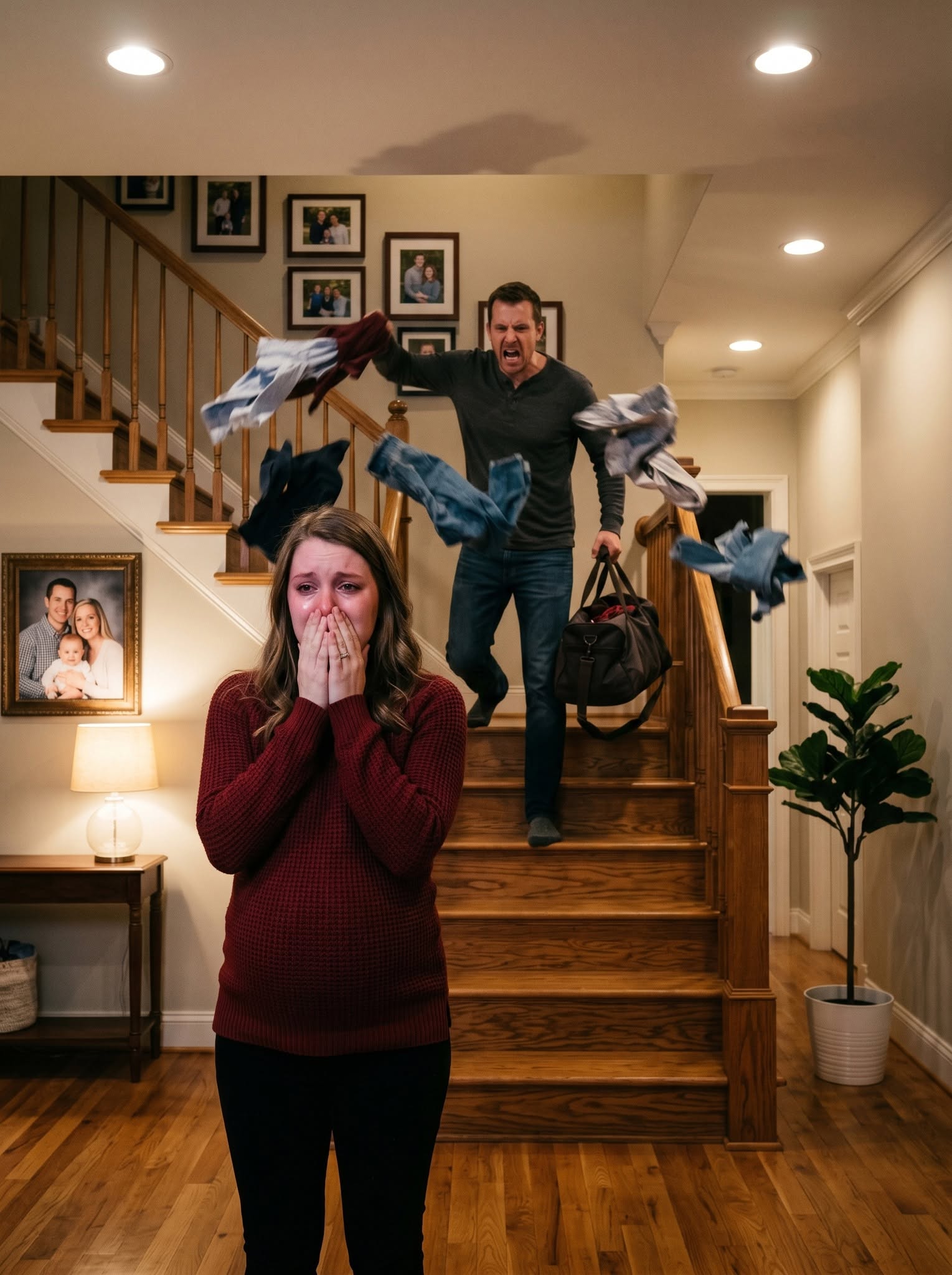
He walked past me into the hall, opened the closet, and yanked out my suitcase. I followed him, confused and suddenly cold, watching him throw it onto the floor and unzip it with brutal efficiency. “What are you doing?” I asked.
“What I should have done months ago,” he said. Then he stormed upstairs, and within minutes my clothes started falling over the railing like evidence being tossed from a crime scene. Sweaters, jeans, shoes, my winter coat, the blue dress I had worn on our second anniversary—everything landed in a heap at my feet.
I stood at the bottom of the stairs with the pregnancy test still in my hand. The man who had promised to build a family with me was packing my life like garbage, and somehow I was the one apologizing between breaths. “Nolan, please,” I begged. “We can see a doctor, we can do a paternity test, we can prove this.”
“I don’t need a test,” he said from above me. His voice echoed down the staircase, colder than the rain beating against the windows. “I know what kind of woman you are now.”
“You’re throwing out your pregnant wife because of a feeling?” I asked. My knees felt weak, and one hand moved instinctively to my stomach, protecting a child too small for the world to know but already rejected by its father. Nolan leaned over the railing and looked at me like a judge delivering a sentence.
“I’m throwing out a liar,” he said.
By 7:05, I was standing on the porch in the rain with one suitcase, no wallet because he had kept the joint cards, and my phone sitting at three percent battery. The door slammed behind me with such finality that the sound seemed to enter my bones. I waited for him to open it again, to realize what he had done, to remember the vows he had spoken in front of everyone we loved.
He did not.
I did not cry until I reached the bus stop. The rain soaked through my robe beneath my coat, ran down my neck, and blurred the streets of Portland into gray ribbons of headlights and puddles. People passed by without looking too closely, because pain is easier to ignore when it belongs to a stranger.
Two hours later, I sat in a cheap motel room paid for with emergency cash I had hidden in my car years ago. The room smelled like bleach, old carpet, and loneliness, and the orange curtains glowed weakly against the storm outside. I laid my hands over my stomach and whispered, “I’m sorry,” though I did not know whether I was speaking to my baby, myself, or the woman I used to be.
My phone rang just as the screen dimmed toward death. Unknown number. I almost ignored it because I had no strength left for another voice, another problem, another person telling me what I had lost.
But something made me answer.
“Is this Mrs. Mira Bellamy Greer?” a man asked. His voice was calm, professional, and strangely careful, as if he already knew I was sitting on the edge of disaster. I wiped my face with the sleeve of my coat and said, “Yes.”
“My name is Harold Winslow,” he said. “I’m an estate attorney in Seattle, and I represented your first husband, Callum Rourke.” At the sound of Callum’s name, the motel room seemed to tilt around me, pulling me backward into a life I had buried years ago.
I had not heard that name spoken directly to me in nearly a decade. Callum belonged to another version of myself, a younger woman who had lived above a laundromat, eaten frozen pizza on the floor, and believed love could survive ambition if both people wanted it badly enough. “What happened?” I asked, though some part of me already knew from the gentleness in Harold’s voice.
“I’m sorry to inform you that Mr. Rourke passed away last month,” he said. My hand tightened around the phone, and all the air left my chest at once. Callum, with his restless mind and loud laugh and impossible dreams, was gone.
Before I could find words, Harold continued. “Before his death, Mr. Rourke revised his estate documents,” he said. “He left you his entire fortune, valued at approximately seventy-seven million dollars.”
For a moment, I thought I had misheard him. I looked around the motel room—the peeling wallpaper, the chipped nightstand, my wet suitcase sagging open beside the bed—and almost laughed because grief, shock, and terror had finally collided into something unreal. “That can’t be right,” I whispered.
“It is right,” Harold said softly. Then his voice changed, not colder, but heavier, as if the next sentence carried the real weight of the call. “But there is one condition.”
Outside, rain hammered against the motel window like a warning. Inside, my unborn child rested beneath my shaking hands while one husband locked me out and another reached back from the grave. I closed my eyes, swallowed the last of my fear, and said, “Tell me
Part 2
Harold Winslow did not tell me the condition over the phone, and for that I hated him for exactly seven seconds. Then I understood that some sentences were too heavy to be dropped into a dying phone call inside a motel room with wet clothes on the floor. He asked if I had somewhere safe to stay that night, and the question broke something open in me because no one else had asked.
I told him I was safe, though the word felt like a coat borrowed from someone whose body was stronger than mine. He offered to arrange transportation to Seattle the next morning, but I refused because accepting help still felt too much like surrender. Before we hung up, he said, “Mrs. Greer, whatever else happened today, please understand this—you are not alone tonight.”
The phone died a minute later. I sat in the silence with Callum’s name ringing in my head and Nolan’s words still burning through my chest. Not my child, he had said, as if our baby were a stain instead of a miracle, as if three years of longing could be erased by one cruel suspicion.
That night, I barely slept. Every time I closed my eyes, I saw Nolan throwing my clothes down the stairs, and then I saw Callum in our tiny old apartment above the laundromat, laughing with grease on his shirt because the stove had smoked again. The past and present twisted together until I could no longer tell which version of love had hurt me more.
By sunrise, the rain had softened into mist, and Portland looked washed clean in a way I did not feel. I drove north with my suitcase in the back seat, wearing yesterday’s clothes and gripping the steering wheel as if the road itself might vanish. My stomach rolled from fear, pregnancy, grief, or all three, and every few miles I touched my abdomen to remind myself there was still one reason to keep moving.
Harold’s office overlooked Elliott Bay, all glass, gray water, and quiet money. I felt absurd walking into that building with damp shoes and swollen eyes, passing receptionists whose voices were polished enough to belong in another world. When Harold came out to greet me, he did not look me up and down, and that small mercy nearly made me cry.
He was in his sixties, tall and neatly dressed, with silver hair and the steady expression of a man who had delivered life-altering news more times than he wished to remember. “Mrs. Greer,” he said gently, extending his hand. “Thank you for coming so quickly.” I shook his hand and tried not to wonder whether he could see the exact shape of my humiliation.
Inside his office, he offered me tea, tissues, and a chair near the window. The kindness felt too careful, and I suddenly hated that strangers were being gentler with me than my husband had been. Harold placed a cream-colored folder on the table between us, then sat across from me with his hands folded.
“What happened to Callum?” I asked before he could begin. I had repeated the question the entire drive, but saying it aloud made my throat close. Harold’s face softened, and for the first time since I entered the room, he looked older than his suit.
“Pancreatic cancer,” he said. “He kept the diagnosis very private.” The words landed quietly, but they spread through me like cold water. Callum had always been noisy with life, always moving, always planning, always chasing some impossible horizon, and I could not imagine him shrinking inside a secret illness.
I looked down at my hands. They were still bare, because in the motel room I had taken off my wedding ring without fully deciding why. The pale mark on my finger seemed to accuse me of every choice I had made since Callum and I signed our divorce papers in 2017.
“We were young,” I said, though Harold had not asked. “We loved each other, but we didn’t know how to survive success.” My voice sounded distant, almost clinical, because if I spoke with too much feeling, I feared I would not stop.
Harold nodded as if Callum had told him enough to understand. “Mr. Rourke spoke of you with deep respect,” he said. “Not often, because he was a private man, but when he did, it was clear you had remained important to him.”
I almost laughed, but it came out broken. “Important enough to disappear from my life for years?” I asked. The bitterness surprised me, because grief should have made me generous, but I was too tired to be graceful.
“Important enough to make sure his final decisions were not careless,” Harold replied. He opened the folder and turned several pages with slow precision. “Mr. Rourke named you as the sole beneficiary of his personal estate, investment holdings, and majority interest in the Rourke Foundation.”
The numbers on the page looked fake. Seventy-seven million dollars did not look like money to me; it looked like a mistake, a trap, a headline that belonged to someone who wore silk blouses and knew what to say at charity dinners. I pressed my fingertips to the paper and felt nothing but terror.
“Why would he do this?” I whispered. “We were divorced. We hadn’t spoken in years.” Harold reached into the folder again and pulled out a sealed envelope, thick and cream-colored like the rest of the documents.
My name was written across the front in Callum’s handwriting. Mira. Just that, no title, no distance, no reminder that I had become someone else’s wife.
For a moment, I was twenty-four again, sitting cross-legged on the floor of our apartment while dryers thumped beneath us and Callum scribbled grocery lists on the backs of envelopes. He used to write my name on sticky notes and leave them on the bathroom mirror when he had to work late. Seeing it now felt like touching a ghost who still remembered my face.
I opened the envelope carefully because tearing it felt like an act of violence. The letter inside was not romantic, and somehow that made it worse. Callum did not beg, did not confess some grand lost-love fantasy, did not try to pull me backward into a marriage we had both failed to protect.
Instead, he apologized. He wrote that ambition had made him arrogant, that money had arrived before wisdom, and that he had mistaken movement for purpose. He said our divorce had been the first time success felt empty enough to echo.
I read slowly, my eyes blurring on words that sounded painfully like the man I had once known and the man he had apparently become after losing me. He wrote that he had followed my life from a distance, not in a frightening way, but through mutual acquaintances, public school newsletters, and the quiet trails people leave behind when they keep helping others. He knew I had become a school counselor, and he wrote that it did not surprise him.
Then I reached the condition. My breath caught so sharply that Harold looked up, but he did not interrupt me. Callum had left me everything on the condition that at least half of the inheritance be used to create and personally oversee a trust for women and children facing sudden displacement, domestic abandonment, or financial abuse.
I read that sentence again and again until the words stopped being legal language and became something else entirely. They became the motel room, the wet suitcase, the porch where Nolan had left me shivering. They became every woman who had ever been forced to choose between pride and shelter, every child who had learned fear from the sound of a door closing.
At the bottom of the page, Callum had written one line that finally broke me. You always knew how to make broken people feel less alone, Mira. I wasted years learning that money cannot do that by itself.
I covered my mouth, but the sob came anyway. It was not the elegant kind of crying people do in movies; it was quiet, ugly, and uncontrollable, pulled from a place too exhausted to defend itself. Harold slid a box of tissues across the table and waited without pretending not to notice.
“There is one more clause,” he said after a long silence. My entire body tightened because I had learned in the last twenty-four hours that every miracle came with a blade hidden inside it. Harold adjusted his glasses and looked at me with something like compassion.
“If you are pregnant,” he continued, “any child legally yours, born after Mr. Rourke’s death, may receive education and healthcare support from the trust at your discretion.” He paused, giving the words room to settle. “He made no assumption of paternity, Mrs. Greer. He simply wanted no child in your care to suffer because adults failed them.”
That was when I put both hands over my stomach and truly cried. Nolan, the living husband who had begged for a baby with me, had thrown that baby into the rain before dawn. Callum, the dead husband I had not spoken to in years, had somehow left a door open for a child who was not even his.
Harold gave me time, and I needed all of it. When I finally looked up, the bay outside the window was silver under the morning light, and the city beyond it kept moving as if my life had not split open twice in one day. “What happens now?” I asked.
“Now,” Harold said, closing the folder gently, “we make sure you are housed, represented, medically cared for, and legally protected.” His calmness should have irritated me, but instead it steadied the room. “Money rarely changes people, Mrs. Greer. It reveals who was already standing nearby.”
By that afternoon, I had an appointment with a family lawyer named Celeste Ward, a temporary apartment secured through the estate, and a prenatal visit scheduled for the next morning. The speed of it frightened me, because survival had always seemed like something you crawled toward inch by inch. Suddenly, people were opening doors before I had to beg.
At 5:40 p.m., Nolan called. His name lit up my newly charged phone, and for a moment my body reacted before my mind could stop it, tightening with that old instinct to answer quickly, soothe quickly, apologize quickly. I stared at the screen until Harold’s words returned to me.
You are not alone tonight.
I answered, but I did not say hello. Nolan’s voice came sharp and immediate, as if he had spent the day getting angrier that I had not come crawling back. “Where are you?” he demanded.
“Safe,” I said.
The silence on his end lasted just long enough to tell me he hated that answer. “You took the car,” he said finally. I looked out the apartment window at the city lights beginning to glow and felt something inside me shift, small but undeniable.
“The car is in my name,” I said.
His breathing changed. “You think this is going to make me look bad?” he asked, and there it was, the real wound he wanted dressed. Not the baby, not me, not the marriage he had shattered before breakfast—only how the broken pieces might reflect on him.
“Nolan,” I said slowly, “you threw your pregnant wife into the rain.” My voice did not shake this time, and that frightened me almost as much as his cruelty had. On the other end of the line, he gave a bitter laugh.
“You cheated on me,” he said.
“No,” I replied. “And we will prove that legally.”
He scoffed, but it sounded thinner now. “You can’t afford a fight, Mira.” I looked at the folder on the table, at Callum’s letter beside it, at the name of Celeste Ward written neatly on a card.
For the first time since the second blue line appeared, I smiled. It was not happiness, not yet, but it was the beginning of something stronger than fear. “You should speak to my attorney,” I said, and then I ended the call before he could teach me how to doubt myself again.
That night, in an apartment paid for by a dead man’s regret and protected by strangers’ competence, I slept with one hand over my stomach. I did not sleep peacefully, because peace was still far away. But I slept behind a door Nolan could not open, and for that night, safety was enough.
Part 3
The first thing Celeste Ward told me was not to mistake Nolan’s anger for power. She sat across from me in her downtown Seattle office, wearing a charcoal blazer and the expression of a woman who had watched too many frightened people confuse cruelty with authority. “He had control over your routine,” she said. “That does not mean he has control over your life.”
I wanted to believe her, but fear had already learned Nolan’s voice. Every time my phone buzzed, my body tightened before my mind could catch up, expecting another accusation, another demand, another reminder that he still thought shame belonged to me. Celeste noticed, and instead of pitying me, she turned my fear into paperwork.
Within days, she filed for legal separation and temporary protections. She documented the morning Nolan threw me out, the missing wallet, the joint cards he had kept, the pregnancy, the verbal accusations, and the sudden abandonment. Seeing it written in formal language made it feel both less personal and more terrible, as if my marriage had become evidence in a case I never wanted to build.
Nolan responded exactly as Celeste predicted. First, he claimed I had abandoned the marriage, as though I had chosen rain, a motel, and terror over my own bed. Then he claimed I had stolen the car, though the title carried my name, and Celeste shut that down with one clean letter that sounded polite enough to cut glass.
His third claim hurt the most. He told his attorney that my pregnancy was proof of adultery, though he could not name a man, a place, a date, or even a reason beyond his own suspicion. I read that sentence in Celeste’s office and felt my baby move only in my imagination, still too small to kick, yet already being dragged into a courtroom by a father who had not bothered to ask for truth.
“We’ll request a paternity test at the appropriate time,” Celeste said. Her voice was calm, but her eyes sharpened when she looked at the paper. “And when it confirms what you already know, remember this feeling, Mira. Proof may clear your name, but it will not give him back the right to define you.”
Meanwhile, Harold began walking me through Callum’s estate piece by piece. There were accounts, properties, investments, foundation documents, board responsibilities, and clauses so careful they made me ache. Callum had not tossed money at me from beyond the grave; he had built a structure around it, as though he knew wealth without purpose could become another kind of prison.
I read more of his letters during those weeks. Some were addressed to Harold, some to the foundation board, and one more was addressed to me, sealed in a smaller envelope that Harold said I could open whenever I was ready. I kept it in a drawer for nine days, afraid that Callum’s kindness would undo me more completely than Nolan’s cruelty had.
When I finally opened it, I was sitting on the floor of the temporary apartment with a blanket around my shoulders. Callum wrote that he did not expect forgiveness, and that made forgiveness rise painfully in my throat. He said he had spent years funding research, shelters, scholarships, and clinics, but every check he wrote had reminded him of how little good money did when no one was willing to stand close to someone in pain.
I cried again, but this time the tears felt different. They did not come from being discarded; they came from being seen after years of making myself convenient. Nolan had looked at my pregnancy and saw betrayal, but Callum had looked at the story of my life and saw a woman who could build shelter from ruin.
The medical appointment confirmed the pregnancy was progressing normally. I heard the doctor say words like early, healthy, follow-up, vitamins, and rest, but I held onto only one truth. There was life inside me, and no accusation could make that life less real.
I bought a small notebook that afternoon and wrote to the baby for the first time. I told them I was sorry their beginning had been surrounded by rain and slammed doors. Then I promised that whatever happened next, they would never have to earn the right to be wanted.
Two weeks later, the paternity test process moved forward under Celeste’s guidance. Nolan’s attorney tried to delay, then tried to frame the request as unnecessary, then finally agreed when Celeste made it clear his accusations had made the truth legally relevant. Nolan sent me no apology, only a message through counsel saying he was willing to “resolve matters privately” if I stopped escalating.
I stared at those words for a long time. Escalating, to Nolan, meant refusing to be humiliated quietly. It meant hiring a lawyer, keeping the car that belonged to me, answering cruelty with evidence instead of tears.
Then Nolan learned about the inheritance.
I never told him. I did not need to, because money that large has a way of creating whispers, signatures, filings, and people who suddenly become curious. One afternoon, Celeste called me and said, “Prepare yourself. His tone is about to change.”
She was right. That evening, flowers arrived at the apartment lobby—white roses in a glass vase, the kind Nolan used to buy only when he needed a fight to end without changing his behavior. The card read, We both made mistakes. Let’s think about the baby.
I held the card between two fingers and felt something colder than anger pass through me. He had not written, I lied about you. He had not written, I am sorry I threw you out. He had written the kind of sentence that spread guilt evenly over a table where only one person had brought the knife.
Celeste read the card the next morning and raised one eyebrow. “He means let’s think about the money,” she said. Then she placed it in a file labeled communication from spouse, and I almost laughed because Nolan’s attempt at tenderness had become Exhibit C.
The test results came back on a cloudy Thursday. Celeste called first, though the lab report had already been sent to both legal teams. “Mira,” she said gently, “Nolan is confirmed as the biological father.”
I sat down slowly on the edge of my bed. I had imagined that moment giving me satisfaction, maybe even triumph, but it did neither. The truth did not feel like a crown; it felt like standing in the ashes of a house and proving I had never lit the match.
Nolan called within an hour, but I did not answer. Then he sent a message saying he needed to see me, that emotions had been high, that the situation had gotten out of hand. He wrote as though the situation were a storm that had blown through our marriage by accident, not a door he had opened and shoved me through.
The next morning, I met Harold to sign documents connected to the trust. I wore a simple black dress, low heels, and no wedding ring. My hands still shook when I signed my name, but each signature felt like placing one brick into a wall between my future and Nolan’s version of the truth.
That was when Nolan walked into Harold Winslow’s office.
He wore the navy suit I had bought him for our anniversary, the one he used to say made him feel successful. His hair was neatly styled, his expression softened into something almost tender, and for one devastating second, I could see the man I had once prayed would become a father. Then his eyes flicked to the documents on the table, and the illusion disappeared.
“Mira,” he said softly. “I’m sorry.”
Harold stood immediately. “Mr. Greer, this is a private meeting.” His voice remained polite, but the room changed around it, becoming smaller, sharper, more dangerous. Nolan lifted both hands as if he were the reasonable one walking into chaos.
“I need five minutes with my wife,” he said. The word wife landed between us like a stolen object. I looked at him, really looked, and realized I no longer felt the old urge to manage his emotions before they hurt me.
“You have two,” I said.
Nolan stepped closer, lowering his voice into the intimate tone he used when he wanted me to forget facts and remember history. “I panicked,” he said. “The timing scared me, and I said things I didn’t mean.”
“You packed my suitcase,” I replied.
“I was hurt.”
“You locked the door.”
His jaw tightened, but he recovered quickly. “We’re having a child,” he said. “That matters more than pride, Mira. We should be together.”
I stared at him and felt the strange calm that comes when a person finally asks the right question. “Would you be here if Callum had left me nothing?” I asked.
Nolan’s mouth opened, but no answer came. His silence filled the office, louder than denial, louder than apology, louder than every promise he might have rehearsed on the way there. I turned back to the table, picked up the pen, and signed the next document.
That was the day the Mira Rourke Shelter Trust truly began.
It started with thirty-nine million dollars in initial funding, half of a fortune Callum had left behind and all of a purpose I could no longer ignore. I chose to keep Callum’s name in the trust, not because I belonged to him, and not because grief had turned him into a saint. I kept it because the best part of our past deserved to become useful.
Nolan stood there watching me sign, and I understood something that freed me. He had thought money would make me reachable again, something to negotiate with, something to soften, something to win back by sounding sorry at the right moment. But the inheritance had not made me powerful because it made me rich; it made me powerful because it gave me enough ground beneath my feet to stop crawling.
When Nolan finally left, he did not slam a door. Men like him rarely make noise when they realize there are witnesses. He only looked at me once, wounded and furious, as if my refusal had betrayed him more deeply than his abandonment had betrayed me.
After he was gone, Harold asked if I needed a moment. I looked down at my signature drying on the page, then placed one hand over my stomach. “No,” I said. “I think I just had one.”
Part 4
The old hotel outside Tacoma did not look like salvation when I first saw it. It looked tired, forgotten, and ashamed of itself, with cracked pavement in the parking lot, faded curtains hanging behind dusty windows, and a sign so weather-beaten that half the letters had given up. Harold stood beside me with his coat collar raised against the wind while I stared at the building and wondered if broken places could really become safe ones.
“This used to be a roadside hotel in the seventies,” he said. “The structure is solid, but it needs work.” I placed one hand over my growing stomach and looked at the rows of locked doors, imagining women arriving with children, trash bags of clothes, bruised pride, and nowhere else to go. “Then we’ll give it work,” I said.
The board of the Rourke Foundation was polite, careful, and quietly skeptical at first. They knew finance, grants, long-term endowments, and public reputation, but most of them had never stood in the rain with their life packed into one suitcase. When I told them each room needed not only a bed but a lock, a phone charger, clean pajamas for children, legal intake forms, and someone awake at midnight, their faces changed.
I did not want a shelter that felt like punishment for needing help. I wanted soft blankets, warm lamps, therapy rooms with toys, a kitchen that smelled like coffee and soup, and staff trained to speak gently to people who flinched when doors closed too loudly. I wanted the kind of place I had needed on that Tuesday morning, before I knew seventy-seven million dollars could arrive after the worst sentence of my life.
Celeste helped connect the trust with legal aid groups. Harold negotiated contracts with clinics, schools, counselors, and job placement programs. I spent afternoons choosing paint colors, reviewing safety plans, interviewing staff, and learning how much grief could hide behind ordinary questions like, “Do you have identification?” or “Is anyone allowed to know you are here?”
The more real the trust became, the angrier Nolan grew. He could no longer accuse me of cheating, so he changed tactics and began accusing me of turning our private marriage into a public performance. Through his attorney, he argued that as my husband, he had a marital interest in my new wealth and that I was deliberately moving assets beyond his reach.
Celeste read his filing aloud with the exhausted patience of a woman listening to a child explain why stolen cookies belonged to him. “He wants access to the inheritance,” she said, closing the document. “He is dressing it up in legal language, but that’s what this is.”
“Can he get it?” I asked.
“No,” she said, so firmly that my shoulders dropped for the first time in days. “Callum’s estate was structured carefully, and the trust requirements are clear. Nolan can pursue fair custody rights after the baby is born, but he cannot turn abandonment into a retirement plan.”
Still, his claims left bruises where no one could see them. There were nights when I sat alone in the apartment, my feet swollen, my back aching, reading emails from contractors while Nolan’s words replayed in my head. He had a gift for making me feel guilty for surviving what he had done to me.
Then one evening, I found the smaller letter from Callum again. I read the final lines under the kitchen light while rain blurred the window, and for the first time, I did not cry. Callum had written, Let the money go where fear once lived, and I finally understood that fear did not vanish because someone handed you keys.
Fear vanished when you used those keys to open doors for others.
The first wing of the shelter opened three months before my due date. We called it the Mira Rourke Shelter Trust because the foundation board insisted my name belonged on it too, though I resisted until Harold quietly reminded me that women arriving there needed to see a living person attached to the promise. “Callum provided the means,” he said. “You are providing the courage.”
Our first resident was a woman named Ana who arrived with two children, a backpack, and a face so still it frightened me. Her son clutched a plastic dinosaur with one missing leg, and her daughter would not let go of Ana’s sleeve long enough to accept a juice box. I greeted them in the lobby, eight months pregnant, with my hands folded over my belly and my heart pounding as if I were the one asking permission to come inside.
“You’re safe here,” I told her.
Ana looked at me for a long time. People who have been hurt do not believe safety just because someone says it in a warm voice. Then her little girl whispered, “Can we sleep?” and Ana’s face crumpled so suddenly that I had to grip the reception desk to keep from crying with her.
That night, I walked the hallway after everyone had settled in. Behind one door, a mother sang softly to a baby. Behind another, a teenage boy laughed at a television show in a way that sounded almost surprised, as if laughter had returned without asking permission. I stopped near the stairwell, pressed my hand to my stomach, and felt my daughter kick for the first time.
Daughter.
The ultrasound had confirmed it the week before, but I had kept the news mostly to myself. I did not want Nolan to turn even that into a negotiation, and I did not want the world to crowd around something so tender before I knew how to protect it. Alone in that hallway, with other families sleeping behind newly painted doors, I whispered, “Hello, Elodie June.”
The name had come to me in pieces. Elodie because it sounded like music, something gentle that could still survive sorrow. June because Callum and I had once promised each other that if we ever had a daughter, we would give her a summer name, even if our own marriage had ended in winter.
Nolan found out through court paperwork and sent a message asking why I had not told him personally. Celeste advised me not to respond emotionally, so I wrote only, Medical information will be shared through counsel as appropriate. It felt cold, but I had learned that warmth offered to unsafe people could become a weapon in their hands.
As my due date approached, Nolan became softer in public and sharper in private. In mediation, he cried once, saying he had made the biggest mistake of his life and wanted to be present for his child. Outside the room, when no one but me could hear, he murmured, “You’re enjoying this, aren’t you?”
I looked at him, my hand on the curve of my stomach. “No,” I said. “I am surviving it.” His face hardened because he had wanted anger, wanted proof that I was cruel, wanted something he could point to and say, See, she is the villain too.
The court granted temporary boundaries before Elodie’s birth. Nolan would be notified when I went into labor, but he would not have unlimited access to my hospital room unless I allowed it. He could petition for custody after birth, but supervised visitation would be considered first because of the circumstances surrounding my displacement.
When Celeste told me, I should have felt victory. Instead, I went home and folded tiny yellow onesies with shaking hands, because motherhood was suddenly no longer an idea glowing softly in the distance. It was coming toward me, real and helpless, and I was terrified of failing someone who had done nothing but trust my body to carry her safely.
Elodie June Greer was born during a spring storm, as if the sky remembered how her story began. Labor was long, brutal, and humbling, stripping away every illusion I had about control. I screamed, cried, begged, prayed, and finally heard the smallest fierce cry answer me back.
When the nurse placed her on my chest, the world narrowed to damp dark hair, a wrinkled face, and a mouth opening in outrage at being born. I touched her cheek with one finger and felt something inside me become permanent. “Hi, baby,” I whispered. “I’m your mom.”
Nolan came to the hospital that evening. He stood in the doorway with red eyes and empty hands, looking less like the man who had thrown me out and more like someone who had finally reached the scene of his own wreckage. For a moment, I saw grief in him, real grief, and I hated that it still had the power to soften me.
He washed his hands before approaching, because the nurse told him to. Then he looked down at Elodie sleeping in the clear bassinet, and his face broke. “She’s so small,” he whispered.
“Yes,” I said. “She is.”
He reached toward her, then stopped and looked at me for permission. That hesitation mattered more than any apology he had given, because it was the first time in months he seemed to understand that access to us was not something he owned. I nodded once, and the nurse guided him as he touched Elodie’s tiny hand.
Nolan cried then. Quietly, honestly, with one finger curled beneath our daughter’s impossibly small palm. I believed those tears were real, and I let them be real without letting them rewrite the past.
People are rarely villains every second of the day. Sometimes they are frightened, selfish, weak, and still capable of love. But as I watched Nolan weep over the baby he had once denied, I understood the hardest truth of all.
Love without accountability was not enough.
Part 5
Bringing Elodie home did not feel like walking into a happy ending. It felt like carrying a candle through a storm, both terrified and determined not to let the flame go out. The apartment was quiet when I stepped inside with her sleeping against my chest, but for the first time in my life, quiet did not feel empty.
For weeks, my world became bottles, diapers, legal calls, foundation meetings, and nights so sleepless they blurred into pale blue mornings. I learned the weight of my daughter’s body against my shoulder, the exact sound of her hungry cry, and the way her tiny fingers curled around mine as if she had chosen me on purpose. Whenever fear rose inside me, I reminded myself that love was not proven by grand speeches, but by staying when things became difficult.
Nolan filed for custody, just as Celeste said he would. He asked for more than he had earned, and in the beginning, that frightened me because courts could turn private wounds into public arguments. But Celeste stayed steady, documenting everything clearly, from the morning he had thrown me out to the counseling he had only begun after realizing consequences were real.
The judge did not erase Nolan from Elodie’s life, and I did not ask for that. He was her father, and one day she would have questions only truth could answer. But the court began with supervised visits, required parenting classes, counseling, and a structured plan that gave Elodie safety before giving Nolan comfort.
The first supervised visit happened in a family center with bright murals on the walls and plastic toys arranged in baskets. Nolan arrived early, holding a stuffed rabbit with the tag still attached, his face pale with nerves. I watched through the observation window as he sat awkwardly on the carpet, trying to remember how to smile without asking to be forgiven.
Elodie was too young to understand any of it. She blinked at him, waved one tiny fist, and then fell asleep in the crook of his arm as if the world were simpler than adults made it. Nolan looked down at her with tears in his eyes, and I allowed myself to believe that his love for her could be real, even if his love for me had failed when tested.
That distinction saved me from bitterness. I did not have to hate him to keep boundaries. I did not have to punish him to protect myself.
Months passed, and slowly, Nolan changed in ways that were too small for dramatic applause but large enough to matter. He completed the parenting classes, attended counseling, and stopped sending messages written to make me feel guilty. When we exchanged Elodie under supervision, he spoke politely, sometimes sadly, but no longer as if my survival were an insult to him.
Still, I did not return to him. Some people believed motherhood would soften me back into marriage, as if a baby were glue for what cruelty had shattered. But every time I imagined moving into a house with Nolan again, I heard the door slamming behind me in the rain.
The divorce became final in the fall. I signed the papers in Celeste’s office while Elodie slept in her stroller beside me, her tiny socks kicked halfway off. I expected grief to swallow me, but instead I felt a clean ache, the kind that comes when a wound is finally washed instead of hidden.
Nolan signed without fighting the last terms. He received structured custody that could expand only if he remained consistent, sober in judgment, and accountable in action. He received the right to be Elodie’s father, but not the right to rewrite what he had done.
As for Callum’s estate, I kept only what allowed me and Elodie to live safely and continue the work with clear eyes. The rest moved into the trust, where money became locks, rooms, childcare, lawyers, therapy, school supplies, clinic visits, bus passes, and second chances. For the first time, wealth did not feel like a wall between people; it felt like a bridge built over a place where too many had fallen.
The old hotel changed faster than I did. New windows replaced the cracked ones, the faded sign came down, and the lobby filled with plants, bookshelves, soft chairs, and a children’s corner painted with clouds. The first time a little boy ran down the hallway laughing, I had to step into my office and cry because the sound proved the building had become alive.
Ana, our first resident, stayed for four months. She found part-time work through one of our partners, secured legal protection, and moved into a small apartment with her children near a good school. On the day she left, her daughter hugged my waist and asked if the shelter would still be there if someone else needed to sleep.
“Yes,” I told her, kneeling carefully with Elodie against my shoulder. “That is exactly why it exists.” Ana looked at me over her daughter’s head, and in her eyes I saw the woman I had been at the motel, except this time, someone had opened the right door before it was too late.
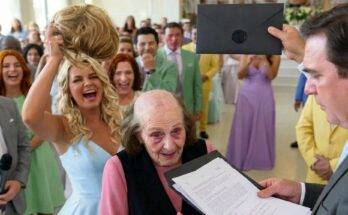
One year after the trust opened, we held a small ceremony in the courtyard of the converted hotel. There were no red carpets, no photographers shouting, no luxury cars lined against the curb. There were folding chairs, donated flowers, paper cups of lemonade, children chasing bubbles, and women standing in sunlight after surviving nights they once thought would never end.
Harold stood at a small wooden podium with Callum’s final letter in his hand. He had aged somehow in the year I had known him, or maybe I had only become strong enough to notice the grief he had been carrying for his old client. When he read Callum’s words aloud, the courtyard grew still.
“Let the money go where fear once lived,” Harold read. “Let it become keys, rooms, medicine, schoolbooks, and second chances.” His voice caught slightly on the last word, and I looked down at Elodie on my hip, her little hand grabbing at the collar of my dress.
I finally understood the condition then. Callum had not left me seventy-seven million dollars only to rescue me from Nolan. He had left it because he believed rescue meant nothing if it ended with only one person safe.
After the ceremony, Harold handed me the original letter. “He would have been proud of you,” he said. I looked at the building, the families, the staff, the children with sticky hands and bright faces, and for the first time, Callum’s memory did not feel like a ghost pulling me backward.
“I think he hoped I would become proud of myself,” I said.
Harold smiled, and we stood quietly while the afternoon light moved across the courtyard. Grief was still there, but it had changed shape. It was no longer a locked room; it was a window I could open without falling through.
Nolan came later that day to pick up Elodie for a supervised visit that had recently become unsupervised for short hours. He stood near the courtyard gate, watching the families with an expression I could not quite read. For once, he did not look jealous or defensive.
“This is bigger than I understood,” he said quietly.
“Yes,” I replied. “It always was.”
He looked at Elodie, then at me. “Do you hate me?” he asked. The question was simple, but I knew it had taken him a long time to become brave enough to ask it without demanding a comforting answer.
I thought about the porch, the rain, the motel, the dead phone, and the pregnancy test clutched in my hand like a broken prayer. I thought about the hospital, his tears, his slow effort to become less dangerous with his own fear. Then I shook my head.
“No,” I said. “But I don’t trust you with my life anymore.”
Nolan lowered his eyes, and this time he did not argue. Maybe that was the closest thing to an apology he could fully understand. Maybe it was the closest thing to peace we could offer each other without lying.
He became part of Elodie’s life, but never again the center of mine. He learned to show up on time, to listen to court orders, to pack extra diapers, to send photos without using them as emotional bait. He was not transformed into a perfect man, but he became a better father than he had been a husband, and for Elodie’s sake, I allowed that truth to stand beside the other one.
Years later, when Elodie was old enough to ask why her last name was Greer but the shelter carried the name Rourke, I told her a version she could understand. I said some people hurt us, some people help us, and sometimes the same story teaches us how to become the person who opens the door for someone else. She listened seriously, then asked if the shelter was like a lighthouse.
I smiled because children often find the truth faster than adults. “Yes,” I said, kissing the top of her head. “Exactly like a lighthouse.”
I never became the woman gossip imagined I would become. I did not spend my life in glittering rooms, did not chase revenge through newspapers, and did not turn suffering into a performance. I became a mother, a director, and a woman who could finally sleep without listening for footsteps.
The man who locked me out became my daughter’s father, but not my home. The man from my past left me a fortune, but not a chain. And the child I carried into the rain became the reason I built doors that opened for others.
In the end, the condition was not a burden. It was a map, drawn by regret, paid for with fortune, and completed by courage. It led me through betrayal, grief, motherhood, and mercy, until finally, after years of mistaking survival for peace, it led me back to myself.
THE END