Three days after my grandmother’s will left me everything she had built, guarded, documented, and protected for more than forty years, my brother Tyler shoved me off a second-floor deck in front of half our family at his own birthday party, and my mother looked down at me lying on the river rocks below and told me to stop making a scene.
A few minutes later, when a paramedic pressed her fingers against my leg and asked whether I could feel anything, the answer that came out of my mouth changed the whole afternoon, because she looked toward her partner with a steadiness my own family had never given me and called for the police.
The heat that day did not feel like weather; it felt deliberate, as if the Connecticut sun had decided to press its full weight against my parents’ backyard, flattening the white patio umbrellas, warming the champagne bottles sweating in silver tubs, and baking the decorative stones that would soon burn through the back of my dress while I stared up at the broken deck railing and tried to understand why my legs would not obey me.
What I remember first is not the pain, though the pain came fast enough to swallow everything, but the smell of fresh-cut grass, sunscreen, bourbon, grilled shrimp, and hot stone, all of it tangled together in the clean suburban air of a party designed to look effortless to people who had no idea how carefully my family arranged every performance.
I remember a champagne flute shattering somewhere above me, then a woman gasping before she swallowed the sound, because in my family even horror had to be polished before it was allowed into public.
I remember the railing hanging open above me like a mouth with its teeth knocked out, and I remember Tyler leaning over the edge with a face so pale and naked with fear that, for one second, I thought my brother had finally understood what he had done.
Then the fear vanished from his eyes, replaced by something flatter and colder, and that was when I knew he was not wondering whether I was alive, whether I could breathe, or whether I would ever walk again; he was wondering who had seen his hands.
Only twenty minutes earlier, I had walked into my parents’ house already knowing that Tyler’s birthday party was never going to be just a birthday party, because Grandmother Rose’s will had been read three days before, and the will had destroyed the family story my parents had spent years protecting.
My mother, Diane, had tied blue and silver balloons around the deck posts, my father, Harold, had ordered enough champagne for sixty guests, and Tyler had turned thirty-eight beneath a canopy of expensive flowers, catered food, and practiced smiles, as though the entire house had been arranged to convince him he was still the sun and all of us were expected to keep orbiting.
The will reading had happened at 10:15 on a gray Tuesday morning, inside an attorney’s office with beige walls, weak coffee, and a wall clock that seemed to tick louder every time my mother inhaled as if she already knew the truth and hated that paper would finally make it undeniable.
The attorney read slowly, without emotion and without apology, and every sentence placed another piece of Grandmother Rose’s life into my hands: the jewelry company, the properties, the investment accounts, the controlling shares, the estate collection, the storefronts, the warehouse, and the records that proved how carefully she had made every decision.
Tyler received one sealed letter, and he did not open it in the office, because he held it in one hand and stared at the envelope as though it had reached across the table and slapped him in front of everyone.
My mother began crying before the attorney finished the final page, my father asked whether Rose had been pressured, and the attorney, clearly prepared for that exact accusation, explained that Rose had updated the trust twice, submitted a medical competency letter, and insisted on recorded signing sessions for the final version.
That was Grandmother Rose in every detail, careful even in death, because she loved beautiful things with an artist’s eye, but she loved proof with the discipline of someone who had survived too many charming lies to trust memory alone.
She had built Rose & Wren Jewelry from a little repair counter into a respected company with three storefronts, a warehouse, private clients, and employees who trusted her judgment more than most people trust blood, and she had done it by writing everything down before anyone could make truth sound negotiable.
When Tyler borrowed money, she wrote it down, and when my parents excused him, explained him, defended him, and begged her not to embarrass him with consequences, she wrote that down too.
For seven years, I had helped her keep those records straight, driving her to appointments, sitting beside her through chemo, scanning vendor contracts, approving payroll, renewing insurance policies, reviewing inventory logs, and photographing every piece in the estate collection so no one could later claim confusion where theft had been.
Tyler called that sucking up, my parents called it hovering, and Grandmother Rose called it being the only adult in the room.
That was the sentence no one wanted to say at the birthday party, because they did not want to admit Tyler had been given chances, jobs, loans, introductions, forgiveness, and clean starts, only to burn through all of them and come back demanding more.
They did not want to admit that Rose had watched him charm, rage, borrow, deny, vanish, return, and blame everyone except himself whenever responsibility stepped across the threshold.
It was easier to call me greedy, because greed was a cleaner accusation than accountability, and families like mine had a strange talent for making labor invisible until money made that labor impossible to ignore.
The moment I stepped through my parents’ front door, I felt the trial begin, not in a courtroom with rules and testimony, but in the glance of every guest who looked at me and then looked away, already deciding it was safer to treat me like the scandal instead of the person who had been named in a legal document.
My mother kissed the air beside my cheek without touching me, her perfume sharp and floral in the hallway, while my father said my name as though it were a bill he had no intention of paying.
“Bridget,” he said, and in that single word I heard every year of being the difficult daughter, the cold daughter, the daughter who remembered too much and forgave too slowly.
Tyler found me before I reached the kitchen, smelling like bourbon and mint gum, his smile stretched across his face with the dangerous charm he used when witnesses were nearby.
His wife Lauren stood behind him with one hand wrapped around their eight-year-old son Mason’s shoulder, and before Tyler said a word, I noticed Lauren’s lowered eyes and the white pressure of her fingers against the boy’s shirt.
“You poisoned her against me,” Tyler said, keeping his voice low enough to pretend the conversation was private and loud enough for my parents to hear every syllable.
I looked at him, then past him at my mother, who stood by the patio doors with a glass in her hand, already waiting for me to apologize for being accused.
“I didn’t poison anyone,” I said, and even though my voice was controlled, something in Tyler’s face twitched because he had expected pleading, guilt, or panic, not the quiet exhaustion of someone who had finally run out of reasons to absorb another man’s anger.
“You always do this,” he said, stepping closer as though he could force me backward with the pressure of his entitlement alone, “you play the victim and then act shocked when people finally see through it.”
Something inside me went cold, not angry yet, not loud, not dramatic in the way my family always accused me of being, but tired in a way that felt older than my body.
“Grandmother made her choice,” I said.
That sentence changed him more than any insult could have, because his jaw shifted, Lauren’s hand tightened on Mason’s shoulder, my father suddenly looked toward the deck as though the view had become fascinating, and my mother whispered, “Not here,” which in our family had always meant not where the truth might embarrass us.
Tyler leaned closer until I could see the small red veins in his eyes and smell the alcohol beneath the mint, and he said, “You think you won.”
“No,” I answered, because I was done lending him the fantasy that everything was a competition arranged around his wounded pride, “I think she knew exactly what she was doing.”
I should have left then, and the thought came to me clearly, almost beautifully, as I imagined setting down my glass, walking through the foyer, passing the small American flag my mother had stuck into the planter by the front door, getting into my car, and driving away while the party collapsed under the weight of everything they refused to name.
For one ugly second, I also imagined throwing my drink in Tyler’s face, watching bourbon and humiliation run down his expensive shirt while the guests pretended not to stare.
I did neither, because restraint is not weakness, even when people who benefit from your silence mistake it for surrender.
Sometimes restraint is the last door you leave open before someone else chooses violence and removes every excuse they once hid behind.
Tyler followed me onto the second-floor deck at 4:37 p.m., and I know the exact time because I had checked my phone after a message from Emma, my best friend, appeared on the screen asking whether I was okay.
I had typed, “Not really,” and I never pressed send.
The deck was crowded with guests balancing paper plates on cocktail napkins, champagne glasses catching the bright afternoon light, and polite conversations buckling under the pressure of what everyone knew but refused to say.
A birthday cake waited under a clear plastic cover near the sliding door, its frosting perfect and absurd, while someone laughed too loudly and someone else said Tyler’s name in that bright warning tone people use when they want a man to stop without having the courage to stop him.
Tyler did not stop.
He crowded me backward inch by inch, not enough for anyone cowardly to call it an attack yet, but enough for my spine to feel the railing behind me and for every nerve in my body to begin counting the space I no longer had.
“Give it back,” he said.
The heat of the wood pressed through my dress, and I could hear the guests breathing around us, their silence spreading like spilled oil.
“It was never yours,” I told him.
His hands struck my shoulders.
That is the detail I have never allowed anyone to soften, because it was not a stumble, not an accident, not a dramatic misunderstanding caused by grief, alcohol, or emotional stress, but hands, both of them, hitting hard enough to send me backward.
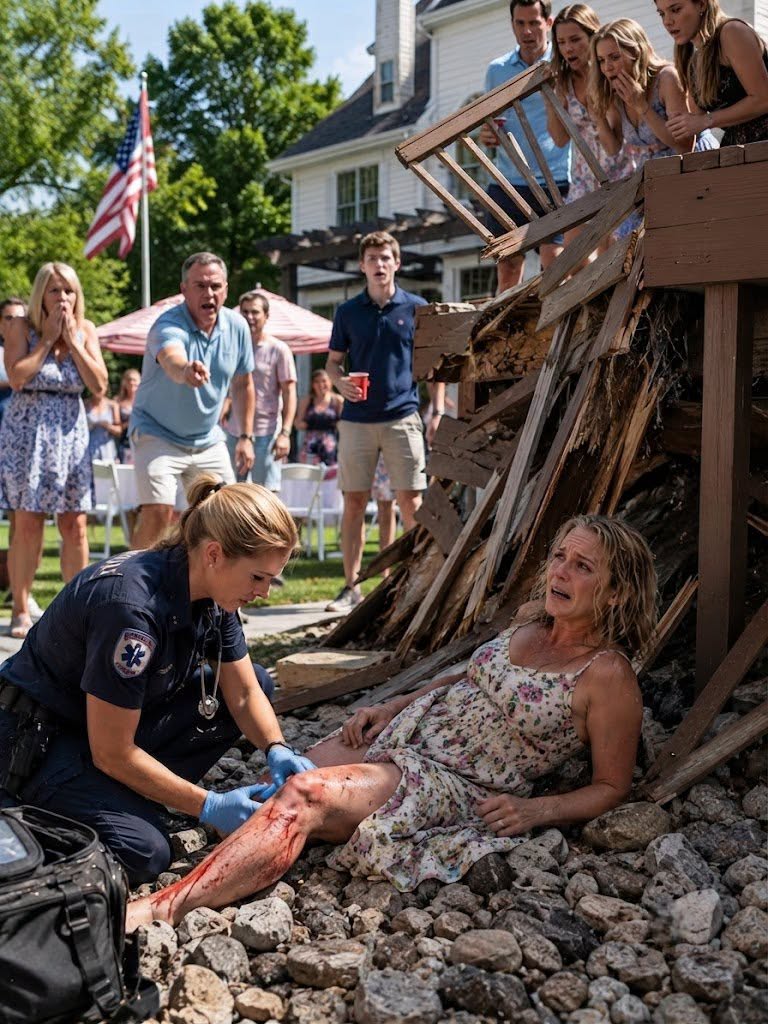
The railing cracked behind me with a rotten, splintering sound, and for one suspended second there was only sky, blue and merciless, before the world turned and the ground rose up.
I hit the river rocks on my back with a force that emptied every breath from my body, and pain burst through my lower spine so bright and brutal that I could not scream because even screaming required air.
Then came the absence.
I could see my legs, one knee angled slightly and one shoe twisted halfway off, but they seemed to belong to someone else, lying there beneath the hem of my dress with terrible stillness.
I tried to move my toes, and nothing happened.
I tried again, silently begging my own body to prove this was only shock, only pain, only a temporary disobedience that would pass if I focused hard enough, but the silence below my waist remained complete.
Panic climbed through me with a metallic taste, and above me the party froze in a tableau of useless privilege, with a woman holding her hand halfway to her necklace, a man staring down into his champagne glass, and the birthday cake sliding off its plate above, leaving a smear of white frosting across the deck boards.
Nobody picked it up.
Nobody moved quickly enough to help.
Then my father came down the stairs slowly, like a man approaching a public inconvenience instead of his daughter, while my mother reached the rocks first and stood over me with her arms locked against her body, furious in the specific way she became whenever my pain threatened her image.
“Bridget, get up,” she snapped.
“I can’t,” I said, but my voice came out thin, broken by the pain and the terror growing inside me.
“You are making a scene,” she said, and in that moment I understood that she truly believed the audience was the wound.
Harold crouched beside me, and for one fragile second I thought he might touch my shoulder, might lower his voice and become my father instead of the man who had spent his life managing consequences away from Tyler.
Instead he leaned close and said, “You’ve embarrassed this family enough.”
I tried to breathe through the pain, tried not to cry, tried to pull myself into a version of dignity they could tolerate, but for the first time in my life I was too injured to perform the daughter they preferred.
Above us, Tyler leaned over the broken railing and called out, “Should we call someone?” in a voice shaped carefully for witnesses.
It was a performance, concern arranged like flowers around a lie, and if you had not known him, you might have believed he was frightened for me.
But from where I lay on the burning stones, I saw Marcus slip through the back door.
Marcus was Tyler’s closest friend, the kind of man who laughed at every cruel joke before deciding whether it was safe to laugh harder, and he was also the man who had installed my parents’ security cameras the previous fall after my father complained about delivery drivers leaving packages too near the front walk.
Marcus did not go toward the street, the front door, or the driveway.
He went toward the interior hallway where the security panel was mounted, moving with the purposeful speed of someone who already knew what he had been sent to do.
Tyler saw him too, and when the fear in my brother’s face eased, that frightened me more than the fall.
I begged them to call an ambulance, but my mother folded her arms and my father began telling anyone close enough to hear that I had always done things for attention, as if lifelong dismissal could become medical expertise if spoken with enough confidence.
Dr. Patricia Winters stood near the patio table with a paper coffee cup in her hand, watching from the safety of social hesitation.
She had been our family doctor since I was twelve, had treated my asthma, my mother’s migraines, my father’s blood pressure, and Tyler’s endless mysterious injuries after drunken nights he refused to explain, yet when she looked at me lying on the rocks and then looked away, something inside me broke in a place that pain could not reach.
The ambulance siren cut through the party music a few minutes later, and I learned later that one of the catering assistants had called 911 from behind the garage because she did not know my family well enough to be afraid of them.
That stranger did what my mother, my father, my brother, and a doctor had not done.
Paramedic Sarah Chen entered through the side gate with a medical bag in one hand and authority in every step, and she knelt beside me without waiting for permission from anyone who had already failed me.
“What’s your name?” she asked.
“Bridget,” I whispered.
“Bridget, I’m Sarah, and I’m going to check you now,” she said, her voice calm enough to hold onto, while her partner began moving people back with the efficient firmness of someone who understood that crowds can be as dangerous as injuries.
My father stepped toward her and said, “I sit on the hospital board,” as though prestige could still bend the air around him.
Sarah did not look impressed.
“Then you know better than to interfere with my scene,” she said, without raising her voice. “Move, or I’ll have police remove you.”
The yard went quiet in a new way, because Harold Whitman was not used to being spoken to like a regular man, especially not in front of guests who had spent years treating his money like a form of gravity.
He stepped back.
Sarah checked my pulse, asked where it hurt, asked whether I had hit my head, and then touched my leg with careful fingers.
“Do you feel this?”
“No.”
She moved lower.
“This?”
“No.”
She moved again, and this time I stared at her face because I was afraid the truth would become larger if I looked at my body.
“This?”
“No.”
Something sharpened in her expression, not panic but training, and she kept her hand steady on my wrist while the whole backyard seemed to hold its breath.
“How did you fall?” she asked.
Tyler was gripping Lauren’s arm now, hard enough that I could see the pressure of his fingers through the fabric of her sleeve, and Lauren winced while Mason stood beside her, pale and silent.
For years, I had swallowed the truth because my family punished honesty more viciously than cruelty.
I had swallowed Tyler’s lies, my parents’ excuses, the casual humiliations, the accusations of selfishness, the warnings not to provoke him, and the endless demand that I make peace with whatever damage he caused because peace always meant my silence.
But Sarah’s hand was steady on my wrist, and for once someone was asking the right question without already choosing the answer.
“My brother pushed me,” I said.
The backyard went so silent I could hear the faint hiss of champagne bubbles in a glass somewhere above me.
Harold began shouting first, because shouting had always been his way of making truth sound disorderly, while Diane cried, “She’s lying,” with a desperation that sounded less like certainty than fear.
Tyler stepped back from the railing and pressed one hand against his chest as if I had wounded him by naming what his hands had done.
Sarah did not argue with any of them.
She looked at her partner and made one small signal, and moments later police were on the way.
The first cruiser rolled into the driveway slowly enough for everyone to hear the tires crunch over the gravel, and my mother rushed toward the officers before they had even closed their doors.
“She fell,” Diane said, her voice already wrapped in the softness she used for outsiders, “she’s confused, and this family has been under terrible stress since the will.”
Sarah stayed beside me.
“Patient reports being pushed from a second-floor deck,” she said. “Loss of sensation in both legs, possible spinal injury, and the scene is not secure.”
That sentence changed the entire yard, because it took the story out of my mother’s mouth and placed it somewhere official, somewhere she could not polish it before handing it to people who preferred manners over truth.
Then Detective James Morrison stepped out of the second car.
He wore a blue shirt, dark slacks, and an expression so unreadable that Tyler’s face drained before anyone said another word.
Morrison looked at me, then at the broken railing, then at Tyler, and then toward the patio door where Marcus had disappeared.
“Where’s Marcus?” he asked.
Tyler’s mouth opened, but no sound came out.
Lauren’s knees seemed to soften beneath her, and she caught herself on a deck post while pulling Mason against her side, looking suddenly less like Tyler’s wife and more like someone who had been waiting for one correct question to split the room open.
Sarah’s partner came back from inside the house with his radio lifted close to his shoulder.
“Security panel’s open,” he said.
Morrison turned fully toward Tyler.
“Then nobody touches another door,” he said, “until I find out what your friend was trying to erase.”
That was when Tyler finally looked afraid again.
The ambulance team lifted me onto a backboard, and the pain that tore through me was so vast and blinding that the world reduced itself to straps, voices, sunlight, and the terrible silence below my waist.
As they carried me past the deck, I saw my mother standing with one hand over her mouth, not because she was worried about me, but because people were watching her reaction and she had not yet decided which version of grief would serve her best.
My father spoke to an officer in the same tone he used with contractors, attorneys, and restaurant managers, but the officer was not nodding.
Tyler stood near the stairs while Detective Morrison questioned him, and Marcus remained somewhere inside the house, cornered at last by the very cameras he thought he could make disappear.
The ambulance doors closed before I saw what happened next.
Sarah leaned close, close enough for me to see the sweat at her temple and the fierce gentleness in her eyes.
“You’re safe now,” she said.
I wanted to believe her, but safety felt like a country I had heard about and never been allowed to visit.
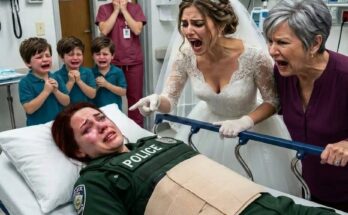
At the hospital, everything became white lights and moving ceilings, panels sliding over my head, a monitor beeping beside me, scissors cutting fabric near my shoulder, a nurse asking for my date of birth, another wrapping a hospital band around my wrist.
There is a strange mercy in medical process, because it does not ask whether your family approves of your pain, whether your injury is convenient, whether your fear will embarrass the people who caused it, or whether your suffering can be postponed until the guests leave.
It measures, records, treats, and writes down what happened.
The intake form said fall from height.
The police report would later say alleged assault.
The MRI said what no one could soften.
My spinal cord had been severed.
Dr. Amanda Foster told me in a room that smelled of disinfectant, plastic tubing, and clean sheets, her face kind but unwilling to decorate the truth with false comfort.
“The paralysis in your legs is permanent,” she said.
Permanent did not land all at once.
It entered the room quietly, sat down beside my bed, and waited for me to understand that it intended to stay.
I thought of stairs, shoes, driving, rain puddles, grocery aisles, the high stool in Grandmother Rose’s workshop, and the way she used to hand me a magnifying loupe under the lamp and teach me how to inspect a clasp until even a tiny weakness told the truth.
Then I thought of Tyler’s hands on my shoulders, and I had to stop thinking because grief was too large to hold while breathing.
Emma arrived before my parents did, which did not surprise me because Emma had been finding me in wreckage since college, when she discovered me crying in a dorm laundry room after Tyler emptied my emergency account and my parents told me I must have misunderstood.
She believed me then.
She believed me now.
She came into the hospital room crying, with her purse clutched against her chest as though it carried something breakable and dangerous.
“I have it,” she said.
Dr. Foster looked from Emma to me, and Emma reached into her purse and pulled out a small blue USB drive.
I knew it immediately.
It was my backup, the one my family never knew existed, the one I had given Emma on a rainy night over takeout after finally admitting that I was afraid of what Tyler might do once Grandmother Rose died.
For years, I had documented everything, not because I was planning revenge, but because living around practiced liars teaches you that memory is never enough when people with money and charm are willing to call your reality a misunderstanding.
I had copies of emails where Tyler asked Rose for loans he later denied receiving, voice memos of my parents pressuring her to change beneficiary forms, photographs of inventory Tyler damaged during one of his brief theatrical attempts to “help” at the warehouse, and a scan of the letter Rose wrote six months before she died.
In that letter, my grandmother said she feared Tyler would do something reckless when the will became public.
Dr. Foster allowed the drive to be opened through a secure workstation after Emma explained what it contained, and the first folder appeared on the screen with a title that made the air leave my lungs.
ROSE ESTATE — INCIDENTS.
Inside were subfolders organized by date, because Grandmother Rose had taught me well: February 12, March 8, April 22, June 3, and then one folder labeled TYLER — THREATS AFTER WILL.
Dr. Foster did not speak for several seconds.
Emma covered her mouth.
The first audio file was time-stamped two days before the party, and when Tyler’s voice filled the hospital room, low and venomous, it seemed to drag the entire backyard in with it.
“You think that will protects you?” he said on the recording. “You have no idea what people will believe about you when I’m done.”
Emma started crying harder.
I closed my eyes, because there it was, the thing my family had spent years denying me.
Not drama.
Not attention.
Evidence.
Detective Morrison came to the hospital that evening and took my statement with a recorder on the tray table and a notepad balanced against his knee.
He did not interrupt, did not ask why my family would do something like that, and did not wear the confused expression people put on when they still believe cruelty must have a reasonable explanation.
I told him about the will, about the deck, about Tyler’s hands, about Marcus slipping inside, and about the way my parents had tried to turn my injury into embarrassment before anyone even called for help.
When I mentioned the security panel, Morrison’s face did not change, but his pen paused.
“We recovered partial footage,” he said.
My throat tightened.
“Partial?”
“Someone attempted to delete the backyard camera file,” he said. “They didn’t finish.”
Later, I learned why.
Mason had followed Marcus inside, not all the way, but far enough to see him open the panel and start pressing buttons, and Lauren saw Mason see it.
When Detective Morrison asked Lauren one question without Tyler standing beside her, something in her finally gave way, though not all at once, because people who have been controlled do not always step into truth like it is a doorway.
Sometimes they crawl toward it.
Lauren admitted Tyler had been drinking before I arrived, admitted he had said, “She’ll give it back if she’s scared enough,” admitted Marcus knew where the camera files were stored, and admitted Tyler had grabbed her arm because she whispered, “Stop,” when he followed me onto the deck.
Mason told a child advocate that Uncle Tyler put both hands on me, and he used his own small shoulders to show the motion.
That image broke me more than almost anything else.
An eight-year-old child should never have to demonstrate adult violence because the adults around him were too cowardly to name it.
My parents came to the hospital the next morning, and my mother brought flowers from the gift shop downstairs, still wrapped in plastic, while my father brought a lawyer.
That told me everything I needed to know before either of them spoke.
Diane cried beside my bed and said the family was being destroyed, Tyler’s life would be over, Mason would grow up with his father in prison, and surely I did not want to be responsible for that kind of damage.
I looked at the flowers, at the drop of water gathered inside the plastic sleeve and sliding slowly down one stem.
“Do you know what the MRI showed?” I asked.
My mother looked away.
Harold said, “This is not the time for emotional accusations.”
I almost laughed, because my spine was severed and he was still trying to manage tone.
Dr. Foster entered before I could answer, carrying my updated chart and wearing the calm expression of a woman who had already decided she would not be impressed by a rich man with a lawyer.
“Only approved visitors remain,” she said.
Harold tried the hospital board line again, as if authority were a key that should still open every door.
It worked no better on Dr. Foster than it had on Sarah Chen.
“Then you know patient consent matters,” Dr. Foster said, turning toward me. “Bridget, do you want them here?”
My mother’s face changed because, for the first time in my life, the question belonged to me.
“No,” I said.
That one word was smaller than a scream and stronger than one.
Security escorted them out, and my mother called my name once in the hallway, not with apology, not with understanding, but with the panic of a woman who had lost control of the scene.
I did not answer.
The months that followed were not clean, dramatic, or triumphant in the way people imagine justice will be when they have never had to survive long enough to receive it.
Real consequences arrive with paperwork, pain scales, insurance calls, police interviews, attorney meetings, physical therapy schedules, medical equipment deliveries, and mornings when you wake before dawn and remember your body has changed before you even open your eyes.
Tyler was charged.
Marcus was charged too, for tampering with evidence and obstruction-related offenses tied to the security system, and the partial footage he failed to erase became one more piece of proof in a case my family had expected to bury under influence and panic.
Lauren cooperated.
So did the catering assistant who called 911.
So did two guests who admitted they had seen Tyler crowd me backward, though both confessed they had been afraid to get involved because my father was powerful in their circle.
Dr. Patricia Winters lost more than my respect, because after the police report and medical documentation became part of the case file, questions were raised about her failure to render aid despite being present as a physician.
I do not know every professional consequence that followed her, but I know she sent one apology letter through an attorney, and I know I did not respond.
Grandmother Rose’s records became the backbone of the estate fight my parents tried to start, and every safeguard she had created held firm: the recorded signing sessions, the competency letter, the trust documents, the dated notes, the loan records, and the written history of Tyler’s behavior.
The company remained mine.
The first time I entered Rose & Wren Jewelry in a wheelchair, every employee in the main office stood up, not out of pity, not because they knew what else to do, but because they understood that I had returned to the place my grandmother trusted me to protect.
I hated that I cried.
I hated that I needed help getting through doors I used to open without thinking, hated the careful ramps, the lowered counters, the way strangers sometimes spoke slowly to me as though my spine had taken my mind with it.
But I remembered Rose’s voice in the workshop, telling me that good metal bends before it breaks, and that repair is a craft people underestimate until something precious is in pieces.
I was in pieces.
I was not gone.
Emma became my emergency contact, the person whose name appeared where family was supposed to be, and the first time I signed the paperwork, my hand shook less than I expected.
Sarah Chen visited once while off duty, carrying a paper coffee cup and a terrible hospital vending machine muffin, and she told me the catering assistant had asked about me, Lauren and Mason were staying somewhere safe, and I did not have to be grateful for surviving every minute of what came next.
That helped more than any speech about strength.
My parents tried to reach me for months through voicemails, letters, family friends, and acquaintances who had ignored me for years until the story became too public to pretend they had not chosen sides.
Diane wrote that she had been in shock, Harold wrote that public charges helped no one, and neither of them wrote, “We are sorry we told you to get up when your spine was broken.”
Neither of them wrote, “We are sorry we protected him until he destroyed part of your life.”
So I kept the letters in a file, not because I needed them, but because documentation had saved me once, and I had learned not to throw away proof of who people were when they thought no one would hold them accountable.
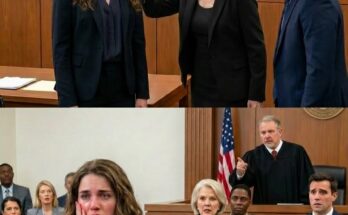
At Tyler’s sentencing, I gave my statement from my chair while the courtroom remained so quiet that every small movement seemed amplified.
Lauren sat near the back with Mason, her shoulders tight but her head lifted, while my parents sat on Tyler’s side because of course they did.
Tyler did not look at me until the judge asked him to.
When he finally raised his eyes, I saw the same thing I had seen above the broken railing: calculation, though weaker now, thinner, stripped of the family stage that had always made him feel untouchable.
The room no longer belonged to him.
I told the court about the fall, the river rocks, the silence in my legs, and the sound of my mother saying I was making a scene while I lay beneath her unable to move.
I told them the worst injury was not only what Tyler did with his hands, but what everyone else did with their silence.
An entire backyard had taught me, in one frozen moment, how many people will watch harm happen if the person causing it has enough money, charm, or family protection.
Then I looked at my brother.
“You did not push me because you lost an inheritance,” I said. “You pushed me because, for the first time, you could not make a woman who knew the truth hand it back to you.”
Tyler looked down first.
That did not heal me.
It did not give me back my legs, my old body, my old mornings, or the casual freedom I had once mistaken for ordinary life.
But it mattered.
Afterward, outside the courtroom, my mother tried to touch my shoulder, and I moved my chair back before her hand landed.
Her face crumpled.
“Bridget,” she said.
I waited, because there had been a time when that one word would have pulled me back into the family script, back into daughter, peacekeeper, apologist, the woman expected to make pain easier for everyone except herself.
Not anymore.
I rolled past her toward Emma, who was holding the elevator door open with one hand and my coffee in the other.
Care looks different when it is real.
It does not ask you to shrink so someone else can remain comfortable, does not call your suffering dramatic because truth arrives at an inconvenient time, and does not stand over your broken body worrying about who might be watching.
Real care holds the door, keeps the backup drive, calls 911 from behind the garage, kneels beside you on burning rocks, and asks, “Tell me how you fell.”
I still live with what Tyler did every day.
Some mornings are hard, and some nights are worse, especially when pain moves through me like weather or when I dream of falling and wake with my hands gripping the sheets.
But Rose & Wren is still open, the lamps still glow over velvet trays, clients still bring in broken clasps and loose stones, and the work still reminds me that damaged does not mean worthless.
Grandmother Rose’s office is mine now, though I kept her old magnifying lamp exactly where she left it.
On the wall beside the inventory shelves, I framed one document no one in my family knows about.
Not the will.
Not the sentencing paperwork.
Not the newspaper clipping.
It is a copy of the first incident log I created after Rose looked at me across her desk and said, “Write it down, Bridget, because the truth deserves a paper trail.”
She was right.
The truth did not save me from the fall, did not soften the stones, did not keep my brother’s hands from my shoulders, and did not make my mother kneel when I needed her.
But it made sure I did not have to lie there forever while my family called it a scene.
The End