The backyard smelled of rain-soaked grass, churned mud, and the sour trace of cheap beer, the kind people spilled carelessly when they believed the person who owned the house was too far away to matter anymore.
Michael Reynolds stood at the edge of his own lawn with a duffel bag hanging from one shoulder, his Army uniform jacket stiff with travel dust and cold wind, while the homecoming he had carried inside his chest for months collapsed in front of him before he even reached the porch.
He had imagined this night a thousand times during the long hours overseas, not as a grand ceremony or some flag-waving reunion at an airport, but as something quieter, something painfully American and ordinary, with the porch light glowing, the hallway smelling faintly of laundry detergent, and his daughter Lily running toward him so fast her little feet would slap against the floor.
He had imagined Sarah opening the door in one of his old T-shirts, exhausted and smiling, her hair twisted into the messy bun she wore when she pretended not to care how beautiful she looked, and he had imagined Buster, their German Shepherd, barking with the wild relief of a dog who understood absence better than most people ever could.
Instead, the house was blazing with lights like a roadside bar after midnight, music thudding through the kitchen windows hard enough to rattle the glass, while laughter rolled out across the lawn in careless waves that made the cold air feel even colder.
Red plastic cups lined the inside sill, shadows moved behind the curtains, and the back porch door had been left cracked open just enough for heat, noise, and the unmistakable smell of alcohol to leak into the wet yard where Michael stood, still wearing the uniform he had dreamed of bringing home to his family.
He checked his phone automatically, although he already knew the time, because soldiers learned to confirm facts when their instincts started screaming, and the glowing screen told him it was two days before Sarah expected him.
That was supposed to be the surprise, the small mercy given to him after his return orders changed without warning, after the base transportation clerk stamped him out at 11:47 p.m. with a tired nod and a flat “welcome home,” as if those words could ever cover what a man felt when he was finally close enough to smell his own state again.
He had not called Sarah because he wanted to see her face before she could prepare it, and he had not called Lily because he wanted the pure sound of his daughter shouting Daddy before she remembered to be brave.
That hope had ridden with him through fluorescent airport gates, through a late-night rideshare that smelled of pine air freshener and burned coffee, and through the last stretch of road where every familiar mailbox had made his chest ache with the promise of return.
Then Buster growled from the darkness beside the shed, and every tender image Michael had been holding vanished as quickly as a match flame in rain.
It was not the greeting bark he knew, not the half-crazed, joyful sound that usually came from deep in Buster’s chest whenever Michael pulled into the driveway, but something lower, sharper, and terribly controlled, the sound of an animal warning the world not to come one inch closer.
“Buster?” Michael whispered, and the name left his mouth almost like a question he was afraid to ask.
The German Shepherd stood in the shadow beyond the porch light, half-hidden where the yard dipped toward the old wooden shed, his ears locked forward, his body tight as a drawn wire, and his eyes fixed on Michael with a strange, desperate intelligence.
When Buster recognized him, his tail gave one hard sweep, not enough for joy and not enough for relief, before the dog looked down at the mud behind him and nudged something Michael could not yet see.
The duffel bag slipped from Michael’s shoulder and dropped into the grass, but the music inside the house swallowed the sound completely, as if even the yard had been trained not to interrupt whatever celebration was happening without him.
He crossed the distance in six long strides, his boots sinking into the soft ground, his heartbeat turning slow and brutal in his ears while Buster remained perfectly still, guarding the shape tucked against the shed wall.
“Easy, boy,” Michael murmured, though his own voice sounded strange to him, steady in the way voices become steady when terror is too large to fit inside them.
Buster shifted aside just enough for Michael to see her, and the world he had survived overseas, the explosions, the sleepless roads, the months of waiting under foreign skies, all seemed to narrow into the sight of his five-year-old daughter curled in the mud outside her own home.
Lily was pressed against the shed in thin pajama pants and a little shirt meant for a warm bedroom, not a backyard soaked by rain, with one sock missing, her hair stuck to her cheek, and her small fingers buried in Buster’s fur as if the dog were the last safe thing left in the world.
For one suspended second, Michael’s mind refused the evidence of his own eyes, because a child did not belong in mud, a daughter did not belong outside a house full of laughing adults, and a father did not come home from war to find the battlefield waiting behind his own kitchen.
His knees hit the ground hard enough to splash water against his uniform, but he did not feel the impact as he reached for her.
“Lily,” he said, and the name cracked somewhere inside him even though he forced it out gently.
Her eyelids fluttered open, heavy with cold and exhaustion, and when she saw his face, recognition did not come first; fear came first, huge and blue and terrible, filling her eyes before any part of her dared believe what she was seeing.
She jerked backward so violently her shoulder struck the shed wall, and Buster pressed his body tighter against her side without taking his eyes off the house.
“D-Daddy?” Lily whispered, but the word sounded less like joy than terror.
“It’s me, baby,” Michael said, reaching slowly because he could see she was trembling too hard to understand him.
Her lips shook, and tears cut clean lines through the dirt on her face as she stared at him like a child staring at something that had climbed out of a nightmare.
“No,” she whispered, shaking her head. “No, you’re a ghost.”
The cold that moved through Michael then did not touch his skin; it passed through muscle, bone, memory, and every fragile belief he still had about the woman inside that house.
“No, sweetheart,” he said, swallowing the roar that wanted to tear out of him. “I’m here, and I’m alive.”
Lily shook her head harder, gripping Buster’s fur so tightly that the dog did not even flinch.
“Mommy said you died in the sand,” she said, her tiny voice breaking beneath words no child should ever have been taught. “Mommy said the bad men made you disappear, and she said if I kept crying for you, ghosts would come for me too.”
The kitchen exploded with laughter behind them, and the sound was so obscene against Lily’s trembling confession that Michael turned his head toward the glowing window with a calm that frightened even him.
For a moment, all he saw in the glass was his own reflection, a soldier kneeling in mud beside his shivering child, a man who had crossed oceans to come home and found that the first enemy he had to face was wearing perfume and laughing in his kitchen.
He looked back at Lily and kept his voice careful, because the rage inside him was not allowed to touch her.
“Who put you out here?” he asked.
Lily’s chin crumpled, and she lowered her eyes as though the answer itself might get her punished again.
“I ruined the party,” she whispered.
Michael’s hand closed slowly around the wet grass.
“Who said that?”
“Uncle Brad.”
The name landed exactly where Michael had always known it would land one day, in the dark place between suspicion and proof.
Brad was not Lily’s uncle, not by blood, not by marriage, not by any decent definition of family; he was Sarah’s friend, the one who had started appearing before Michael deployed, first to fix a garage door that never seemed fully broken, then to watch games, then to stay too late and stand too close while pretending every boundary was just Michael’s imagination.
Michael had told Sarah once that he did not like the way Brad looked at her, and she had laughed too quickly while folding Lily’s pajamas in the laundry room, calling him tired, calling him paranoid, telling him deployment had made him see threats in everyone.
Maybe deployment had sharpened him, or maybe his body had recognized the truth long before his marriage had the courage to confess it.
“What did Brad say to you?” Michael asked, though part of him already hated the answer waiting in Lily’s frightened eyes.
“He said I had to sleep outside with Buster until I learned how to be quiet,” she whispered, and Buster released another low growl toward the house as if he understood every word.
Michael took off his uniform jacket with hands that remained steady only because his daughter needed them to be steady, then wrapped the heavy fabric around Lily’s shoulders, tucking it beneath her cold feet and pulling it close until the muddy little body in front of him had something warmer than fear around it.
She lunged into his arms then, sudden and desperate, wrapping herself around his neck with all the strength left in her, and the wet mud from her hands smeared across his collar like evidence he would have carried forever even if no one else believed him.
“Daddy,” she whispered against his throat, “are you going away again?”
There are moments when anger begs to become violence, when it rises so fast and so hot that it feels like another person waking beneath the skin, ready to do what grief cannot say.
Michael wanted to stand, kick open the door, and drag Brad into the truth by the front of his shirt, and he wanted to ask Sarah what kind of mother uses a child’s grief like a weapon, what kind of wife buries a living husband in a lie because the truth is inconvenient to her pleasure.
Instead, he held Lily tighter and spoke the only promise that mattered.
“No, baby,” he said, his mouth against her wet hair. “I am not going anywhere.”
Then the training took over, not the combat training people imagined from movies, but the colder and more useful discipline of documentation, because Michael had learned in places far from home that when people knew they were wrong, they reached for confusion before remorse.
They called cruelty a misunderstanding, neglect a mistake, betrayal stress, and horror one bad night, so before sunrise gave everyone a chance to rewrite what had happened, Michael pulled out his phone and photographed the truth.
He took pictures of Lily’s muddy pajama legs, the missing sock, the wet ground around the shed, Buster pressed against her like a living shield, and the bright kitchen window behind them where adults drank and laughed while a child shook in the cold.
Photo one, photo two, photo three, each image captured with a steadiness he did not feel, each one a piece of evidence against the comfortable lies that would certainly come.
Then he stood with Lily in his arms, and through the kitchen window he saw Sarah.
She held a wineglass loosely in one hand, her hair falling over her shoulders, her head tilted back in laughter, and behind her Brad stood with his arms around her waist, his posture intimate in a way that made every old argument between husband and wife suddenly look like a rehearsal for this exact scene.
Seven or eight other people filled the kitchen, maybe more beyond the doorway into the living room, and someone had pushed Michael’s dining chairs against the wall as though this house had become a rented space for strangers.
On the counter, beside a stack of cups, Michael saw the framed deployment photograph Sarah had once cried over, turned facedown.
That small, deliberate cruelty nearly broke him more than the party, because they had not forgotten him, they had not failed to see him, they had chosen to lay his face against the counter and continue as though his absence gave them permission.
Lily stirred against him, her fingers clutching his collar.
“Daddy?”
“I’m here,” he said.
“Mommy said you weren’t.”
“I know.”
“Was I bad?”
The question struck harder than any sound Michael had ever heard overseas, because it carried the full weight of what the adults in that house had done to her, how they had taught a little girl to believe her need for love was an offense.
He looked down at her dirty face, at the red skin around her eyes, at the way she still tried not to cry too loudly even while wrapped in her father’s arms.
“No,” he said, with every ounce of command he had ever learned. “You were never bad.”
He stepped onto the porch with Buster moving beside him, the dog low and controlled, his shoulder nearly brushing Michael’s boot, his teeth visible just enough that the first guest near the cracked back door noticed and stopped smiling.
A man in a ball cap glanced over, irritation forming on his face before recognition wiped it clean.
Then Sarah saw him.
At first, her expression was merely annoyed, probably because of the cold air, probably because the open door was letting the party out and the weather in.
Then her eyes found Michael’s face, and the wineglass froze halfway to her mouth.
Brad followed her stare, and the color drained from him so quickly that Michael would have laughed if the weight of Lily in his arms had not reminded him what this night really was.
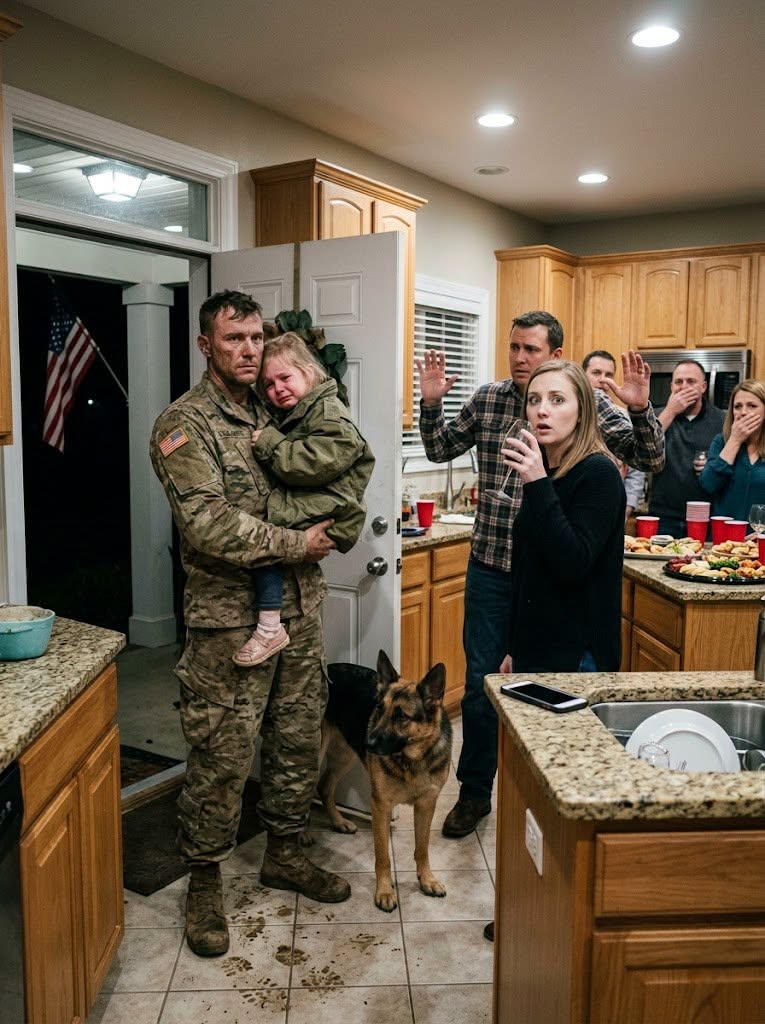
Michael reached for the handle, and inside the house, the music kept pounding for one more second, shameless and stupid, until he kicked the back door open and the sound of wood striking wall cracked through the kitchen like a command.
The room snapped silent.
Lily flinched, so Michael shifted his arm around her and turned his body between her and the people who had abandoned her.
Sarah stared at him as though he were the ghost she had invented.
Brad’s hands dropped from her waist.
A bottle rolled from the counter, hit the floor, and spun in a slow circle no one moved to stop.
“Sarah,” Michael said, his voice so quiet that every person in the room had to lean into the silence to hear him, “take one step away from him.”
Her mouth opened, but no words came out.
Brad lifted both hands, trying to look harmless after proving he was anything but harmless.
“Mike,” he said. “Man, this is not what it looks like.”
Michael looked at him, then deliberately looked down at Lily’s bare muddy ankle hanging from beneath the jacket.
Brad stopped talking.
“She was outside,” Michael said.
Sarah blinked hard, as if blinking might change the room.
“She was having a tantrum,” she said, and the weakness of the lie made one woman near the refrigerator set her cup down very slowly.
Michael could feel every guest trying to decide what story would allow them to leave this house still believing they were decent people.
“Say that again,” he said.
Sarah swallowed, her eyes darting toward the others, toward Brad, toward Lily, toward every place except the truth.
“She was screaming,” Sarah said. “She would not calm down, and I only sent her out for a minute.”
Lily buried her face in Michael’s neck, and that tiny movement did what no argument could have done, because it exposed the lie without needing a single adult to be brave.
Someone whispered, “Oh my God.”
Brad pointed toward the open door with a drunk man’s confidence and a coward’s eyes.
“The dog was with her,” he said. “She was fine.”
Buster’s growl rolled through the kitchen so deep and controlled that Brad took half a step backward before he seemed to realize he had moved.
That was when Michael saw Sarah’s phone on the island, face-up beneath the overhead light, the screen still awake and displaying a text thread with Brad.
The newest message had not been sent yet, but it sat in the message box like a confession too arrogant to hide.
She finally stopped crying. Come back inside.
Michael turned his head slowly toward Sarah, and she saw the moment he read it.
Her face changed, but it did not change into guilt.
It changed into fear of being caught, and somehow that was worse.
Michael set Lily down behind him with one hand firm on her shoulder, then reached for the phone.
Brad lunged first.
Buster moved faster.
The dog did not bite him, because he did not need to; he slammed between Brad and the island with a single explosive bark, and Brad stumbled backward into a chair that tipped over and crashed hard against the floor.
Sarah screamed as though she were the victim in the room.
Lily whimpered, and Michael reached back without looking, resting his palm against her shoulder until he felt her breathing.
He picked up Sarah’s phone, and only then did his hand begin to shake.
The kitchen had become a photograph, every guest frozen inside the shame of what they had witnessed and what they had ignored.
Michael took a screenshot of the thread, then handed his own phone to the woman near the sink, whose face had gone pale beneath the bright kitchen lights.
“Call 911,” he said.
She stared at him, stunned.
“Now,” he said.
Her hands trembled so badly she almost dropped the phone, but she dialed.
Sarah began crying immediately, not with the crushed, helpless grief of a mother seeing what she had done, but with the useful tears of a person trying to arrive at pity before consequence arrived at her door.
“Michael, please,” she said, stepping toward him. “You do not understand what it has been like.”
He looked at her, and for a heartbeat he saw the woman he had married, the woman who once cried when Lily was born, the woman who promised under a courthouse archway that she would keep their family whole until he came home.
“I was gone,” he said. “I was not dead.”
“You might have been,” she whispered.
“But I was not.”
Brad muttered something under his breath, and Michael turned toward him with a calm that made the other man’s mouth close.
“Say it clearly,” Michael said.
Brad raised both palms again.
“She told me you were done,” he said, glancing at Sarah now as though betrayal belonged to everyone except him. “She said you were not coming back, and she said you were basically a ghost in this house already.”
The words struck the room and remained there, too ugly to disappear into the music or the alcohol or the old excuse of stress.
Sarah stopped crying.
A real collapse does not always come with screaming or broken glass; sometimes it comes in the quiet moment when a person realizes the lie they built has become too heavy to carry one step farther.
The dispatcher’s voice came through the speaker, professional and distant, asking for the emergency.
The woman by the sink looked at Michael, and Michael answered with the clean precision of a man who knew facts mattered more than fury.
“My five-year-old daughter was locked outside in the cold while adults were drinking inside the house,” he said. “She is muddy, frightened, shivering, and possibly hypothermic, and I need police and medical assistance.”
Sarah flinched when he said police.
Brad shook his head. “Come on, man.”
Michael did not look at him.
“No weapons visible,” he continued. “One intoxicated adult male attempted to interfere when I secured evidence, and my German Shepherd is present but under my control.”
Even then, even with rage pushing against his ribs, he gave the facts cleanly, and that mattered later more than he knew.
The first deputy arrived nine minutes later, and those nine minutes stretched longer than the longest night Michael had ever spent waiting for extraction under a foreign sky.
He sat on the bottom stair with Lily wrapped in his jacket and held in his lap, while Buster lay directly in front of them like a barricade made of fur, muscle, and loyalty.
No one turned the music back on.
No one touched the red cups.
No one looked at Sarah for very long.
When the knock came at the front door, Brad cursed under his breath, and Sarah pressed both hands to her face as if covering her eyes might make the uniform outside disappear.
The deputy stepped inside, saw Michael’s uniform, saw Lily’s muddy pajamas, saw the wet footprints across the kitchen floor, and his expression shifted from routine caution to something much more careful.
That carefulness told Michael he was no longer the only adult in the house willing to name what he saw.
The officers separated everyone, one speaking to Sarah in the kitchen while another questioned Brad near the hallway, and Michael stayed in the living room with Lily asleep against his chest, though her body jerked every time Sarah’s voice rose behind the wall.
The emergency medical team checked Lily’s temperature, her pulse, her fingers, and her feet, then wrapped her in a clean thermal blanket that made her look even smaller than she already was.
One medic knelt beside her and asked gently whether anybody had hurt her.
Lily looked at Michael before answering, and he nodded because she needed permission to tell the truth after being punished for needing help.
“Brad said ghosts do not count as dads,” she whispered.
The medic’s face tightened, not dramatically, not enough to scare her, but enough for Michael to see that the sentence had landed exactly where it should.
He wrote it down.
Later, that sentence would appear in the report, not because it was the loudest part of the night, and not because it was the only cruelty, but because sometimes the smallest line spoken by a child reveals the whole shape of what adults have done.
At the pediatric emergency room, Lily finally slept beneath a white blanket, one hand still clenched in the sleeve of Michael’s jacket as if letting go might make him disappear again.
Her hair smelled like wet earth and hospital soap, and Michael sat beside the bed with a paper cup of coffee he never drank, staring at the rise and fall of her chest as though he could guard every breath by watching it.
At 3:18 a.m., a social worker entered with a folder and a gentle voice, and Michael hated how calm everyone had to be around something that made him want to tear the walls apart.
But he stayed calm for Lily, because fatherhood, he realized, was not always the powerful thing people imagined; sometimes it was signing forms with a hand that wanted to become a fist.
He gave them the photos.
He gave them the screenshots.
He gave them the stamped return paperwork, the rideshare receipt, the exact time he arrived, the deputy’s case number, and every detail he could remember without adding one unnecessary word.
Sarah called twelve times before dawn.
He did not answer.
At 6:42 a.m., she sent one text message.
Please do not take my baby from me.
Michael stared at the words for a long time, feeling nothing simple enough to call hatred, because hatred would have been easier than the ruined mixture of grief, disgust, memory, and the love he had once wasted on a woman who had taught their child to fear his ghost.
He looked at Lily asleep in the hospital bed with dirt still beneath one fingernail and his jacket sleeve trapped in her hand.
He did not respond.
The days that followed did not feel like victory, because victory had trumpets and endings, while this was made of paperwork, interviews, courtrooms, supervised waiting areas, and the terrible education of learning how many signatures it took to protect a child from the people who should have protected her first.
There were protective orders, temporary custody hearings, statements taken under fluorescent lights, and a family court hallway with gray walls where vending machines hummed beside exhausted parents clutching folders like life rafts.
Sarah cried before the hearing officer, wearing a pale sweater and no makeup, looking smaller than Michael had ever seen her, but every tear seemed to arrive only when someone official was watching.
Brad did not show up.
That absence told Michael almost everything he needed to know.
Sarah’s explanation changed three times before the hearing was over.
First, Lily had only been outside for a minute, then Sarah claimed she thought Lily was asleep in Buster’s dog bed in the mudroom, and finally she said Brad must have taken the child outside while she was too drunk to realize what was happening.
Every version asked the room to feel sorry for Sarah.
None of them asked Lily for forgiveness.
The judge looked at the photographs for a long time, one image after another, and in that small room no one mistook mud for confusion or a shivering child for a misunderstanding.
Michael was granted temporary custody, Sarah received supervised visitation pending the investigation, and Brad was ordered to stay away from Lily completely.
When the order was read aloud, Sarah looked at Michael as if he had betrayed her.
He almost laughed, not because anything about the moment was funny, but because some people become so accustomed to escaping consequence that accountability feels like cruelty when it finally finds them.
Lily did not become better overnight.
Children do not drop fear simply because adults finally tell the truth, and the mind of a frightened child does not unlock just because a judge signs paper and strangers promise safety in careful voices.
For weeks, Lily slept only if Buster was outside her bedroom door, his body stretched across the threshold like a furry line no nightmare was allowed to cross.
She asked whether sand could follow people home.
She asked if ghosts could open windows.
She asked whether Mommy had been scared too, or just mad.
Michael answered what he could, and when the answer was too complicated or too painful for a five-year-old heart, he gave her the truth in the simplest shape he could manage.
“I do not know, baby,” he would say, brushing her hair back from her forehead. “But you are safe right now.”
Right now became their sentence, their anchor, their small bridge across every ordinary day that no longer felt ordinary.
At breakfast, when Lily stared too long at the back door, Michael said, “Right now, you are safe.”
At school drop-off, when she hesitated near the classroom entrance because another parent’s cologne smelled faintly like Brad’s, Michael knelt and said, “Right now, you are safe.”
In the grocery store, when a tall man laughed too loudly behind them and Lily grabbed Michael’s hand hard enough to hurt, he squeezed back and said, “Right now, you are safe.”
In the backyard, when the wind moved against the shed and she froze with her little shoulders rising toward her ears, he lifted her into his arms and said it again.
The house changed in small, deliberate ways.
The party cups went into black trash bags, the kitchen floor was scrubbed until it smelled of bleach instead of beer, and every trace of that night was removed except the ones that had to remain in evidence folders and court records.
Michael turned his deployment photograph upright once, then took it down and placed it in a drawer because Lily flinched whenever she saw his face in uniform behind glass.
He bought her warmer pajamas, replaced the shed latch, installed a small night-light in the hallway, and left his boots near the front door where she could see them from the stairs.
Buster became her shadow, following her from room to room with patient devotion, and at first Michael worried that such dependence might be unhealthy until Lily’s therapist told him that safety often begins as a shape a child can recognize.
For Lily, that shape had four paws, a gray muzzle, and a low growl that had held the world back until her father came home.
Three months later, Sarah saw Lily in a supervised visitation room painted in cheerful colors that seemed almost insulting beneath the circumstances.
There were plastic toys in bins, a camera in the corner, a social worker at a desk, and a box of tissues placed where crying adults could reach them without standing.
Lily wore a pale blue hoodie and kept both hands tucked inside her sleeves.
Sarah cried the moment she saw her daughter.
“I am sorry,” Sarah said, bending forward as if she could make herself harmless by appearing broken.
Lily looked through the glass toward Michael before she answered, and he nodded once, not telling her what to feel, only reminding her that she was allowed to speak.
“You said Daddy died,” Lily said.
Sarah covered her mouth.
“I was wrong.”
“You said ghosts would take me.”
Sarah folded in on herself as if the words had struck her in the stomach, and Michael looked away because he did not enjoy her pain, even after everything.
He had once loved Sarah.
He had stood beside her in a small courthouse years earlier, laughing when Lily kicked during the vows and Sarah said their daughter wanted to be included, and he had believed, with the innocent arrogance of a man who thought vows could hold against loneliness, that the woman beside him would protect what they had made together.
He had trusted her with his absence.
That had been the real vow, deeper than rings or paper or anything spoken under a judge’s ceiling, because he had gone away believing the woman at home would keep their daughter safe from the dark.
Instead, Sarah had given the dark a name and taught Lily to fear it.
“I am sorry,” Sarah whispered again.
Lily did not move closer.
Buster was not allowed in the visitation room, so Lily held the sleeve of Michael’s jacket instead, the same jacket that had wrapped around her in the mud.
The visit lasted eighteen minutes.
Afterward, in the parking lot, Lily asked if she had to hate Mommy, and Michael stopped with one hand on the SUV door because the question deserved more care than any answer he had ever given under pressure.
“No,” he said.
“Are you mad?”
“Yes.”
“At me?”
“Never,” he said, and this time he took her face gently in both hands so she could see there was no hidden meaning beneath the word. “Never at you.”
She nodded, but her eyes were still searching his expression, still checking for the danger children learn to find in adult silence.
A child learns fear by listening to the adults who are supposed to make the dark safe, so Michael gave her something else to listen to, something steady enough to repeat until it became stronger than the lies.
“Listen to me, Lily,” he said. “You are not bad because grown-ups failed you, you are not too loud because you needed help, and no matter what anyone says, I came home.”
She looked down at the jacket sleeve twisted in her hands.
“Buster knew,” she whispered.
Michael smiled for the first time in what felt like weeks, and the smile hurt because it had to pass through so much grief to reach his face.
“Yes,” he said. “Buster knew.”
That night, Lily slept in her own bed for four straight hours.
It was not a miracle, and it was not the kind of ending people imagine when they want pain to become beautiful before it is done being painful.
It was four hours, a warm blanket, a night-light in the hallway, a dog breathing softly outside the door, and a father in the next room staying awake long after the house had gone quiet.
Sometimes healing begins that small.
Sometimes it begins with a child opening her eyes when the wind scratches against the shed, listening for the steady sound of Buster outside her door, and believing, for one more night, that the ghosts were never real.
And sometimes a father proves he came home not by one dramatic rescue, not by one courtroom order, and not by one furious confrontation in a kitchen full of cowards, but by staying every morning after, making breakfast, checking the locks, answering the hard questions, and showing a frightened little girl that love does not vanish when the house goes dark.
The End