I looked at her in disbelief.
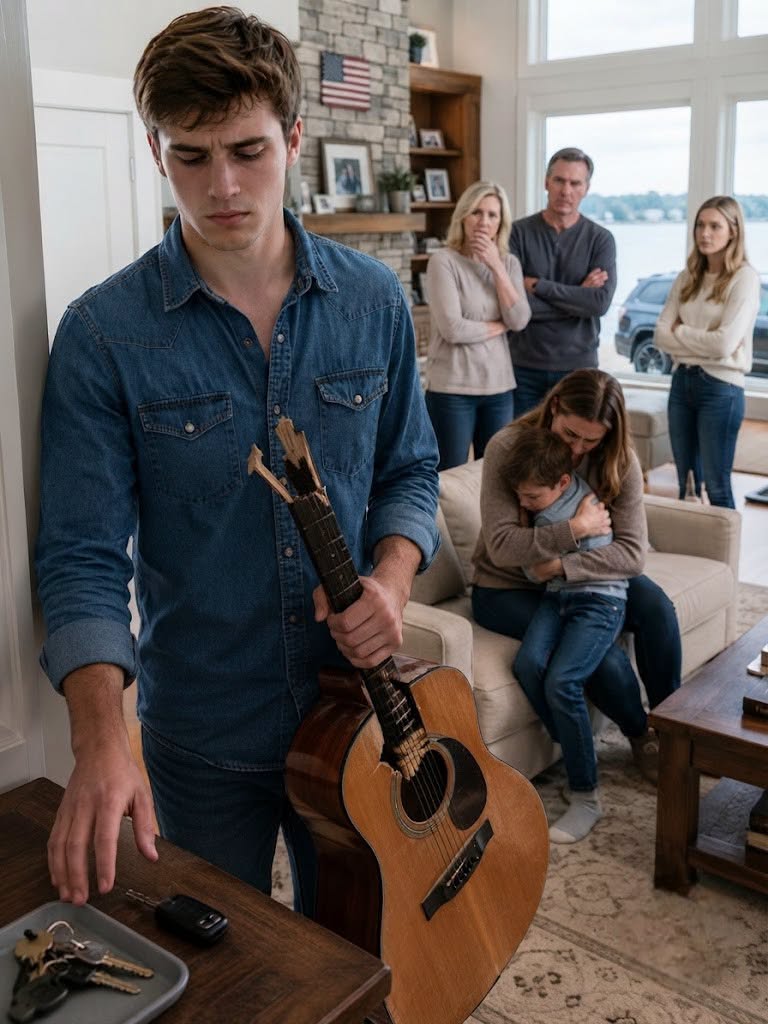
I held up what remained of the Gibson.
“Tyler destroyed this,” I said. “Derek told him to test it.”
Clare did not hesitate for even half a second. She rushed to Tyler, crouched, and pulled him into her arms as though I were the danger in the room.
“He’s nine, Marcus,” she said. “He didn’t know it was expensive.”
“Eight thousand dollars,” I said.
She gasped.
For one brief moment, I thought she understood.
Then her shock hardened into anger.
“You spent eight thousand dollars on a guitar?” she asked, as if that were the crime.
“It’s vintage,” I said. “A 1975. Worth more now than when I bought it. I use it professionally.”
Derek stepped forward then, trying to play peacemaker after lighting the match himself.
“Look,” he said. “I’ll pay for repairs.”
“It’s not repairable.”
“Come on, Marcus.”
“The top is split. The bridge is gone. This isn’t a scratch, Derek. It’s destroyed.”
My mother arrived next. Barbara Reed, sixty-two years old, a woman who had built an entire identity around appearing neutral while quietly protecting whoever made the biggest scene. She took one look at Tyler crying in Clare’s arms and made her choice instantly.
“Marcus,” she said, “stop scaring the boy.”
My father came in behind her. Richard Reed, sixty-four, retired, square-shouldered, still convinced crossing his arms turned him into a judge.
He looked at the guitar pieces scattered on the floor.
He looked at me.
He looked at Tyler crying.
“It’s just a guitar, son,” he said. “You can get another one.”
That sentence hung in the room like smoke from a fire nobody wanted to admit had started.
Just a guitar.
Get another one.
Nobody asked what that guitar meant to me.
Nobody scolded Tyler.
Nobody demanded Derek apologize.
Nobody even looked at the destroyed instrument long enough to understand that it had not broken by accident.
All the concern in that room flowed toward Tyler. All the protection went to the child who had destroyed my property, and by extension, toward the adults who had trained him to believe other people’s things did not matter if they belonged to someone they disrespected.
I was completely alone in my own family.
Clare kept one hand on Tyler’s shoulder, positioning herself like a shield.
“Tyler’s a child,” she said. “He doesn’t understand the difference between a two-hundred-dollar guitar and an eight-thousand-dollar one.”
“Then teach him not to destroy other people’s property.”
“He didn’t mean it.”
“Derek did.”
Derek’s eyes narrowed.
“Careful,” he said.
“No,” I said. “You be careful. You mocked my guitar in front of your son, told him it was probably fake, and now you’re hiding behind him because he did exactly what your arrogance taught him to do.”
Barbara moved between us, palms raised.
“Marcus, you’re being unreasonable.”
Richard crossed his arms tighter.
“It’s replaceable,” he said. “Family isn’t.”
I looked at each of them.
My sister. My parents. My brother-in-law, who had started all of this and now wanted to vanish behind a nine-year-old. My nephew, who still had not heard one adult tell him clearly that what he had done was wrong.
“So I should just let this go,” I said.
Clare’s response came fast and sharp.
“You’re supposed to forgive him. He’s just a child.”
Nobody mentioned compensation.
Nobody offered to replace what had been broken.
Nobody suggested any consequence at all for Tyler or Derek.
They only wanted me to let it go. To keep the peace. To be the one who bent so everyone else could stay comfortable.
I nodded slowly.
Then I turned and walked deeper into the house without another word.
Behind me, my mother sighed with visible relief. Clare hugged Tyler tighter. Derek muttered something low and soft, probably trying to calm his own racing heart.
They thought I had accepted it.
They thought the crisis was over.
They thought I was being mature.
They had no idea.
I walked through the living room and into the entryway, where a decorative wooden bowl sat on the polished table, full of car keys. My parents’ keys. Clare’s keys. Derek’s keys.
The Mercedes fob sat on top, stamped with that three-pointed star.
Cold metal settled into my palm when I picked it up.
Through the window, I could see Derek’s black Mercedes AMG GT parked near the boat ramp, gleaming in the morning light.
Derek bragged about that car constantly. He talked about it the way some men talk about their own children. He mentioned the leather interior, the horsepower, the trim package, the monthly payment he pretended was nothing. It was his favorite proof that he was successful, important, superior.
I looked outside for a long moment, then back into the house.
Through the living room window, I saw Tyler laughing again while Clare smoothed his hair. Derek stood beside them, looking nervous but not sorry.
No consequence.
No accountability.
No lesson learned.
I put the keys in my pocket.
That evening, we had the planned Labor Day barbecue anyway.
Of course we did.
Richard grilled steaks on the back patio. Barbara set the table with her good dishes. Tyler ran around with a water gun as if nothing had happened, as if he had not destroyed eight thousand dollars of someone else’s property a few hours earlier.
Clare kept praising him.
“My energetic boy,” she said more than once. “So full of life.”
I stood by the railing, watching the lake darken, feeling something cold settle into me.
Derek approached with a beer in one hand and that careful expression men wear when they want forgiveness without humiliation.
“I can write you a check,” he said. “Ten thousand. More than the guitar cost.”
I did not look at him.
“You can’t make this right.”
He exhaled sharply through his nose.
“I’m trying.”
“No,” I said. “You’re trying to make this disappear.”
“It’s a guitar, Marcus.”
“It was my guitar.”
He looked irritated then, because men like Derek can tolerate guilt only for a few seconds before converting it into anger.
“What do you want me to do? Build a time machine?”
“I wanted you to teach your son that other people matter.”
He had no answer.
Dinner began beneath the string lights. The whole family gathered around the outdoor table, forced cheerfulness sitting between us like an uninvited guest. Barbara asked about the potato salad. Richard asked Derek about work. Clare laughed too loudly at something Tyler said.
Everyone performed the appearance of a fine evening.
Eventually, my father looked at me across the table.
“You’re being childish about this,” he said.
I set down my fork.
“Am I?”
Barbara used the soft tone she reserved for making me feel guilty while pretending she was soothing me.
“We’re family, honey. Let it go.”
I looked at her and kept my voice perfectly level.
“You’re right,” I said. “Family should forgive each other.”
Clare visibly relaxed.
She actually smiled.
“Thank you,” she said. “That’s mature of you.”
I did not smile back.
I ate silently, mechanically, counting the hours until morning.
Everyone thought my calmness meant surrender.
It should have frightened them.
At 6:15 the next morning, the house was still asleep.
The lake outside sat glassy and pale, mist rising off the surface in slow white layers. I dressed quietly, took Derek’s keys from the entry table, and walked outside into the cool dawn air.
I will not pretend I was confused about what I was doing.
I will not pretend it was an accident.
I made a choice.
A bad choice, maybe. A costly one, absolutely. But in that particular moment, it felt less like revenge and more like translation.
They had taught me a language the day before.
I was simply speaking it back to them.
A short time later, the sound echoed across the lake.
Water erupted.
Then silence.
Then a steady rise of bubbles.
Derek walked out onto the deck in his pajamas, coffee mug in hand, and saw me standing near the ramp.
He saw the empty space where his Mercedes had been parked.
He saw the water.
The mug slipped from his fingers and shattered against the deck boards, coffee spreading between the planks.
Then he screamed.
The sound woke the entire house.
Derek ran down toward the water though there was nothing left to save. He stared at the bubbles rising from below, his face twisted in disbelief.
“What did you do?” he shouted.
I stayed perfectly calm.
“Physics did the rest.”
“My car,” he said, his voice breaking. “My car.”
I used his own dismissive tone right back at him.
“It’s just a car, Derek. You can buy another one.”
He moved toward me, furious and shaking, but Richard shouted his name before things got worse.
Clare ran outside in her robe.
“Where’s the Mercedes?”
I pointed at the lake.
“Under the water.”
Her mouth fell open.
“You put his car in the lake?”
“I applied the lesson.”
Barbara and Richard arrived next, both in robes, hair disheveled, faces stunned.
“Marcus,” my mother whispered. “Have you lost your mind?”
My father stared at me like he had never seen me before.
“What is wrong with you?”
I looked at each of them calmly.
“Yesterday, Tyler destroyed something I spent years saving to buy. Something I use professionally. You told me it was just a guitar. You told me I could get another one. You told me family forgives each other. You told me I was childish for being upset.”
I gestured toward the lake, where bubbles still broke the surface.
“So I let Derek’s car go. We’re even now.”
Silence.
Just the lake.
Just the bubbles.
Derek pulled out his phone, hands shaking so badly he nearly dropped it.
“I’m calling the police.”
“Go ahead.”
His finger hovered over the screen.
“When they come,” I said, “I’ll file a report about Tyler destroying my guitar. I’ll explain how you told a nine-year-old to test whether it was fake. I’ll explain how an adult used a child to damage someone else’s property.”
Derek froze.
Clare’s face drained of color.
She grabbed the phone out of Derek’s hand.
“Don’t call,” she said. “Please don’t call.”
Derek stared at her.
“He destroyed my car.”
“And you helped destroy my guitar,” I said. “So call. Let’s both explain our sides. Let’s both face consequences together.”
Derek lowered his arms.
He could not risk it.
Clare could not risk it either.
Richard stepped between us.
“Both of you need to calm down.”
“I am calm, Dad.”
He had no response to that.
They had taught me the lesson.
I had simply applied it.
I walked to my truck and opened the door. In the back seat sat the guitar case with the remains of my Gibson inside. Derek was already on the phone again, this time calling the insurance company, frantic and desperate.
“It went in the lake,” he said. “Yes, the entire car. No, I don’t know how.”
Barbara followed me to the truck.
“Where are you going?”
“Home.”
“Marcus, please.”
I looked at her.
“Thanks for the lesson.”
She blinked.
“What lesson?”
“You taught me how this family handles the destruction of expensive property. I’m a fast learner.”
Richard stepped forward and drew his line in the sand.
“If you leave now, you’re choosing to end this family.”
I climbed into my truck.
“No, Dad. You chose yesterday. When you sided with Tyler over me. When you dismissed my feelings. When you told me it was just a guitar.”
Clare was crying now, her voice breaking apart.
“We still owe eighty-seven thousand dollars on that car loan.”
I started the engine.
“It’s just money,” I said. “You can earn more.”
Then I backed out of the driveway.
In my rearview mirror, Derek was shouting into his phone. Clare had both hands pressed over her face. Barbara stood frozen. Richard looked helpless and defeated.
Then Tyler came outside and looked around at all the adults yelling and crying.
“Why is everyone mad?” he asked.
Nobody answered him.
I drove away and left them standing in the ruins they had built.
Two hours later, I was home in Nashville.
It was ten in the morning, and my phone would not stop ringing.
Clare. Barbara. Richard. Derek. Clare again. Barbara again.
I blocked every number, made a pot of coffee, and sat on my porch.
Finally, quiet.
Then an unknown number called.
I answered.
Derek’s voice came through shaking, though he was trying hard to sound in control.
“We’re getting it out.”
“Getting what out?”
“The car. I called a tow company. They have a crane.”
“How much is that costing you?”
“Forty-five hundred for the crane. Eight hundred for the tow.”
I laughed before I could stop myself.
“What’s funny?” he demanded.
“You left the windows open, remember?”
Silence.
“Water damage,” I said. “Engine, electronics, interior, all of it. Even if they recover the car, it’s finished.”
His voice cracked.
“You knew that?”
“Yeah.”
Then I hung up.
That afternoon, messages began coming through another thread Clare still had access to.
Insurance denied the claim.
Intentional submersion was not covered.
Derek still owed eighty-seven thousand dollars.
The bank wanted monthly payments on a car that had spent the morning underwater.
We’re ruined, Clare wrote. Marcus, you have to help fix this.
I read every message, deleted the thread, and went to work.
I had a recording session at three.
That evening, I opened the family group chat and found forty-seven unread messages.
Aunt Linda had started it.
Marcus destroyed Derek’s car over a guitar. This is unforgivable.
Uncle Tom piled on.
A hundred-thousand-dollar car over a guitar. Marcus has lost his mind.
Then cousin Sarah surprised me.
Hold on. Tyler destroyed Marcus’s eight-thousand-dollar guitar first. Derek told him to do it.
Cousin Mike jumped in next.
Derek has been acting superior for years. About time someone checked him.
Barbara tried to mediate.
Everyone stop. We need to heal as a family.
Clare answered immediately.
Heal? Marcus destroyed our lives.
Sarah fired back.
You mean like Tyler destroyed Marcus’s guitar?
Uncle Tom wrote again.
A guitar is not the same as a hundred-thousand-dollar car.
Mike replied.
Then maybe teach your nephew not to destroy expensive things.
Aunt Linda tagged me directly.
You’re tearing this family apart.
I had stayed silent the whole time, reading as they fought over me like I was not even there.
Finally, I typed one response.
I didn’t tear anything. You chose sides yesterday.
Then I muted the chat.
The next morning, an email arrived at 7:42.
Subject line: Intent to Sue — Property Damage.
Derek’s attorney was some man out of Louisville. The demand letter listed everything. Car replacement. Emotional distress. Lost work time. Total demand: one hundred twenty-three thousand dollars.
I forwarded it to my attorney, Joel Ramos, a Nashville guy who had handled contracts for half the musicians I knew.
He called ten minutes later, laughing.
“This is the funniest demand letter I’ve seen all year.”
“They have no case?”
“They have problems,” Joel said. “The kid destroyed your guitar first. Derek’s role in that matters. If they sue, we counter. Hard.”
“For how much?”
“Guitar, related damages, emotional distress, interference with your professional work. I’d ask for fifty thousand just to make them sweat.”
“Do it.”
Two days later, someone knocked on my studio door while I was mixing tracks.
I opened it and found Clare standing there with Tyler beside her. He held a folded piece of paper and looked down at his shoes.
“Tyler has something to say,” Clare told me.
He unfolded the paper and read in a flat, rehearsed voice.
“Dear Uncle Marcus, I’m sorry I broke your guitar. I didn’t know it was expensive. I promise to be more careful. Please forgive me. Love, Tyler.”
He folded the paper back up and looked at Clare.
“Can we go now?”
I looked at him.
“Do you know why what you did was wrong?”
He shrugged.
“Because it was expensive.”
“No,” I said. “Because it wasn’t yours. The price doesn’t matter. You don’t destroy other people’s property.”
Tyler looked genuinely confused.
“I guess.”
“Do you feel bad about breaking it?”
For the first time, Tyler was honest.
“Derek said you’d just buy a new one.”
Clare cut in quickly.
“See? He apologized. Drop the countersuit.”
“That wasn’t an apology. That was a performance. You wrote that for him.”
“He’s nine.”
“Then teach him. That’s your job as his mother.”
Clare grabbed Tyler’s hand and left, slamming the studio door hard enough to rattle the window.
Tyler looked back once before the door closed.
Confused.
Sad.
That was when I understood something I had not wanted to admit.
Tyler was not the villain.
He was a kid being trained by terrible adults.
Three days later, Joel sent the discovery documents.
Derek’s financial life appeared in black and white.
Mercedes loan: eighty-seven thousand dollars.
Home equity loan: two hundred fifteen thousand.
Credit cards across four accounts: fifty-two thousand.
Personal loan from Derek’s parents: thirty-eight thousand.
Total debt: three hundred ninety-two thousand dollars.
Savings thin.
Investments nearly nonexistent.
Net worth negative.
Joel’s note at the bottom was simple.
Your brother-in-law was drowning long before the car went into the lake. The Mercedes was there to maintain appearances.
I read it twice.
Derek was not successful.
He was desperate.
The Mercedes had been the mask.
I had only taken it off.
Four days after the lakehouse, a certified letter arrived from Richard and Barbara Reed.
Not Mom and Dad.
Richard and Barbara Reed.
Marcus, it read. We raised you better than this. Derek made a mistake. Tyler is a child. What you did was vindictive and cruel. Clare called us sobbing. They might lose their house. Drop the lawsuit immediately. Pay half of Derek’s car loan. Apologize to Tyler for scaring him. If you refuse, do not come to Thanksgiving or Christmas. We will not have someone who destroys family in our home.
I read it twice, folded it carefully, and walked to my desk.
In the bottom drawer sat a folder I had labeled Expected Outcomes the morning after the lakehouse.
I filed the letter inside it and made coffee.
That same week, something unexpected happened.
I was at the studio when my phone buzzed with a text from Jake, a musician friend.
Dude. Check Facebook.
I opened the app and found his post.
It was a photo of my smashed Gibson, one he had apparently taken at the lakehouse.
His caption read: Shout out to Marcus Reed, who taught entitled people a lesson. Kid destroyed this eight-thousand-dollar vintage guitar. Family said just forgive him. Marcus returned the lesson.
Six hours old.
Hundreds of likes.
Over a hundred comments.
The Nashville music community understood immediately.
Never mess with a musician’s guitar.
Family that enables destruction deserves consequences.
Derek learned the cost of disrespect.
Then emails started arriving.
Blackbird Studio said they stood with me.
Sound Emporium told me to call if I needed session work.
Ocean Way Nashville said their rooms were open anytime.
My professional reputation had not been damaged.
If anything, it had grown.
One week after the lakehouse, Derek called.
His voice was barely recognizable.
“Marcus, please. Can we talk?”
“I’m listening.”
A long pause followed.
“I messed up,” he said finally.
“I know.”
“I shouldn’t have said what I said about your guitar. Tyler shouldn’t have broken it. I’m sorry.”
He was crying by then.
“Can you drop the lawsuit?”
“No.”
“We’re going to lose the house. Foreclosure in sixty days. Clare’s parents won’t help. Mine won’t give any more. We’re drowning.”
“You should have thought about that before using a child to damage my property.”
“I’ll pay for the guitar. I’ll get you a new one. Just drop the suit.”
I used his own words back at him.
“Can’t replace it. It’s irreplaceable.”
Then I hung up.
At eleven that night, my doorbell rang.
Clare stood outside my apartment, mascara running down her face, looking like she had been crying for hours. I let her in only because I did not want a scene in the hallway.
She sat on my couch, shaking.
“Marcus, please. I’m begging you.”
I stayed standing.
“We’re losing the house in sixty days. Derek’s job is at risk. He can’t commute without a car. Tyler keeps asking why Uncle Marcus hates him.”
“I don’t hate Tyler. I hate that nobody taught him consequences.”
“He’s nine.”
“He’s old enough to know not to destroy things.”
“What do you want?” she asked. “What will make this right?”
I looked at her steadily.
“I wanted an apology before the lawsuit. From you. From Derek. From Mom and Dad. I wanted you to say you were wrong to dismiss my feelings. Wrong to protect Derek automatically. Wrong to make excuses. But you didn’t. You only came after the consequences reached your own front door.”
“I’m apologizing now.”
“Too late.”
“Marcus.”
“That’s not remorse, Clare. That’s panic.”
She stood, tears streaming.
“You’re going to destroy us.”
“No. Derek destroyed you. I just held up a mirror.”
She left and slammed the door behind her.
Two weeks after the lakehouse, the attorneys reached a settlement.
Joel called with the terms.
“Derek drops his lawsuit. You drop your countersuit. He pays eight thousand for the guitar across twelve monthly installments. He and Clare sign an affidavit admitting Derek influenced Tyler’s actions. Tyler writes you an unscripted letter of his own. Two-year mutual no-contact order between all parties.”
“And the car?”
“No admission of guilt. No criminal charges filed.”
“Take it.”
The papers were signed within forty-eight hours.
Ten days later, a handwritten letter arrived in a child’s handwriting.
Uncle Marcus,
I broke your guitar because Derek said it was fake. I didn’t know it was real until it broke. Mom says we might move because Derek’s car sank. Derek says it’s your fault. Mom says it’s my fault. I don’t know who’s right. I’m sorry I broke it. I wish I didn’t.
Tyler.
No love before his name this time.
Just his signature.
I read it three times.
Tyler was finally being honest. No script. No coaching. Just a kid trapped between adults blaming each other.
I could not write back because of the settlement, but I kept the letter. I taped it to my studio wall as a reminder that Tyler might still turn out okay someday.
Six weeks later, December settled cold over Nashville.
I walked into Carter Vintage Guitars looking at Martins and high-end Taylors. The sales guy recognized me from session work.
“We have a ’74 Hummingbird in back if you’re interested,” he said. “Close to what you had.”
I shook my head.
“No. I’m looking for something different.”
He handed me a Martin D-28.
Bright tone. Clean cut through a mix. Different feel under my fingers.
I played a few chords.
It did not sound like my Gibson.
Not better.
Not worse.
Just different.
“I’ll take it,” I said.
That night, I brought the Martin to my studio and played for two hours, learning its resistance, its clarity, the way it answered my hands. It was not my Gibson. It never would be.
But it was mine.
I started writing a new instrumental and called it Underwater.
The Martin required different technique, different dynamics, different choices. Some things cannot be replaced. You just learn to play something new instead.
Over the following months, updates came through Sarah, who became something like a bridge back to family news.
Derek lost his job in February after refusing a remote position he considered beneath him. He took a job at a credit union making fifty-eight thousand a year, down from one hundred seventy-five.
Clare got her first job in twelve years, retail management, thirty-six thousand annually.
Tyler went into after-school care and hated it.
The house went on the market two months behind on payments.
Tyler had two school suspensions for fighting, and a counselor said he was processing family trauma.
“He asks about you constantly,” Sarah told me over coffee.
“How am I supposed to feel about that?”
She stirred her drink.
“How do you feel?”
“I thought I’d feel satisfied. Like consequences finally landed where they belonged. But I mostly feel empty.”
“That’s normal,” she said. “You can be right and still be sad about it.”
I started seeing a therapist around then, Dr. Patel, whose office sat in Green Hills.
During our third session, she asked the question I had been avoiding.
“Do you regret what you did?”
“No.”
“Are you happy about the outcome?”
“No.”
“Can both be true?”
I thought about it.
“Yeah.”
She nodded.
“You are not mourning the family you had, Marcus. You are mourning the family you wished you had.”
That landed deep.
A few weeks later, I bought a child-sized acoustic guitar for two hundred eighty dollars and shipped it to Tyler anonymously.
The note card said only: Music heals. Keep playing. Someone who cares.
No signature.
The no-contact order was still technically active, but I hoped music might help him the way it had helped me.
In May, Clare filed for divorce.
The court filing cited financial irresponsibility, negative influence on their child’s development, unwillingness to admit fault or seek counseling, and irreconcilable differences.
Derek fought for custody, claiming Clare abandoned him during a crisis.
Tyler was caught in the middle again.
Reading about it made me sad, mostly for him.
Derek would never really change. The car had never been the actual problem. Derek’s character was the problem, and the Mercedes had only exposed what was already broken underneath.
One afternoon, Barbara showed up at the small house I had bought in East Nashville.
I opened the door but did not invite her in.
We stood on the porch.
“Your house is beautiful,” she said.
“Thanks. What do you want?”
“Can I come in?”
“No.”
She flinched.
“I was wrong about everything,” she said.
I waited.
“Derek has been lying about his finances for years. The Mercedes was leased. He couldn’t afford it. Clare is divorcing him. You tried to tell us, and we didn’t listen.”
“I know.”
“Can you forgive me?”
“I already did.”
She looked relieved too quickly.
“That doesn’t mean I trust you,” I added.
Her face fell.
“What can I do to fix this?”
“Nothing. Just live with it. Like I have to.”
She cried on my porch, and I did not move toward her.
Eventually, she walked back to her car and drove away.
Forgiveness had happened for me.
Not for her.
Trust would take years, if it came at all.
In June, Sarah called to tell me my father had suffered a heart attack.
My chest tightened instantly.
“Minor,” she said quickly. “He’s stable. But he’s asking for you.”
I drove to Vanderbilt Medical Center, room 312.
It was the first time I had seen Richard in four months.
He looked pale and thinner, hooked to monitors, older than I remembered.
When he saw me, tears formed in his eyes.
“You came.”
“You’re my dad.”
He nodded but could not speak for a moment.
“I was a terrible father,” he finally said. “I took Clare’s side without ever listening.”
“Yeah.”
Silence followed.
Not comfortable, exactly.
Honest.
“I’m sorry.”
“I know.”
“Can we fix this?”
“We can try. Slowly.”
He understood what slowly meant.
Years.
Not weeks.
I stayed thirty minutes and left.
No promises.
Just presence.
Meanwhile, my own life kept moving.
I released my second EP, Displaced, a collection of instrumental guitar tracks that pulled in one hundred eighty thousand streams in the first month. Nashville Scene featured me as a musician to watch. Session work doubled. I started teaching guitar workshops and found more fulfillment in it than I expected.
I bought a 1967 Martin D-18 for ninety-eight hundred dollars, not as a replacement for the Gibson but as a new chapter entirely.
I met Emma at a showcase. She was a music journalist, thirty-two, smart and kind, someone who understood boundaries without treating them as a personal attack. Dating her became serious in the calmest, healthiest way I had ever experienced.
I built a tight circle of musician friends who became chosen family in every sense.
I started volunteering at a youth music program on weekends, teaching kids guitar.
Some wounds become doors if you live long enough.
Sarah sent another update five months after the lakehouse.
Derek lost the custody fight.
Tyler now lived with Clare eighty-five percent of the time.
Derek had been evicted from his apartment and moved back into his childhood bedroom at forty years old. His credit was destroyed. Bankruptcy filed. He worked at his parents’ accounting firm for forty-five thousand a year.
Sarah included a screenshot of a Facebook post he had made.
When family betrays you over materialism, you learn who your real friends are. Some people care more about things than people. I’ll rebuild stronger.
Three comments beneath it.
All from his parents.
I read it once and felt something close to pity.
Derek still did not understand.
Still blamed me.
Still played the victim in his own story.
Then Sarah texted with a different tone.
Clare wants to meet. Says she needs to talk to you. I told her I’d ask. No pressure.
I thought about it, then agreed to a neutral coffee shop on Woodland Street.
Clare arrived without makeup, without the polished family image, without a defensive husband beside her.
She looked older.
“Thank you for seeing me,” she said.
I nodded.
“I’m getting divorced.”
“I heard.”
“You were right,” she said. “About Derek. About Tyler. About all of it.”
I waited.
“I enabled Derek’s ego. I raised an entitled kid because it was easier than confronting the real problems underneath.”
Her voice cracked.
“That day at the lakehouse, Derek had been mocking your guitar all weekend. Saying you wasted money on hobbies while he drove a Mercedes. I knew about it. I didn’t stop him.”
“Why not?”
She looked down at the table.
“I was afraid. If I admitted Derek was wrong, I’d have to admit I married the wrong man.”
Then she cried.
Real tears this time.
Not strategy.
Not panic.
“I’m sorry,” she said. “I’m so, so sorry.”
I passed her napkins from the dispenser.
“I forgive you.”
She looked up, shocked.
“Really?”
“Yeah. But we’re not going back to how we were.”
“I understand.”
“Maybe someday. Not now. You’re my sister. I don’t hate you. But I don’t trust you yet. Trust takes time.”
“Can we try slowly?”
“Maybe,” I said. “Time will tell.”
A week later, Clare asked if I would be willing to see Tyler.
No pressure, she said. He asks about you constantly. It might help him to hear from you directly.
I thought about it, then replied.
Saturday afternoon. My house. You drop off only.
Saturday came.
The doorbell rang.
Tyler stood there, ten years old now, holding the small guitar I had sent anonymously.
“Thank you for the guitar,” he said.
I looked at it.
“How do you know it was me?”
“The note said music heals,” he said. “That’s what you always say.”
I invited him in, and we sat together on the porch.
“Can you play anything?”
He played a basic progression. C, G, E minor, F. Not clean, but close enough.
“Not bad.”
“I practice every day.”
I showed him a new chord. He struggled, tried again, got it.
Then he looked down at the guitar in his lap.
“I’m sorry I broke your guitar.”
“I know.”
“Mom says I need to understand why it was wrong.”
“Do you?”
“Because it was yours and I didn’t ask,” he said. “And because Derek told me to do it, and I should have said no.”
“That’s exactly right.”
Tyler looked up.
“I’m not supposed to listen when Derek says mean things about people anymore.”
“Good. Think for yourself.”
We played for an hour. I taught him three new chords.
He left happy, and Clare waved from the car.
Tyler was going to be okay.
Good parenting could still repair a lot of damage, given enough time.
On Father’s Day, six months after the lakehouse, Richard invited me to lunch.
Just the two of us.
For the first time, I accepted.
We met at a local diner, neutral territory. It was awkward at first, but conversation eventually found its way through the silence.
“I’m proud of you,” he said.
“For what?”
“For standing up for yourself. For not backing down. I taught you to be a man. I just didn’t think you’d use it against me.”
He laughed at that, self-deprecating, not bitter.
“I didn’t do it against you,” I said. “I did it for me.”
“I know. Took me six months to understand that.”
We ate in comfortable silence after that.
For the first time in years, Richard paid the check without turning it into a performance.
Just a father taking care of his son.
“Can we do this again next month?” he asked.
“Yeah,” I said. “Next month.”
One year later, on Labor Day weekend, I stood at a different lakehouse entirely.
This one was rented with friends instead of family.
Emma stood beside me on the deck while five musician friends grilled and laughed inside. I held my Martin D-18 and played Underwater, the instrumental I had written after everything happened.
When I finished, they applauded.
Emma kissed my cheek.
“That was beautiful.”
My phone buzzed.
Barbara.
Thinking of you today. Miss you.
I looked at the message for a long moment.
Then I replied.
Miss you too, Mom.
Small progress.
One careful step at a time.
Sarah was there that weekend too. Later, we sat on the deck with drinks while the lake darkened around us.
“Derek is still at his parents’ place,” she said. “Forty-one now. Still working at their firm. Pays child support. Sees Tyler twice a month. Drives a 2009 Honda Civic your parents helped him buy.”
She paused.
“He’s smaller now.”
“Physically?”
“No. Just diminished.”
“Does he still blame me?”
“Probably. But he doesn’t talk about it much anymore.”
I felt no satisfaction hearing that.
No pity either.
Just a quiet awareness.
Derek had become ordinary.
His ego had never been built to survive ordinary.
Clare texted me monthly by then. She had been promoted at work. Her apartment was modest but clean. Tyler was doing better in school, fewer incidents, weekly therapy, guitar practice thirty minutes every day.
Clare was in therapy too, individual sessions and family sessions with Tyler.
Her most recent message stayed with me.
I’m not asking for forgiveness anymore. I just want you to know I’m trying to be better. Tyler asks about you. Says you’re teaching him guitar through the videos you sent. Thank you for not abandoning him the way I abandoned you.
I saw Clare every six weeks or so after that.
Coffee.
Civil.
Sometimes warm.
Not siblings the way we once were.
Not strangers either.
Progress, slow but real.
Tyler became the bridge between us.
He visited monthly. One afternoon, he played me a song he had written called I Broke Something.
The lyrics were simple.
“I broke something that wasn’t mine,” he sang, his voice cracking with early puberty. “Said I was sorry, but it took some time. Now I’m learning what it means to think before I act, keep my conscience clean.”
I listened with wet eyes and pretended they were not wet.
“That’s really good,” I told him.
He looked at me seriously.
“Is it true you sank Derek’s car?”
I was honest.
“Yeah.”
“Was it because of me?”
“No. Because of him. Your family taught me about consequences. I applied the lesson back.”
Tyler thought about that.
“Mom says you were right to leave. She says sometimes family breaks you and you have to save yourself.”
I was surprised Clare had told him that.
“Yeah,” I said. “Your mom’s learning.”
“Me too,” Tyler said.
And I believed him.
The cycle had a crack running through it now.
Maybe that was where the light got in.
Dinner with Richard and Barbara eventually became a monthly ritual, and I finally went back to their house for the first time in over a year.
Walking in felt strange.
Some old photos remained on the walls. Others had quietly disappeared.
Clare’s wedding photo with Derek was gone entirely, replaced by a picture of Tyler playing guitar, given a place of honor by Barbara herself.
The house felt lighter.
She cooked pot roast, my favorite from childhood. Richard asked about my music career and actually listened. He asked follow-up questions. He told me he had bought my EP online.
We talked about Emma.
We talked about Tyler.
Nobody mentioned Derek.
His name stayed out of the room completely.
After dinner, Richard and I stood together on the porch.
“Son,” he said, “I’ve been thinking about that letter we sent. The one telling you not to come for the holidays.”
“I remember it.”
“I was wrong. Completely wrong. I want you at Thanksgiving this year. Will you come?”
“Will Clare be there?”
Barbara answered from the doorway.
“Yes.”
“And Derek?”
Richard’s voice went firm.
“Absolutely not. Never again.”
“Then I’ll come.”
Barbara cried.
Happy tears this time.
My parents had finally chosen me.
Not perfectly.
Not quickly.
But clearly.
One night at the rented lakehouse, Emma and I sat alone on the dock, stars scattered across the still water beneath us.
“Do you ever regret it?” she asked.
“Regret what?”
“The Mercedes.”
I took a long pause.
“Sometimes I regret that it was necessary.”
“What’s the difference?”
“I wish my family had been different. I wish they had stood up for me. But they didn’t. So I stood up for myself. The regret is that they made me choose. Not that I chose.”
“Do you miss them? The family you had?”
“I miss who I thought they were. Not who they actually turned out to be.”
“That’s sad.”
“Yeah. But I’m not sad anymore.”
“What are you?”
“At peace.”
Peace was not happiness.
It was not victory.
It was not satisfaction.
It was quieter than all of that.
Steadier too.
My professional life kept growing. A third EP, Surface Tension, pulled three hundred forty thousand streams in its first month. Session work on four Grammy-nominated albums followed. I took a teaching position at Belmont University. A feature interview in Premier Guitar magazine led to a luthier building me a custom signature model from reclaimed wood.
When the interviewer asked what losing the Gibson taught me, I told the truth.
“I lost a guitar once,” I said, “and it taught me that instruments are tools, not identities. What you create matters more than what you own. Music doesn’t sink, even when everything else around you does.”
That quote traveled further than I expected.
Probably because people understood it was never really about a guitar.
On the final night of that lakehouse weekend, I stood alone on the dock long after everyone else had gone to bed.
Emma slept inside, the windows glowing warm behind me.
My guitar leaned against the porch railing nearby.
The lake reflected the stars so clearly it looked like another sky beneath my feet.
A year earlier, I had stood at a different lakehouse and watched my family choose a comfortable lie over me.
I could have walked away quietly that day.
I could have let them keep their story intact.
Tyler made a mistake.
Derek meant no harm.
Marcus overreacted.
It was just a guitar.
Get another one.
But I had not let them keep it.
I taught them back the exact lesson they had taught me, and it cost everyone something.
Derek lost his facade, his car, his marriage, his status.
Clare lost her marriage but slowly found herself.
Tyler lost his false sense of stability but gained real accountability.
My parents lost the comfortable illusion of a perfect family.
And I lost the family I once believed I had.
But I gained peace.
Not happiness exactly.
Not victory.
Peace.
The kind that comes from finally standing up for yourself. From refusing to remain the family’s designated punching bag. From teaching consequences to people who had spent years avoiding them.
Here is what I understand now.
Family is not blood.
Family is accountability, practiced consistently over time.
Real family does not ask you to shrink yourself so everyone else can stay comfortable. Real family does not protect the guilty party while quietly blaming the person who got hurt. Real family does not demand forgiveness without offering genuine change in return.
Some relationships can be repaired.
Slowly.
Imperfectly.
Over years, not weeks.
My mother is trying now.
My father is trying.
My sister is trying.
We are building something new together. Not what we had before. Something different. Maybe, in time, something better.
Tyler is learning what accountability looks like, and that alone feels like enough.
Derek is living with the choices he made.
So am I.
And I would make the same choice again.
Because sometimes the most loving thing you can do is walk away. Sometimes teaching someone consequences is the only kindness left. Sometimes something has to sink completely before you find out whether you yourself can still swim.
I can swim.
And the water, it turns out, is just fine.
I walked back toward the lakehouse.
Emma’s silhouette was visible in the window above. Chosen family laughed softly somewhere inside. My guitar waited patiently by the porch rail.
The music remained.
Steady.
Mine.
And for the first time in a very long time, I smiled and meant every bit of it.
THE END