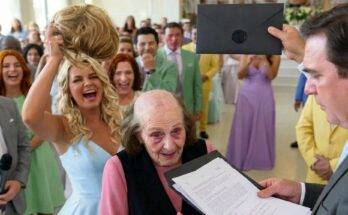
Madison’s friend Brooke was capturing content for Madison’s page. I didn’t think anything of it.
I’d think a great deal of it later. The whole event was built around the gift opening, which Madison ran like a product launch.
She sat in a throne-like white chair under the balloon arch. Brooke filmed, and Gail narrated for the room.
“Oh, that’s the Italian one,” Gail said. “Isn’t it gorgeous?”
And Madison held each gift up to the camera, named the brand, and thanked the giver by tagging them in the air, as if the whole point of the present was the label it announced. A cashmere onesie, a designer diaper bag that cost what I used to take home in a month, a stroller with a name like a sports car.
Each one was held up, admired, photographed, and cooed over. The currency of the room was visible, and I didn’t have any of it.
I watched my son across the room. Kyle stood near the wall with a drink he wasn’t drinking, smiling the smile of a man who’d rather be anywhere else.
He caught my eye once and gave me a small, helpless shrug, like a boy apologizing for weather. I should have read that shrug better than I did.
It was the shrug of a man who already knew his wife was going to do something unkind, and had already decided not to stop her. Aunt Caroline was there, Frank’s younger sister, sixty-five, sharp and warm, the one person in that room besides me who’d loved Frank.
She squeezed in beside me. “Designer diaper bag,” she muttered. “In my day, we used a tote, and the baby survived.”
I laughed. She patted my box.
“Is that the famous blanket? Frank told me what you were putting in it, you know, the old softy.”
She winked. “That baby is one lucky little fish.”
I had no idea that Caroline’s knowing, and her assuming everyone else knew too, would become the fuse on the whole thing. “You should tell her before she opens it,” Caroline whispered about the bonds, “so she’s careful with it.”
I shook my head, smiling. “Frank’s orders. Make her open the blanket and find it herself. I’ll point her to the seam after.”
Caroline chuckled. “He always did love a bit of theater, my brother.”
I think about that exchange a lot. If I’d listened to Caroline, if I’d stood up and announced before Madison touched it that there was fifty thousand dollars and Frank’s last letter sewn inside, none of what followed would have happened.
Madison would have handled it like the Hope Diamond. There would have been no story.
But I didn’t, because I was honoring a dying man’s wish. And honestly, it never occurred to me in a thousand years that anyone would simply throw a handmade blanket away.
Refold it badly, maybe. Set it aside politely, perhaps.
Regift it someday, even. But throw it in the trash in front of everyone with a camera running?
That was a failure of imagination on my part. I’d lived sixty-eight years and never met cruelty quite that casual.
I didn’t know to guard against it. The gifts dwindled, and the designer pile grew into a little mountain beside Madison’s throne.
Then there were only two presents left on the table. A gift card in an envelope, and my plain cream box with its blue ribbon.
Gail picked up my box and read the little tag. “From Grandma Darlene,” she announced with the gentle condescension you’d use for a child’s macaroni art.
A few people went, “Aww.” Someone’s phone came up.
Madison took the box, gave the plain wrapping a quick assessing look, and the corner of her mouth did something I didn’t like. “Let’s see what Grandma made,” she said, and she pulled off the paper.
For a moment, one moment, I let myself hope. The cream paper fell away, and there it was.
Four months of my hands, the softest wool I could afford, the tiny blue sailboats marching along the border, and Frank’s initials hidden in the corner like a held breath. In that bright, glossy room full of things made by machines in factories, my blanket looked, to my eyes, like the only real thing there.
Madison held it up by two corners, the way you’d hold something to check it for stains. I watched her face.
I watched her register that it was handmade. The slight unevenness that means a human did this, the very thing that the magazines now say makes a thing precious.
I watched her decide what that meant. Her nose wrinkled just slightly, the micro-expression of a woman who’d been taught that homemade is a synonym for poor.
“Oh,” she said. “Did you make this?”
“I did, sweetheart,” I said, and my voice was warm. I started to lean forward to tell her about the seam, about Frank, about feeling along the bottom.
“There’s something special about it if you—”
But Madison was already talking over me, to the room and to the camera. “That’s so sweet,” she said in the voice you use to end a conversation. “It’s very homemade.”
Gail laughed, that little tinkling laugh, and said, “Bless her heart.” I felt the room tilt just slightly, the old familiar feeling of being made small.
But I still didn’t understand what was about to happen. I thought the worst of it was the word homemade and the bless her heart.
I thought I’d just smile through it, point Madison to the seam in private, and let the bonds redeem the whole afternoon. I was wrong about how far she’d take it.
What happened next happened fast, and I’ve replayed it in slow motion ten thousand times since. Madison folded the blanket back over her arm with a kind of finality.
She looked around at her perfect greige party, her registry mountain, her watching friends, her filming Brooke, and I watched her make a calculation. The social math of a woman who lives for an audience.
A homemade blanket didn’t fit the picture. It clashed with the brand.
And Madison had a camera running and a room to perform for. Somewhere in her label-measured heart, she decided that the funny, on-brand, content-worthy thing to do was to make a little joke of it.
There was a tall steel trash can at the end of the gift table, the nice kind, lined with a crisp white bag for the wrapping paper. Madison stood up, blanket over her arm, and crossed to it.
“Okay, so,” she said, laughing and playing to Brooke’s phone. “I love Grandma, but we have a whole aesthetic for the nursery.”
And she held the blanket out over the open can like a magician about to drop a scarf. “We only use designer things here.”
Then she let go. My blanket, Frank’s sailboats, Frank’s initials, Frank’s fifty thousand dollars, and Frank’s last letter to the grandson he’d never meet dropped into the trash can on top of the torn wrapping paper.
The room laughed. Not everyone, but enough.
The nervous follow-the-leader laugh of people who’ve decided the powerful person in the room is the one being funny. Brooke’s phone caught all of it.
Gail clapped, delighted. And my son, my Kyle, stood against the wall, went pale, opened his mouth, and closed it again.
He said nothing. That was the worst second of the whole day.
Not the blanket in the bin. My son’s mouth closing.
“We only use designer things here.” I’ve heard a lot of unkind things in sixty-eight years.
I’ve been called old-fashioned, behind the times, and a sweet little nobody with her yarn. None of it ever landed like those six words in that bright room, with my husband’s heart sitting in a garbage can.
Here is what I want you to understand about that moment, because it’s the hinge of everything. I had a choice.
I could have stood up and shouted. I could have said, “You foolish, shallow girl. Do you have any idea what you just threw away?”
“There is fifty thousand dollars in that blanket. There is the last letter your child’s grandfather ever wrote.”
I could have made a scene that would have lived forever. Part of me, the mother bear, the widow, the woman whose ruined hands had bled into those rows, wanted to badly.
But I didn’t, because in that exact second, three things were true at once. One, the bonds and the letter were safe, sewn shut inside the lining, and Madison hadn’t found them and wasn’t going to.
Two, a camera was running, and the cruelty was being recorded by the cruel woman’s own friend, which meant the truth would keep without my help. And three, this is the one that decided it.
I looked at that smug, performing, frightened young woman and understood that the worst possible punishment I could give her was not a scene. It was the truth delivered later, when she could no longer pretend she didn’t know.
So I did the only thing that had any dignity in it. I stood up quietly, walked to the trash can, and reached in to take back what was mine.
If you’ve ever stood in a room full of people and had something you made with love treated like garbage, had your effort, your time, and your heart tossed aside because it didn’t come with the right label, then you know there’s a particular silence that follows. It is the silence of deciding how much of yourself you’re willing to defend in front of people who’ve already decided you’re not worth much.
I lifted the blanket out of the trash can. A few wrapping paper scraps clung to it.
I brushed them off calmly, the way you’d brush crumbs from a child’s shirt. I folded it neatly, the way I fold everything, the way forty years behind a counter teaches your hands to fold without thinking.
Then I tucked it into my bag. The room had gone quiet now.
The laugh had curdled. Even Madison seemed to sense she’d misjudged the wind, though she covered it with a bright voice.
“Oh, did you want it back? That’s fine. Take it. Sorry, I just—”
“It’s all right, dear,” I said. My voice was perfectly steady.
“It’s not really your kind of thing. I’ll keep it.”
And that steadiness, I could see it land on her, bothered her more than anger would have. She’d braced for tears or a tantrum, the two reactions her world had prepared her for.
A calm old woman folding a blanket and saying, “I’ll keep it,” did not compute. “I think I’ll head out,” I said to the room gently.
“Thank you for having me. Congratulations on the baby.”
I found Caroline’s eyes, gave her a small nod, picked up my bag with Frank inside it, and walked out of Gail’s boutique-hotel house with my back straight. I didn’t cry until I reached the car.
In the car, with the door shut and the glossy house in my mirror, I let myself fall apart for exactly as long as it took to feel it. I held the blanket against my chest.
It still smelled faintly of the trash. Banana peel, floral garbage bag, plastic.
And that somehow was the thing that undid me. That Frank’s last gift, his thirty years of patient love, had spent two minutes smelling like a garbage can because a young woman thought it would look good on her page.
“I’m so sorry, Frank,” I whispered. “I should have just told them. I should have protected it better.”
But here’s the strange thing about grief and clarity. They can ride in the same car.
By the time my tears stopped, something underneath them had gone very calm and very certain. It was the way the surface of water goes still, and you can suddenly see all the way to the bottom.
I was not going to give Madison those bonds. Not like this.
Not into hands that would call them tacky if they came without a logo. Frank’s last wish had been to make it last, make them find it, and make it mean something.
You cannot hand a legacy to someone who throws legacies in the trash for content. It would be like pouring wine into a torn cup.
But the baby, little Hudson, who hadn’t done anything, who was innocent of all of it, still deserved his grandfather’s gift. That was non-negotiable.
Frank had saved it for the child, not for the child’s mother. So somewhere on the drive home, I started very quietly to think like a tailor again, not about how to make a scene, but about how to make this last exactly the way Frank had asked, in a way no one could throw away.
The phone was already ringing when I walked in. It wasn’t Kyle, not yet.
It was Caroline. “Darlene,” she said, her voice tight. “I’m so sorry. I am so ashamed of that whole thing. I should have said something. I should have stood up.”
“You and Kyle both,” I said, not unkindly. “It’s all right, Caroline. I have it. It’s safe. She didn’t find the pocket.”
There was a pause. “She doesn’t know about the bonds? The letter?”
“No,” I said. “She just thinks she threw away a homemade blanket.”
Caroline was quiet for a moment, and then she said the thing that lit the fuse, though neither of us knew it yet. “Darlene, I have to tell you. After you left, I was so rattled.”
“I said something to Kyle. I didn’t think. I told him his father would be heartbroken, all those bonds finally going to the baby in that blanket, just like Frank wanted.”
Her voice caught. “Darlene, the look on his face. I don’t think he knew. I think I just told my nephew what was inside the thing he watched his wife throw in the garbage.”
I closed my eyes. “It’s all right, Caroline,” I said again, though my heart had started to ache in a new direction now, toward my son.
“He went white as a sheet,” Caroline said. “He left right after. Didn’t say a word to Madison, just left.”
I thanked her and hung up. Then I stood in my kitchen holding the blanket.
And I understood that somewhere across town, my son was driving home with a piece of information detonating inside him. He now knew the blanket in the bin had held his dead father’s thirty-year gift and his last letter.
He had watched it happen, laughed his nervous laugh, and said nothing. I set the kettle on and waited, because I knew, the way mothers know, that Kyle would call.
Three minutes later, he did. Before I tell you about the call, let me tell you what I’d done in those few minutes of waiting, because it matters.
I’d taken the blanket to my kitchen table, and with a seam ripper, the same little tool I’d used ten thousand times in the shop, I’d carefully opened the inner pocket. Not to remove the gift, but to make sure it was all still there, undamaged, and to touch it.
The bonds were exactly as I’d folded them. Thirty years of Frank’s patience in a neat, rubber-banded stack, and the letter in its sealed envelope.
“To be opened when you’re eighteen. Love, Grandpa Frank.”
I held that envelope and thought about the hospital room where he dictated it, pausing for breath between sentences, making me read it back. He’d wanted that letter to outlive him by decades.
He’d wanted a teenager someday, long after Frank was a photograph and a name, to open an envelope and meet his grandfather for the first time. And a young woman in a greige party dress had nearly thrown that meeting in a trash can for a laugh.
“Make her open the blanket,” Frank had said. “Make them find it. Make it last.”
She never opened it. That was the bitter joke at the center of everything, the one instruction Frank gave.
Madison had skipped it. She held the blanket, judged it, and tossed it, never once feeling along the seam.
She never knew she was thirty seconds and one curious touch away from fifty thousand dollars and her child’s inheritance. I refolded everything and slipped it back into the pocket.
I did not sew it shut again. I had a feeling I’d be opening it properly soon, for the right people.
Then the phone rang, and it was my son. His voice was already broken before he said a single word.
I learned later exactly what those minutes had been like for Kyle. And I’ll tell it to you the way he told me, because you should see it from his side too.
He’d been standing by the wall, he said, in that awful second after the blanket dropped. He was fighting the urge to cross the room and pull it out himself, and losing the fight because Madison was laughing, Brooke was filming, and making a scene would have ruined her day.
So he’d swallowed it and told himself it was just a blanket. He told himself he’d smooth it over with me later.
The old reflex: choose easier. Then Caroline had appeared at his elbow, shaken, and said the words.
Fifty thousand in bonds. Your father’s last letter in the blanket, just like Frank wanted.
Kyle said it was like the floor disappeared. He said he turned and looked at the trash can.
And of course, it was empty now, because I’d taken the blanket. For one horrible minute, he thought it was gone.
Genuinely gone. That his wife had thrown his father’s final gift into a garbage bag that someone would haul to a curb.
And that he had stood there, let it happen, and laughed. He didn’t confront Madison.
He couldn’t even look at her. He just walked out of the party, got in his car, and sat in the driveway with his hands shaking on the wheel, trying to do the math of what he’d allowed.
Then he called the one person who’d know. The one person who’d made the blanket, his mother.
He was praying I’d say I had it, and he was terrified I’d say I didn’t. “Mom,” he said, his voice cracking on the single syllable.
“Mom, please tell me you took the blanket home. Please tell me you have it.”
“I have it, sweetheart,” I said. “It’s right here on my kitchen table. It’s safe.”
I heard him exhale like a man surfacing from deep water. A long, shaking breath that turned halfway through into something that wasn’t quite a sob.
“Oh, thank God,” he said. “Oh, thank God.”
“I thought Caroline said—” He stopped. “Mom, what was folded inside that blanket?”
And there it was. The question the whole day had been driving toward, my son in his car in a driveway, asking what his wife had thrown away.
I could have softened it. I could have spared him.
But Kyle was thirty-two years old and a father now, and there are things a man needs to hear in full, because the weight of them is the whole point. “Your father’s savings bonds, Kyle,” I said gently.
“All of them. The ones he bought for his first grandchild, every birthday and bonus for almost thirty years.”
“They came due. They’re worth just under fifty thousand dollars.”
I let that sit. “And his letter. The last one. The one he dictated to me in the hospital for the baby to open at eighteen, to meet his grandfather someday.”
My voice stayed steady for his sake. “That’s what was folded inside the blanket, sweetheart.”
“That’s what Frank sewed his whole heart into. That’s what you watched go into the trash.”
The line went very, very quiet. And then my son, my gentle, peacekeeping, conflict-avoiding son, made a sound I had not heard from him since he was a small boy.
A raw, helpless, breaking sound. And he said, “I didn’t stop her, Mom. I was right there, and I didn’t stop her.”
I let him cry. Sometimes that’s the whole job of being a mother.
You let them cry, and you don’t rush it, and you don’t fix it too fast. “I keep telling myself it’s just a blanket,” he said when he could talk again.
“That’s what I told myself in the room. It’s just a blanket. Don’t make a thing of it.”
“And it was—Mom, it was Dad. It was Dad’s whole—” He stopped, and then he cried again.
“And I laughed. I made the little laugh. I’m going to hear that laugh for the rest of my life.”
“I know,” I said.
“How are you so calm?” he asked. “How are you not—? I would understand if you never spoke to either of us again.”
“Because I have it, Kyle,” I said. “Because your father’s gift is safe on my table, and the baby is going to get every cent of it and every word of that letter.”
“Nothing precious was actually lost today,” I said after a pause. “Except maybe some illusions, and those needed losing.”
“And because being calm is the only weapon I’ve ever found that the people who threw it away can’t argue with.” He was quiet.
Then he said, “What do you want to do? Tell me what you want, and I’ll do it.”
“For once in my marriage,” he said, “I’ll do the right thing instead of the easy one.”
And there it was, the first real spine I’d heard in my son’s voice in years. It had cost him this much to find it.
Maybe it always does. “I want one thing,” I told him.
“I want the whole family in one room. Your aunt Caroline, Madison, Gail, if she’ll come.”
“And I want to give Hudson his grandfather’s gift properly, out loud, where everyone can see exactly what it is and exactly what almost happened to it.”
I let that land. “Frank said, ‘Make her open the blanket.’ So we’re going to open the blanket together, just a little later than planned.”
Kyle told Madison that night. He had to.
He couldn’t sit across a kitchen table from her holding something that size. I wasn’t there, but I heard about it from both of them eventually.
And the two versions tell you everything you need to know about the people who told them. Kyle’s version was that he sat her down, shaking, and told her there had been fifty thousand dollars and his father’s last letter sewn into the blanket she’d thrown away on camera.
Madison’s first words, her very first words, were not, “Oh my God,” or “Is it gone?” or “What have I done?” Her first words were, “Well, how was I supposed to know?”
“She should have said something. Who sews money into a blanket? That’s insane.”
“This is kind of her fault, honestly.”
This is kind of her fault, honestly. That sentence is the whole of Madison, I’m afraid.
Caught doing something unforgivable, her instinct was not remorse, but defense. She searched for the angle where she was the wronged party.
She’d thrown a dead man’s legacy in the trash, and within thirty seconds, she’d constructed a version where the real villain was the grieving widow who hadn’t labeled her gift properly. Madison’s version, when I heard it later, was that she’d been blindsided and made to feel terrible over an honest mistake.
She also said nobody appreciates how stressful planning a shower is. Not once in any telling did Madison say the words, “I’m sorry,” and mean them.
I want you to hold on to that, because it matters for what I decided. I did not lock those bonds away to be cruel.
I locked them away because a woman who responds to throwing away your husband’s heart with, “Honestly, that’s kind of her fault,” is not a woman you hand an unlocked inheritance to. So I made some calls of my own the next week, with my reading glasses on and Frank’s cigar box open on the table.
I’d spent forty years being good with my hands and quietly good with money. And now I put both to work.
I went to the bank with the bonds, and a kind young man helped me confirm what Frank had told me. Forty-seven thousand and change, just under the fifty he’d promised.
Every dollar of it earned by a man buying small and waiting long. Then I went to see a woman named Patricia, who handles these things.
And I set up an education trust for Hudson. A real one, locked.
The money would go to the child, his schooling, his start in life, administered independently where it could not be spent, borrowed against, or “honestly, that’s kind of her fault”-ed by anyone. Not Madison, not Kyle, and not me.
The child’s and only the child’s, the way Frank intended. It cost me a little to lock Kyle out too.
I won’t pretend it didn’t. But Frank’s wish was for the grandbaby, and the cleanest way to honor a wish is to make it impossible to bend.
Then I did the other thing, the more important thing. I made copies of nothing and kept the original of everything.
And I planned a family gathering, a small one at my house, where I have the home-court advantage of a kitchen that smells like forty years of good meals. I decided that at that gathering, in front of everyone, I was going to do exactly what Frank asked.
I was going to make them open the blanket, this time the right way. It took a few weeks to arrange, partly because the baby came in the middle of it.
Hudson arrived on a rainy Thursday, seven pounds and furious about it, with, I am not making this up, his grandfather’s exact frown. The first time they put him in my arms, that cross little face working itself up to a holler, I saw Frank so clearly I had to sit down.
“There you are,” I whispered to him. “We’ve been saving up for you a long time, little man.”
The baby changed things a little in everyone. Even Madison was softer, exhausted and human in the way new mothers are.
The labels were temporarily forgotten under spit-up and no sleep. For a few days, I let myself hope the gathering might not even be necessary, that the baby would melt the whole thing.
But then I saw Madison’s first posted photo of Hudson, staged and filtered in a four-hundred-dollar outfit, captioned with brands. And I knew the softness was a phase.
The values were the structure. Hudson was already being measured for the same little tags his mother had been raised inside, which meant Frank’s gift and Frank’s letter mattered more than ever.
That baby was going to grow up in a house that taught him a thing’s worth is printed on its label. Somewhere in his life, he’d need the opposite lesson.
Sewn by hand, paid for in patience, waiting in an envelope marked eighteen. So I sent the invitations.
Sunday dinner. My house. Everyone.
And I got out the blanket. They came on a Sunday evening into a house that smelled like the pot roast I’d made, because some weapons are kindness.
Kyle came in gray and quiet, carrying the baby. Madison came polished again, wary.
Gail came because missing it would have looked worse than attending. Caroline arrived early to help me and to stand at my shoulder like the sister Frank would have wanted there.
I’d set the table nicely, and in the center, where the centerpiece would go, I’d laid the blanket. It was washed now, the garbage smell gone, the sailboats bright, Frank’s initials in the corner, folded with the inner pocket facing up.
Madison’s eyes went to it the second she walked in, and her face did something complicated. She hadn’t expected to see it again.
I think she’d hoped it would quietly disappear, the way uncomfortable things do for people used to having discomfort handled for them. We ate first, I insisted.
You don’t do the hard thing on an empty stomach. And I wanted everyone settled, fed, and unable to claim they’d been ambushed.
We talked about the baby. It was almost pleasant.
Madison even thanked me for the roast and seemed surprised to mean it. Then I cleared the plates, sat back down, and put my hand flat on the blanket.
“I’d like to give Hudson his gift from his grandfather now,” I said. “Properly this time, the way Frank asked me to before he died.”
The table went still. Kyle’s jaw tightened.
Gail set down her wine. Madison went carefully blank.
“Madison,” I said, and my voice was warm, steady, and not unkind. “You held this blanket a few weeks ago, and you decided what it was worth, and you threw it away.”
“I’d like to show you, and everyone here, what you were actually holding.” And I picked up the seam ripper.
I opened the inner pocket in front of all of them, slow and deliberate. The little tool slid through the stitches I’d sewn with such care.
Then I drew out the contents and laid them on the clean table one at a time, like a banker counting out a fortune, which is exactly what I was doing. “These,” I said, setting down the thick, rubber-banded stack, “are United States savings bonds.”
“Your father bought them, Kyle. A few at a time, every birthday and every bonus for almost thirty years, starting the year you turned ten.”
“The envelope in his closet said, ‘For our first grandbaby.’” I smoothed the stack. “They came due this year. They’re worth forty-seven thousand dollars.”
The number went around the table like a cold draft. Gail’s mouth opened.
Madison had gone very pale. “And this,” I said, setting down the envelope gently, like setting down a sleeping child, “is the last letter your husband ever wrote, Kyle.”
“He dictated it to me in the hospital. It’s for Hudson to open on his eighteenth birthday.”
“So that a boy who’ll never meet his grandfather can sit down someday and hear from him anyway.” I touched the envelope.
“Frank’s exact words to me were, ‘Make her open the blanket. Make them find it. Make it last.’”
I looked up, and I looked directly at Madison. I kept my voice as gentle as I have ever kept it, which somehow made it worse for her.
“This is what you held in your hands at the shower,” I said. “Forty-seven thousand dollars and the last words of a dying man.”
“This is what you called homemade. This is what you dropped in the trash can on camera in front of twenty people because it didn’t match your aesthetic.”
Nobody breathed. Brooke’s video, I knew, was still out there in the world, and everyone at that table knew it too.
Madison did what Madison does. She reached immediately for the version where she was the victim.
“You can’t put this on me,” she said, her voice climbing. “How was I supposed to know? Who sews fifty thousand dollars into a blanket and doesn’t tell anyone?”
“That’s a trap. Basically, you set me up. You let me—”
“I didn’t let you do anything, Madison,” I said, still calm. “Your husband’s father asked with his dying breath that the gift be hidden in something handmade, so it would be treasured instead of spent.”
“I honored him. I assumed, foolishly, I’ll grant you, that no one would throw a handmade blanket in the garbage.”
“That assumption was my only mistake. The throwing was entirely yours.”
“It was a joke,” she said. “It was for the—”
“It was for the camera,” I finished gently. “I know. That’s rather the whole problem.”
I folded my hands on the table. “You only use designer things, Madison. You told the whole room.”
“So you took the only priceless thing you were given that day and put it in the trash because it didn’t come with a logo, because your friend was filming, and because you have been taught your entire life that worth is something printed on a tag.”
I let it land. “There is no tag on love.”
“There’s no brand on thirty years of a man saving for a child he knew he might not live to meet. You couldn’t see it because you’ve never been taught how to look.”
“And it nearly cost your son his inheritance and his grandfather’s last words.” Gail started to say something.
“Now that’s not fair. Madison didn’t—”
I turned my eyes to her just once. “Gail,” I said, “you taught her how to look. I’d sit this one out.”
Gail sat it out. Then I told them what I’d decided, because mercy and consequence can sit at the same table.
And I’d raised Kyle to know the difference. “Here is what happens now,” I said. “Hudson gets every cent.”
“Frank saved it for the baby, and the baby will have it.” I laid my hand on the bonds.
“But not the way it was meant to be given. I can’t hand an open inheritance to a household that throws legacies in the trash for content.”
“So this money is going into a locked education trust, administered independently for Hudson and Hudson alone, for his schooling and his start. It cannot be spent, borrowed against, or touched by his parents.”
“Not by Madison, not by you, Kyle, and not by me.” Kyle nodded slowly.
I saw with a small ache that he understood the locking out included him. He didn’t argue because he knew he’d earned it by the wall that day.
“And the blanket,” I said, “comes home with me tonight. Hudson can have it when I see it’ll be honored, and not before.”
“A thing isn’t safe in a house that didn’t know it was precious.” Madison opened her mouth to protest the blanket, I think, which tells you she still hadn’t understood a word.
And Kyle, my quiet son, finally spoke. “Madison.”
Just her name, but in a voice I’d never heard him use with her. “Don’t. Not one more word.”
“Not about the blanket. Not about whose fault. Not one more word.”
And Madison, for the first time since I’d met her, closed her mouth and kept it closed. It had taken fifty thousand dollars and a dead man’s letter to give my son a spine.
But there it was. Better late.
There was one thing left to do, the most important thing. The thing Frank actually wanted.
“His letter is for Hudson at eighteen,” I said. “And it’ll wait, sealed in the trust until then.”
“But Frank wrote one part for all of us too. A little opening for the day the family first learned about the gift.”
“He made me promise to read it out loud when that day came.” I took a second, smaller envelope from my cardigan pocket.
“He didn’t know it would be a day like this, but here we are.” I opened it.
My hands shook, not from the arthritis this time. And I read my husband’s words to his family in my kitchen, with his grandson asleep in his son’s arms.
“If you’re hearing this,” I read, “then the little one has finally arrived, and I’m sorry I couldn’t be there to be a nuisance about it.”
“I’ve been saving for this baby since Kyle was ten years old because the best thing my own grandfather ever gave me wasn’t money. It was the proof that someone was thinking of me before I existed.”
“That’s what’s in this blanket. Proof you were wanted, little one, by an old man who never got to meet you.”
“Spend the money on something that lasts, and whatever you do—” My voice broke here, and I let it.
“Be the kind of family that knows the difference between what a thing costs and what a thing is worth. Your grandmother does. Learn it from her.”
“All my love, Frank.”
The room was silent. Caroline was weeping openly.
Kyle had his face pressed to the top of his sleeping son’s head, his shoulders shaking. And Madison was looking at the blanket on the table, the one she’d thrown away.
For the first time, I think she was actually seeing it. It was too late to be forgiveness.
But it might, just might, have been the beginning of learning how to look. I folded the letter back into its envelope.
The hard part was done, and I’m not a cruel woman, so I softened. The way you let a room breathe after a hard truth.
“I didn’t do this to humiliate you, Madison,” I said. “Though I understand it feels that way.”
“I did it because that baby is going to grow up in your house, learning your values. And someday, he’s going to need to know there was another way to measure things.”
“The bonds are for his future. The letter is for his heart.”
“And the blanket,” I rested my hand on it, “is just to remind everyone, including me, that the most precious thing in a room is almost never the most expensive one.”
I looked at my son. “Kyle,” I said, “you stayed quiet at that shower because quiet was easier.”
“You’ve stayed quiet your whole life because it was easier. I’m not angry at you, but I need you to hear me as your mother.”
“The blanket survived because I refused to be quiet about what it was worth, even when being quiet would have been so much more comfortable. That’s the inheritance, son. Not the bonds.”
He nodded. He couldn’t speak.
He didn’t need to. “I’m Hudson’s grandmother,” I said to the whole table now. “Not optional.”
“Not a thrift-store relative you tolerate at holidays. I made that baby a blanket with hands that don’t work anymore, and I will be in his life fully, or this family and I will have a much harder conversation than this one.”
“Those are the terms.” Nobody argued with the terms.
Here’s how it shook out in the months after, because I know you want the ledger and not just the feeling. The trust is locked and growing.
Forty-seven thousand dollars is sitting quietly, doing for Hudson exactly what Frank intended, waiting patiently the way Frank himself would have. Hudson can’t touch it until he’s grown, and neither can anyone else.
And that’s the point. Frank thought in decades, so now does his grandson’s future.
Brooke’s video, the one of Madison dropping the blanket and saying, “We only use designer things here,” turned out to have been seen by more of the family than Madison realized. She’d posted it as a cute moment before any of us knew what was inside.
She took it down, of course, the day Kyle told her the truth. But the internet keeps what it’s given.
Enough people had seen it that Madison spent a long, quiet season being known in her own circle as the woman who threw away her child’s inheritance for a laugh. I didn’t do that to her.
She filmed it herself. There’s a lesson in that too, about living for a camera.
Gail and I are not close. We never will be.
But she has stopped saying “Bless her heart” to me, which I count as a diplomatic victory. Madison and I are careful.
She has never fully apologized. She’s not built for it.
But she asked me a few weeks later, in a small voice, if I would teach her to knit. I said yes.
We made a lopsided, ugly, wonderful little hat for Hudson together. Her first handmade thing.
She kept it. She didn’t throw it away.
It’s a start. Kyle is the one who changed the most.
Grief and shame did to him what forty years of comfort never could. They grew him a backbone.
He came to me about a month after the dinner alone and sat at my kitchen table where the blanket had been. Then he said, “I’ve been replaying it, the shower, and I keep landing on the same thing.”
“I didn’t fail Dad when I let the blanket go in the trash. I failed him a hundred times before that.”
“Every time I stayed quiet to keep Madison happy. The blanket was just the one I couldn’t unsee.”
“That’s a hard thing to know about yourself,” I said.
“You knew it about me for years,” he said. “Why didn’t you ever say?”
“Because some things a person has to find for himself,” I told him. “I could have told you a thousand times. It took a blanket in a bin to make you believe it.”
He’s different now. He speaks up.
He and Madison are in counseling, which I never thought I’d see. He keeps Frank’s fishing hat on the hook still, but now he’s told Hudson he’ll teach him to fish himself, the way Grandpa would have.
“I’m still learning how not to choose easier,” he told me. “But I’m choosing it on purpose now. That’s new.”
It is. And I’m proud of him.
Better late. The blanket lives on Hudson’s crib now.
It took a few months, long enough for me to be sure the house it was going into had learned, even a little, what it was holding. When I finally brought it over, Madison had cleared a place of honor for it.
She’d put away the designer throw that used to be there. And she didn’t say a word about aesthetics.
She just watched me lay Frank’s sailboats over her son. Then she touched the corner with his initials and said quietly, “FM. I never even noticed that was there.”
“Most people don’t,” I said. “You have to know to look.”
My hands are worse this winter. Some mornings, the needles win, and I can’t knit at all.
But I’m making Hudson a sweater slowly, a few rows on the good days, with his grandfather’s initials hidden in the cuff where he’ll find them someday if he knows to look. Because that’s what we do, the homemade grandmas.
We sew ourselves into things quietly, and we wait. Frank taught me that.
Time pays interest on patience. If there’s one thing I’d hand you from all of this, it’s this.
The world will tell you louder every year that worth is a thing you can read off a label. That the expensive gift is the real one, and the homemade one is sweet but lesser.
Don’t you believe it. The most valuable things in any room are almost always the quiet ones, made by hand and given without logos.
Easy to throw away if you’ve never been taught how to look. Learn how to look.
And whatever you love, sew it into something that lasts. Never let anyone tell you it belongs in the trash.
That’s my story. One homemade blanket, one trash can, and a love worth more than the whole designer room.
THE END