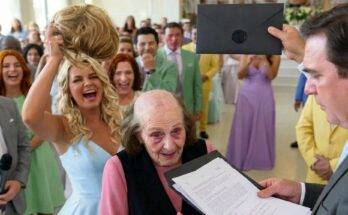
Two days after my son’s wedding, after I had written checks so large they made even the restaurant’s finance director blink twice, the manager of the Gilded Oak called my private number and said something that turned the air in my kitchen cold.
He told me not to put him on speaker, told me to come to the restaurant alone, and then, in a voice I had never heard from him before, told me not to tell my wife where I was going.
Tony Russo was not a nervous man, and that was the first thing that made my hand tighten around the phone until my knuckles looked pale against the dark wood of the kitchen table.
For nearly twelve years, Tony had managed the Gilded Oak, the most expensive private dining restaurant in Atlanta, and I had seen him smile calmly through spoiled brides screaming over flower arrangements, oil executives threatening lawsuits over seating charts, drunk politicians trying to intimidate waiters, and rich men who believed a platinum card was the same thing as a crown.
Tony did not tremble, Tony did not whisper, and Tony did not call a man like me two days after his son’s wedding unless something had happened that could not be handled with an apology, a refund, or a discreet phone call to security.
So when he said, “Mr. Barnes, please listen carefully, because you need to come here alone,” I stopped looking at the cold coffee in front of me and began listening as if my life depended on every word.
Across the kitchen, my wife, Beatrice, stood at the farmhouse sink arranging white lilies in a crystal vase, her movements careful and graceful, her cream sweater spotless, her silver bracelet flashing in the morning light each time she turned a stem.
She looked exactly like the woman everyone in our church believed she was, refined and devoted, the kind of wife who remembered birthdays, prayed over meals, sent handwritten thank-you notes, and rested one gentle hand on her husband’s shoulder whenever people praised him too loudly.
“What happened?” I asked Tony, keeping my voice low as Beatrice trimmed the end of a lily and dropped it into the trash.
There was a pause on the line, the kind that makes a man’s mind start filling the silence with all the things he does not want to imagine, and then Tony said, “We checked the security footage again, and you need to see this yourself.”
I looked toward Beatrice, and she lifted her face just enough to smile at me with that soft, practiced expression she had worn through funerals, board dinners, charity galas, and every argument she wanted to end without appearing to lose.
“Twenty minutes,” I told Tony, and when I ended the call, I sat there for one more second with the phone in my hand, feeling as if I had just been invited to attend the funeral of the life I thought I understood.
“Who was that?” Beatrice asked, turning from the sink with a lily in her hand, her voice light enough to pass for curiosity but sharp enough underneath to catch on my nerves.
“Pharmacy,” I said, pushing back my chair slowly, because after forty years of marriage a man learns how to lie in the same tone he uses to discuss the weather, “something about my blood pressure prescription.”
Her eyes narrowed, not much, not enough for anyone else to notice, but enough that something in me, some old sleeping instinct, lifted its head and paid attention.
Yesterday I would have missed that look, or maybe I would have explained it away as concern, because that was what I had done for decades whenever Beatrice’s sweetness turned too still or her tenderness arrived a little too perfectly timed.
“I thought they filled that last week,” she said, and she laid the lily down on the counter as if the answer mattered less than how quickly I gave it.
“They said there was an issue with the dosage,” I replied, taking my keys from the brass hook by the door, and for the first time in my life, I wondered how many times the woman watching me leave had studied my face for weakness instead of love.
The drive to the Gilded Oak took twenty-three minutes because morning traffic had already begun choking Peachtree Street, but I remember almost none of it except the dull pressure in my chest and the strange sensation that every red light was holding me in place for something I was not ready to know.
By the time I parked behind the restaurant, Tony was waiting at the service entrance in a charcoal suit with no tie, his face tight, his eyes bloodshot, and his mouth set in a line that told me he had not slept much since he first saw whatever was waiting for me.
He did not shake my hand, did not offer coffee, did not make small talk about the wedding or congratulate me again on a beautiful reception, because there are moments when polite rituals become insults.
Instead, he led me through the back hallway, past stacks of linen carts and crates of wine, down a narrow stairwell into the basement security room where two monitors glowed above a metal desk and an older guard stood up the second we entered.
“Leave us,” Tony said, and the guard did, closing the door behind him with the kind of care people use around hospital rooms.
Tony motioned toward the chair in front of the screen, then stood beside me with his arms folded and his jaw flexing, as if he had replayed this footage so many times he could hear it before it began.
“This was from the VIP lounge after the reception,” he said, his finger hovering over the keyboard, “and I need you to understand that our cameras record audio in that room because of previous security incidents with high-profile guests.”
I nodded, though I did not yet understand why his voice had grown softer, and when he pressed play, the screen filled with the private lounge where my family had gathered after the last guests left the wedding ballroom.
At first, there was nothing remarkable, just candlelight, empty champagne flutes, scattered rose petals on polished tables, and the quiet aftermath of a celebration that had cost more than my first warehouse.
Then Beatrice entered the frame.
She walked quickly, shoulders straight and steps firm, without the fragile limp she sometimes used after long church services, without the little wince that always made people rush to help her into cars, without the delicate helplessness that had made me open doors and carry bags and worry over her for years.
A minute later, Megan came in behind her, still wearing her wedding dress, her veil gone, her hair loosened, her smile no longer sweet and bridal but sharp with the confidence of a woman who believed the room belonged to her because the cameras did not.
Beatrice reached for the champagne chilling in a silver bucket, poured two glasses, and handed one to my new daughter-in-law as if they were old partners celebrating the closing of a profitable deal.
“To the stupidest man in Atlanta,” Megan said, raising her glass with a laugh so clear and cruel that my stomach clenched before I even heard Beatrice answer.
“To Elijah,” my wife replied, touching her glass to Megan’s, “the goose that lays the golden eggs.”
I gripped the edge of the chair so hard the metal bit into my palm, because hearing your wife insult you is painful, but hearing her toast your humiliation with the girl your son just married does something deeper, something uglier, something that makes all the years behind you rearrange themselves under a new and merciless light.
Tony said nothing, and that silence, more than any apology could have, told me that the worst had not yet arrived.
On the screen, Megan dropped onto the velvet sofa and kicked off her heels while Beatrice took the chair opposite her, calm and elegant, sipping champagne like a queen reviewing the success of a campaign.
They talked about the lakehouse first, the cedar-sided property on Lake Lanier that I had given Terrence as a wedding gift because I believed my son deserved a beautiful beginning, and Megan laughed about selling it before the first mortgage tax documents even arrived.
“The market is perfect,” Megan said, rubbing the satin of her wedding dress between two fingers, “and Terrence will sign whatever I put in front of him if I cry hard enough.”
Beatrice smiled with such fond approval that for one absurd second I thought she might scold Megan, might remind her that the house was meant to build a family, but instead she leaned forward and said, “Do it quickly before Elijah starts attaching sentimental conditions.”
They spoke of Megan’s credit card debts, then of a condo in Miami, then of the family trust I had spent thirty years protecting from foolishness, addiction, divorce, lawsuits, and every greedy hand that had ever drifted toward the Barnes name.
That trust, as only a handful of people knew, would unlock a new tier of inheritance when my first biological grandchild was born, because I had written it years ago in an old-fashioned burst of pride, believing blood meant continuity and continuity meant safety.
Then Megan touched her stomach.
“Terrence thinks the baby is his,” she said, laughing as if my son’s trust was entertainment purchased for her amusement, “and he doesn’t even know how to do the math.”
I felt the basement room tilt slightly, or maybe it was my body realizing before my mind did that the family I had just celebrated in front of five hundred guests was already a fraud before the first toast was poured.
Beatrice did not look shocked, which was what broke something in me next, because she simply pointed one manicured finger at Megan and warned her not to let me demand a DNA test.
“Elijah is old, not stupid,” Beatrice said, and the little smile on her face was so familiar that I hated myself for ever having called it love.
Megan rolled her eyes and asked when I would finally “retire permanently,” drawing out the words in a way that made Tony inhale sharply beside me.
Beatrice looked into her champagne, swirled it once, and answered as calmly as if she were discussing a lunch reservation.
“Soon,” she said.
Megan leaned forward, interested now, her playful contempt sharpening into hunger.
“I switched his heart medication three weeks ago,” Beatrice continued, “and I’ve been crushing digoxin into his morning smoothies, so one day he’ll fall asleep and not wake up, and then we own everything without having to fight him.”
There are moments so terrible the body cannot respond properly, because fear, rage, disbelief, and grief all arrive at once and crowd the doorway of the heart until nothing can move.
I sat there, a man who had hauled freight through ice storms, built a logistics company from one truck, survived two heart procedures, buried both parents, and watched competitors try to ruin me, yet I could not find enough breath to speak.
For forty years, Beatrice had prayed over my meals, tucked blankets around my legs after surgery, kissed my forehead in hospital rooms, and stood beside me at charity banquets while people praised our marriage as proof that old-fashioned devotion still existed.
Every morning for weeks, she had handed me a green smoothie with ginger and spinach and apple, smiling as she watched me drink, and every morning she had been poisoning me with the steady patience of a woman watering flowers.
The footage should have ended there, because a man can only be gutted so many times before there is nothing left to cut, but the truth had one more blade waiting.
Megan asked something about Terrence, something careless and mocking about how easy he was to manage, and Beatrice laughed softly before delivering the sentence that finished the life I thought I had lived.
“He gets that from his father,” she said.
Megan frowned, confused for once.
“Elijah?” she asked.
Beatrice looked at her as if she had said something naive, then took another sip of champagne and shook her head.
“No,” she said, and her voice carried cleanly through the security room speakers.
“Terrence is Silas’s son.”
Pastor Silas Jenkins.
My best friend, my spiritual brother, the man who had stood beside me on my wedding day, baptized the boy I believed was mine, preached loyalty from my pulpit, sat at my Thanksgiving table, borrowed my fishing rods, prayed over my hospital bed, and hugged me at my son’s wedding while calling me blessed.
I rose so fast the chair scraped the concrete floor, and if Tony had not grabbed my arm with both hands, I believe I would have driven my fist through the monitor just to stop Beatrice’s face from smiling at me.
“Don’t,” he said, holding me with surprising strength, “because if you destroy this, you destroy your only advantage.”
I turned on him, shaking, humiliated by my own tears and fury, but Tony did not let go.
“This is not a family argument, Mr. Barnes,” he said, each word slow and hard enough to enter my mind through the storm.
“This is a conspiracy.”
He was right, and I hated that he was right, because if I went home shouting, Beatrice would paint me as unstable before I finished my first sentence.
She would say I was confused by medication, grieving the end of my usefulness, jealous of Silas, irrational about the trust, and perhaps already suffering the mental effects of whatever poison she had been feeding me.
Without evidence, I would not only lose the fight, I would lose the right to name what had been done to me.
So I sat back down, watched the footage twice more, and let the pain turn cold enough to become useful.
By the time Tony copied the files onto an encrypted drive and sealed the restaurant’s internal record behind a legal preservation notice, I had stopped shaking and started thinking like the man who built Barnes Freight from a rusted cab-over truck and a second mortgage on a house Beatrice once claimed she hated.
My first call was not to the police, because police reports can leak and family conspirators can run when they smell consequences.
My first call was to Naomi Sterling, the kind of attorney other attorneys hated across a table, a woman with silver hair, quiet shoes, and a memory so exact that men twice her size learned not to lie in her presence.
“Open a new file,” I told her when she answered.
“Code name Omega.”
She did not ask whether I was being dramatic, because Naomi Sterling had represented me through corporate raids, hostile buyout attempts, and one federal inquiry started by a competitor who later apologized in writing.
“What are we protecting?” she asked.
“Everything,” I said.
Then I gave her instructions in a voice so calm it sounded almost like someone else’s: freeze the discretionary accounts, lock the properties, suspend trust access pending medical review, secure the lakehouse title, notify the bank that any new power of attorney was to be treated as suspect, and find me a toxicologist who could test for digoxin discreetly and quickly.
When I finished, Naomi was silent for three seconds, and then she said, “Elijah, are you safe right now?”
I looked at the frozen image of my wife smiling over champagne and understood that safety, like love, was something I had mistaken for routine.
“No,” I said.
“But I will be.”
The drive home felt longer than the drive there, not because of traffic, but because every street in Atlanta seemed to carry some memory of the life I was losing.
There was the florist where I bought Beatrice roses after our thirtieth anniversary argument, the church where Silas had preached about forgiveness while standing ten feet from my wife, the bank where I opened Terrence’s first college fund, the restaurant where Megan had once thanked me for welcoming her into the family with tears in her eyes.
By the time I turned into my driveway, I had made one decision that steadied me more than rage could have.
I would not give them the explosion they expected from an old man; I would give them the silence they had mistaken for weakness.
Beatrice was waiting in the kitchen when I came in, standing beside the island with a tall glass of green smoothie in her hand, the surface frothy and pale from ginger, apple, and spinach.
“I made your favorite,” she said sweetly, holding it toward me with the same soft smile that had once made me feel cared for.
“You missed it this morning.”
I took the glass, and for one impossible second my hand wanted to hurl it against the wall, to watch it splatter across the white cabinets the way the truth had splattered across my life.
Instead, I lifted it to my mouth, let the bitter smell rise beneath the ginger, and pretended to drink while my wife watched me over the rim with eyes that were no longer loving enough to fool me.
When she turned to rinse the blender, I let the liquid slide into a napkin folded inside my palm, coughed once to cover the motion, and carried the glass with me toward the living room like an obedient fool.
Then I sat in my chair, waited, and gave her the performance she had apparently been rehearsing for weeks.
At first I rubbed my chest.
Then I breathed harder, slower, letting my head tilt back as if the room had begun to spin, and when Beatrice came in from the kitchen, I let one hand fall uselessly from the armrest.
“Elijah?” she said.
There was no panic in her voice.
Only interest.
I tried to stand, staggered two steps, and collapsed onto the living room rug hard enough to bruise my shoulder but not hard enough to break anything, because revenge is not useful if the actor dies before the curtain rises.
Beatrice did not scream.
She did not run for the phone, did not kneel beside me, did not shout my name the way a wife of forty years should shout when the man who built a life beside her falls at her feet.
She walked slowly closer, looked down at me, nudged my side with the toe of her shoe, and whispered, “Wake up, old man.”
I kept my eyes closed, made my breathing shallow, and listened as the woman I once trusted laughed under her breath.
Then she called Megan.
“It’s done,” Beatrice said, her voice low but clear in the quiet house.
“He drank it, so bring the binder, because we need the medical power of attorney and the DNR ready before anyone calls paramedics.”
I had never signed a DNR.
I had never given Megan medical power of attorney.
I had, however, hidden a recorder beneath the side table before leaving for the restaurant, because an old trucker knows that the road only kills men who believe nothing can come around the bend.
Megan arrived faster than grief would have allowed but exactly as fast as greed could travel across town.
Her heels clicked across my foyer, her voice hissed from the hall, and when she entered the living room, she did not ask whether I was breathing.
She asked where the original medical files were kept.
Beatrice told her the safe code had changed, and Megan cursed Terrence for being useless with numbers.
They were still arguing over the binder when the front door opened again and my son rushed in, breathless and pale, his tie loose as if he had been dragged from work or from whatever weak little dream he had been living inside.
“Dad!” Terrence shouted, and the sound pierced something in me despite everything I had heard in that basement.
He dropped beside me, his hands hovering over my shoulder, and for one precious second, before the rest of him betrayed me, I felt hope rise like an old reflex.
“Call 911!” he cried.
Megan snapped his name so sharply the whole room seemed to flinch.
“Don’t touch that phone,” she said.
Terrence looked at her, confused and frightened, and she leaned toward him with a fury that finally showed him the marriage he had just entered.
“He’s supposed to die.”
The words fell into the room, and even Beatrice seemed annoyed that Megan had said them so plainly, but Terrence did not leap for the phone, did not shout for help, did not put his body between me and the women arranging my death like paperwork.
He looked at his mother, then at his bride, then back at me, and he began to cry in the weak, helpless way he had cried as a boy whenever consequences arrived.
Beatrice softened her voice, the way she always had when she wanted obedience to feel like comfort.
“Your father signed a DNR,” she said.
“No,” Terrence whispered.
“He did not want machines, he did not want humiliation, and he wanted us to respect his wishes,” she continued, as if she were already standing in front of mourners with a handkerchief in her hand.
I lay there listening, tasting dust from the rug, feeling the recorder under the table gather every word, while the man I had raised trembled between cowardice and conscience.
Then Terrence let go of my arm.
“Okay,” he whispered.
“We wait.”
That was when something inside me stopped being his father.
Not because Tony’s footage said Terrence was not my blood, because blood had never been the measure by which I loved him.
I stopped being his father because he looked at me lying helpless on the floor and chose inheritance over rescue.
They began arranging their story with the disgusting efficiency of people who had imagined this moment before.
Megan opened the binder, Beatrice gave instructions, Terrence signed where she pointed, and together they built a timeline in which I had been frail, confused, declining, and ready to leave everything to the people standing around my body.
I waited until the room had settled into the rhythm of conspiracy.
Then I coughed.
The sound was small, rough, and almost ordinary, yet it froze them harder than a gunshot would have, because nothing terrifies the guilty like the dead refusing to cooperate.
I rolled onto my back, blinked up at them, and let my face arrange itself into confusion.
“What happened?” I rasped.
Their expressions were worth every bruise in my shoulder.
Megan went white, Terrence stumbled backward, and Beatrice recovered first because Beatrice had spent forty years training her face to obey ambition before emotion.
“Oh my God, Elijah,” she cried, dropping beside me with a tenderness so swift and false it should have drawn applause.
“You’re alive.”
“Of course I’m alive,” I muttered, letting her help me sit while she searched my eyes for understanding.
“Takes more than a dizzy spell to kill an old trucker.”
That line comforted them more than it should have, because they wanted me tough enough to survive this mistake but weak enough to remain manageable.
I let them believe the episode had frightened me into dependency, let Terrence hover uselessly, let Megan pretend to be concerned, and let Beatrice guide me back into my chair while her fingers trembled against my sleeve.
Then, when the house had gone quiet and they were waiting for me to ask no dangerous questions, I gave them the bait.
“This scare made me think,” I said, keeping my voice tired and slow.
“I need to get my affairs in order while I still can.”
Beatrice’s hand stilled on my shoulder.
Megan lowered her eyes, but not quickly enough to hide the flash of victory in them.
Terrence swallowed, looking ashamed and relieved, which was somehow worse than looking guilty.
“Next week,” I continued, “we’ll have a family meeting after church, with Pastor Silas, Naomi Sterling, the board, and the people who matter, because I want everyone to get exactly what they deserve.”
Beatrice kissed my forehead.
Megan squeezed Terrence’s hand.
My son smiled through tears.
They thought I had just surrendered the kingdom, when in truth I had invited them to stand in the center of it before I burned their lies to the ground.
Over the next week, Naomi Sterling moved so quietly that even I sometimes had to call her office just to confirm the machinery was still turning.
The accounts were frozen under medical incapacity review, the properties were locked behind revised trustee approval, the lakehouse transfer was suspended, every safe-deposit box was flagged, and the trust access Megan believed she could pry open with a pregnancy was sealed pending biological verification.
The toxicologist tested the napkin I had brought from the living room and confirmed the presence of digoxin, not in a trace amount that could be explained away by contamination, but in a concentration consistent with deliberate dosing.
My physician, Dr. Patel, reviewed my blood work and found enough irregularity to say what the word poison had already said inside my mind.
Naomi arranged the DNA tests through a private lab with court-ready procedures, and the results arrived in sealed envelopes that sat on her desk like loaded weapons.
Terrence was not my biological son.
Terrence was Silas Jenkins’s son.
And the unborn baby Megan was carrying was not Terrence’s either.
That last result made me sit alone in Naomi’s conference room for a long time, not because I felt sorry for Terrence in the way I once would have, but because betrayal had apparently become the family language, passed from one liar to another like an inheritance more durable than land.
“Do you want to stop?” Naomi asked me after reading the final report, and I looked at her across the polished table with the calm of a man who had already stood beside his own grave and heard his family discuss the paperwork.
“No,” I said.
“I want witnesses.”
Megan gave us the final piece herself, because greed has a way of mistaking silence for fear.
She asked me to meet at a café near Buckhead, claiming she wanted to apologize for being tense after the wedding and to discuss how we could make the transition easier on Beatrice, Terrence, and the baby.
I wore an old denim jacket, put a recorder in the inside pocket, and sat across from her while she stirred a latte she never drank.
For ten minutes, Megan smiled like a daughter-in-law in a greeting card, telling me how much she respected family, how overwhelmed she felt, how badly Terrence wanted to make me proud.
Then, when I did not offer what she wanted, the smile vanished.
“You’re going to sign the medical power of attorney,” she said, leaning close enough for me to smell the sharp perfume she had worn at the wedding.
“You’re going to confirm the trust release, and you’re going to make sure the lakehouse goes forward, because if you don’t, I can make people believe terrible things about a lonely old man who gets too affectionate with his daughter-in-law.”
I looked at her for a long moment, not because the threat frightened me, though it should have, but because I was fascinated by how much ugliness could fit inside a face still young enough to be mistaken for innocent.
“Anything else?” I asked.
She smiled again, smaller this time.
“Yes,” she said.
“Don’t test the baby, don’t question Beatrice, and don’t embarrass Pastor Silas, because nobody believes old men when young women cry.”
The recorder caught every word.
By Saturday night, everything was ready, and sleep became impossible.
I walked through my house after midnight, touching the backs of chairs, the banister Terrence slid down as a boy, the dining room table where Silas had once carved turkey while Beatrice laughed beside him, the hallway where family portraits hung like evidence of a crime committed in public.
I stood outside the bedroom door and listened to Beatrice breathing on the other side, amazed that I had slept beside her for forty years without hearing the blade under the pillow of her heart.
Then I went downstairs, made myself coffee, and waited for morning.
On Sunday, Greater Hope Baptist was full in a way I had not seen since Christmas Eve or the governor’s visit.
Family members filled the first rows, business partners sat shoulder to shoulder with bankers, board members, donors, city officials, reporters from two local outlets, and half the church community crowded into the sanctuary because they believed they had been invited to witness a proud old businessman transfer power to the next generation.
That was the story we had allowed to spread.
Elijah Barnes, aging founder of Barnes Freight, would bless his son, recognize his new daughter-in-law, secure his future grandchild, and make a public announcement about the family trust under the spiritual guidance of Pastor Silas Jenkins.
Beatrice wore cream silk and pearls, the uniform of a woman who expected sympathy and admiration in equal measure.
Megan wore soft green, one hand placed delicately over her stomach whenever she noticed someone looking, performing motherhood like a campaign speech.
Terrence sat between them, pale and restless, his knee bouncing beneath the pew.
And Pastor Silas stood at the pulpit, tall and righteous, his Bible open, his voice rich as honey while he preached about legacy, faithfulness, and the sacred duty of family.
I listened to every word.
It is a strange thing to hear a man preach faithfulness when you know he helped steal your marriage bed, your son, your dignity, and the truth of your home.
When the sermon ended, Silas called me forward with a grand smile, and the congregation rose in warm applause as if they were sending a beloved patriarch into the golden light of retirement.
I stepped to the podium slowly, not because I felt weak, but because timing matters when you are about to end four lives without raising your voice.
Behind me, the large projection screen waited blank and white.
In the front row, Beatrice smiled, Megan lifted her chin, Terrence wiped his palms on his pants, and Silas stood just behind me with one hand on my shoulder like Judas posing for a stained-glass window.
“Many of you think you are here to witness a transfer of power,” I said, looking across the sanctuary at faces I had known for years.
“You are.”
A murmur of pleased expectation moved through the room.
“But first,” I continued, “we are going to take a walk down memory lane.”
Naomi stood near the sound booth.
Tony Russo stood beside her.
The lights dimmed.
The screen came alive.
At first, people shifted with polite confusion as the VIP lounge from the Gilded Oak appeared behind me, candlelit and quiet after the wedding.
Then Beatrice walked onto the screen, strong and steady, followed by Megan in her wedding dress, and when Megan raised her champagne glass to “the stupidest man in Atlanta,” the first sound that moved through the sanctuary was not outrage but disbelief.
People leaned forward.
Beatrice went rigid.
Megan’s hand dropped from her stomach.
Silas whispered my name behind me, but I did not turn.
The footage continued, because truth, once invited into a room, does not politely leave before finishing its sentence.
The church heard them discuss the lakehouse, Megan’s debts, the Miami condo, the trust, the unborn baby, and Terrence’s inability to count months.
They heard Beatrice warn Megan not to allow a DNA test.
They heard Megan ask when I would “retire permanently.”
Then my wife’s voice, calm and elegant and unmistakable, filled the sanctuary.
“I switched his heart medication three weeks ago,” she said from the speakers.
“I’ve been crushing digoxin into his morning smoothies.”
Five hundred people sat frozen.
Not quiet, not merely surprised, but frozen in the sacred horror that comes when a congregation hears evil speaking in the voice of a woman who served on the hospitality committee.
Beatrice stood, then sat again, as if her own body could not decide whether flight or denial would save her.
Megan began shaking her head before anyone accused her, which is how the guilty sometimes confess with their necks before their mouths catch up.
The footage moved on to the conversation about my death, about ownership, about the plan that would leave them with everything.
Then came the living room audio, Beatrice telling Megan it was done, Megan telling Terrence not to touch the phone, my son whispering that they would wait while I lay on the rug pretending to die.
By then, women were crying in the back rows, men were standing with fists clenched, and one of Silas’s deacons had moved away from him as if betrayal might spread by contact.
Terrence turned toward me with a face ruined by panic.
“Dad,” he whispered, but the microphone caught it, and everyone heard the smallness of his voice.
I did not answer him.
Naomi advanced the next file.
The café recording played, and Megan’s threat echoed through the church with a clarity so sharp it seemed to scrape the paint from the walls.
Nobody moved while she described the lie she would tell if I did not sign away authority, and nobody breathed when she said young women were believed over old men when they cried.
Megan screamed then, not with remorse, but with the fury of a person whose weapon had fired backward.
“You recorded me?” she shouted.
I looked at her for the first time since I stepped to the podium.
“Yes,” I said.
The next slide appeared.
Terrence Barnes and Elijah Barnes: zero percent probability of paternity.
A sound moved through the church, low and collective, like wind striking a closed door.
Then the second result appeared.
Terrence Barnes and Silas Jenkins: 99.9 percent probability of paternity.
The sanctuary erupted.
People turned toward Silas, and the man who had spent thirty years teaching others how to confess stood speechless beneath the weight of a sin he had hidden behind scripture, potlucks, hospital prayers, and fatherly embraces.
Beatrice covered her face, though not before I saw that her tears were not grief for what she had done, but terror for what she had lost.
Terrence staggered into the aisle, crying openly now, looking from Silas to Beatrice to me as if hoping one of us would put the world back together around him.
“Dad, please,” he said, and the word struck me in the chest despite all my preparation.
“It doesn’t matter. I’m still your son.”
I looked at the man I had raised, the boy whose first bike I had steadied, whose fevers I had sat through, whose college tuition I had paid, whose mistakes I had forgiven again and again because fatherhood had trained my heart to find excuses before judgment.
Then I remembered him kneeling beside me, hearing his wife say I was supposed to die, and letting go of my arm.
“A son protects his father,” I said, and because the microphone carried my voice, every person in that sanctuary heard the sentence settle over him.
“He does not sign his death warrant for a check.”
Terrence made a sound like a wounded child, but I had already turned away.
The final slide appeared.
The unborn baby was not Terrence’s.
Megan’s scream tore through the sanctuary with all the elegance stripped out of her, and Terrence looked at her as if betrayal had finally found a way to injure him personally enough to become real.
For a moment, chaos threatened to swallow the room.
People shouted, Silas tried to speak, Beatrice stood again, Megan lunged toward the aisle, and two security officers moved in from the side doors with the quiet efficiency Naomi had arranged in advance.
I lifted one hand, and because money, age, pain, and truth all carry their own authority when they stand together, the room slowly quieted.
“I invited you here to witness a transfer of power,” I said.
“And you will.”
From inside my jacket, I removed a checkbook.
Even then, even after everything, I saw hope rise in their faces like a sickness that refused to die.
Beatrice lowered her hands, Megan stopped crying, and Terrence stared at the checkbook with the desperate attention of a man drowning close enough to shore to believe the water might forgive him.
“This represents twenty-five million dollars,” I said.
“Every liquid dollar I made available for this day.”
No one spoke.
The whole church seemed to lean toward me, waiting to learn which bloodline, which wife, which false son, which unborn claim, which public humiliation, which old loyalty would still be rewarded because people like them always believe punishment has a limit when money is involved.
I tore out the check slowly.
Then I looked past my wife, past my son, past my daughter-in-law, past the pastor who had stolen more from me than any enemy ever could, and found in the crowd the director of Westside Orphanage, a quiet woman named Ruth Coleman who had spent her life raising children nobody fought over until they needed tax deductions or applause.
“I am giving it all to Westside Orphanage,” I said, holding the check where the whole sanctuary could see it.
“Because they are the only children in this city who actually need a father.”
For a long moment, nobody moved.
Then Ruth Coleman began to cry, not loudly, not performatively, but with the stunned humility of someone who had just watched heaven arrive through the wreckage of another man’s life.
I stepped down from the podium and handed her the check.
Behind me, Beatrice said my name once, and in that single word I heard forty years of manipulation searching for the old doorway back into my mercy.
I did not turn around.
Silas tried to speak too, but one of his own deacons blocked him with a look so full of disgust that the pastor lowered his eyes before any officer touched him.
Megan cursed me as security escorted her out, her green dress flashing between pews, her hand no longer resting on her stomach because the performance had lost its audience.
Terrence stood alone in the aisle, looking younger than his years, older than his innocence, and emptier than any man should look in the ruins of a life he helped destroy.
I passed him without stopping.
Outside the church, sunlight hit my face with a brightness that almost hurt after the dim sanctuary, and for the first time that morning, I let myself breathe without measuring the air for poison.
The bells above Greater Hope began ringing for the next service, absurdly normal, as if the world had not just split open in front of everyone who thought they knew me.
Naomi came outside a few minutes later and stood beside me on the steps without speaking.
In the parking lot, reporters gathered near the curb, police cars flashed silently, church members whispered in clusters, and somewhere inside, the people who had built their future on my death were discovering that truth is far less forgiving than an old man.
“You did what you had to do,” Naomi said eventually.
I looked across the street at a small American flag moving in the warm Atlanta breeze outside the veterans’ hall, its fabric snapping gently against the pole, and I thought of all the years I had mistaken endurance for peace.
“I know,” I said.
But knowing did not make the loss smaller.
I had lost a wife who had slept beside me with murder in her patience, a son who had chosen not to save me, a best friend who had baptized his own child under my name, and the story I had told myself every morning for forty years just so the house would feel like home.
Yet beneath that ruin, beneath the grief and humiliation and rage, there was something clean waiting for me.
Truth.
Not comfort, not revenge, not even justice in its fullest form, because justice can punish liars but it cannot return the years they stole.
Still, truth had weight, and when I stepped down from the church steps into the sunlight, I carried it like a man carrying the first honest thing he had owned in decades.
I drove home alone, past the restaurant where the footage had saved my life, past the café where Megan had threatened me, past the streets where Beatrice and I had once ridden with the windows down, laughing like people who believed time would make them kinder.
At the house, I opened the front door and stood in the foyer, listening to the silence that remained after all the lies had been dragged into the open.
The lilies Beatrice had arranged still sat in the kitchen, white and perfect in their crystal vase, their stems drinking clean water as if nothing in the room had ever been poisoned.
I carried them outside, set them beside the trash bins, and watched the petals tremble in the heat.
Then I went back inside, poured the green smoothie from the refrigerator down the sink, and rinsed the glass until the bitter smell was gone.
That evening, when the sun lowered behind the trees and filled the windows with gold, I sat at the kitchen table with a fresh cup of black coffee and the first peaceful loneliness I had ever known.
I had paid a terrible price for the truth, but I was alive to pay it, and after everything Beatrice, Megan, Silas, and Terrence had taken from me, that was the one thing they had failed to steal.
The End