My son froze my credit cards before lunchtime, certain that a few declined purchases would frighten me into surrendering the forty-two-million-dollar empire my husband and I had built from oil-stained floors, unpaid invoices, and years of work nobody in my family seemed to remember anymore.
He thought he had cornered an aging widow at a grocery store register, but before the day was over, one phone call from the bank would prove that Desmond Morrison had never truly understood the woman who raised him.
The first card failed with a sharp little beep that seemed far too loud for a quiet morning inside Whole Foods, where my cart sat full of chicken breasts, tomatoes, fresh bread, and the imported olive oil Warren used to inspect with the seriousness of a jeweler judging diamonds.
The cashier smiled at me with the careful politeness people use when embarrassment is spreading in public, while the woman behind me shifted her cart forward and pretended not to listen.
“Would you like to try another form of payment?” the cashier asked, her voice soft enough to seem kind but clear enough for everyone nearby to understand that something was wrong.
I handed her my debit card, then my emergency Amex, the one that had survived twenty-eight years of marriage, five years of widowhood, business dinners, dealership crises, and medical emergencies without once failing me.
Both were declined, and as the machine rejected me again, I felt every eye in that checkout lane settle against the back of my neck like heat.
I left the groceries behind with my chin lifted, because pride was the only thing I could still carry out of that store without approval from a bank.
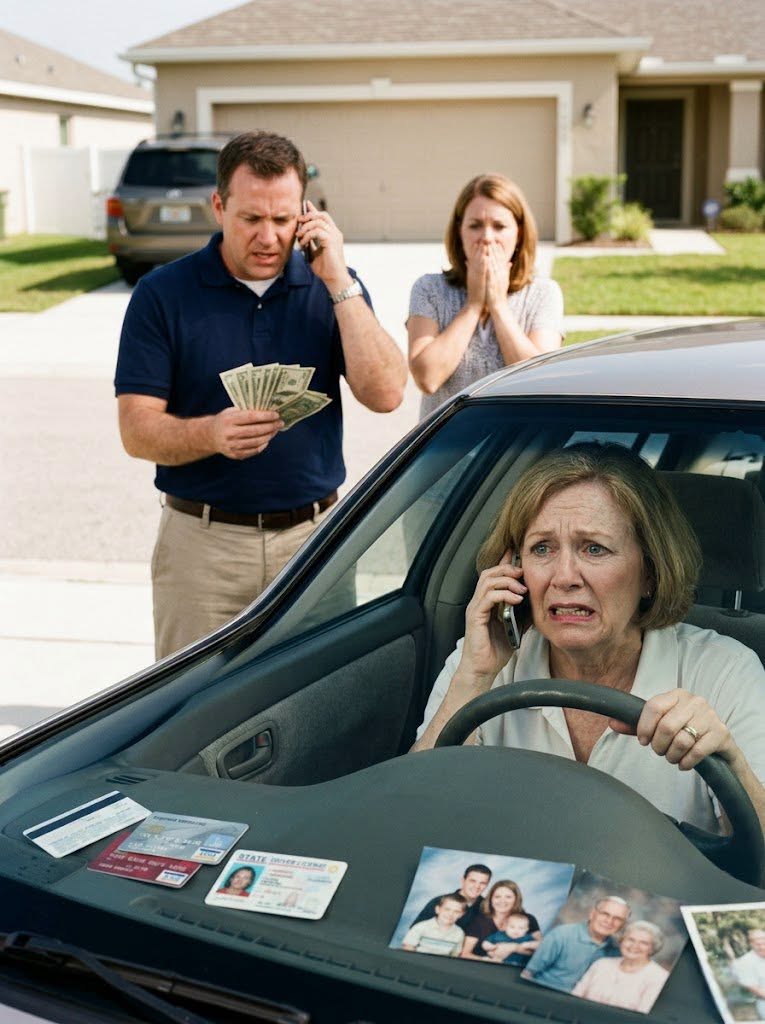
Inside my car, my hands shook so violently that I dropped my purse onto the passenger seat, spilling receipts, lipstick, and an old anniversary photo of Warren across the leather.
There he was, smiling with that exhausted tenderness he always wore after a long day at the dealership, a man who had begun with grease beneath his fingernails and ended with twelve dealerships across three states.
Together, Warren and I had built Morrison Auto Group from one repair bay, two secondhand desks, and a coffee machine that only worked if someone kicked the side panel hard enough.
By the time Warren died, our business was worth forty-two million dollars, yet there I was at 10:17 in the morning, unable to pay for groceries.
I called the bank from the parking lot, and after the automated menu trapped me in its cheerful little maze, I endured hold music, three transfers, and finally the voice of a woman who spoke as though every word had passed through a legal department first.
“Mrs. Morrison,” she said carefully, “your accounts appear to be frozen.”
She began explaining verification procedures and account restrictions, but I barely heard her, because deep in my chest, below the shock and humiliation, a colder truth had already settled into place.
I knew exactly who had done it.
My son, Desmond, the miracle baby I had prayed for after three losses, the feverish little boy I rocked at two in the morning, the teenager Warren made wash cars so he would understand that a family name was not a substitute for labor.
Desmond, the only child I trusted with power of attorney after my hip surgery, because he was my son, because Warren was gone, and because I had been foolish enough to believe blood could still recognize loyalty.
Some betrayals do not begin with screaming, slammed doors, or shattered glass; they begin with a signature given out of love, a password shared out of trust, and a chair at the table that someone mistakes for a throne.
I drove straight to Desmond’s house, a perfect suburban home with tall windows, clipped hedges, and a stone walkway I had paid to have repaired the year his wife, Karen, decided the old brick made the property look “tired.”
His Range Rover sat in the driveway, Karen’s Mercedes beside it, both financed through my dealerships at zero percent because even their luxuries had learned to call me Mom.
Karen opened the door in white tennis clothes, her blonde ponytail smooth, her nails perfect, and her smile as thin as a paper cut.
“Oh, Nora,” she said, as if I had dropped by uninvited during a garden tour. “What a surprise.”
“My cards don’t work,” I said, keeping my voice level because rage would have given her too much satisfaction. “The bank says my accounts are frozen, and I want to speak to my son.”
Karen glanced down at her manicure before answering, and that tiny pause told me more than any confession could have.
“You should have called first,” she said. “Desmond blocked you this morning because he felt it was time to set some boundaries.”
Boundaries, she said, as if the word itself could perfume what she was doing, as if the mortgage, the vacations, the private school tuition, the cars, and the designer kitchen behind her had not all been paid for by the life Warren and I built.
Then Desmond appeared behind her, wearing a gray quarter-zip sweater and the tired expression of a man preparing to explain obvious truths to a difficult child.
He had Warren’s square jaw and Warren’s broad shoulders, but none of Warren’s quiet decency, and seeing that resemblance without the kindness beneath it hurt more than I expected.
“Yes, I froze the accounts,” he said, calm enough to sound rehearsed. “We need to talk about your spending, Mom, because someone has to protect the family assets before this gets out of hand.”
“The family assets?” I repeated, staring at the son who had once cried when Warren made him apologize to a porter for speaking rudely. “Your father and I built that money, Desmond, every cent of it.”
Karen sighed from the doorway, folding her arms as though she had been forced to watch the same boring play too many times.
“Here we go again,” she said. “Every family dinner becomes another speech about how hard you and Warren worked, and honestly, Nora, everyone is tired of being guilted by history.”
Then they explained their plan to me as if it had already been signed, sealed, and executed in a room where I no longer had a seat.
They intended to sell the dealerships, take thirty-eight million in cash, use documents they claimed I had signed after surgery, and rely on Desmond’s power of attorney to remove me from every account, every decision, and every dollar.
Desmond spoke of transfer forms, board approvals, asset protection, and my supposed decline with the smooth confidence of a man who had practiced in front of a mirror.
Karen stood beside him checking the time, as if dismantling my life was making her late for Pilates.
At 10:54 a.m., Desmond pulled two twenty-dollar bills from his wallet and held them out toward me with a cruel little smile that did not quite reach his eyes.
“Here, Mom,” he said. “For groceries, since your cards don’t work.”
Forty dollars, offered to the woman who had spent forty years helping build the empire he was trying to steal.
I did not take it, and when his hand remained suspended between us, I looked at those bills as though they were something dead on the floor.
“I would rather go hungry,” I said, “than beg my own son for money that exists because of me.”
Karen laughed softly, not loudly enough to seem vulgar, only enough to make sure I heard the pleasure in it.
“You’ll come back,” she said. “Hunger makes women cooperative.”
Then they mentioned assisted living, my house, my spending, my supposed confusion, and the need for me to “step aside with dignity” while they sold everything Warren and I had worked ourselves half to death to create.
When I turned to leave, Desmond used the threat he knew would cut deepest.
“If you fight us,” he said, lowering his voice, “you won’t see the kids again.”
Olivia, Max, and little June, my grandchildren, the three living pieces of innocence left in a family suddenly rotting from the inside, became weapons in my son’s mouth.
I walked back to my car on legs that felt too weak to belong to me, climbed inside, gripped the steering wheel, and tried to breathe through the shaking.
In one morning, my son had frozen my money, tried to steal my company, questioned my mind, and threatened to cut me away from my grandchildren.
Then my phone rang.
The number was unknown, but something made me answer before the second ring ended.
“Mrs. Morrison?” a man said. “This is Frederick Peyton, senior vice president of private wealth banking at First National, and we have been attempting to reach you about unusual activity on several protected accounts.”
The world seemed to narrow to the sound of his voice.
“What activity?” I asked.
“There were multiple transfer attempts this morning using your credentials,” he said. “The total value was approximately twenty-three million dollars.”
Twenty-three million, I thought, while staring at my son’s front door.
My hand tightened around the phone so hard that my knuckles blanched.
“Mrs. Morrison,” Frederick continued, “several accounts your son attempted to access are protected by security measures you activated years ago with your late husband, and he cannot enter those accounts without your direct authorization.”
I looked up at the house, where Karen was watching from the window with a coffee mug in her hand, certain she was witnessing a frightened old woman collapse.
She had no idea.
Desmond thought he had frozen me out of my own life, but he did not know what Warren and I had built underneath the visible money.
We had built trusts, silent accounts, layered protections, emergency clauses, and one founder’s provision my son had never bothered to read because entitlement rarely studies the locks before reaching for the door.
At 11:08 a.m., I looked at my son’s house and spoke into the phone with a calmness that surprised even me.
“Freeze everything he touched,” I said. “Then call legal.”
Frederick did not waste my time with false reassurance, and that alone made me trust him more than almost anyone else I had spoken to that morning.
He asked whether I had authorized Desmond to transfer twenty-three million dollars, whether I had permitted any change in ownership details, and whether I had granted permission for my personal accounts to be frozen under claims of vulnerability.
Each answer was no.
When Frederick advised me to come directly to the downtown office with identification and any legal documents I possessed, his final warning landed with the weight of a hand on my shoulder.
“Do not go back inside that house,” he said.
“I have no intention of doing that,” I replied, and for the first time that morning, my voice sounded like my own.
As I drove away, I saw Karen step onto the porch, with Desmond behind her still holding those two twenty-dollar bills like a prop from a cheap tragedy.
I did not look back, because I had spent too many years looking back every time Desmond disappointed me, excusing his cruelty as grief, stress, insecurity, or influence from his wife.
That ended in the driveway.
At First National, Frederick met me inside a private conference room overlooking downtown Chicago, where glass towers rose against a pale sky and people hurried below, unaware that my life was being dissected twenty floors above them.
He was younger than I expected, with silver-rimmed glasses and the steady expression of someone who had seen rich families commit ugly acts while using polite language.
He placed a thick folder on the table and waited until I sat down.
“Nora,” he said, after I gave him permission to use my first name, “your son has been trying to consolidate control since Warren died, and today was not the beginning.”
He opened the folder, and inside were attempted transfers, suspicious logins, beneficiary-change requests, liquidation drafts, internal alerts, and notarized documents submitted by attorneys whose names I did not recognize.
Desmond had used the power of attorney I signed after surgery two years earlier, back when he told me it was just in case.
Just in case, I thought, feeling the phrase change shape inside my memory until it no longer sounded loving, only strategic.
“He froze my grocery money,” I said quietly.
Frederick’s jaw tightened.
“The freeze was requested this morning under a claim of elder financial vulnerability,” he said. “He represented that you were mentally declining, making irrational purchases, and endangering the family estate.”
For the first time since the checkout machine humiliated me, I smiled.
It was not a happy smile.
It was the kind of smile Warren used to notice across a conference table right before telling someone they had made a terrible mistake by lying to his wife.
“Did he?” I asked.
Frederick slid another document across the table.
“There is something your son either forgot or never knew,” he said. “Twelve years ago, Warren created a founder’s protection structure, and you co-signed it.”
I stared at the page, remembering the day vaguely, when Warren had become worried after another dealership owner lost half his business during a family lawsuit.
I had teased him for acting as if we were running a government agency instead of selling trucks, but Warren had tapped the paperwork and said, “Love is love, Nora, but paper is paper, and we protect the work so nobody destroys it on a bad day.”
Now, five years after I buried him, Warren’s caution reached back through the legal system and steadied me.
Frederick explained that Desmond could freeze surface accounts with the power of attorney, file paperwork, pressure staff, and frighten ordinary bankers into hesitation.
But he could not sell Morrison Auto Group, could not move the protected twenty-three million, could not remove me from the founder’s trust, and could not touch the core assets without my biometric confirmation and verbal authorization.
I exhaled for what felt like the first time all day.
“What can I do?” I asked.
Frederick removed his glasses and looked me directly in the eye.
“Legally, a great deal, but you need your own attorney immediately, not the company attorney and not anyone Desmond recommended.”
I knew exactly who to call.
Evelyn Shaw had been Warren’s old friend and one of the toughest corporate litigators in Chicago before she semi-retired into what she called “selective annoyance.”
She answered on the second ring, and when I told her Desmond had frozen my accounts and tried to move twenty-three million dollars, she was silent for one hard second before saying, “I’ll be at First National in twenty minutes.”
She arrived in eighteen, wearing a charcoal suit, red lipstick, and the kind of calm that makes nervous men sit straighter.
Evelyn reviewed every document without speaking, though I watched her eyes grow colder with each page.
When she finally closed the folder, she rested both palms on top of it, as if holding down something poisonous.
“Your son has committed financial abuse, attempted fraud, breach of fiduciary duty, and possibly forgery,” she said. “His wife may be involved, and the lawyers who prepared these documents are going to have questions to answer.”
“My grandchildren,” I whispered.
There were three of them: Olivia, fourteen, who loved old cars and had Warren’s serious eyes; Max, eleven, who collected baseball cards and still called me every Sunday when Karen remembered to allow it; and June, six, who ran into my arms shouting Nana as if I were the safest place on earth.
Desmond knew exactly where to cut, because I had taught him where my heart lived.
Evelyn’s voice softened, but only slightly.
“He can make access difficult,” she said. “He can use them to hurt you for now, but he cannot use children as ransom forever while committing financial crimes.”
That night, I did not go home, because Evelyn insisted it was unsafe until we knew whether Desmond had changed locks, removed documents, or arranged someone to pressure me.
Frederick secured a suite through the bank, and Evelyn’s associates began emergency filings while I sat beside a hotel window overlooking the city I had driven through a thousand times with Warren.
By 9:00 p.m., my daily accounts were restored under new security, and by 10:30, Desmond’s power of attorney was suspended pending review.
By midnight, an emergency injunction was drafted to stop any sale, transfer, liquidation, debt pledge, or restructuring involving Morrison Auto Group.
At 12:17 a.m., Desmond called.
I let the phone ring until it stopped, then he called again, then Karen called, then the texts began arriving like small stones thrown against glass.
Mom, you’re making a mistake.
We were trying to help you.
You’re confused, and Evelyn is taking advantage of you.
Then came the message I knew would come.
Think about the kids.
I placed the phone face down on the table.
Evelyn watched me without pushing.
“Do you want me to respond?” she asked.
I shook my head.
“Not yet.”
The next morning, Desmond walked into Morrison Auto Group headquarters expecting obedience, because for five years I had allowed him to sit in Warren’s office, behind Warren’s desk, repeating Warren’s phrases without Warren’s discipline.
He loved the title, hated the work, and wore inheritance as though it were the same thing as competence.
At 8:05 a.m., his keycard failed at the executive elevator, and at 8:07, his assistant refused to print documents without legal clearance.
At 8:12, our CFO, Martin Hale, who had worked for Warren since the second dealership, asked Desmond to join an emergency board call.
Desmond arrived furious, and Karen came with him in a cream blazer, her face arranged into the concerned expression she used whenever cameras or wealthy people were nearby.
The board call was already live, and when my face appeared on the conference screen from Evelyn’s office, Desmond froze.
I wore a navy blouse, pearl earrings, and not a trace of the woman who had abandoned groceries in public the day before.
“Mom,” Desmond said, his voice tightening. “What is this?”
I looked directly at him.
“This is the part where you stop speaking for me.”
Karen gave a small laugh, smooth and practiced.
“Nora, this is unnecessary,” she said. “Everyone knows you’ve been under tremendous stress.”
Evelyn leaned into the frame.
“Mrs. Morrison is represented by counsel,” she said. “Choose your next words carefully.”
The room went quiet enough for me to hear the faint hum of the lights above Evelyn’s conference table.
I placed both hands on the table and told the board that my son had frozen my accounts using a medical power of attorney, attempted to transfer approximately twenty-three million dollars from protected trust accounts, and represented to financial institutions that I was mentally unfit.
Desmond stood so quickly his chair rolled back.
“That is not what happened.”
Martin looked sick, and several board members exchanged the kind of glances people share when the truth has just entered a room carrying paperwork.
“Effective immediately,” I continued, “Desmond Morrison is removed from all operational authority pending forensic review, and his access to company accounts, legal files, payroll systems, vendor contracts, and dealership sale discussions is revoked.”
“You can’t do that,” he snapped.
My voice stayed calm.
“I already did.”
Karen stepped forward, anger flashing through her polished mask.
“This company belongs to the family.”
I looked at her, letting every year of labor, grief, payroll anxiety, sleepless expansion, and quiet sacrifice harden into one sentence.
“I am the family founder.”
That ended the room.
For nearly forty years, people had called Warren the builder and me the wife, because Warren shook hands at ribbon cuttings while I negotiated bank loans, chased receivables, caught inventory fraud, and kept payroll alive from our kitchen table.
Warren never forgot that, which was why my name sat at the center of the protection structure Desmond had tried and failed to breach.
The board voted within the hour, and Desmond was suspended unanimously.
Karen stormed out first, while Desmond stayed long enough to threaten Martin, only for the older man to look him in the eye and say, “Your father would be ashamed.”
Security escorted my son out of the building before noon.
By evening, local business reporters had heard about turmoil at Morrison Auto Group, and the story spread across Chicago business circles with the speed only money, scandal, and family betrayal can create.
Founder’s widow blocks son after alleged attempt to seize forty-two-million-dollar auto empire.
I hated the publicity, but Desmond had always loved attention until the room turned against him.
Then he became dangerous.
Three days later, Karen posted online that I was mentally declining and being manipulated by outside legal vultures.
She wrote about family heartbreak, elder care, paranoia, and the agony of watching a beloved mother become suspicious of the people trying to protect her.
It was beautifully written, and it was a lie so polished that strangers nearly mistook it for compassion.
Evelyn advised silence, but I surprised everyone by recording a short video from the original Morrison dealership service bay, standing beneath the first sign Warren had ever hung.
My silver hair was pulled back, my voice was steady, and behind me stood the red toolbox Warren had kept even after the company became too large for sentiment.
“My name is Nora Morrison,” I said. “I am seventy-one years old, and I built Morrison Auto Group with my husband from one repair shop and a used-car lot.”
I looked into the camera, not smiling, not trembling.
“I know the difference between care and control, I know the difference between help and theft, and I know exactly who I am.”
I never said Desmond’s name.
I never said Karen’s.
I did not need to.
The video spread faster than Karen’s post, because former employees commented, customers shared stories, retired mechanics remembered me bringing soup during snowstorms, and old managers described the years when I kept the company alive while Warren stood out front selling the dream.
Desmond had underestimated something Warren never had.
People loved me.
But public support does not heal a private wound, and one week after the injunction, a handwritten note arrived from Olivia.
Nana, Dad says you’re trying to destroy us, Mom says we can’t talk to you, and I don’t know what’s true. I miss you. Please don’t forget me.
I sat at my kitchen table and cried for the first time since the grocery store.
Not loudly, not dramatically, just quiet tears falling onto a child’s handwriting while the house around me felt too large.
Evelyn filed for court-protected grandparent visitation, citing Desmond’s use of the children as leverage during financial coercion.
Desmond fought viciously, Karen claimed I was unstable, and their attorneys submitted selective texts, edited voicemails, and old photos of me looking exhausted beside Warren’s hospital bed.
Evelyn responded with bank records, medical evaluations, sworn statements, and the Whole Foods incident that Desmond had created with his own cruelty.
The judge ordered temporary visitation.
Outside court, Desmond stepped close enough that I could smell his expensive cologne.
“You bought this,” he hissed. “You bought my own children away from me.”
I looked at him sadly, because even then, beneath all the anger, some part of me still saw the boy who used to sleep with a nightlight shaped like a moon.
“No, Desmond,” I said. “I bought groceries, and you turned that into evidence.”
The first visit happened at a supervised family center with beige walls, plastic chairs, and a cheerful mural that tried too hard to hide the sadness of the building.
I arrived early with three gifts: a vintage car magazine for Olivia, a baseball card binder for Max, and a stuffed rabbit for June.
When the children entered, June ran first, throwing herself into my arms so fiercely I nearly lost my balance.
Max came next, stiff at first, then crying into my shoulder when I whispered that none of this was his fault.
Olivia stood back, older and more guarded, until I opened my arms and waited without asking anything from her.
Slowly, she stepped forward.
Then she broke against me.
For one hour, I did not mention court, money, banks, lawyers, or betrayal.
I asked about school, listened to Max explain baseball statistics with great seriousness, let June cover my purse with stickers, and pretended not to notice Olivia watching my face as if searching for proof that I was still the grandmother she remembered.
At the end, Olivia whispered, “Are you really sick?”
I held her gaze because children deserve honesty carefully delivered, not lies prettied up for adult convenience.
“No, sweetheart,” I said.
“Then why did Dad say that?”
I took a slow breath.
“Because sometimes adults say things that help them keep control.”
Olivia looked down at her shoes.
“Is he a bad person?”
My heart ached, because there was no answer that would not wound her.
“He is your father,” I said. “And he has done wrong things, but you are allowed to love him and still know when something is wrong.”
The forensic audit finished six weeks later, and it was worse than I expected.
Desmond had not only tried to seize protected funds, but had borrowed against company assets without proper board approval, inflated executive expenses, paid Karen’s fake consulting company nearly nine hundred thousand dollars over three years, and secretly negotiated the sale of three dealerships below market value.
The buyer had ties to Karen’s brother.
With every page, my grief became cleaner, not smaller, but cleaner, because there is a special pain in realizing betrayal was not a single desperate moment.
It was a system.
A pattern.
A plan carried out by someone who still kissed your cheek on holidays and let his children sit on your lap while he prepared to strip your name from your own life’s work.
Evelyn closed the report and sat back.
“We can refer this for criminal investigation,” she said.
I stared at the skyline beyond her window.
“He could go to prison.”
“He might.”
“He is my son.”
“Yes.”
“He tried to take everything.”
“Yes.”
I turned back to her, and whatever softness remained in me became something steadier.
“Then file it.”
Desmond was arrested two months later outside a steakhouse, where he had been meeting investors who no longer returned his calls.
Someone filmed him being placed into a black SUV, and by midnight the video had traveled through every business circle in Chicago.
Karen called me thirty-seven times.
I did not answer, but I saved the voicemail she left, because even her anger had become evidence now.
“You ruined him,” she said, her voice trembling with fury. “You ruined your own son, and I hope the money keeps you warm when your family is gone.”
Karen’s downfall came through the consulting payments, because her company claimed to provide brand strategy, yet investigators found no real work beyond copied reports, inflated invoices, and approvals Desmond signed without hesitation.
The money had paid for vacations, jewelry, private school donations, and a kitchen renovation she once showed me while saying the old layout felt “too middle-class.”
When confronted, Karen turned on Desmond.
Desmond turned on Karen.
Their polished marriage cracked under subpoena, and I watched from a distance, not satisfied, only exhausted.
Warren used to say pressure did not change people, it revealed construction quality.
Desmond and Karen had been marble veneer over rotten beams.
The case lasted nearly a year, and during that time I returned to Morrison Auto Group not as a grieving widow but as chairwoman.
Some expected me to sell, because people love assuming women of a certain age want comfort more than authority.
Instead, I rebuilt.
I brought back longtime managers Desmond had pushed out, created an employee profit-sharing plan, launched a scholarship fund in Warren’s name for the children of mechanics, porters, receptionists, and sales staff, and stopped the secret dealership sale before it could hollow out the company.
The company grew stronger, not because I wanted revenge, but because I remembered what it was supposed to be.
Warren had never wanted a dynasty for one spoiled heir.
He wanted a company where a mechanic could become a manager, a receptionist could become a finance director, and a customer with bad credit was still treated like a person.
One autumn afternoon, I walked through the original service department while the smell of oil, rubber, and old concrete brought Warren back so clearly I could almost see him at twenty-eight, laughing under the hood of a stubborn Buick.
Martin Hale walked beside me, carrying a clipboard as if nothing in the world could convince him to retire.
“You know,” he said, “Warren always said you were the dangerous one.”
I laughed, and the sound surprised me.
“He did not.”
“He did,” Martin said. “He said he could sell a car to anyone, but you could read a balance sheet and a liar before breakfast.”
I stopped beside Warren’s old red toolbox, a corner I had avoided for years because grief lived there with its hand on my throat.
This time, I placed my palm on the dented metal and felt something other than loss.
“I wish he were here,” I said.
Martin smiled sadly.
“He is,” he replied. “In the paperwork.”
I laughed through tears because it was true.
The trial ended with plea deals.
Desmond pleaded guilty to financial exploitation, attempted fraud, breach of fiduciary duty, and related corporate crimes, while Karen pleaded guilty to tax and wire fraud connected to the consulting payments.
At sentencing, Desmond asked to speak, and I sat in the second row with Evelyn beside me, my hands folded tightly in my lap.
He looked thinner than I remembered, his suit hanging loose on his frame, and for the first time in years, he looked less like Warren and more like a frightened boy wearing his father’s jaw.
“Mom,” he said, turning toward me, “I lost myself after Dad died.”
I did not move.
“I thought I had to prove I could run everything,” he continued. “Karen pushed me, but I made choices, and I told myself you were old, that you didn’t understand the business anymore, and that I was protecting what would be mine anyway.”
His voice broke, and the courtroom held its breath.
“When I gave you those forty dollars, I knew I was being cruel. I wanted you to feel small because I felt small next to what you and Dad built.”
I closed my eyes.
That was the first honest thing he had said.
“I’m sorry,” he whispered. “Not because I got caught, but because I looked at my mother and saw an obstacle.”
The judge sentenced him to prison, restitution, probation, and a permanent restriction preventing him from holding any fiduciary or executive role connected to me, my trusts, or Morrison Auto Group.
Karen received a shorter sentence, financial penalties, and supervised release.
When it ended, Desmond looked back once.
I did not smile, but I nodded, because forgiveness, if it ever came, would not be a door thrown open.
It would be a porch light left on far away, visible but unreachable without a long walk through truth.
Two years later, Morrison Auto Group celebrated its fortieth anniversary at the original dealership instead of the luxury hotel Karen would have chosen.
There were food trucks, folding chairs, old photos, classic cars, and employees wearing navy shirts printed with Warren’s favorite saying: Earn trust before profit.
I stood on a small stage beside a restored 1978 Chevy pickup, the first vehicle Warren had ever bought at auction, and looked out at the crowd that had helped build a company larger than one man’s ego.
Olivia, now sixteen, stood near the front with Max and June, their faces brighter than I had dared hope during the worst months.
Their visits had become regular, not perfect, because nothing after betrayal is perfect, but real.
Desmond was still serving his sentence, and Karen had moved to Florida after her release, blaming everyone but herself.
The children spent summers with me under an arrangement Desmond once swore would never happen.
I adjusted the microphone and let my eyes rest on Warren’s old service bay.
“Forty years ago,” I began, “my husband and I had one broken lift, two desks, and a coffee machine that worked only when threatened.”
The crowd laughed, and the sound loosened something in my chest.
“People like to say Warren built this company, and he did, but so did I, and so did Martin, and so did every technician who stayed late, every receptionist who calmed an angry customer, every porter who showed up in snow, and every manager who chose honesty when dishonesty would have been easier.”
I paused long enough for the words to settle.
“My mistake was thinking legacy meant handing power to blood.”
The crowd grew quiet.
“I know better now,” I said. “Legacy is not what you give someone because they share your name, but what survives because the right people protect it.”
Olivia’s eyes filled with tears.
“That is why Morrison Auto Group will never again belong to one heir,” I continued. “Today, controlling ownership begins transferring into a founder’s trust that will support employees, community programs, and future family members who earn their place through service, not entitlement.”
The applause started slowly, then rose until I felt it in my ribs.
Max cheered, June clapped because everyone else was clapping, and Olivia cried openly before running to me after the speech and wrapping her arms around my waist.
“Grandpa would be proud,” she whispered.
I looked toward the service bay, where Warren’s toolbox still stood exactly where I wanted it.
“Yes,” I said. “I think he would.”
Later that evening, after the crowd thinned and the sun dropped behind the dealership signs, I walked alone through the showroom and listened to the soft echo of my own steps.
My phone buzzed.
The message came through an unknown prison email system.
Mom, I saw the news. Dad would have liked the trust. I am trying to understand what I became. I do not expect an answer. I just wanted you to know. —Desmond
I read it twice.
Then I placed the phone back in my purse.
I did not answer that night.
Maybe one day I would, and maybe I would not, because healing is not a debt owed to the person who broke you.
Outside, Olivia was helping June into the car while Max argued about dinner, and the ordinary sound of them laughing felt richer than any account balance I had ever seen.
I opened my wallet and took out the old anniversary photo of Warren, its edges worn soft from years of being carried through boardrooms, hospitals, grocery stores, courtrooms, and one terrible morning when my own son thought he had made me powerless.
“You were right,” I whispered to the man in the picture. “Paper is paper.”
Then I looked at the dealership, the people, the children, and the empire Desmond had tried to steal but accidentally forced me to save.
My son froze my cards because he believed money was power, but money had never been the real source of mine.
Power was not a credit limit, not a signature, not a title, and not a son standing in a doorway with forty dollars in his hand, mistaking cruelty for control.
Power was knowing who you were after everyone else tried to rewrite you.
And I, Nora Morrison, seventy-one years old, widow, mother, founder, and survivor, drove home that night with my grandchildren laughing in the back seat, my accounts secure, my company protected, and my name finally back where it belonged.
At the center of everything.
The End