[The following]
I unlocked my phone.
“Leased,” I said.
The word was soft, but it landed like a stone dropped through glass.
Richard’s smile slowed.
“Through Sovereign Trust,” I continued, keeping my voice level. “Balloon structure, floating rate, personal guarantees attached, and three missed payments.”
Around us, the laughter thinned into silence.
Victoria stared at me as if the furniture had suddenly started reading her bank statements aloud.
“What did you just say?” Richard asked.
I did not answer him immediately, because men like Richard are used to questions becoming commands when they place enough money behind them, and I wanted him to feel the first cold inch of power failing to obey.
On my phone, the Vantage Capital authorization page was already open, with the final approval screen waiting beneath the review notation.
Documented defaults.
Collateral verified.
Service team on standby.
Victoria stepped closer, her perfume sweet and expensive over the sharper smell of spilled gin.
“Shut your mouth,” she snapped.
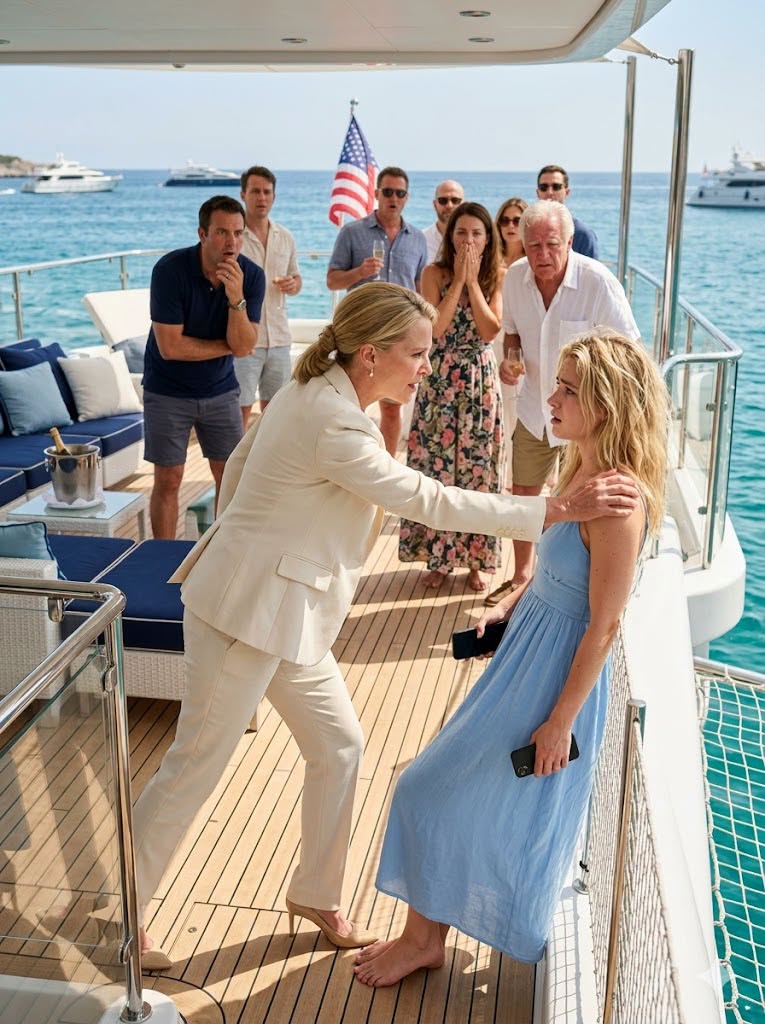
Then she shoved me.
It happened fast enough that several people later claimed they had not seen the beginning, which was convenient for them and meaningless to me.
I saw it.
I felt it.
Her palm struck my shoulder with an ugly force, my heel caught on a metal cleat near the rail, and for one suspended second, the entire yacht vanished beneath me.
There was only sky above, polished metal beside me, and dark harbor water chopping below.
My hand caught the rail hard enough to send pain burning up my wrist.
A woman screamed.
A glass shattered.
The jazz kept playing.
That part bothered me more than it should have, because the music remained soft, elegant, and polished, still pretending the world was civilized while I clung to the rail trying not to fall.
I pulled myself upright inch by inch.
My knuckles turned white around the metal, my shoulder burned, my dress clung wetly to my legs, and nobody helped me.
The guests stood frozen with their glasses, tans, linen shirts, diamonds, and practiced manners, wrapped in all that expensive silence.
Richard did not move.
Victoria looked furious that I had caught myself.
Then Liam sighed.
“Babe, honestly,” he said. “Maybe go downstairs for a minute. You’re upsetting Mom.”
There are moments when love dies in a dramatic explosion, with slammed doors, broken promises, and voices raised high enough for the neighbors to hear.
There are others when it simply stops breathing.
Mine stopped right there, between the rail and Liam’s sunglasses.
I did not cry.
I did not throw a glass at him, though for one ugly heartbeat I imagined Richard’s cigar hitting the water, Victoria’s smile cracking, and Liam finally being forced to remove those ridiculous sunglasses and look directly at the woman he had allowed his family to degrade.
Instead, I did what years of discipline had taught me to do.
I acted on paper.
My thumb pressed the red authorization button.
For three seconds, nothing happened.
Then the captain’s radio crackled across the upper deck.
At first, people assumed it was ordinary harbor traffic, some routine communication from shore or another vessel drifting too close.
Then the siren rolled over the water.
Every head turned.
A police launch cut through the chop toward the yacht, blue lights flashing against the white hull, throwing hard pulses of color across Victoria’s face.
The jazz shut off abruptly.
The sudden silence felt louder than the music ever had.
Liam stood too quickly, and his beer tipped over onto the deck.
Victoria took one step back.
Richard rose from his chair with the stiff, theatrical slowness of a man trying to look offended before anyone noticed he was afraid.
“This is private property,” he said, though his voice had lost much of its body.
The launch came alongside.
Two harbor police officers secured the position, their expressions professionally neutral in the way officers look when they have already been briefed enough not to be impressed by wealth.
The first person to step onto the yacht was not one of them.
It was Elena Marquez.
Elena was Sovereign’s chief legal officer for asset recovery, and she looked exactly the way she always looked when expensive men were about to discover the difference between confidence and documentation.
Navy suit.
Wind-whipped hair.
Waterproof case under one arm.
Megaphone in hand.
She stepped onto the deck, looked past Victoria, past Richard, past Liam, and directly at me.
“Madam President,” she said, clear enough for every guest to hear. “The foreclosure papers are ready for your signature.”
No one laughed then.
Victoria’s face changed first.
Her contempt did not disappear all at once, because contempt had been holding her upright for too many years to release her easily.
It drained slowly, as if she were trying to keep it fixed in place and could not.
Richard’s cigar slipped from his fingers and struck the deck, leaving a dark burn mark against the white surface.
Liam removed his sunglasses.
It was the first honest thing he had done all afternoon.
“There’s been some mistake,” Victoria whispered.
Elena did not look at her.
“Maritime repossession order is active,” she said. “Default amounts have been verified, cure periods have expired, and harbor police are present to witness service.”
Richard found his voice, though it arrived rough and thin.
“You can’t just board my yacht.”
Elena opened the waterproof case on the nearest table.
“It is not your yacht.”
The sentence did not need volume.
It had documents.
She removed the first folder and placed it flat beside the spilled beer, where the top page listed the vessel identification, lease structure, missed-payment schedule, notice dates, and final cure deadline.
Richard stared at it.
His eyes moved faster than his mouth could recover.
“You bought this?” he asked.
I took the folder from Elena.
“My firm acquired the package this morning.”
Liam’s head snapped toward me.
“Your firm?”
The question was almost funny.
Almost.
I looked at him, and for one second, I remembered the man from the coffee shop, the one who had stood by the register during my Saturday shift and brought me a paper cup with my own name misspelled on it as a joke.
I remembered the man who once told me he liked that I was “real,” and I understood, with sudden perfect clarity, that he had never meant real as a compliment.
He had meant small.
He had meant manageable.
He had meant someone who would be grateful for a place on his family’s deck.
“Yes,” I said. “My firm.”
Victoria’s voice sharpened again, though it trembled around the edges.
“She’s a barista.”
Elena turned one page.
“Ms. Carr is president of Vantage Capital.”
That was the first moment Richard looked truly afraid.
Not angry.
Afraid.
Men like Richard can dismiss women, service workers, girlfriends, and anyone who fails to arrive wearing obvious power like a uniform, but they have a much harder time dismissing signatures, lien schedules, and dated notices.
Elena flipped to the second tab.
“This section concerns the summer property.”
Victoria grabbed the back of a chair.
The Hamptons house had been her favorite prop all afternoon, a phrase she repeated four separate times without ever saying anything meaningful about it, as though the word itself proved she belonged to a class of people consequence could not reach.
“The house?” she said.
“The collateralized property,” Elena corrected.
Richard opened his mouth, then closed it.
The third tab was worse.
His operating line.
That was where the family image truly began to come apart, because the yacht was vanity, and the summer house was theater, but the operating line was the business, the foundation Richard had used to make himself sound untouchable at dinners, charity auctions, club lunches, and parties where nobody asked too many questions about cash flow.
Elena laid out the default notice, amended repayment schedule, and final demand letter.
Each page had a date.
Each date had passed.
Each signature led back to him.
“This is predatory,” Richard said.
“No,” I replied. “This is overdue.”
Victoria turned on Liam.
“Say something.”
He looked at his mother, then at me.
For the first time since I had met him, Liam did not know which woman in the room had more power, and that confusion told me everything I needed to know about the way he measured loyalty.
“Elena,” he said weakly, as though using her first name might soften the law.
Elena ignored him and reached for the final divider.
It was thinner than the others.
That made it more dangerous.
Richard saw the label before anyone else did.
PERSONAL GUARANTY — ADDENDUM B.
His face went gray.
“Don’t,” he said.
It was not loud, and that made Victoria turn toward him with sudden alarm.
“What is that?” she asked.
Richard did not answer.
Liam reached for the page, but Elena moved it just out of reach with the calm precision of a woman who had prevented desperate hands from touching dangerous documents many times before.
“Copies will be provided after service,” she said.
I looked down at the signature line.
There was Richard’s name.
There was the date.
And beneath it was the supporting acknowledgement Liam had signed as witness months earlier, back when he was still telling me his family had “a few cash-flow issues” but nothing serious.
He had known enough.
Not everything.
Enough.
The difference mattered legally, but not emotionally.
Liam whispered my name.
I looked up.
He had no sunglasses now.
No lazy smile.
No convenient silence to hide inside.
“Please,” he said.
That word might have mattered if he had said it when his mother spilled a drink on me.
It might have mattered when she told me to mop the floor.
It might even have mattered when she shoved me toward the rail.
But now it was only fear wearing a softer shirt.
Victoria began to cry.
It was not grief.
It was calculation losing its balance.
Richard leaned both hands on the table and stared at the folders as though the papers might rearrange themselves if he looked hard enough.
The guests had gone silent in a new way.
Earlier, their silence had protected Victoria, but now it protected themselves.
Nobody wanted to be remembered as laughing.
Nobody wanted to be standing too close to Richard when the documents were served.
Nobody wanted their name attached to the moment the Richardson family stopped looking untouchable.
Elena placed a pen in my hand.
“The repossession can proceed upon signature,” she said.
I looked around the yacht.
The champagne tower.
The teak chairs.
The polished rail that had nearly slipped from my hand.
The cigar burn on the deck.
The martini stain drying stiffly on my dress.
Then I looked at Liam.
He took one step toward me.
I lifted one hand, and he stopped.
That, too, told me everything.
He knew obedience when it came from power.
He had simply never offered it to pain.
“Your family wanted to know where I belonged on this boat,” I said.
Victoria made a small sound.
I signed the first page.
“Apparently,” I continued, “the answer is above the signature line.”
The pen moved smoothly.
One signature for the yacht.
One acknowledgement for service.
One authorization for recovery to proceed according to the terms Richard had agreed to when he still believed terms were for other people.
The harbor police witnessed everything.
There were no handcuffs.
There did not need to be.
Sometimes consequence does not arrive shouting.
Sometimes it arrives with a folder, a pen, and a woman in a navy suit who has already checked the dates.
The captain received instructions from the recovery team, and the guests were told they would be escorted back to shore.
Victoria sat down hard in a chair she had probably chosen for its imported wood and never imagined using because her legs could no longer hold her.
Richard asked Elena for time.
Elena explained the cure period had already expired.
He asked for a call with his attorney.
She gave him the number listed on his own loan documents.
He asked who had authorized all this.
Everyone looked at me.
That was when Liam tried one last time.
He followed me toward the lower stairs, away from the guests, the folders, the ruined performance, and his mother’s trembling hands.
“Emily,” he said.
I stopped because I wanted to hear what a man says after failing a test he did not know he was taking.
“I didn’t know it was like this,” he said.
I believed him in the narrowest possible way.
He did not know about every document, every notice, every missed deadline, or the acquisition that had closed at 9:14 that morning.
He did not know my title.
He did not know my firm.
He did not know that the quiet woman in the pale dress, the woman his mother called a barista, had been holding the legal authority to take the yacht out from under him before he even opened his first beer.
But he knew his mother was cruel.
He knew his father enjoyed it.
He knew I was being cornered.
He knew I almost went over the rail.
And he knew he had told me to go downstairs because I was upsetting his mother.
“You knew enough,” I said.
His face tightened.
“That’s not fair.”
I almost laughed.
Fair was not a word people like Liam reached for until consequences entered the room.
“It is exactly fair,” I said.
Then I walked past him.
Onshore, the air felt different.
Not cleaner exactly.
Just honest.
The harbor smelled of diesel, salt, wet rope, and fried food from a dockside stand where people were eating from paper trays and not pretending the world owed them softer chairs.
I stood near the railing while Elena finished a call, my ruined dress drying against my legs and my shoulder pulsing with a dull ache that seemed to move deeper now that the adrenaline had started to leave.
My phone buzzed three times.
Emily, please.
Can we talk?
I love you.
I looked at the last message for a long time.
Then I deleted the thread.
The first night after the yacht, I did not sleep.
People imagine that justice feels like a clean strike, a bell ringing, a final door closing with satisfying force, but real consequence is messier, slower, and colder than fantasy.
I sat on the edge of my bed in my apartment overlooking the city, wearing an old sweatshirt and holding a mug of tea that went cold before I drank any of it.
My wrist ached from the rail.
My shoulder had begun to bruise where Victoria’s palm had hit me.
The martini dress lay across the back of a chair like evidence from someone else’s life, pale fabric stained and stiff, carrying the smell of salt and gin.
At midnight, Elena called.
She had waited until she knew I would still be awake.
“Richard’s attorney reached out,” she said.
“Already?” I asked.
“He called it a misunderstanding.”
I looked at the dress.
“Of course he did.”
Elena was quiet for a moment, not because she lacked words, but because she had known me long enough to understand when business and humiliation were standing too close together.
“You handled it cleanly,” she said.
I let out a breath.
“That doesn’t mean I handled it easily.”
“No,” she said. “It just means they mistook your restraint for weakness.”
That was the sentence I carried with me into the next morning.
They had mistaken my restraint for weakness.
That mistake had shaped the entire afternoon.
Victoria had not spilled a drink because she lost control.
She did it because she believed control belonged to her.
Richard had not mocked me because he was careless.
He did it because he believed my dignity was cheaper than his cigar.
Liam had not stayed silent because he did not understand.
He stayed silent because my humiliation cost him less than confronting his mother.
The next week was not glamorous.
That is the part people never imagine when they fantasize about revenge.
There were calls with counsel, asset schedules, notice confirmations, insurance reviews, creditor responses, vessel condition reports, and settlement proposals written in language so dry it could drain the drama from a thunderstorm.
Richard tried to dispute the default amounts.
The numbers did not move.
Victoria tried to claim she had not understood the structure.
Her name was not required for the sections she wanted to deny.
Liam left voicemails I did not listen to all the way through.
The first began with apology.
The second began with explanation.
The third began with anger.
By the fourth, he had discovered the tone of a man who wants forgiveness without surrendering the version of himself that caused the damage.
I deleted that one before he finished saying my name.
Three days after the yacht, Victoria sent flowers to my office.
White lilies.
No card at first.
Then my assistant, Mara, found a small cream envelope tucked under the ribbon, written in the kind of slanted cursive that looked more like social training than sincerity.
Emily, emotions ran high on Saturday, and I regret that the afternoon became unpleasant.
I read it once, then handed it to Mara.
“Would you like me to respond?” she asked.
“No,” I said. “File it.”
“Under what?”
I looked at the lilies.
“Evidence of character.”
Mara tried not to smile.
By Friday, the story had started to leak.
Not officially, not through any statement from Vantage, and certainly not from Elena, who treated confidentiality like a religion.
It moved the way all humiliating stories move among people who pretend not to gossip, through careful omissions, raised eyebrows, and sentences beginning with “I shouldn’t say this, but.”
Someone from the yacht had told someone at the club.
Someone at the club had told someone whose brother worked near the marina.
Someone at the marina had mentioned the police launch.
By the weekend, the version circulating through three different circles was simple and wrong.
A barista had secretly owned the yacht.
A barista had destroyed a rich family.
A barista had tricked a man into dating her so she could take revenge.
People like simple stories because simple stories do not require them to examine themselves.
The truth was uglier and less convenient.
I had not tricked anyone.
I had told Liam the truth in plain language, and he had translated it downward until it fit the size he wanted me to be.
I had not destroyed Richard.
Richard had signed documents, ignored notices, missed payments, leveraged assets, and performed wealth so loudly that he drowned out the sound of his own collapse.
I had not humiliated Victoria.
Victoria had humiliated herself by assuming basic dignity was optional when offered to someone she considered beneath her.
Still, I did not correct every version.
Let people talk.
Let the harbor carry the noise.
The documents were quieter and stronger.
On Monday morning, I went to Rowan Street Coffee before sunrise.
The sky was still gray, the sidewalks damp from overnight rain, and the streetlights shone against the storefront windows in soft, uneven streaks.
Inside, the shop smelled like espresso, warm milk, cinnamon, toasted bagels, and the faint lemon cleaner our opener always used too generously on the counter.
I tied on an apron.
Mara, who had once asked me why I still worked shifts there when my calendar could barely survive normal business hours, had finally stopped asking.
She understood that not every valuable thing needed to make sense on a balance sheet.
At 6:42, the first regular came in.
Mr. DeLuca, retired electrician, black coffee, no room, two sugars he always pretended were for his wife.
At 6:55, a nurse from St. Agnes came through with wet hair under a hood, ordered a large coffee and a blueberry muffin, and stood by the pickup counter rubbing one hand over her eyes.
At 7:10, the school rush began.
Mothers, fathers, teachers, teenagers with backpacks, one little boy in dinosaur rain boots who always asked whether hot chocolate counted as breakfast.
Real life, ordinary life, moved in and out through the sticking bell.
Nobody cared about yachts.
Nobody asked about lease structures.
Nobody spilled a drink on anyone to prove dominance.
Then Liam appeared outside the front window.
I saw him before he saw me.
He looked smaller without the yacht behind him.
He stood near the door holding his keys, wearing a button-down shirt too formal for the neighborhood and a face full of rehearsed apology.
For a moment, he did not come in.
He looked at the café window, at the people inside, at me behind the counter, and I saw the old calculation moving behind his eyes.
He was trying to decide which version of me he was facing.
The barista.
The executive.
The girlfriend.
The woman who had signed his family’s boat away.
The bell over the door stuck twice when he entered.
I kept wiping the counter.
“Emily,” he said.
The shop was busy enough that his voice had to compete with the grinder, the steam wand, and a toddler asking for a cookie with the urgency of a person negotiating a hostage situation.
“I owe you an apology,” he said.
“Yes,” I replied.
He waited for more.
I gave him nothing.
“I should have defended you,” he said.
“Yes,” I said again.
His eyes reddened, and for one second I saw the man he might have been if comfort had not raised him badly.
“I was scared of making it worse,” he said.
“No,” I said. “You were scared of making it yours.”
That landed.
His mouth opened, but nothing useful came out.
Behind him, the nurse reached for her coffee and gave me a look that said she had heard enough to understand more than he wanted her to.
I handed over her cup.
“Have a good shift,” I told her.
She nodded and slipped a dollar into the tip jar.
Liam looked around the coffee shop as though seeing it for the first time, not as a quaint background for his fantasy of dating someone humble, but as a living place full of people who had never been small simply because he failed to recognize their size.
The worn floor.
The community board.
The cracked blue mug beside the register.
The tip jar with a sticky note on it.
The old man reading the paper in the corner.
The young mother bouncing a baby against her shoulder while checking her phone.
All the ordinary human weight he had mistaken for scenery.
“I thought you worked here,” he said quietly.
“I do,” I replied.
He swallowed.
“But you own—”
“I own a lot of things,” I said. “That was never the part you were supposed to respect.”
He looked down.
For a moment, I thought he might finally say something honest without trying to protect himself from it.
Instead, he asked the question that ended him.
“Was any of it real?”
I looked at him across the counter, with the espresso machine hissing beside me and the morning rush pressing in around us, and felt no anger at first.
Only sadness.
Not the soft kind.
The tired kind.
“It was real for me,” I said. “That was the problem.”
His face changed.
He wanted to argue, to tell me I was being cruel, to reach across the counter and make the moment intimate enough that I would forget where we were and what he had done.
But the people behind him were waiting for coffee, and life had already moved on without asking his permission.
He left without ordering.
The bell stuck again on his way out.
That afternoon, Richard’s attorney sent a revised proposal.
It was insulting.
Not because the numbers were low, though they were.
It was insulting because the tone assumed we would be motivated by embarrassment, nostalgia, or the desire to make this go away quietly.
Men like Richard often believe every person has a private price, because they have spent their lives selling pieces of themselves and calling it strategy.
Elena read the proposal in my office, sitting across from me with her glasses low on her nose.
“He wants time, reduced penalties, confidential restructuring, and a non-disparagement clause broad enough to cover the weather,” she said.
I looked through the window at the city.
“Does he admit default?”
“No.”
“Does he cure?”
“No.”
“Then decline.”
Elena closed the folder.
“I assumed.”
I turned back to her.
“And Elena?”
“Yes?”
“No personal language in the response.”
Her expression softened slightly.
“You’re sure?”
“I am.”
Because anger, no matter how justified, can become a place people lure you into so they can accuse you of being emotional once you arrive.
Richard would have loved a furious response.
Victoria would have loved proof that I was vindictive.
Liam would have loved evidence that my decision had come from heartbreak instead of documentation.
So I gave them none of it.
Vantage responded with dates, amounts, terms, and deadlines.
Not one adjective.
Not one insult.
Not one wound.
By the end of the month, the yacht had been secured, inspected, and transferred into recovery management.
The Richardson summer property entered a separate negotiation track, and Richard’s operating line became the center of a much larger unraveling than his wife’s friends could understand from gossip alone.
Vantage did not crush him.
We did not need to.
The structure he had built was already collapsing under the weight of its own arrogance.
The more his advisors examined the documents, the quieter they became.
That is the thing about paperwork.
It has no ego, but it remembers everything.
Victoria tried once more.
Not at my office.
Not through lawyers.
At a charity luncheon.
I had almost skipped it, but the foundation we supported funded housing transition programs for women rebuilding after financial abuse, and I refused to let Victoria’s presence exile me from rooms where real work mattered.
The luncheon was held in a bright hotel ballroom with white tablecloths, silver chargers, soft floral arrangements, and the particular kind of lighting that makes wealthy donors look generous even before they write checks.
I arrived in a slate-blue dress, my hair pinned low, my wrist still faintly tender when I reached for a glass of water.
Victoria was there in pale pink, seated near the front beside two women who had been on the yacht.
For the first hour, she avoided looking at me.
Then, after the first speaker and before the main course, she crossed the ballroom with a smile too practiced to be innocent.
“Emily,” she said.
The women at my table went quiet.
“Victoria,” I replied.
Her eyes flicked over my dress, my face, my hands, looking for damage she could name.
“I hope you understand,” she said, keeping her voice low enough to perform privacy and high enough to be overheard, “that Saturday was a difficult day for everyone.”
I looked at her.
“Was it?”
Her smile tightened.
“You embarrassed my family.”
There it was.
Not apology.
Not regret.
A charge.
I set down my water glass carefully.
“No,” I said. “Your family was documented.”
One woman at the table coughed into her napkin.
Victoria’s jaw hardened.
“You could have handled it quietly.”
“You could have behaved decently.”
Her cheeks flushed.
For a second, I saw the same fury that had flashed across her face before she shoved me.
But we were not on a yacht now.
There was no rail behind me.
There were too many witnesses, too much daylight, and too little borrowed territory beneath her feet.
“I don’t know what Liam saw in you,” she whispered.
That might have hurt once.
By then, it only clarified her.
“He saw someone he thought you could look down on,” I said. “I can understand why that appealed to both of you.”
Victoria inhaled sharply.
Then the luncheon chair approached, smiling brightly with the desperate cheer of a woman sensing danger near the salad course.
“Everything all right here?”
“Perfectly,” I said.
Victoria returned to her table without another word.
Ten minutes later, I stood at the podium and announced that Vantage Capital would double its annual commitment to the foundation, specifically expanding emergency legal support for women facing housing instability tied to coercive financial control.
I did not look at Victoria when the room applauded.
I did not need to.
Some victories are stronger when they refuse to stare at the person who made them necessary.
After the luncheon, an older woman stopped me near the coat check.
She had silver hair, a navy suit, and a small pearl pin shaped like a dove.
“I was at the next table,” she said.
I braced myself.
Instead, she touched my arm gently.
“My husband used to do that,” she said. “Make things unbearable, then accuse me of embarrassing him when I stopped pretending.”
I felt the room tilt slightly around her words.
“I’m sorry,” I said.
She smiled, but it carried years.
“Don’t be. He’s gone now, and I’m still here.”
Then she squeezed my arm and walked away.
That moment stayed with me longer than Victoria’s insult.
Because beneath every dramatic story people tell for entertainment, there are quieter truths that belong to real women in real rooms.
There is always someone listening who recognizes the shape of the bruise, even when the bruise is not visible.
Summer moved forward.
The harbor filled with other boats, other parties, other people performing ease while engines burned money beneath them.
The Richardson yacht disappeared from its usual slip, and for a few weeks, that absence seemed to disturb certain people more than the behavior that caused it.
I heard Richard had stopped appearing at the club.
I heard Victoria had blamed stress, bad advisors, interest rates, jealousy, and “unprofessional aggression.”
I heard Liam had taken a leave from his position at the family firm.
I did not ask for updates.
They arrived anyway.
Powerful families rarely fall quietly, because too many people have spent too long pretending the noise they make is music.
One evening in late August, I went back to the harbor alone.
Not for business.
Not for confrontation.
For myself.
The sky was soft with the last light of day, and the water moved in small silver folds against the docks.
Tourists walked with ice cream cones.
Children leaned over railings looking for fish.
A man in a Red Sox cap argued gently with his wife about where they had parked.
Life continued with extraordinary indifference.
I stood where I had stood after leaving the yacht, near the railing that overlooked the launch path, and watched the boats move slowly through the harbor.
For weeks, people had asked me whether I felt powerful in that moment, whether watching Victoria tremble had satisfied something wounded inside me.
The truthful answer was complicated.
I did not feel powerful when Elena called me Madam President.
I felt exposed.
I did not feel victorious when Richard’s cigar hit the deck.
I felt tired.
I did not feel pleasure when Liam said please.
I felt the final door close.
Power, real power, is not the theatrical moment when everyone finally realizes who you are.
It is the private discipline of knowing who you are before anyone else admits it.
I had been powerful before the yacht.
Before the martini.
Before Victoria’s insult.
Before Liam’s silence.
The papers had not made me valuable.
The title had not made me worthy.
The police launch had not made me human.
Those things had only forced people who should have known better to confront what they had chosen not to see.
My phone buzzed while I stood at the railing.
Unknown number.
I almost ignored it.
Then I answered.
“Emily Carr,” I said.
For a moment, there was only breath.
Then Liam spoke.
“I know I shouldn’t call.”
“No,” I said. “You shouldn’t.”
“I’m not calling to ask for anything.”
I stayed silent.
He understood enough to keep talking.
“My father is stepping down,” he said. “The board pushed it.”
“That sounds like something your family should discuss with counsel.”
“I know.”
The harbor wind moved against my face.
“My mother says you ruined us.”
“She would.”
“But I know that’s not true,” he said, and his voice cracked in a way that might have moved me months earlier. “We were already ruined. You just stopped letting us pretend.”
I closed my eyes briefly.
“That is closer to the truth.”
“I’m sorry,” he said.
This time, the words were quieter.
No performance.
No audience.
No request tied to them.
“I’m sorry for the yacht, for the coffee shop, for every time I let her talk to you like you were lucky to be near us.”
I looked out at the water.
“You were not the worst person on that deck,” I said. “But you were the one who owed me better.”
“I know.”
“You loved the version of me that made you feel generous.”
He did not answer right away.
Then he said, “Yes.”
It was the first time he had told the truth without decorating it.
I let that truth sit between us.
“Goodbye, Liam,” I said.
“Emily—”
“No,” I said, not harshly, but finally. “Goodbye.”
I ended the call.
The harbor kept moving.
No lightning struck.
No music swelled.
No perfect cinematic justice arrived to underline the moment.
Sometimes healing is not dramatic.
Sometimes it is just ending a call and realizing your hand is steady.
In September, Rowan Street Coffee held a neighborhood fundraiser after a fire damaged two apartments above a laundromat three blocks away.
The shop was packed from morning until late afternoon, with volunteers squeezing behind the counter, children decorating paper cups, and local musicians playing near the window.
I worked the register for six hours.
My hair smelled like coffee, my shoes ached, and by closing time, the tip jar was stuffed with bills folded so tightly we had to empty it into a mixing bowl.
A little girl in a yellow raincoat handed me three quarters and a button.
“For the people whose house got smoky,” she said solemnly.
I put the button beside the cash.
“Very important contribution,” I told her.
Her father smiled over her head.
Moments like that reminded me why I loved the place.
It was not charming because it was small.
It was powerful because it connected people before crisis turned them into case files.
That evening, after the last customer left and the chairs were turned upside down on the tables, Mara came by with takeout and a stack of documents needing signatures.
“You know,” she said, watching me wipe the counter, “most presidents of capital firms do not clean espresso machines after charity fundraisers.”
“Most presidents of capital firms are missing out.”
She leaned against the counter.
“On sticky milk residue?”
“On perspective.”
Mara laughed.
Then she grew thoughtful.
“Do you ever get tired of people needing the reveal before they respect you?”
I rinsed a cloth and wrung it out.
“Yes.”
“What do you do with that?”
I looked around the quiet shop.
The community board.
The worn floor.
The little bell over the door.
The button in the donation bowl.
“I try not to become someone who needs the reveal too.”
Mara was quiet after that.
So was I.
Because that was the danger nobody warned you about.
After you survive being underestimated, there is a temptation to overcorrect, to walk into every room carrying proof like a weapon, to make sure nobody ever mistakes your silence for permission again.
But I did not want to become a woman who demanded awe before offering kindness.
I did not want Victoria’s worldview to survive inside me wearing better clothes.
So I kept working where I wanted to work.
I kept listening before correcting.
I kept my title when necessary and let it rest when it was not.
The difference was that I no longer confused humility with hiding.
In October, the final settlement on the Richardson business assets closed.
Richard avoided personal bankruptcy, though narrowly, and only after surrendering more control than a man like him could easily survive.
The yacht was sold.
The summer property was transferred.
The operating company was restructured under oversight that would have made Richard’s old golfing friends choke on their drinks.
Victoria disappeared from several committees, then reappeared in smaller rooms with less flattering lighting and fewer people willing to laugh too quickly.
Liam took a job outside the family business.
I learned that from Elena, who mentioned it only because his name appeared in a closing document.
“Do you care?” she asked.
I thought about it.
“No,” I said.
Then, after a moment, I added, “But I hope he learns.”
Elena looked at me over the folder.
“That is generous.”
“It’s not for him.”
And it wasn’t.
Somewhere along the way, I had stopped wanting Liam punished forever.
I did not want him back.
I did not want his regret placed at my feet like flowers.
I did not want his mother humbled on repeat until the bruise inside me applauded.
I simply wanted the truth to remain true without requiring my constant witness.
That is when I knew the story was no longer controlling me.
Months later, people still told the yacht story as if it were about a secret millionaire humiliating a rich family.
They liked that version.
It sparkled.
It had disguise, arrogance, a public reveal, a police launch, a ruined dress, and a wealthy woman forced to sit down before her legs betrayed her entirely.
That version always missed the point.
Money was not the lesson.
Power was not the lesson either.
The lesson was simpler and harder.
A person should not have to own the debt beneath your feet before you decide she deserves basic dignity.
I still work shifts at Rowan Street Coffee when I want to.
I still like the sound of the grinder in the morning, the stubborn bell over the door, the little rush near school drop-off when parents come in half-awake with backpacks, car keys, and paper cups stacked in their hands.
Sometimes someone recognizes me from the story and asks whether it felt good to sign those papers.
I tell them the truth.
It did not feel good.
It felt clean.
There is a difference.
Good would have meant I enjoyed watching Victoria tremble.
Clean meant I finally stopped pretending her cruelty was something I had to absorb quietly.
Good would have meant Liam suffered enough for me to feel repaid.
Clean meant I no longer needed him to understand what he had broken.
Good would have made the yacht the center of the story.
Clean let me leave it at the harbor.
The martini stain came out only halfway.
I kept the dress anyway.
It hangs in the back of my closet, pale linen marked faintly at the knees, not as a trophy and not as a wound, but as a receipt.
Because that afternoon on the yacht taught me something I do not intend to forget.
Quiet betrayal rarely announces itself with a scream.
It sits in sunglasses, watches you reach for the rail, and calls your survival an inconvenience.
It hides behind words like peace, family, timing, and don’t make this worse.
It asks you to shrink so someone cruel can remain comfortable.
And when the harbor finally answered, when the police launch cut through the water and Elena stepped aboard with the documents that made everyone stop laughing, it did not make me powerful.
It only revealed that I had been powerful before they ever decided I was nothing.
The End