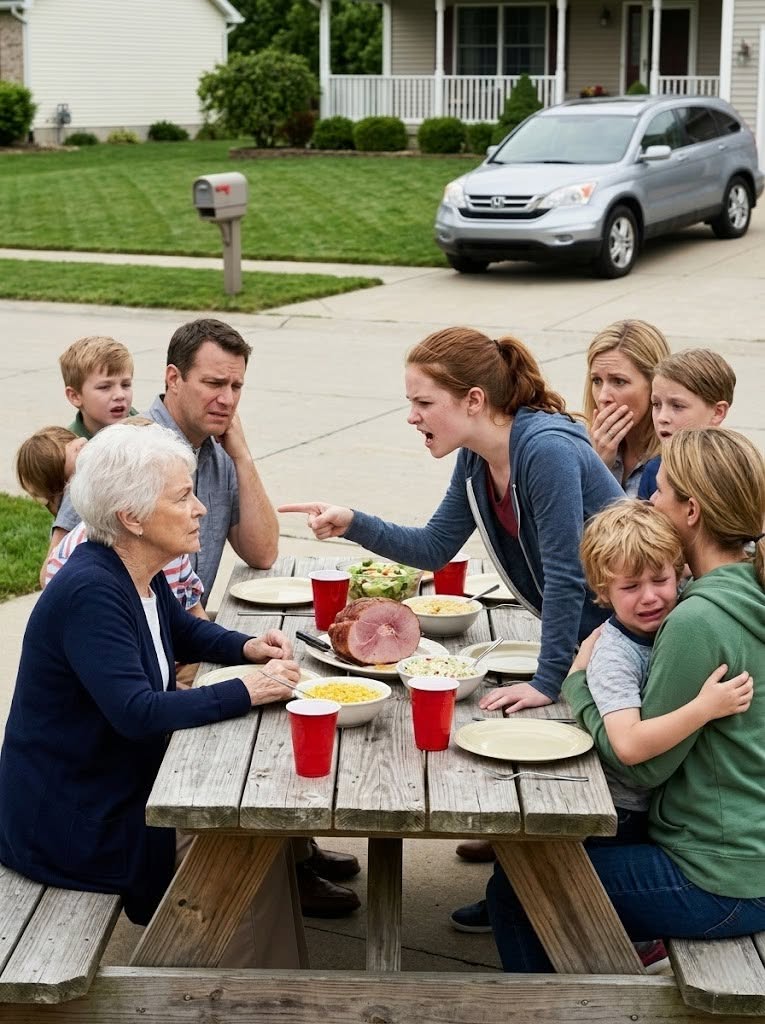
At the Easter picnic, my mother looked across a table crowded with ham, paper plates, sweating deviled eggs, and children’s candy-sticky hands, then said, as calmly as if she were asking someone to pass the rolls, “Next time, don’t bring the kid.”
No one defended my son, not my father under the shade umbrella, not my brother with his plastic cup frozen near his mouth, not my aunts who had spent decades correcting everyone else’s children but suddenly found the potato salad more interesting than a six-year-old boy’s broken face.
The only person who moved was my thirteen-year-old daughter, Marlo, who shoved her chair back so hard the metal legs screamed across my sister’s patio concrete, then stood with her fingers planted on the table and looked straight at my mother.
“Say that again,” she said, and every conversation in that backyard died as if someone had cut the power to the whole afternoon.
It had been warm that day, the kind of spring Sunday that tricks people into believing life is softer than it really is, with cut grass in the air, sunscreen on the children’s shoulders, chocolate melting too quickly inside plastic eggs, and the faint snap of a small American flag clipped to the porch railing because my brother-in-law put one there every spring and forgot about it until the first cold wind of fall.
My sister Sarah had dragged folding tables across the backyard, thrown pastel tablecloths over them, filled coolers with soda, and arranged desserts on the porch like she was hosting the kind of family gathering people take pictures of and pretend represents who they are.
Theo had been excited from the moment he woke up, because he was six years old and still believed family meant cousins, candy, grown-ups who smiled when they saw him, and a grandmother who meant it when she called children sweetheart.
He wore his blue hoodie even though the afternoon was too warm for it, because the zipper had a tiny plastic dinosaur hanging from it, and he had told me, with deadly seriousness over breakfast, that the dinosaur made him lucky.
By noon, he had chocolate on his chin, grass stains on both knees, and the bright, trusting look of a child who has not yet learned that some adults can reject you without raising their voices.
By one-thirty, my mother had already corrected two relatives for using the phrase “our boy,” and both times she had done it with the careful sweetness that made people doubt their own ears.
“Well,” she had said the first time, not looking at me and smoothing the sleeve of her pale cardigan, “technically he’s Emily’s son.”
That word had followed me for years, sharp and polished and always delivered with just enough restraint to look harmless.
Technically.
It was my mother’s favorite way to push my son outside the circle without admitting she was the one drawing the line.
Technically, Theo was mine.
Technically, he had arrived after my divorce.
Technically, he did not carry the family name my mother treasured when it was useful and used as a weapon when it was not.
Marlo was my daughter from my marriage, and nobody questioned her place at the table, because she fit into a story my family understood, even if they never cared enough to know all of her.
Theo came later, during the difficult years when I worked closing shifts, paid bills in trembling order of urgency, drove a used SUV with a passenger window that stuck halfway down, and learned exactly how long one woman could stand in a grocery aisle doing math before she put something back.
My mother had never forgiven me for needing help, but what took me longer to understand was that she had hated me even more for surviving after I stopped asking for her approval.
Some people do not hate your weakness as much as they hate the day you prove their control was never the same thing as love.
For years, I had been useful to my family, and useful people get invited, useful people get teased, useful people get handed grocery lists at the last minute, and useful people get called dramatic when they finally say the teasing hurts.
I paid for groceries when my parents’ card declined at the pharmacy, sent my brother money for truck tires after he swore he would pay me back the following Friday, and bought birthday gifts for nieces and nephews whose parents forgot my children’s birthdays twice in the same year.
I brought paper towels, foil pans, dinner rolls, plastic cups, and cash for the egg hunt prizes that Easter because my mother texted me at 8:17 that morning, not with a request, not with a please, not with even the faintest shape of gratitude.
Don’t forget cash for the kids.
That was all.
I brought it anyway, because the humiliating truth is that training does not disappear just because a woman grows older, pays her own rent, raises her own children, and tells herself she is done crawling back to people who only recognize her when they need something.
I brought the cash, the side dish, the extra napkins, the children, and the old, folded instinct to apologize for things I had not done.
The first hour was fine in the way family gatherings are fine when everyone agrees not to step directly on the land mines buried under the lawn.
My father sat beneath the shade umbrella and complained about gas prices as though prices, not cowardice, had been the great burden of his life.
My brother leaned back in his chair, talking about his job, his boss, and the endless bad luck that had somehow followed him into every paycheck and every unpaid loan.
My mother moved from table to table in pearls and a pale cardigan, making little corrections like she was tending a garden only she could see.
“Move that dish out of the sun.”
“Don’t let the kids track mud near the porch.”
“Emily, did you bring the cash?”
I said yes, and she smiled like I had passed a test I never signed up to take.
Then Theo ran past her with a plastic egg in one hand and a chocolate bunny in the other, and I saw her smile thin until it barely belonged on her face.
I saw it, and I looked away.
That was my mistake, though I had made it so many times by then that it no longer felt like a choice.
Silence becomes a family habit the same way smoking does, because at first you choose it, then you crave it, then you pretend it is keeping everyone calm while it slowly poisons the room.
We sat down to eat around two, with twenty-three adults gathered around folding tables and children scattered between the lawn, porch steps, and the egg baskets abandoned in the grass.
The plastic tablecloths snapped in the breeze, someone’s phone played soft music through a speaker near the cooler, and for a few minutes, the afternoon looked almost normal if you did not know where to look.
Theo climbed into the chair beside me with the careful seriousness of a child balancing a full paper plate, and on it he had ham, fruit salad, two rolls, and one deviled egg he had already decided he did not trust.
Across from him, Marlo sat with her long legs tucked under her chair, her jean jacket pulled over her Easter dress, and her eyes moving between Theo and the adults with the kind of vigilance no child should have to develop.
She had always watched him differently from the rest of my family, not like an obligation, not like a complication, but like a promise she had made before she was old enough to understand the weight of it.
She remembered the nights he had fever dreams and I had to work the next morning.
She remembered standing in the school pickup line with me when the SUV would not start, the sun was dropping, and I had to call a neighbor for help while pretending I was not close to crying.
She remembered Theo sleeping on her lap in the laundromat while I folded work uniforms at ten o’clock at night under fluorescent lights that made every tired face look ghostly.
My children knew the history my family pretended not to see, and that is the thing adults forget about children, because children may not understand every bill, every insult, or every careful family lie, but they always know who showed up and who only commented from a safe distance.
My mother waited until plates were in everyone’s hands, and I understood later that it was not an accident.
She always chose moments when leaving would look rude, when objecting would look dramatic, and when pain could be dismissed as an overreaction because dessert had not yet been served.
Theo reached for a chocolate egg that had rolled near the center of the table, and as he stretched, the cuff of his blue hoodie brushed a stack of napkins.
Two napkins slid off the table and landed on the grass.
He froze as if he had broken something valuable.
“Sorry,” he said quickly.
I reached down to pick them up, but before my fingers touched the grass, my mother sighed.
It was not a big sigh, and that was why it worked.
It sounded almost reasonable, almost tired, almost like she had been patient for far too long with a six-year-old boy who had dropped two paper napkins in the grass.
“Next time,” she said, “just don’t bring the kid.”
The sentence did not crash through the backyard.
It landed softly, neatly, almost politely, and somehow that made it more violent than shouting.
For half a second, the world continued moving as though it had not heard her.
A cousin laughed near the fence, the speaker kept playing music beside the cooler, and the little flag on the porch snapped once in the breeze.
Then the adults at our table went still.
My father looked down at the wicker pattern of his chair like it had suddenly revealed the meaning of life.
My aunt stared at her potato salad.
My brother tapped his cup once against the table, then stopped as if the sound had betrayed him.
A fork hovered halfway to someone’s mouth, and a spoonful of macaroni salad slid from the serving spoon onto the pastel tablecloth with a soft, wet sound.
Nobody moved.
Theo sat beside me with his mouth slightly open, and the chocolate on his chin, which had looked sweet five seconds earlier, suddenly made him seem unbearably small.
Six years old.
Small hands.
Dinosaur zipper.
A paper plate full of food he had been excited to eat.
A grandmother’s voice teaching him, in front of everyone, that his presence could be treated like a mistake.
I opened my mouth, and this is the part of the story I hate most because I know exactly what I was about to do.
I was going to apologize.
Not because I thought my mother was right, not because Theo had done anything wrong, and not because I did not feel rage rising hot and sick through my chest.
I was going to apologize because some daughters are trained so well that peace feels like survival, even when peace is the thing hurting their children.
I was going to say, “Mom, he didn’t mean anything,” as if my son’s existence had been an accident that required softening.
I was going to make him smaller so the adults around him could stay comfortable.
Then Marlo’s chair scraped back.
The sound cut through the yard so sharply that even the children near the fence turned around.
She stood slowly, not flailing, not screaming, not performing outrage for attention, but rising with a cold kind of courage that made her look older than thirteen and too young to have needed it.
She planted one hand on the table, her fingers spread against the plastic tablecloth, and looked straight at my mother.
“Say that again,” she said.
My mother’s eyes flicked around the table, searching for the audience she had always counted on, but for the first time that day, she seemed unsure of what she would find.
Then she laughed, a small brittle laugh designed to remind everyone that a child had stepped out of place.
“Marlo, sit down,” she said. “This is an adult conversation.”
Marlo did not sit.
“Then stop acting like a child,” she said.
Nobody breathed normally after that.
My sister’s husband looked toward the driveway as though he might find a safer version of the afternoon parked beside the cars.
My aunt pressed her napkin against her mouth.
My father closed his eyes, not with pain, but with the exhausted surrender of a man who wanted women and children to absorb what he had spent his life refusing to confront.
My mother straightened her pearls, and that tiny motion made me angrier than any scream could have.
She was still arranging herself as the injured party.
Theo leaned into my arm, and his voice came out so softly I almost did not hear it.
“Mama,” he asked, “does Grandma not want me here?”
That was the moment the old version of me ended.
Not with a thrown plate, not with a speech, not with a dramatic curse fired across the Easter table, but with one little boy asking whether he had been invited into a family that wished he had stayed home.
I looked at my son, then at my daughter standing across from him with her jaw tight and her eyes too bright.
A thirteen-year-old had done what twenty-three adults would not do.
She had protected a child.
The shame of that reached me before the courage did, because sometimes a mother’s bravery is not born from strength, but from the terrible realization that her children have been standing in front of her pain, holding the line she was supposed to hold first.
I placed my hand over Theo’s.
His fingers were sticky from candy, and they curled around mine so fast it hurt.
Then I looked at my mother.
She was waiting for me to smooth it over, because she expected my apology the way a bank expects a payment.
On time.
Predictable.
With interest.
But there was a folder at home in my kitchen drawer, a cheap manila folder from a grocery store aisle, the kind most people use for school forms or tax receipts they only half understand.
Inside were screenshots, bank transfers, pharmacy receipts, handwritten IOUs, and little scraps of proof from years of being treated like the family’s emergency fund while being spoken to like a burden.
I had started keeping them after my brother borrowed eight hundred dollars for tires and posted photos from a lake weekend three days later, smiling beside a cooler that probably cost more than the last pair of shoes I bought for myself.
I had not known why I was keeping them at the time.
Maybe some part of me knew that memory would not be enough when the day finally came.
Proof matters in families that rewrite pain before the dishes are cleared, because if you do not document the wound, they will call it your imagination.
I pushed my plate away.
The entire table watched me.
My mother tilted her head, and there was a warning tucked inside my name when she said, “Emily.”
For one ugly second, I wanted to say everything.
I wanted to list every unpaid loan, every ignored birthday, every grocery run, every emergency I had handled while they called me emotional for wanting basic respect.
I wanted to ask my father why his chair deserved more attention than his grandson.
I wanted to ask my brother how many tires Theo had bought him without knowing it.
I wanted to ask every adult at that table whether the potato salad tasted better with cowardice in their mouths.
I did none of that.
Rage wanted a performance.
My children needed a mother.
So I kept my voice low, because sometimes a quiet voice is the only way to make sure the truth does not lose its shape.
“If you cannot treat a six-year-old boy like family,” I said, “then I have absolutely no reason to continue treating you like mine.”
My mother’s face changed.
It happened quickly, so quickly that if I had blinked I might have missed it, but I saw the smile disappear first, then the warmth, then the mask settling back into place thinner than before.
“Don’t be ridiculous,” she said.
I stood.
Marlo reached for Theo’s hand.
Theo climbed down from his chair without taking his plate, and that broke me more than anything else that day.
He loved ham.
He loved rolls.
He had been excited about dessert.
Now all he wanted was to leave without making more noise.
I picked up my purse from the back of the chair, leaving behind the serving spoon I had brought, the plastic container of pasta salad, and the last few shreds of the woman I had been when I arrived.
My mother said my name again, and this time it sounded less like a warning and more like disbelief.
“Emily.”
I looked at her.
“No.”
One word.
It felt strange in my mouth.
Clean.
I did not collect the pasta salad, apologize to my sister for leaving early, or explain myself to the relatives who had suddenly remembered how to look at me now that the danger had shifted from my son’s humiliation to my refusal.
I walked across the grass with my children, past the porch steps, past the clipped flag, past the cooler full of soda, and past the row of adults who had just taught my son that silence can be a family language.
Nobody followed.
That sentence still sits in me.
Nobody followed.
Not one adult came after Theo to say, “You are wanted.”
Not one person told Marlo she had been brave.
Not one person told my mother she had gone too far.
At 2:46 p.m., I buckled Theo into the back seat of my SUV, my hands moving gently because I did not trust them not to shake.
Marlo stood beside the open door with her arms folded across her stomach, and the courage that had carried her across the patio was already leaking out through her trembling jaw.
People think brave children are not scared.
They are.
They are just tired of waiting for adults to earn the title.
I touched her shoulder.
“You should not have had to do that,” I said.
She shrugged hard, like she could shake the emotion off if she moved sharply enough.
“Somebody had to.”
I had no answer for that, because the truth stood between us heavier than any apology.
I drove away from Sarah’s house, past the mailbox, the porch flag, and the crooked line of cars along the curb, while Theo stared out the window and did not say a word.
Marlo reached across the back seat and placed her hand over his.
That was when I started crying.
Quietly.
Not enough for them to hear.
Just enough that the road blurred and I had to blink hard at the stop sign before I trusted myself to keep driving.
I thought leaving was the end of it.
I thought the hard part had been standing up, walking away, and accepting that the family table would never look the same again.
I was wrong.
My mother started calling people before I reached the main road, because my phone began lighting up at 3:03 p.m., first with Sarah’s name, then my aunt’s, then my brother’s, then the family group text I had muted six months earlier because every message in it somehow became a request for money, labor, or forgiveness.
Mom is crying.
You embarrassed everyone.
Theo didn’t even understand.
Marlo was disrespectful.
You always make things about you.
I pulled into a gas station parking lot and read the messages while my children sat quietly in the back seat, their faces reflected in the rearview mirror like two small witnesses to a trial no one had admitted we were having.
Theo finally spoke.
“Are we in trouble?”
I turned around so fast the seat belt caught my shoulder.
“No, baby,” I said. “You are not in trouble.”
“Is Marlo?”
Marlo looked out the window.
“No,” I said, and then I added the sentence I should have said years earlier, the sentence that should have been hanging over every table, every doorway, every holiday in that family.
“The people who were cruel are responsible for being cruel, not the people who told the truth.”
Theo nodded like he wanted to believe me.
Six-year-olds should not need sentences that heavy.
We went home, and the house felt different the moment we walked in, not peaceful exactly, but ours in a way I had not noticed before.
There were shoes by the door, homework papers on the counter, a laundry basket on the couch, and the soft disorder of a life built by one tired woman and two children who deserved more than survival.
I made grilled cheese because it was soft and fast, because nobody wanted the Easter leftovers we had not brought home, and because the ritual of buttering bread gave my hands something ordinary to do.
Theo fell asleep on the couch before seven, still wearing his sneakers, one cheek pressed into a throw pillow and the plastic dinosaur zipper tucked under his chin.
Marlo sat at the kitchen table with her phone face down beside her, her shoulders stiff and her eyes swollen from the tears she kept swallowing.
I opened the kitchen drawer and pulled out the manila folder.
It looked almost pathetic at first, too plain for what it held, too flimsy for the years folded inside it.
Receipts.
Screenshots.
A pharmacy printout from the time I paid for my father’s medication after my mother called me from the parking lot and said, “Don’t make this difficult.”
A bank transfer from the day my brother needed tires.
A note in my mother’s handwriting that read, Just until payday, with no date because she hated records that could become inconvenient.
Marlo watched me spread the papers across the table.
“What is all that?” she asked.
“A reminder,” I said.
“For them?”
I looked down at the papers, at the small financial history of a woman who had tried to buy belonging from people who kept raising the price.
“For me.”
Marlo studied my face, and I could tell she understood more than I wanted her to.
Children of single mothers often grow up with two childhoods, the one they are supposed to be having and the one they quietly build from overheard calls, late bills, and the expression on their mother’s face when the bank app opens.
I gathered the papers into piles, and for the first time, I did not feel embarrassed by them.
They were not proof that I had been foolish.
They were proof that I had been generous to people who mistook access for ownership.
At 7:09 p.m., my porch camera lit up.
My phone buzzed on the table.
Motion detected at front door.
I tapped the alert.
My mother stood on my porch under the yellow light, wearing the same cardigan and pearls, though the softness she had worn for the family had hardened into something sharper.
My father stood behind her with his hands in his pockets and his eyes lowered.
My brother’s pickup sat at the curb, and my brother leaned against it with his arms crossed, wearing the expression of a man who had come to help create pressure without wanting to be blamed for it.
My mother held a folded white paper in one hand.
She knocked once.
Theo shifted on the couch but did not wake.
Marlo came to stand beside me, close enough that her sleeve brushed mine.
“Don’t open it,” she whispered.
I did not.
My mother knocked again.
Then she leaned toward the glass.
“Emily,” she called. “We need to talk.”
There it was again.
My name as a leash.
I watched her through the phone screen, my thumb hovering near the record button.
The woman who could not defend my son in daylight had found the energy to drive to my house after dark, and the absurdity of that would have been funny if it had not been so familiar.
She lifted the paper.
At first, I thought it was a letter, maybe even an apology, because some stupid part of me was still capable of hope even after everything I had seen.
Then the porch light caught the top line.
It was a screenshot.
Not even a full one.
Just a cropped piece of the family group chat showing my message from earlier.
We are done.
Under it, in my mother’s handwriting, were three words.
Unfit.
Ungrateful.
Unstable.
Marlo read them over my shoulder, and I heard the breath leave her.
“Mom,” she said.
Not a question.
A warning.
My phone buzzed again.
A text from Sarah appeared across the top of the screen.
You need to fix this before Mom calls someone.
I stared at that sentence for a long time.
Then I looked back at the porch camera.
My mother was no longer smiling.
She was performing concern now, and it was one of her best roles, with rounded shoulders, softened mouth, and just enough worry in her eyes to look convincing to anyone who had not spent a lifetime watching her rehearse.
To a neighbor passing by, she would have looked like a worried grandmother.
To me, she looked like a woman building a case.
She leaned closer to the door.
“You don’t want me telling people what kind of mother you really are,” she said.
Marlo reached for my sleeve.
Her hand was cold.
“What does she mean?” she whispered.
I did not answer right away because the truth was, I knew exactly what my mother meant.
She meant she would use every tired night, every late bill, every time I had asked for help, every honest struggle of single motherhood, and twist it into evidence that I was failing.
She meant she would punish me through reputation first.
Then through fear.
That had always been her way.
I walked toward the front door.
Marlo grabbed my arm.
“Mom.”
“I’m not opening it,” I said.
I turned the deadbolt slowly, making sure the lock was secure, then checked the chain.
Set.
My mother’s face changed when she heard the lock.
The porch camera caught it perfectly.
That mattered.
For once, the house was documenting her instead of me documenting myself.
I lifted my phone and started screen recording.
Then I spoke through the door.
“You need to leave.”
My father finally looked up.
My brother pushed off from the truck.
My mother laughed once, a small sound meant to shrink me.
“Don’t be dramatic.”
“You came to my house after insulting my child,” I said. “You brought my father and my brother, and you are holding a paper calling me unstable. Leave.”
There was a pause.
A real one.
Not silence from shock.
Silence from calculation.
My mother looked toward the camera, and I watched her notice the tiny blue light.
The color drained from her face in a way I had not seen at the picnic.
She understood then that this moment had a witness she could not charm, pressure, or bully into silence.
My brother said, “Mom, let’s just go.”
That was the first useful thing he had said all day.
She ignored him.
“After everything I’ve done for you,” she said.
I almost laughed, not because it was funny, but because the sentence was so old it had mold on it.
I looked back at the kitchen table where the folder still lay open, receipts and screenshots sitting under the warm overhead light like evidence from a life I was finally finished defending.
For years, I had thought those papers proved what my family owed me.
That night, I understood they proved something else.
They proved what I had survived while still trying to keep a seat for them at my table.
“I’m not discussing this through a door,” my mother said.
“Good,” I replied. “We’re not discussing it at all.”
She stared at the camera, and the softness fell away so completely that even my father took a step back.
Then she said the sentence that finally made him move.
“If you keep those children away from me, I will make sure everyone knows you are not safe to raise them.”
My father stepped forward.
“Linda,” he said.
Her name in his mouth sounded like both a warning and a plea.
She did not stop.
“You think you can humiliate me in front of my family?” she said.
There it was.
Not Theo.
Not Marlo.
Not the sentence she had said at the table.
Her humiliation.
That was the injury she had driven across town to treat.
I saved the screen recording.
Then I called Sarah on speaker.
She answered on the second ring, breathless and already crying.
“Emily, please just apologize so this doesn’t get worse.”
My mother heard her voice through the door.
So did Marlo.
So did my father.
So did my brother standing beside his truck with his arms no longer crossed.
I said, “I’m going to ask you one question, and I need you to answer carefully. Did you hear Mom tell me not to bring Theo next time?”
Sarah went silent.
That silence said yes, but silence had already done enough damage in our family.
“Sarah,” I said.
Her breath shook.
“Yes,” she whispered.
My mother slapped her palm against the door, not hard enough to damage anything, but hard enough to remind us she was there.
“Don’t you dare,” Mom snapped.
Sarah started crying harder, and that was the first crack I heard that did not come from me or my children.
“I heard it,” Sarah said. “I heard it, and I didn’t say anything. I’m sorry.”
Marlo covered her mouth.
Theo stirred on the couch and opened his eyes.
For one second, the whole house seemed to hold its breath.
Then my son sat up, sleepy and confused, hair flattened on one side, and said, “Is Grandma here?”
That did it.
I walked away from the door and went to him.
I knelt in front of the couch, taking in his small face, the nervous way his eyes moved from me to the hallway, and the way his little hands grabbed the blanket as if he expected trouble to walk into the room.
“She is outside,” I said. “But she is leaving.”
“Am I in trouble?”
The same question as before.
Smaller this time.
More tired.
I put both hands on his cheeks.
“No,” I said. “You are loved. You are wanted here. And nobody who makes you feel unwanted gets to come through that door.”
Marlo started crying then, quietly at first, turning her face away like she was embarrassed by the sound of her own relief.
I pulled her in too.
The three of us stayed like that on the living room floor while my mother’s voice rose on the porch, sharp and wounded, then faded when my father finally convinced her to step back.
My brother’s truck door opened.
A few seconds later, my father spoke through the door.
“Emily,” he said. “I’m sorry.”
I closed my eyes.
I had wanted those words for thirty years.
Funny how small they sounded when they finally arrived through a locked door.
I did not answer.
Not because I hated him.
Because my children were in my arms, and for once, his discomfort was not the emergency.
The truck pulled away at 7:31 p.m.
I saved the porch camera clip.
I saved my sister’s call log.
I took photos of the folder on the kitchen table.
Then I made a note in my phone with the date, the time, and the exact words I remembered from the picnic.
Not for revenge.
For clarity.
Because when you grow up inside a family that changes the story every time truth becomes inconvenient, you learn that memory alone can be worn down by repetition.
The next morning, I woke before the kids and sat at the kitchen table with coffee cooling between my hands.
The house was quiet in that fragile way homes are quiet after a storm, when everything looks the same but nothing feels untouched.
Theo’s sneakers were still by the couch.
Marlo’s jean jacket hung over the back of a chair.
The manila folder lay closed beside my laptop, and for the first time, it looked less like a secret and more like a boundary.
I left the family group chat before seven.
My phone immediately felt lighter, as though a room I had been trapped inside for years had finally gone dark behind me.
My mother texted six times before noon.
You are overreacting.
Your daughter humiliated me.
You need to think about what this is doing to your father.
Families forgive.
Call me.
Do not punish your children because you are angry.
I read the first message and then stopped reading the rest as they came in, because I understood the pattern too well.
The first message would deny.
The second would accuse.
The third would recruit sympathy.
The fourth would wrap control in the word family.
By the sixth, she would be the victim, and my son would be a footnote in the story of her pain.
My brother sent one message.
You really going to cut everybody off over one comment?
I typed a reply and deleted it.
Then I typed the only answer that mattered.
No. I am cutting everybody off over the silence after it.
I sent it, then blocked him before he could answer.
Blocking him should have felt dramatic, but it did not.
It felt like turning off a faucet that had been dripping for years.
Sarah called twice that morning, and I let both calls go to voicemail, not because I did not care, but because I had spent too many years mistaking someone else’s panic for my responsibility.
At lunch, Theo asked if we were still having Easter candy.
The question nearly broke me with its innocence.
“Yes,” I said, and I pulled the small basket from the counter where I had hidden the eggs I had bought myself, just in case the family hunt ran short or somebody forgot to include him.
He chose a foil-wrapped chocolate bunny, then held it out to Marlo.
“You can have the ears,” he said.
Marlo smiled for the first time since the picnic.
That was how we began again, not with a grand declaration, not with healing music and perfect lighting, but with a little boy offering half a chocolate bunny to the sister who had stood up for him when everyone else stayed seated.
Two days later, Sarah came to my porch with grocery bags in both hands.
I saw her on the camera before she knocked.
She looked smaller than she had on Easter, without the hostess smile, without the busy movements, without the comfortable shield of everyone else’s silence around her.
She had been crying.
I opened the door, but not all the way at first.
Trust does not return just because somebody finally tells the truth.
It comes back in inches, if it comes back at all.
Sarah looked at the chain still hooked across the door and swallowed hard.
“I deserve that,” she said.
I did not disagree.
She lifted the grocery bags slightly.
“I brought a few things. Milk, bread, fruit, and the cereal Theo likes, unless he stopped liking the one with the little marshmallows.”
“He still likes it,” I said.
Her face trembled.
“I’m sorry.”
I held the door for a moment longer before I unhooked the chain.
When Sarah stepped inside, Theo was sitting on the rug with a set of plastic dinosaurs, and Marlo was at the kitchen table pretending to do homework while watching every move my sister made.
Sarah set the groceries on the counter, then turned to Theo.
She did not stand above him.
She knelt, lowering herself until she was eye level with a child she had failed to protect.
“Theo,” she said, and her voice cracked. “I should have said something at the picnic. You did not do anything wrong, and you did not deserve what Grandma said.”
Theo looked at me before answering.
I nodded once.
He looked back at Sarah.
“Okay,” he said.
Not forgiveness.
Not trust.
Just okay.
That was enough for one day.
Sarah wiped her face, then turned to Marlo.
“You were braver than every adult at that table,” she said.
Marlo’s expression held for half a second, hard and guarded, then crumpled.
She tried to hide it by looking down at her notebook, but the tears slipped anyway.
I put my arm around her shoulders.
Sarah started crying again, not loudly, not theatrically, but like someone finally understood the cost of what she had allowed.
“I was scared of Mom,” she said.
Marlo looked up, and there was something older than anger in her face.
“So was Theo.”
Sarah flinched.
Good, I thought, then immediately hated that I had thought it.
But some truths should hurt when they land.
“I know,” Sarah whispered. “I know, and I am so sorry.”
After she left, I put the groceries away.
Milk.
Bread.
Eggs.
Apples.
Cereal with marshmallows.
Ordinary things.
The kind of care that does not announce itself with speeches, does not demand a photograph, does not arrive holding a debt ledger behind its back.
The kind I understood.
My mother did not apologize.
She sent messages through relatives for three weeks, as predictable as weather and twice as exhausting.
She told my aunt I was keeping her grandchildren from her.
She told my cousin Marlo had become disrespectful because I let her speak like an adult.
She told my brother that Theo was too young to remember anyway, and that last one almost made me answer.
I did not.
Because Theo did remember.
Not every word, maybe, and not the exact angle of the sun, not the sound of the spoon dropping macaroni salad onto the tablecloth, not the way my father stared at his chair.
But he remembered the feeling.
Children remember the temperature of a room that rejects them.
They remember which adults looked away.
They remember who reached for their hand.
And Theo remembered the locked door.
One night, a week after Easter, he came into my room holding his dinosaur hoodie against his chest.
It was late, and I had been sitting in bed with my laptop open, pretending to work while reading the same sentence over and over.
He stood in the doorway with bare feet and sleepy eyes.
“Can Grandma come in if she says sorry?” he asked.
I closed the laptop.
“That depends,” I said carefully.
He climbed onto the bed beside me, dragging the hoodie with him.
“On what?”
“On whether the apology is real,” I said. “And on whether you feel safe.”
He thought about that with the seriousness only children can bring to simple truths adults have spent lifetimes avoiding.
“What makes it real?”
I leaned back against the headboard and searched for an answer that would not turn him into someone suspicious too soon.
“A real apology does not blame you for being hurt,” I said. “It does not ask you to hurry up so the other person can feel better. It does not say, ‘I’m sorry, but.’ It says, ‘I hurt you, and I will not do it again.’”
Theo nodded slowly.
Then he asked, “Did Grandma say that?”
“No,” I said.
He looked down at the hoodie.
“Then I don’t want her to come in.”
I pulled him close, and he rested his head against my arm.
“That is allowed,” I said.
The sentence was for both of us.
Marlo changed after Easter too, though not in the dramatic way people imagine when they talk about children standing up to adults.
She still went to school, rolled her eyes at my reminders, left socks in places socks had no right to be, and argued with me about how much eyeliner was appropriate for eighth grade.
But there was a new heaviness in her, and sometimes I caught her watching me as if she was checking whether I would fold again.
One Saturday, she found me sorting laundry and said, “Are you going to forgive Grandma?”
I lowered a towel into the basket.
“I don’t know.”
“That means yes,” she said.
“No,” I replied. “It means I don’t know.”
Marlo leaned against the doorway, arms crossed.
“She’ll do it again.”
I did not answer right away because I wanted to be honest, and honesty with your children can be difficult when you are still grieving the version of family you wish you had.
“She might,” I said.
Marlo’s eyes hardened.
“Then why would you ever let her back?”
I folded another towel slowly.
“Because sometimes people change.”
“Do you think she will?”
“No.”
The word came out before I could soften it.
Marlo blinked.
I sat on the edge of the bed and motioned for her to sit beside me.
She hesitated, then came over, dropping onto the comforter with all the dramatic weight of a teenager carrying more than a teenager should.
“I don’t plan to let her back in the way she was,” I said. “But forgiveness, if it ever happens, does not mean pretending nothing happened.”
“What does it mean?”
“Sometimes it just means you stop carrying the whole thing in both hands every day.”
Marlo looked down.
“I don’t want Theo to think he was the reason.”
“He won’t,” I said. “Not if we keep telling him the truth.”
Her voice went quiet.
“Was I wrong to say what I said?”
I turned toward her so quickly she looked startled.
“No.”
“But I called her a child.”
“You told the truth in a way adults should have made unnecessary.”
Her eyes filled.
“I was so mad.”
“I know.”
“I wanted to scream.”
“I know.”
“She looked at him like he was trash.”
The words came out cracked and furious, and when they did, I saw not just the sister defending her brother, but the daughter who had been watching me swallow little insults for years.
“She was wrong,” I said.
Marlo nodded, but tears slipped down her cheeks.
“And I was wrong,” I added.
She looked up sharply.
“Not for what she said,” I said. “But for all the times I taught you, without meaning to, that keeping peace mattered more than saying something hurt.”
Marlo wiped her face with her sleeve.
“You were just trying.”
“I know,” I said. “But trying is not the same as protecting, and I am learning that too.”
She leaned into me then, and I wrapped both arms around her, my tall, brave, wounded girl who had stood up in a backyard full of adults and dragged me, with one sentence, out of thirty years of obedience.
The following month was quieter than I expected.
There were no grand family meetings, no dramatic apology dinners, no sudden movie-scene realization from my mother where she arrived with tears and a casserole and the right words.
Instead, there were small aftershocks.
My aunt mailed Theo an Easter card three weeks late with a twenty-dollar bill tucked inside and no mention of what had happened.
I returned the card unopened.
My father called once, but when I answered, he spent two minutes asking about the weather before finally saying, “Your mother is having a hard time.”
I stood in my kitchen, watching Theo build a tower of blocks on the floor.
“So is Theo,” I said.
My father sighed.
“She didn’t mean it the way it sounded.”
I laughed once, and the sound surprised both of us.
“Dad, she meant it so clearly that a six-year-old understood.”
He went quiet.
Then he said, “You know how she gets.”
And there it was, the family prayer, the phrase that had excused everything from cruel comments to ruined birthdays to slammed doors and all the little humiliations we were expected to absorb because naming them would make us difficult.
You know how she gets.
I looked at my son on the floor.
Then at Marlo’s backpack hanging by the door.
“No,” I said. “I know how she chooses to behave.”
My father did not answer.
I wanted him to fight for us, even then.
That was the ridiculous part.
Even after the picnic, the porch, the threat, the silence, and the apology that sounded too small through a locked door, some childish part of me still wanted my father to say, “You are right, and I should have protected you.”
Instead, he said, “I don’t want this family broken.”
“It broke when everyone stayed silent,” I said.
He breathed into the phone.
“You’re making this hard.”
“No,” I said. “I’m refusing to make it easy.”
He ended the call not long after that.
I cried after we hung up, because strength does not stop grief, and boundaries do not erase the ache of wishing the people who raised you had become better before your children needed protection from them.
But I did not call him back.
That mattered.
At school, Marlo’s English teacher assigned a personal essay about courage.
I found the draft by accident because she left her notebook open on the kitchen table.
I did not mean to read it, but the first sentence caught me.
Courage is not always loud, and sometimes it sounds like a chair scraping backward when everyone else is pretending not to hear.
I stood there for a long time, one hand on the back of the chair, staring at the words.
She wrote about a backyard, a table, a little boy, and a sentence that made her feel like her body moved before her brain caught up.
She did not use our names.
She did not call anyone Grandma.
But I knew every line.
She wrote that adults talk a lot about manners when what they really mean is obedience, and she wrote that she had learned the difference between being disrespectful and refusing to let someone be cruel.
At the bottom of the page, she had written one sentence three times, each version crossed out until the last.
I wish my mom had stood up first.
I sat down slowly, the notebook open in front of me, and the shame that moved through me was not sharp like it had been at the picnic.
It was deeper.
Cleaner.
The kind that tells you where the work is.
When Marlo came home, I asked if we could talk about the essay.
Her face closed immediately.
“You read it?”
“I saw it open,” I said. “I should have asked first.”
She dropped her backpack near the door.
“It’s fine.”
“It’s not fine,” I said. “I’m sorry.”
She looked at me, suspicious now, because apologies in our family had always arrived wrapped around excuses.
“I am not sorry that you wrote the truth,” I added. “I am sorry that I read it before you were ready.”
Her mouth tightened, then softened.
“You weren’t supposed to see that line.”
“I know.”
She looked away.
“I didn’t mean it like I hate you.”
“I know.”
“I know you were scared too.”
I nodded.
“I was.”
Her eyes filled again.
“But you’re the mom.”
There it was, plain and terrible and true.
“Yes,” I said. “I am.”
She waited, and I understood that this was one of those moments that would either become another silence or a small repair.
“I should have stood up first,” I said. “You are right.”
Her face crumpled.
I stepped forward, but she did not move toward me, so I stopped.
“I can’t change that moment,” I said. “I wish I could. But I can promise you this: you will not have to be the first one to defend Theo from my family again.”
She wiped her face and nodded.
“I don’t want to go to any more holidays.”
“You don’t have to.”
“What about Thanksgiving?”
“We will make our own.”
“What about Christmas?”
“We will make that too.”
She looked at me like she was trying to decide if I meant it.
“We can do that?”
“Yes,” I said. “We can do that.”
And we did.
That first Thanksgiving without them was smaller than any holiday table I had ever known.
There was no row of folding chairs, no loud debate over football, no cold remarks disguised as jokes, no last-minute texts asking me to bring cash, rolls, ice, chairs, or patience.
There was just me, Marlo, Theo, and Sarah, who came with green bean casserole and asked before hugging either child.
She had been trying, not perfectly, but steadily.
She called Theo by name every time, never “the kid,” never “your son” in that careful distancing way.
She showed up to Marlo’s school play with flowers and sat in the back row, crying when Marlo stepped onto the stage with her chin high.
She did not ask me to forgive my mother.
That became the first sign I trusted.
On Thanksgiving morning, Theo helped stir mashed potatoes while standing on a step stool, and Marlo burned the rolls because she got distracted choosing music.
Sarah laughed, then immediately looked at me as if laughter might be dangerous in a house still learning safety.
“It’s okay,” I said. “We have more.”
Theo wore the blue hoodie, though the dinosaur zipper had finally cracked in half, leaving only the tiny tail attached.
He did not seem to mind.
He carried plates to the table with grave importance and placed one at each chair.
Only four chairs.
He paused at the empty side of the table.
“Should we put one for Grandpa?” he asked.
The room went quiet, but not like the backyard had gone quiet.
This silence was tender.
I crouched beside him.
“Do you want to?”
Theo thought about it.
“Would he come?”
“No,” I said gently. “Not today.”
“Because Grandma won’t let him?”
I glanced at Marlo, who was watching from the counter.
“I think Grandpa makes his own choices,” I said.
Theo looked at the empty space for a moment, then took the plate back to the cabinet.
“Then he can choose later,” he said.
That was six-year-old wisdom, and it carried us through dinner.
We ate turkey that was a little dry, rolls that were only burned on the bottoms, mashed potatoes with too much butter, and pie from the grocery store because I was not trying to become a different woman overnight.
Sarah raised her glass of sparkling cider.
“To smaller tables,” she said, then looked at Theo. “And safer ones.”
Marlo glanced at me.
I nodded.
“To safer ones,” she said.
Theo lifted his cup with both hands.
“To dinosaurs,” he added.
We laughed, and for once, laughter did not feel like something we were using to cover a wound.
It felt like air coming back into a room.
By Christmas, my mother had shifted strategies.
When accusation failed, she tried nostalgia.
She mailed a box of ornaments from my childhood with no note, just tissue paper, old glitter, and the smell of her attic.
There was the ceramic angel I had painted in third grade, one wing chipped.
A macaroni wreath.
A tiny wooden sleigh with my name written on the bottom in black marker.
I stood at the counter opening them one by one, and grief came for me so suddenly I had to grip the edge of the sink.
That is what people do not understand about going no-contact, or low-contact, or whatever polite phrase makes strangers less uncomfortable.
You do not stop loving the version of your family you needed.
You do not stop wanting the good memories to mean the bad ones were impossible.
You can hold proof in your hands and still cry over a chipped ceramic angel.
Marlo found me there.
She looked into the box, then at my face.
“Are you going to call her?”
I shook my head.
“No.”
“Do you want to?”
I answered honestly.
“Yes.”
She came closer.
“Why?”
“Because I wish she had sent this for the right reason.”
Marlo touched the chipped angel carefully.
“Did she?”
“No,” I said. “I think she sent it because she knows exactly where I am soft.”
Marlo nodded like that made sense.
“What are you going to do with it?”
I looked at the ornaments, at the little museum of a girl who had wanted so desperately to be good enough.
“I don’t know.”
Theo wandered in, dragging a blanket behind him.
“What’s that?”
“Old ornaments,” I said.
He picked up the macaroni wreath and smiled.
“This one’s weird.”
“It is,” Marlo said.
“Can we put it on our tree?”
Marlo looked at me, and I understood the question beneath the question.
Could we keep pieces of the past without letting the past back in?
Could we use what was ours without opening the door to the person who had used it as bait?
I took the macaroni wreath from Theo and turned it over in my hands.
“Yes,” I said. “We can put it on our tree.”
So we did.
We kept the ornaments.
We did not answer the message behind them.
That Christmas Eve, my father came by alone.
I saw him on the porch camera at 5:42 p.m., standing under the light with a paper grocery bag in one hand and his old winter coat zipped crookedly.
For a full minute, I only watched him.
He looked older than he had at Easter.
Not softer.
Just older.
Marlo stood beside me, her arms crossed.
“Are you going to open it?”
“I don’t know.”
Theo was in the living room watching a Christmas movie with a bowl of popcorn in his lap.
He had not noticed the camera alert.
My father knocked once, then waited.
He did not call my name through the door.
He did not hold up a piece of paper.
He did not bring my mother.
That was something.
I opened the door but left the storm door locked.
“Hi,” he said.
“Hi.”
He lifted the bag slightly.
“I brought gifts. For the kids.”
“You can leave them on the porch.”
He nodded, and for a second I thought he would do exactly that.
Then he said, “I miss them.”
The words irritated me because they sounded true.
It would have been easier if he were cruel in a way that made him simple.
“I know,” I said.
He looked past me toward the warm living room lights.
“Is Theo there?”
“Yes.”
“Can I see him?”
I kept one hand on the doorframe.
“Not tonight.”
Pain crossed his face, and for once, I did not rush to rescue him from it.
“I said I was sorry,” he said.
“You said it through a locked door after Mom threatened me.”
He looked down.
“I should have said it sooner.”
“Yes,” I said. “You should have.”
He swallowed.
“I froze.”
That excuse was true, but truth does not automatically absolve.
“You always freeze,” I said.
He closed his eyes briefly.
“I know.”
The admission hung between us, small and late.
Behind me, the movie played some cheerful scene full of bells and snow, and I could hear Theo laughing.
My father heard it too.
His face changed.
“I don’t want to be like this,” he said.
“Then don’t be.”
He looked at me.
It was harsh, maybe, but it was also the clearest invitation I could give him.
Not to come inside.
Not to pretend.
To change.
He set the grocery bag on the porch.
“There’s a receipt in there,” he said. “In case anything doesn’t fit.”
That nearly undid me, because my father had never included receipts.
My mother hated receipts for gifts because receipts implied the receiver had a choice.
“Thank you,” I said.
He nodded.
Then he looked at the camera, then back at me.
“I told your mother I was coming.”
“And?”
“She said if I came, I should not come back.”
My hand tightened on the doorframe.
“What did you say?”
He looked down at the porch.
“I said I was tired of choosing wrong.”
I did not open the door.
But I did cry after he left.
Not because everything was fixed.
Because something had shifted, and after so many years of stillness, even a small movement can sound like thunder.
We let the gifts sit by the door for two hours before Theo noticed them.
The bag held a dinosaur puzzle, a set of colored pencils for Marlo, and a small envelope with my name on it.
Inside was a check for eight hundred dollars.
The memo line read: tires.
I sat down on the floor because my knees did not trust me.
Marlo looked over my shoulder.
“What does that mean?”
“It means Grandpa remembered something.”
“Is that good?”
I stared at the check, at the number, at the one word that carried years inside it.
“It might be a beginning,” I said.
Beginnings, I learned, do not always look like apologies delivered with perfect language.
Sometimes they look like a man standing on a porch without the woman he has spent his life hiding behind.
Sometimes they look like a receipt in a gift bag.
Sometimes they look like an old debt paid too late to erase the wound, but not too late to prove the wound was real.
My mother did not change.
That is important to say because stories often want every cruel person to collapse into understanding by the final page.
Real life is not that generous.
My mother became colder, more righteous, and more certain that I had poisoned everyone against her.
She told relatives I had turned my children into weapons.
She told Sarah that therapy had made women selfish, though I had not mentioned therapy to her once.
She told my father that he was betraying his marriage by seeing his grandchildren without her, which would have been almost funny if it had not been so sad.
But her power was no longer complete.
Sarah stopped carrying messages.
My father visited once a month at first, then twice, always alone, always by invitation, always leaving when I said it was time.
The children adjusted slowly.
Theo was shy with him at first, hiding behind my leg in the doorway and answering questions with one-word replies.
My father did not push.
He sat on the living room rug and built dinosaur puzzles, even though his knees cracked every time he got down and he needed the coffee table to stand back up.
The first time Theo laughed with him, I had to leave the room and cry in the bathroom because grief and relief had collided so hard I could not separate them.
Marlo took longer.
She was polite, which in a teenager can be colder than anger.
My father brought her a sketchbook one afternoon, a black hardcover one with thick paper, and she accepted it with a careful “Thanks.”
He stood there awkwardly, then said, “Your mom told me you like drawing.”
Marlo looked at me.
“I mentioned it,” I said.
My father nodded.
“You’re good,” he said. “I saw the picture on the fridge.”
Marlo’s face changed, not into forgiveness, but into surprise.
“Thanks,” she said again, softer this time.
Later, after he left, she picked up the sketchbook and ran her fingers over the cover.
“Do you think he’s trying because he feels guilty?” she asked.
“Yes,” I said.
“Is that bad?”
“Not if guilt makes him do better instead of just asking us to make him feel better.”
She thought about that.
“I still don’t trust him.”
“You don’t have to.”
“Do you?”
I looked toward the window, where his car had just disappeared down the street.
“Not fully.”
“But you let him come.”
“Yes.”
“Why?”
“Because he is respecting the boundary right now,” I said. “And because trust can be tested without being handed over all at once.”
Marlo nodded, then tucked the sketchbook under her arm.
“That sounds like something a therapist would say.”
I smiled.
“It is.”
She rolled her eyes, but she was smiling too.
Spring came again.
The first warm Saturday in April smelled like cut grass and old memories, and I found myself gripping the kitchen counter for no obvious reason.
The body remembers anniversaries before the mind names them.
Theo was almost seven now, taller, louder, and newly obsessed with building forts out of every blanket in the house.
Marlo was fourteen, with sharper eyeliner, stronger opinions, and a softness with Theo she pretended was irritation.
Sarah invited us to an Easter brunch at her house, but this time her message was different.
I understand if you don’t want to come. Mom will not be there. Dad may come if you’re comfortable. No pressure. I love you.
No pressure.
I read those words three times.
Then I showed Marlo.
“What do you think?” I asked.
She stared at the message.
“Is Grandma really not going?”
“Sarah says no.”
“What if she shows up?”
“Then we leave.”
“Immediately?”
“Immediately.”
She studied my face.
“You mean it?”
“Yes.”
Theo came into the kitchen wearing a blanket like a cape.
“Where are we going?”
“Maybe Aunt Sarah’s for Easter,” I said.
His face became cautious.
“Will Grandma be there?”
“No.”
“Promise?”
I crouched in front of him.
“I can promise that if she comes, we will leave.”
He nodded.
“Can I bring my dinosaur hoodie?”
“It’s too small.”
“I can still bring it.”
So he did.
We went to Sarah’s house on Easter Sunday, one year after the picnic, and I would be lying if I said my hands did not shake on the steering wheel when we turned onto her street.
The porch flag was there again, clipped to the railing, snapping in the spring wind.
For a moment, my chest tightened so hard I nearly drove past the house.
Then Marlo reached from the passenger seat and touched my arm.
“We can leave if it feels weird,” she said.
I looked at her, at my daughter who had been forced into bravery too young and was now offering it back to me with gentleness.
“I know,” I said.
Sarah met us at the driveway.
She did not rush us.
She did not hug anyone without asking.
She smiled at Theo and said, “I’m really glad you came.”
Theo hid partly behind me, then held up the too-small hoodie.
“I brought my dinosaur.”
Sarah smiled like she understood the seriousness of that.
“Good,” she said. “We could use some luck.”
Inside, the gathering was smaller.
No aunts.
No brother.
No mother.
Just Sarah, her husband, my father, a few cousins who had chosen not to pretend nothing happened, and a table set with real plates instead of paper ones because Sarah said she wanted it to feel different.
My father stood when we came in.
He did not move toward the children until they moved first.
That mattered too.
Theo eventually went to him with a plastic dinosaur in one hand and asked if Grandpa knew how to make it roar.
My father made the worst dinosaur sound I had ever heard.
Theo laughed so hard he dropped the toy.
Marlo tried not to smile and failed.
We ate at one o’clock.
Theo sat beside me again.
Marlo sat across from him again.
For a moment, the arrangement was so similar to the year before that my skin prickled.
Then Sarah placed a bowl of rolls near Theo and said, “Could you pass these to your mom, please?”
Theo passed the rolls.
No one sighed.
No one corrected his place in the room.
No one called him technically anything.
After lunch, Sarah stood at the end of the table and cleared her throat.
“I want to say something,” she said.
My body went tense.
Marlo’s eyes cut toward me.
Sarah looked at Theo first, then Marlo, then me.
“Last Easter, someone said something cruel at this table, and most of us acted like silence was safer than honesty,” she said. “It wasn’t. It hurt a child, and it hurt the people who loved him, and I am sorry I did not stop it when it happened.”
The room was still, but not frozen.
This silence was listening.
Sarah continued, her voice shaking but steady enough to hold.
“In this house, nobody gets treated like they are optional. Not children. Not guests. Not family by blood, marriage, divorce, adoption, circumstance, or love.”
Theo looked at me, confused but not frightened.
I squeezed his hand under the table.
My father looked down, and for a moment I thought he would retreat into shame.
Instead, he stood.
“I should have spoken too,” he said.
His voice was rough.
“I didn’t, and I am sorry.”
He looked at Theo.
“You should never have had to wonder whether you were wanted. You are.”
Theo stared at him.
Then, with the simple directness of a child who has been carrying a question for too long, he asked, “How come you didn’t say it then?”
My father’s face folded.
No one rescued him.
No one told Theo not to be rude.
No one said this was an adult conversation.
My father took a breath.
“Because I was wrong,” he said. “Because I was scared of making someone angry, and I let that matter more than protecting you. I am sorry.”
Theo looked at him for a long time.
Then he said, “Okay.”
That word again.
Small.
Careful.
Not forgiveness, not absolution, but a door cracked open on a chain.
After brunch, the children hunted eggs in the yard.
Theo ran across the grass with his basket banging against his knee, laughing as if laughter had finally found a safe place to land.
Marlo walked beside me near the porch.
The little flag snapped in the breeze above us.
“You okay?” she asked.
I watched Theo find a purple egg near the fence and hold it up like treasure.
“I think so,” I said.
Marlo leaned against the railing.
“It’s weird.”
“What is?”
“When it gets better but not all the way.”
I looked at her.
“That might be the most honest description of family I’ve ever heard.”
She smiled faintly.
“I still don’t miss Grandma.”
“You don’t have to.”
“Do you?”
I watched the flag move in the clean afternoon light.
“I miss who I wanted her to be.”
Marlo nodded.
“That makes sense.”
Across the yard, Theo opened an egg and discovered three jelly beans inside.
He ran toward us, breathless and triumphant.
“Mom! Marlo! Look!”
He held out the candy in his palm.
Three jelly beans, one for him, one for his sister, and one for me.
That was Theo.
Still generous.
Still sweet.
Still willing to share what the world gave him, even after someone had tried to make him feel like he should ask permission to exist.
I took the jelly bean.
So did Marlo.
Theo popped his into his mouth and grinned.
For a second, standing there on my sister’s porch with my children beside me, I felt the strange, tender ache of peace beginning to take shape.
It was not the big family peace I had imagined as a girl.
It was not a table full of people laughing easily because no one had ever been hurt.
It was smaller.
More careful.
Built with boundaries, apologies, locked doors, grocery bags, returned calls, unanswered texts, and children who were finally allowed to ask hard questions without being punished for them.
That evening, after we came home, Theo fell asleep on the couch again, taller now, his feet hanging farther over the edge.
Marlo sat at the kitchen table sketching in the black hardcover notebook my father had given her.
I made tea, though I forgot to drink it.
The house was quiet.
Not tense.
Quiet.
I opened the drawer where the manila folder still lived.
I had not thrown it away.
I did not think I would for a long time.
Some people say keeping proof means you are holding onto bitterness, but I disagree.
Sometimes proof is not a weapon.
Sometimes it is a railing beside a staircase you are still learning to climb.
I opened the folder and looked at the receipts, screenshots, notes, and dated records.
Then I added one more page.
Not a receipt.
Not a threat.
Not a message.
A photo Sarah had sent that afternoon.
In it, Theo was running across the Easter grass with his basket in one hand, Marlo laughing behind him, and the porch flag lifted in the wind above them.
No one in the picture was looking at the camera.
They were looking at each other.
I printed it, wrote the date on the back, and placed it inside the folder.
Proof of hurt matters.
So does proof of repair.
That night, I sat at the edge of Theo’s bed after carrying him there from the couch.
He blinked sleepily at me.
“Did we have a good Easter?” he asked.
I brushed his hair from his forehead.
“Yes,” I said. “I think we did.”
“Grandpa said I was wanted.”
“He did.”
“Was he telling the truth?”
I looked at his face, at the child who had been forced to ask questions love should have answered before he knew how to speak them.
“I think he was,” I said.
Theo nodded, satisfied for now.
“Can we go again next year?”
“If it still feels safe.”
He smiled a little.
“Safe is good.”
“Yes,” I whispered. “Safe is very good.”
He closed his eyes.
In the hallway, Marlo waited for me, her sketchbook hugged against her chest.
“Is he okay?” she asked.
“He’s getting there.”
She nodded.
“Are you?”
I looked down the hall toward the kitchen, the locked front door, the small shoes by the entry, and the home we had rebuilt without asking cruel people for permission.
“I’m getting there too,” I said.
She leaned her head briefly on my shoulder, and this time, she did not have to be brave.
Months turned into a year, then almost two.
My mother remained outside the circle, not because I enjoyed excluding her, not because I wanted punishment to become my personality, and not because I had forgotten the chipped angel or the macaroni wreath.
She remained outside because she never learned to approach the door without carrying a weapon in one hand and a debt in the other.
She sent birthday cards with underlined phrases.
She left voicemails that began with love and ended with accusation.
She told anyone who would listen that I had destroyed the family, and for a while, that sentence hurt more than I wanted to admit.
Then one day, Theo came home from school with a drawing.
It showed our house, our car, Marlo with very dramatic eyelashes, me with hair much bigger than mine had ever been, and him standing in the middle wearing a blue hoodie with a tiny dinosaur zipper.
Above the house, he had drawn a flag.
Not on the porch.
Not in someone else’s yard.
On ours.
I asked him about it, and he shrugged.
“It means home,” he said.
I pinned the drawing to the refrigerator.
Marlo stood beside me, looking at it.
“He drew Grandma’s house smaller,” she said.
I looked closer.
In the far corner of the page, almost hidden behind a tree, was a tiny house with no people in it.
Theo had drawn it, but he had not labeled it.
“He can decide what belongs in his picture,” I said.
Marlo nodded.
“So can we.”
That was the lesson, in the end.
Not that family stops mattering.
Not that blood means nothing.
Not that forgiveness is impossible or that every cruel person must be hated forever.
The lesson was simpler and harder.
Love without safety is not a home.
Blood without kindness is only biology.
And no child should have to earn a chair at a table where adults are passing plates around his pain.
Years from now, when Theo thinks about that first Easter, I hope he remembers the whole truth.
Not only that his grandmother said, “Don’t bring the kid.”
Not only that twenty-three adults went silent.
Not only that his mother almost apologized for him before she remembered who she was supposed to protect.
I hope he remembers his sister standing up, her chair screaming against the concrete, her voice steady enough to shake the whole backyard.
I hope he remembers my hand closing over his, sticky from chocolate, late but finally firm.
I hope he remembers the locked door, the porch camera, the night air, the grilled cheese on a paper plate, and the sentence I should have given him from the beginning.
You are loved.
You are wanted here.
Nobody who makes you feel unwanted gets to come through that door.
That was the day our family got smaller.
But it was also the day it became safer.
And sometimes smaller is not a loss at all.
Sometimes smaller is the first shape peace takes after you stop begging cruel people to make room for your children.
The End