Mom laughed again, not with nervousness, not with shame, not with the tremor of someone suddenly aware that she had crossed a line she could never uncross.
It was the laugh of a woman who had spent decades convincing herself that rules were for neighbors, strangers, banks, creditors, employers, and police officers, but never for her, never for her husband, and certainly never for the daughter she had trained to pay quietly.
“Fraud is such an ugly word,” she said. “We’re family.”
In the background, my father’s voice cut through the tropical music. “Tell her to stop being dramatic.”
Then my sister Ashley squealed, bright and careless, as if she were asking someone to pass dessert. “Mom, ask her if she saw the purse. Tell her it was on sale.”
On sale.
I stared at the number until the screen blurred, and the rain-streaked windows reflected my face back at me like I was someone watching a stranger’s life collapse.
Ninety-nine thousand dollars, not groceries, not medicine, not an emergency roof repair, not a crisis that had driven desperate people to a terrible choice, but money for luxury, money for performance, money for my sister to feel chosen, and money for my mother to make sure I understood that even theft could be turned into a family celebration when Ashley was the beneficiary.
I had been the responsible daughter for so long that the role had hardened around me like a cast, and by then almost everyone in my family had forgotten there was a living person trapped inside it.
When Dad lost his job for six months, I paid the electric bill and listened while Mom told relatives he was simply “between opportunities,” because his pride mattered more than my savings.
When Mom said the insurance company needed my Social Security number to update old family records, I gave it to her because she made me feel cruel and suspicious for asking why.
When Ashley wrecked her car after ignoring two recall notices, then cried that she could not get to work without help, I covered the insurance deductible, and the next morning she posted brunch photos with a caption about “soft life energy.”
I did not call her out, because calling Ashley out meant Mom would call me jealous, Dad would call me rigid, and Ashley would cry until everyone forgot the original issue and focused instead on how cold I had been for making her feel judged.
In my family, Ashley was fragile even when she broke things, Mom was selfless even when she took things, Dad was tired even when he enabled things, and I was difficult whenever I noticed things.
That was the arrangement.
That was the family system.
That was the invisible contract I had signed before I was old enough to understand that children should not be born owing their parents repayment for being raised.
Mom used to tell everyone I was “difficult but useful,” and the room would laugh as if it were affectionate.
Useful, not loved.
Useful, not cherished.
Useful, like a spare key, a backup credit card, a second checking account, an emergency contact, a ride, a loan, a signature, a document, a quiet solution to every problem they created and refused to name.
At 6:14 p.m., with rain ticking against the windows and my mother laughing through my phone, some exhausted younger version of me finally stepped back from that joke and left me standing there alone with the truth.
For one ugly heartbeat, I pictured screaming into the phone until my throat tore.
I pictured telling my mother exactly what kind of woman uses one daughter as a wallet and another as a trophy, and I pictured telling my father that silence was not neutrality when he had benefited from every theft he pretended not to see.
I pictured throwing the phone hard enough to shatter against the polished stone floor.
I did none of those things.
Instead, I looked down at the glowing list of charges and said, “Don’t celebrate too soon.”
Mom snorted. “What are you going to do, call the police on your own parents after everything we’ve done for you? You would never survive the guilt.”
The worst part was that she did not sound afraid.
She sounded amused, because she knew guilt had worked on me for years, and in every previous test, she had been right.
Guilt made me answer when I did not want to answer, pay when I could not afford to pay, apologize when I had been insulted, and forgive financial “misunderstandings” that always seemed to move money in one direction.
Guilt made me send birthday gifts to a sister who remembered my birthday only when Mom wanted to stage a performance of family unity on social media.
Guilt made me believe that if I just stayed patient enough, useful enough, quiet enough, generous enough, and forgiving enough, love would eventually appear on the other side of obedience.
But guilt is only powerful while you still believe love is waiting behind the door it guards.
That evening, standing in the corporate glow of an office hallway while my mother bragged about stealing nearly six figures, I stopped believing it.
“You’re right,” I said quietly. “I’m not going to do anything reckless.”
“Well, good,” she said, smugness already returning to her voice.
“I’m going to handle it the smart way.”
She laughed one more time, sharper now, as if the idea of me acting without her permission was entertaining. “Sure you are, sweetheart. Enjoy your little spreadsheets.”
Then she hung up.
The elevator doors opened again, but I did not step inside, because my old life was inside that elevator, the one where I went home, cried, drafted an angry text, deleted it, slept badly, and woke up ready to be manipulated into silence.
Instead, I turned away from the elevator, walked through the lobby with my laptop bag digging deeper into my shoulder, passed the security desk, crossed through the revolving doors, and stepped into the damp Seattle evening.
The sidewalk smelled like wet concrete, food truck smoke, and the metallic smell the city gets after a hard rain.
A bus hissed at the curb, office workers hurried past under black umbrellas, and somewhere nearby someone laughed with the carefree ease of a person whose mother had not just confessed to identity theft.
Life kept moving around me with offensive normalcy.
I sat on a concrete bench outside my building, opened my laptop on my knees, and logged into the folder I had been ashamed to create but smart enough to keep.
The folder was labeled Emergency.
Not because I was paranoid, not because I wanted to build a case against my own family, and not because I had ever imagined a night exactly like this.
I had created it because this was not the first time they had taken from me, only the first time my mother had laughed loudly enough for the law to hear.
Inside were screenshots, credit alerts, bank statements, old texts, voicemail transcriptions, utility bills, loan requests, receipts, emails, reimbursement promises, and quiet little documents I had preserved during moments when everyone else told me I was overreacting.
There was a subfolder for the medical bill Mom had put in my name and later described as a clerical mix-up.
There was another for the phone plan Dad kept using after promising he would reimburse me every month, which somehow turned into me being selfish for bringing it up.
There was one for the furniture account Ashley tried to open with my information back in March, when she had cried so hard over FaceTime that I almost apologized to her for being suspicious.
At the time, Ashley had said it must have been a computer mistake.
Mom said I was being hateful for accusing my sister.
Dad told me, “You always think the worst of us, and one day you’re going to regret treating family like enemies.”
So I did not file the report then.
I gathered documents instead.
I made calls quietly.
I spoke to a financial crimes attorney named Marissa Bennett, a woman with a clear voice and no patience for emotional fog, who told me during our first consultation that love did not require me to absorb felonies.
I saved her intake form.
I saved her email.
I saved the checklist she gave me of what to preserve if my family escalated, because she had said people who test boundaries with small violations often become bold when they are not stopped.
At the time, I hated myself for needing that checklist.
At 6:23 p.m., sitting on a wet concrete bench with office lights glowing above me and rain dotting my laptop screen, I downloaded the full American Express transaction history.
At 6:31 p.m., I froze the card.
At 6:44 p.m., I called American Express and reported unauthorized charges, using a voice that sounded almost professional until the representative asked whether I recognized the names attached to the purchases.
When I said the users were my parents and my sister, her tone changed.
Not judgmental.
Not shocked in the theatrical way people sometimes are when they want your pain to entertain them.
Softer, steadier, and sadder, like she had heard versions of this story before and knew how badly family fraud could hollow a person out.
She gave me a dispute case number and told me to preserve every message, every voicemail, every screenshot, every call log, and any online posts showing the trip or the purchases.
By 7:08 p.m., the fraud file was open.
By 7:19 p.m., I had exported the transaction list into a PDF and a spreadsheet, because if my mother wanted to mock my little spreadsheets, I would make sure those spreadsheets had teeth.
By 7:36 p.m., I had saved the incoming call record from Mom, including the exact time she called from Hawaii to brag.
By 7:42 p.m., I uploaded the text where she had once asked for my Social Security number under the excuse of insurance paperwork.
By 7:51 p.m., I found Dad’s old message joking that “family shouldn’t need permission.”
That one almost made me laugh.
Almost.
At 8:02 p.m., Ashley posted from an airport lounge, holding a flute of champagne with her sunglasses pushed into her hair, a white designer shopping bag beside her feet, and a smile so bright and empty that it looked almost rehearsed.
The caption read, “Some girls are just blessed.”
Mom commented beneath it, “You deserve the world, baby.”
I stared at those words for a long time, because in that one little exchange was the entire architecture of my childhood.
Ashley deserved the world.
I deserved invoices.
Ashley deserved celebration.
I deserved sacrifice.
Ashley deserved softness, rescue, excuses, trips, attention, tears, and another chance every time she destroyed the last one.
I deserved to be useful.
I saved the post.
Then I saved Mom’s comment.
Then I saved the timestamp, the location tag, and the image metadata, because pain is slippery when it stays inside your body, but evidence becomes harder to dismiss when it has dates attached.
My hands were no longer shaking.
I created one clean folder for Marissa, one clean folder for American Express, and one clean folder for the police report.
Everything was labeled by date, time, source, and category, because a family can make you feel crazy when all you have is memory, but paper has a different voice.
Paper does not apologize for existing.
Paper does not flinch when a mother cries.
Paper does not forget the way a father conveniently does.
At 8:28 p.m., I submitted the online police report draft I had been too ashamed to complete in March, updated it with the new charges, attached the card records, and included the attempted furniture account that had once seemed too painful to escalate.
At 8:41 p.m., I emailed Marissa.
At 9:03 p.m., she replied with one line that I read six times.
“Do not warn them again. Let the process work.”
So I did.
That may have been the hardest part of the whole night, harder than the app screen, harder than the fraud report, harder than writing down my mother’s words in a statement box meant for crimes instead of family betrayals.
I did not call to explain.
I did not text to give one final chance.
I did not beg my mother to deny what she had already bragged about, and I did not offer my father another doorway through which he could step carrying shame disguised as love.
I went home to my apartment, kicked off my shoes by the door, set my laptop on the kitchen table, and stood under the overhead light while the refrigerator hummed and rain tapped against the balcony glass.
The apartment was small, clean, and mine, which suddenly felt like a miracle and a warning.
I made tea and forgot to drink it.
At 9:17 p.m., the fraud portal updated.
Intake received.
At 9:24 p.m., the supporting documents appeared as attached.
At 9:41 p.m., the local report number generated.
I took a screenshot of that too, because I had finally learned that if my family could deny a conversation, they would deny a storm while standing in the rain.
Then, at 9:58 p.m., my phone buzzed with a message from Marissa that changed the shape of the night entirely.
“They attempted a second card application using your SSN at 5:52 p.m. It was denied. We have the alert. Preserve everything.”
I read it once, then twice, then a third time, each reading stripping away another layer of the lie I had almost allowed myself to believe.
The Hawaii charges were not a single impulsive grab.
They had tried again.
While I was still at work.
While my mother was laughing.
While Ashley was lifting champagne in an airport lounge and telling the world she was blessed, someone in my family had already been trying to open another door into my life.
Not panic.
Not desperation.
Not one bad decision made too quickly under pressure.
A pattern.
A plan.
A habit with my name on it.
My phone rang at 10:06 p.m.
Dad.
I watched his name glow on the screen until the third ring, and in those few seconds I felt the child inside me hold her breath the way she always had before he spoke.
My father had never needed to yell as much as my mother did, because he had mastered disappointment as a weapon, and for most of my life one tired sigh from him had been enough to make me fold.
I answered.
For a moment, all I heard was breathing, hard and uneven, and behind it my mother’s voice, sharp now, stripped of all tropical sweetness.
“What did you do?” Dad asked.
I looked at my laptop screen, at the clean list of uploaded evidence, and felt something inside me stand still and strong.
“I told the truth.”
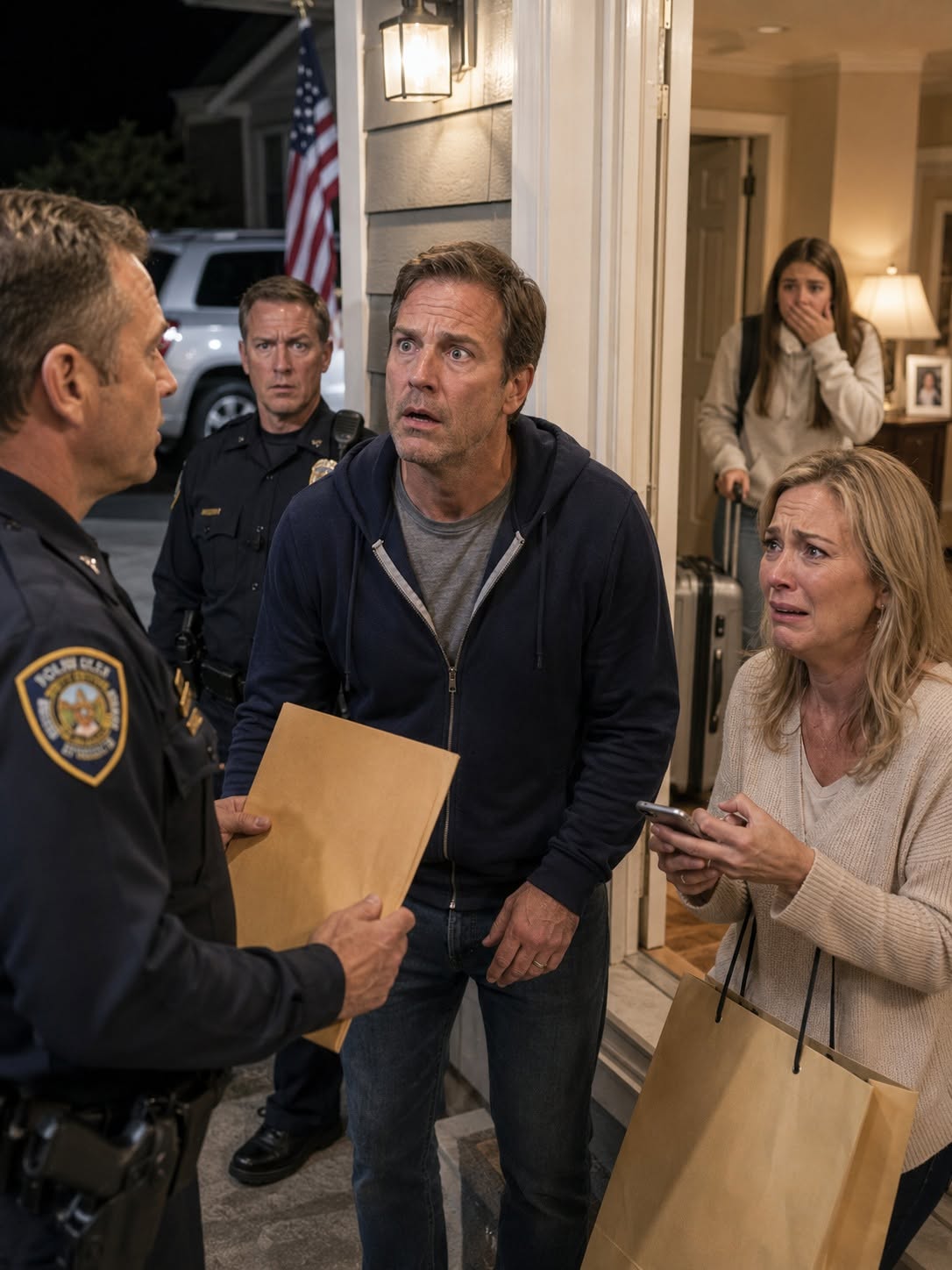
“There are officers here,” he said, and his voice cracked on the word officers, not because he was sorry, but because he had never imagined consequences arriving at his own front door.
“Then you should talk to them.”
“You sent police to your parents’ house?”
“No,” I said. “I filed a report. They decided where to go.”
There was a scuffle, then my mother grabbed the phone, because I knew the exact sound of her taking control away from someone else.
“You ungrateful little witch,” she hissed. “Do you have any idea what you’ve done?”
For the first time in my life, her anger did not make me smaller.
It made her sound far away, like a radio left on in another room.
“Yes,” I said. “I protected myself.”
Ashley started crying in the background, and once upon a time that sound would have worked faster on me than Mom’s rage, because Ashley cried when she wanted money, cried when she wanted forgiveness, cried when someone asked her to explain herself, and cried when the consequences of her choices came close enough to touch.
This time, she sounded less like a wounded sister and more like a woman realizing that the receipt had her fingerprints on it.
“Tell them it was a mistake,” she sobbed. “Emily, please, tell them we thought you said it was okay.”
My name in her mouth felt strange, because Ashley almost never used it unless she wanted something.
“I never said that.”
“But we’re family.”
There it was again, the old magic word, the one they used like a key, like a password, like a legal defense, like a leash.
I looked around my kitchen at the unpaid vendor invoice beside my cold tea, the small plant I kept trying not to kill on the windowsill, the rainwater streaking down the balcony door, and the life I had built from years of being more disciplined than the people who mocked me for it.
This was my life.
Not theirs.
Mine.
“Family is not a password,” I said.
The line went quiet.
Then a man’s voice came through, calm and official. “Ma’am, this is Officer Harris. Are you safe where you are?”
I sat up straighter as if he could see me. “Yes, I’m safe.”
“We’re speaking with your parents regarding the report. We may need a formal statement from you.”
“I have everything ready.”
There was a pause, not long, but long enough for me to hear paper moving and someone murmuring behind him.
“I can see that,” he said.
I do not know why that nearly broke me.
Maybe because for once someone saw the labor it had taken to make chaos legible, or maybe because no one in my family had ever believed me until a stranger saw the documents and treated them like reality.
Maybe because those four words sounded like a door opening after years of standing outside my own life, knocking softly and apologizing for wanting to come in.
I gave my formal statement the next morning.
Not in a dramatic courtroom, not with cameras, not with swelling music, not with my mother begging forgiveness or Ashley collapsing into the kind of sincere remorse people write into stories because they need the world to make emotional sense.
I sat in a plain interview room with beige walls, a box of tissues, a paper cup of coffee going cold beside me, and Officer Harris across from me asking questions in a voice that remained steady no matter how ugly the answers became.
When did your mother obtain your Social Security number?
When did you first notice unauthorized charges?
Did you authorize any Hawaii-related purchases?
Did your sister have access to the card?
Did either parent admit to using your information?
Were there previous incidents involving your identity or accounts?
Each question landed softly, but each answer pulled something sharp through me.
Yes.
No.
Here is the call log.
Here is the screenshot.
Here is Ashley’s airport post.
Here is the denied second application alert.
Here is the March intake form.
Here is the message where my father wrote that family should not need permission.
Here are the transactions.
Here are the dates.
Here is my life, finally presented in a way nobody can call dramatic without lying.
Officer Harris did not interrupt.
He did not ask why I would do this to my parents, did not suggest I settle it privately, did not tell me family matters are complicated in the tone people use when they want victims to be easier.
He asked why I had waited so long.
That question hurt more than all the others, because it did not accuse me, but it still reached the deepest bruise.
I looked down at my hands, at the faint red marks where my nails had pressed into my palms during the interview, and told him the truth.
“Because they trained me to think protecting myself was betrayal.”
He looked down at the file for a moment, then back at me.
“It isn’t.”
I held myself together until I made it back to my car.
Then I sat behind the steering wheel in the police station parking lot, rain crawling down the windshield in crooked lines, and cried so quietly that even I barely recognized the sound.
American Express reversed the pending charges first, and seeing those numbers change felt like watching someone pull a knife halfway out but leave the blade still near the bone.
The completed charges took longer.
The resort fought some of them.
The rental company wanted documentation.
The designer store asked for signatures, receipts, matching identifiers, and proof that the person who had smiled into a security camera with my stolen credit was not me.
Every process had a form, a deadline, a case number, and a person who needed me to tell the story again in a voice that did not shake.
So I told it.
Again and again.
Marissa handled the parts I could not, and there were many of those parts.
She sent letters, preserved records, contacted the credit bureaus, flagged the second attempted application, and explained to me with brutal patience that the denied application mattered because it showed intent after the first card had already been compromised.
That word became important.
Intent.
My mother had survived my entire life by making cruelty look accidental.
A misunderstanding.
A joke.
A family matter.
A mother just trying to help.
A father too tired to notice.
A sister too fragile to be held responsible.
A daughter too sensitive to understand that love sometimes looked like sacrifice.
But intent has edges, and this time those edges were sharp enough to cut through every story my family had used to keep me quiet.
Dad called me seventeen times in two days.
I did not answer.
Mom texted first in rage, then in guilt, then in fake concern, then in the dramatic language of illness and collapse she had always used when ordinary manipulation failed.
“Your father’s blood pressure is through the roof.”
“Ashley hasn’t stopped crying.”
“You are destroying this family.”
“I hope you’re proud of yourself.”
“After everything I did carrying you, feeding you, raising you, this is what you do to me?”
I saved every message.
The old me would have explained.
The old me would have written paragraphs full of pain, trying to prove that I had not wanted this, that they had forced my hand, that I loved them, that I was not cruel, that all I had ever wanted was basic respect.
The old me would have given them a map back into my life and then called it compassion.
I did not.
Silence can be weakness when it is fear.
Silence can also be a locked door.
By the end of the week, Ashley deleted the airport lounge post, but it did not matter because I had the screenshot.
By the end of the month, my business account was separated from every personal line of credit I owned, and my accountant helped me build a financial wall so tall and boring that no family member could sentimentalize their way over it.
I changed banks.
I froze my credit.
I replaced passwords, security questions, recovery emails, backup phone numbers, and every small opening my family had used to walk into my life like it was their hallway.
I changed “mother’s maiden name” to a random string saved in a password manager, because my mother had turned even the facts of my birth into keys.
I changed my emergency contact from Dad to my closest friend, Lauren, who had once driven across the city at midnight with soup and a spare phone charger because I had texted only, “I think I am not okay.”
When I told Lauren what had happened, she did not gasp in a way that made me feel like a spectacle.
She sat across from me in my kitchen, wrapped both hands around the coffee mug I had given her, and said, “I believe you.”
Those words should not have felt revolutionary.
They did.
For years, my family had mastered the art of making me sound unstable whenever I described their behavior with accuracy.
If I said Mom had taken something, she had borrowed it.
If I said Dad had ignored the truth, he had been trying to keep peace.
If I said Ashley had lied, she had been scared.
If I said I was hurt, I was dramatic.
If I said no, I was selfish.
Lauren listened to the whole thing, from the March furniture application to the Hawaii charges to the second attempted card, and when I finished, she did not ask what I had done to provoke them.
She asked whether I had eaten.
That was when I cried again, not because the question was profound, but because care that did not demand repayment felt almost unbearable.
The legal process moved slowly, nothing like television and nothing like the dramatic revenge fantasies people imagine when they hear that someone finally stood up to their family.
There were no instant arrests broadcast across relatives’ group chats, no cinematic courtroom showdown within forty-eight hours, no judge slamming a gavel while my mother dissolved into tears.
There were interviews.
There were affidavits.
There were certified letters.
There were requests for clearer copies of documents I had already sent twice.
There were days when nothing happened, and on those days my imagination became crueler than my family had ever been, whispering that maybe I had misunderstood, maybe they would slide out of it, maybe everyone would decide I was overreacting after all.
Then Marissa would send a two-line email reminding me that the case was moving, that silence was not failure, and that paperwork often makes less noise than justice deserves.
My parents tried their first defense through a lawyer I later learned had gone to church with my father’s old supervisor.
They claimed I had authorized the trip as a gift.
When Marissa told me that, I closed my eyes and laughed once, a sound so dry and humorless that she paused on the other end of the line.
“Can they prove that?” I asked.
“No,” she said. “And your mother’s call makes that argument very difficult for them.”
The call.
The one where she laughed.
The one where she told me every dollar was gone.
The one where she said they knew my birthday and Social Security number because they raised me.
The one where she thought cruelty was safe because she had always performed it privately and I had always absorbed it quietly.
That recording became the center of everything.
When it was transcribed, her words looked uglier in black and white than they had sounded in my ear.
“We know your birthday. We know your Social Security number. We raised you.”
I had heard it as a threat.
On paper, it looked like a confession.
Ashley tried to separate herself from it, of course.
According to her, she had no idea how the trip had been paid for, even though her name was on reservations, her signature appeared on store receipts, and one security still showed her smiling beside Mom in a boutique while a clerk handed over a shopping bag charged to my account.
She told relatives she had been “caught in the middle.”
She posted vague quotes online about being betrayed by people who cannot stand to see you happy.
She cried to our aunt Debbie that I had always resented her because she was “the pretty one,” as if beauty could explain a denied credit application made with my Social Security number.
Aunt Debbie called me once.
I let it go to voicemail.
Her message was exactly what I expected, wrapped in concern and soaked in cowardice.
“Emily, honey, I know what they did was wrong, but your mother says you’re trying to ruin Ashley’s future, and I just think maybe there’s a way to handle this without involving the law any more than you already have.”
I listened to it twice, not because I was considering her advice, but because I wanted to understand how easily some people could step over the crime to criticize the consequence.
Then I saved the voicemail and sent it to Marissa, who replied, “Do not respond.”
So I did not.
There is a strange loneliness in refusing to defend yourself to people committed to misunderstanding you.
At first it feels like losing.
Then, very slowly, it begins to feel like dignity.
My mother’s second defense was that she had been under emotional stress and had only wanted to give Ashley one beautiful experience after a difficult year.
Ashley’s difficult year, as far as I could tell, included quitting a job she disliked, breaking up with a man who stopped paying her rent, and discovering that people in their late twenties still had to pay their own car insurance.
My difficult year included building a business through two contract delays, covering my own dental surgery, paying quarterly taxes, and quietly absorbing family emergencies until my savings looked thinner than my patience.
But Ashley’s disappointment was always treated like a public crisis, while my exhaustion was treated like a character flaw.
Mom wrote me one email during that period from a new address after I blocked her number.
The subject line was “Your Family Is Bleeding.”
I did not open it for two days.
When I finally did, I read a page and a half of accusation disguised as heartbreak, every paragraph designed to drag me back into the old courtroom where she was always the injured party and I was always on trial for noticing the knife.
She wrote that I had humiliated her.
She wrote that my father could not sleep.
She wrote that Ashley had lost weight from stress.
She wrote that I would regret treating my mother like a criminal when I finally had children of my own and understood what sacrifice meant.
She did not write, “I am sorry.”
Not once.
I forwarded it to Marissa, added it to the file, and closed my laptop.
That night, I dreamed I was twelve years old again, standing in our old kitchen while Mom searched through my backpack for lunch money she said she needed to borrow.
In the dream, Ashley sat at the table eating cereal, watching without expression as Mom pulled out the five-dollar bill I had saved for a school book fair, and when I protested, Dad looked up from his newspaper and said, “Don’t be selfish, Em. Your mother knows what the family needs.”
I woke up at 3:13 a.m. with my heart racing and my hands clenched so tightly that my palms ached.
Healing, I learned, was not one brave phone call or one police report.
Healing was discovering all the places the old life still lived inside your body.
It lived in the way I apologized when a barista corrected my order even though I had said it clearly.
It lived in the way I felt guilty buying myself a new coat because Mom had once said women like me should not waste money trying to look special.
It lived in the way my first instinct after every family text was still to answer before I checked whether answering would harm me.
It lived in the way peace felt suspicious, like a room gone quiet because someone was hiding.
I began seeing a therapist named Dr. Patel, who did not let me make jokes when the story became too painful.
The first time I told her that my family’s love had always been expensive, she leaned back slightly and asked, “What did it cost you besides money?”
I wanted to say, “Nothing important,” because that was the answer my mother had trained into me.
Instead, I sat there in a soft gray chair with a box of tissues beside me and realized I did not know where to stop counting.
It had cost me birthdays I pretended not to care about.
It had cost me relationships where I chose emotionally unavailable people because needing too much felt dangerous.
It had cost me the ability to rest without feeling lazy.
It had cost me the belief that being loved and being used were different things.
It had cost me the kind of confidence that does not need to arrive with receipts.
Dr. Patel did not tell me to forgive them.
She did not tell me to remember that my parents had done their best, which is a sentence people often use when they want survivors to carry the emotional debt of people who harmed them.
She asked what safety would look like if guilt were not allowed to design it.
At first, I had no answer.
Then, slowly, I built one.
Safety looked like frozen credit.
Safety looked like passwords my mother could not guess.
Safety looked like an attorney copied on all communication.
Safety looked like not answering Dad’s calls just because he had taught me to fear the silence afterward.
Safety looked like taking my own name back from people who had treated it as a financial instrument.
The investigation continued through the fall.
Seattle turned colder, the rain became a daily presence instead of weather, and the trees along my street shed their leaves until the sidewalks looked bruised gold and brown.
My business survived, not because nothing had been damaged, but because I acted fast enough to keep the damage from spreading.
I lost sleep, time, focus, and several clients I could not afford to lose, because fraud does not simply take money; it takes the hours required to prove that your life belongs to you.
There were mornings when I sat at my desk before sunrise, staring at emails from vendors who did not need the intimate explanation behind late reimbursements, and I felt so tired that my bones seemed filled with wet sand.
There were other mornings when I looked at the same inbox and felt something like pride, because every reply I sent from that chair was proof that my mother had not destroyed what I built.
That realization came slowly.
My mother had wanted me panicked, humiliated, ashamed, and begging for family permission to survive.
Instead, I became organized.
She had wanted my fear.
Instead, I gave her documentation.
The first court-related meeting I attended was not a trial, but it still made my stomach knot so tightly that I could barely drink water beforehand.
Marissa met me outside the building with a navy folder tucked under her arm and said, “You do not need to perform calm for me.”
That nearly made me laugh, because performing calm had been one of my oldest jobs.
“I don’t know how not to,” I admitted.
“Then just answer what is asked,” she said. “You are not responsible for making this feel comfortable.”
Inside, the hallways smelled like old paper, floor polish, and coffee that had been sitting too long.
My parents were there.
I saw them before they saw me.
Mom wore a cream coat I recognized because I had bought it for her birthday two years earlier after she hinted for three weeks that her old one made her look poor.
Dad stood beside her with his hands in his pockets, his face arranged into the weary expression he used whenever he wanted to be seen as the reasonable man trapped between emotional women.
Ashley stood slightly behind them in a pale sweater, smaller than usual somehow, though I knew that was part of the performance.
For a moment, my body forgot everything I had learned.
My heart lurched.
My palms dampened.
Some child-shaped part of me wanted to walk over, apologize, smooth Mom’s collar, ask Dad if he had eaten, tell Ashley she looked thin, and make the room bearable again.
Then Mom saw me.
Her expression did not break into regret.
It hardened into accusation.
That saved me.
Because grief is confusing when the person who harmed you looks sorry, but my mother gave me the terrible gift of looking exactly like herself.
She looked offended that I had survived her.
Dad took one step toward me, and Marissa stepped slightly forward, not blocking him dramatically, just enough to remind everyone that access to me now had a witness.
“Emily,” Dad said, in the voice he used at funerals and bank appointments. “This has gone too far.”
I looked at him, at the man who had watched my mother turn me into a resource and called his silence peace.
“No,” I said. “It finally went far enough.”
His face tightened.
Mom made a sound of disgust, but before she could speak, Marissa said, “All communication through counsel.”
Ashley’s eyes filled immediately.
I could tell she expected me to look away first.
I did not.
Months earlier, that would have felt cruel.
That day, it felt like standing.
The meeting itself was procedural and dull, which almost made the betrayal feel stranger.
People discussed signatures, timelines, fraud alerts, charge categories, restitution options, and communications between parties, while my family sat only a few feet away and pretended we were all strangers who had met through paperwork.
In some ways, we were.
The people across from me were not the family I had invented in order to survive childhood.
They were the people shown by the evidence.
That difference mattered.
The invented family lived in my hope, in the birthday cards where Mom wrote “love you” under messages she had not meant, in the Thanksgiving photos where Dad’s hand rested on my shoulder just long enough for the camera, in Ashley’s occasional late-night texts calling me her “favorite sister” when rent was due.
The evidence family lived in bank records, application alerts, screenshots, and my mother’s own voice.
One of them had raised me.
The other one had freed me.
When the meeting ended, Mom waited until Marissa turned slightly to put papers back into her folder, then leaned close enough for only me to hear.
“You will never be happy after doing this to your mother.”
The old me would have swallowed those words whole.
The new me looked at her and said, “Watch me.”
Her face changed then.
Not much.
Just enough.
For the first time, I saw uncertainty pass through her eyes, and it was not because she feared prison or penalties or public shame, though those things mattered to her.
It was because she had heard something in my voice that she did not recognize.
She heard absence.
The absence of pleading.
The absence of guilt.
The absence of the daughter she had trained to return after every injury with open hands and an apology ready.
I went home that afternoon and slept for eleven hours.
When I woke, the apartment was dark, rain tapping softly against the balcony door, and my phone was quiet.
For the first time in months, the quiet did not feel like punishment.
It felt like mine.
The financial consequences unfolded gradually and without the neat emotional satisfaction people expect.
Some charges were reversed.
Some required further review.
Some became part of restitution discussions.
My parents faced legal restrictions, financial penalties, and credit consequences that were far more boring and far more lasting than a public scene would have been.
Ashley’s name became attached to documents she could not delete like an airport post.
The Hawaii trip that had made her feel blessed became evidence.
The luxury purchases became exhibits.
The champagne photo became a timestamp.
My mother’s laughter became a transcript.
There is a particular kind of justice in watching someone’s performance turn into paperwork.
Not loud justice.
Not clean justice.
But real enough.
My extended family reacted exactly as people do when the truth threatens the stories that keep family gatherings comfortable.
Some disappeared.
Some sent careful messages saying they loved everyone and hoped healing could happen, which usually meant they wanted me to stop making consequences visible.
Some privately admitted that they had always known my mother took too much from me, but never said anything because they “didn’t want to get involved.”
That phrase changed meaning for me.
I used to think not getting involved meant neutrality.
Now I knew it often meant watching the easiest person to hurt get hurt because stopping it would make dinner awkward.
Cousin Rachel was the only one who called and said the words plainly.
“I should have said something years ago,” she told me. “Your mom always told the story like you were cold and Ashley was helpless, but I saw things that didn’t feel right, and I stayed quiet.”
I sat on my couch, wrapped in a blanket, and listened.
Part of me wanted to punish her for being late.
Another part was too relieved to hear one person from the family system speak without fog.
“Why are you telling me now?” I asked.
“Because my daughter is seventeen,” Rachel said, her voice breaking slightly, “and last week your mom joked that she has your kind of ‘useful energy.’ I felt sick.”
That sentence stayed with me.
Useful energy.
A generational curse with a cute label.
Rachel cried a little, apologized again, and did not ask me to forgive anyone else in order to make her apology easier.
So I did the only thing I could do.
I thanked her for saying the truth out loud.
After that, she sent me old messages from family group chats where Mom had hinted about my finances, joked about my “control issues,” and described Ashley as deserving a break because “Emily always lands on her feet.”
I saved those too.
Not because every message mattered legally, but because they mattered to the part of me still tempted to minimize what had happened.
Abuse rarely begins with a felony.
More often, it begins with a family joke.
A nickname.
A role.
A story told so many times that everyone starts mistaking it for truth.
Mine was useful.
Ashley’s was delicate.
Mom’s was selfless.
Dad’s was tired.
Those four lies had cost me more than ninety-nine thousand dollars.
By winter, my apartment changed in small ways that seemed ordinary to anyone else and monumental to me.
I bought the new coat I had wanted, a deep green wool coat with a clean collar and warm lining, and when the cashier rang it up, I did not hear my mother’s voice telling me I was vain.
I replaced the cheap kitchen table where I had built the fraud files with a sturdier one that did not wobble when I typed.
I bought fresh flowers every other Friday, not expensive ones, not a grand symbol of rebirth, just tulips or lilies or whatever looked alive near the grocery store entrance.
The first time I put them in a vase, I cried again.
It is embarrassing how often freedom arrives disguised as something small.
A coat.
A password.
Flowers no one can accuse you of wasting money on.
Dinner you do not have to defend.
One Saturday morning, Lauren came over to help me assemble a bookshelf, though mostly we drank coffee on the floor and argued with the instructions.
At some point, she looked around and said, “Your place feels different.”
I tightened a screw and pretended not to understand. “Different how?”
“Like nobody else is allowed to walk in and rearrange the air anymore.”
That was exactly it.
My mother had never needed a key to enter a room.
She entered through guilt, through memory, through the old reflex that made my shoulders rise when the phone rang, through the internalized belief that my comfort was always negotiable.
Now, for the first time, my apartment felt like a place where my nervous system could stop standing guard at every doorway.
The case continued.
There were delays, negotiations, and legal language that turned emotional devastation into phrases like unauthorized use, identity compromise, fraudulent application, and restitution schedule.
Marissa explained every step carefully, but there were still days when the process seemed designed to exhaust me into surrender.
Maybe all systems feel that way when you enter them already wounded.
Still, I kept going.
Not because I wanted revenge in the way people imagine revenge, with dramatic speeches and public collapse, but because stopping halfway would have meant teaching my family one final time that pressure worked.
My mother tried apology only once.
It came in a voicemail from an unknown number, which I should not have played, but did.
Her voice was soft, trembling, almost convincing.
“Emily, I am your mother, and I made mistakes. Maybe I panicked, maybe I handled things wrong, but I never meant for it to get this serious. Ashley needed something good, and you have always been stronger than she is. I thought you would understand.”
There it was.
Even her apology made my strength a justification for taking from me.
She did not say she was sorry for stealing.
She was sorry things had become serious.
She was sorry I had not absorbed it.
She was sorry the old arrangement had failed.
I forwarded the voicemail to Marissa and sat for a long time afterward with my phone face down on the table.
Then I opened my laptop and paid a vendor invoice early, not because it mattered, but because I could.
The day the formal restitution agreement was discussed, I wore the green coat.
That might sound childish, but I needed to wear something I had bought for myself without guilt, something my mother had never touched, criticized, borrowed, or made about Ashley.
I walked into the building with Marissa beside me and felt nervous, but not breakable.
My parents looked smaller than they had in my childhood, which is a strange and painful thing to realize, because the people who terrify you as a child often become ordinary-sized only after they have already done extraordinary damage.
Dad’s hair looked thinner.
Mom’s face looked tighter.
Ashley would not look at me.
For a second, I almost felt sorry for them, and then I remembered that empathy did not require access.
Compassion did not require surrender.
Seeing someone as human did not mean handing them the knife again.
The restitution discussion was not satisfying in a cinematic sense.
There were numbers, timelines, responsibilities, and the dull machinery of consequence.
My parents’ lawyer tried again to frame the trip as a family misunderstanding that had spiraled because emotions were high, but Marissa responded by reading a section of my mother’s call transcript aloud.
She did not raise her voice.
She did not dramatize the words.
She simply read them.
“Every dollar is gone.”
“You thought you were clever hiding it.”
“We know your birthday.”
“We know your Social Security number.”
“We raised you.”
The room changed as she spoke.
Not dramatically, not in a way anyone could object to, but enough that I felt the truth settle over the table like dust.
Mom stared straight ahead.
Dad closed his eyes.
Ashley began crying silently.
I waited for the old guilt to rise.
It did not.
What I felt instead was grief, but grief has a cleaner shape when it is not being used as a leash.
I grieved the mother I had invented because I needed one.
I grieved the father I had excused because blaming both parents at once had once felt too lonely.
I grieved the sister I had protected from accountability because I mistook her dependence for closeness.
I grieved the person I had been when I believed being needed meant being loved.
But I did not regret the report.
When it was my turn to speak, I had prepared a long statement, four pages of carefully written pain, history, facts, and impact.
I had stayed up late revising it, removing anything that sounded too angry, then putting some anger back in because Dr. Patel had asked why I believed truth needed to be pleasant.
But when everyone looked at me, I did not read the four pages.
I folded them once in my lap and said something much simpler.
“My family did not borrow money from me. They stole my identity, charged nearly ninety-nine thousand dollars to my card, tried to open another account in my name, and then told me I would be too guilty to protect myself. I am not here because I hate them. I am here because I finally understand that loving people does not mean letting them destroy you.”
The room was very quiet after that.
Mom looked at me like I had slapped her, though all I had done was describe what she did.
Dad’s mouth tightened, and for once he had no wise, tired sentence to offer.
Ashley whispered, “I didn’t know it would go this far.”
I looked at her then.
“I know,” I said. “You never thought about how far anything went once someone else paid for it.”
She cried harder, but I had spent enough of my life mistaking her tears for proof of innocence.
Afterward, Marissa told me I had done well.
I nodded, but on the drive home, I pulled over near a park and sat in my car watching rain darken the windshield until the world outside became abstract.
I did not feel victorious.
I felt emptied.
People who have never escaped a family role sometimes imagine that the moment you stand up for yourself, all pain converts instantly into empowerment.
It does not.
Sometimes empowerment feels like nausea.
Sometimes it feels like shaking hands, blocked numbers, legal bills, and waking up from dreams where your mother is still calling you selfish.
Sometimes freedom is not a roar.
Sometimes it is simply not turning the car around.
Spring arrived slowly that year, unfolding in pale sunlight and wet sidewalks, and my life began filling with things that had nothing to do with the case.
A client referred me to another client.
Lauren and I started taking Sunday walks along the waterfront, where gulls screamed over the ferries and tourists took photos under gray skies as if Seattle had personally arranged the weather for them.
I learned to cook one decent pasta dish that did not involve opening three cans and calling it survival.
I went on two dates with a kind architect named Daniel, who noticed when my voice changed after a family-related notification and did not push when I said I did not want to talk about it yet.
The first time he asked about my family, I gave him the short version.
“My parents and sister committed identity fraud using my information, and I reported it.”
He set down his fork slowly, not with disgust, not with pity, but with the careful attention of someone handling a truth that mattered.
“I’m sorry,” he said. “Do you still talk to them?”
“No.”
“Good,” he said, and then after a beat, “I mean, good if that’s what keeps you safe.”
That answer did not make me fall in love with him, but it did make me relax enough to finish dinner.
Not everyone needed the whole story.
Not everyone deserved it.
I became more selective with my history, and that selectiveness felt like ownership.
The final major update came almost a year after the call.
Marissa phoned on a Tuesday afternoon while I was reviewing a contract, and when I saw her name, I felt the familiar cold line of anxiety move through my chest.
“It’s mostly done,” she said.
Mostly done.
Those words should have sounded clean, but life rarely gives clean endings.
The restitution structure had been finalized, the credit disputes resolved in my favor, the denied second application preserved as part of the record, and the consequences attached to my parents and Ashley in ways that would continue long after the social embarrassment faded.
No one was dragged dramatically from a resort in handcuffs.
No one stood in court and confessed to a lifetime of treating me like an object.
No one returned my childhood with interest.
But the documents were real.
The penalties were real.
The credit protections were real.
The boundaries were real.
And my life, which my mother had treated as something she could swipe through, was still standing.
After the call, I walked to the window and looked down at the city.
Seattle was bright that day in a rare, clean way, sunlight glancing off glass buildings and car roofs, the water in the distance flashing silver between towers.
For the first time in a long time, I thought about the night of the call without feeling my throat close.
At 6:12 that evening, exactly one year after my mother had called laughing, I returned to the same concrete bench outside my office building.
I did not plan it as a ceremony, not exactly, though maybe part of me needed one.
The air was cool, the sidewalk dry, and the lobby behind me glowed with the same polished indifference it had held the year before.
I sat with a cup of coffee instead of a laptop.
No emergency folders.
No shaking hands.
No tropical music bleeding through a phone speaker.
Just me, the city, and the strange quiet of a life no longer waiting for permission.
My phone buzzed while I sat there.
Unknown number.
I knew before I opened it that it would be her.
My mother had always had a gift for finding cracks in closed doors.
The message was short.
“I hope someday you understand what you did to this family.”
I read it once.
Then I looked up at the building across the street, at the reflection of clouds moving over glass, and thought about all the ways that sentence would have broken me before.
The old me would have heard accusation.
The old me would have heard duty.
The old me would have heard a mother’s pain and mistaken it for proof of my cruelty.
This time, I heard only the final echo of a woman who still believed the family was something I had damaged by refusing to be stolen from.
I typed one sentence back.
“I do understand. I stopped funding it.”
Then I blocked the number.
For a long time, I believed the worst thing my mother ever said to me was, “That’s what you get, worthless girl.”
I was wrong.
The worst thing was everything she had trained me not to say back.
No, when she reached for my money.
Stop, when she reached for my identity.
This is mine, when she treated my life like family property.
You cannot have it, when guilt came dressed as love and knocked with both hands.
That night in Seattle, sitting on a wet concrete bench with my laptop balanced on my knees, I finally said all of it without screaming.
I said it in reports, screenshots, call logs, statements, frozen accounts, changed passwords, and silence where explanations used to be.
My mother had called laughing because she thought every dollar was gone.
By the time she came home from Hawaii, the money was the smallest part of her problem.
She had mistaken my patience for weakness, my silence for permission, my guilt for a lifetime contract, and my love for an unlimited credit line.
For the first time in my life, I let the evidence speak louder than family.
And when it did, everyone finally heard me.
The End