The younger hotel manager looked pale enough to faint into the hand towels.
“Ms…?”
“Rowan Vale,” I said.
Something flickered behind his eyes.
Not recognition exactly.
Calculation.
I knew that look. Wealthy spaces kept quiet records of who mattered and who did not. Standing there in a soaked thrift-store hoodie with coffee running down my neck, I did not look like someone who mattered.
But my name had started moving through his internal system.
“Ms. Vale,” he said carefully, “we are deeply sorry this happened on our property.”
“I want the security footage preserved,” I said.
He stiffened.
“Of course.”
“All angles from the terrace, hallway, and lobby. Timestamped. I want the names of every employee who witnessed it.”
“Yes, absolutely.”
“And I want the police notified.”
The restroom went quiet.
The manager looked at the security officer. The security officer looked at the floor. That glance told me everything. They wanted discretion. Resorts like the Obsidian did not sell rooms. They sold the illusion that no one with enough money ever had to face consequences in public.
I looked at his name tag.
“Daniel,” I said, “a woman just poured near-boiling coffee over my head in front of witnesses while two other people recorded it. You can call the police now, or my attorney can call them after requesting every second of footage from your legal department.”
Daniel swallowed.
“I’ll make the call.”
Good.
My hands finally stopped shaking.
At urgent care, a doctor confirmed first- and second-degree burns across my scalp, neck, and shoulder. He treated the blister behind my ear, documented every injury, and asked me how it happened.
“My mother poured coffee on me,” I said.
His pen paused over the chart.
Then he wrote it down.
Those words looked different once they belonged to a medical record.
Not family drama.
Not Beatrice being Beatrice.
Not Rowan making things difficult again.
A fact.
My mother poured coffee on me.
When I left the clinic, a black Lucien sedan waited at the curb. Not a ride-share. Not a rental.
Mine.
The back door opened, and Nora Chen stepped out in a navy wool coat, her silver-streaked hair pulled into a perfect knot. Nora had been my attorney for seven years. She had the calmest face of any person I had ever met, which was terrifying because she usually wore that calm face while destroying people with paperwork.
Her eyes moved over the bandage near my hairline.
“Rowan,” she said softly.
That almost broke me.
Not Beatrice. Not Caleb’s laughter. Not Maya’s camera. Genuine concern with no audience to reward it.
I took one hard breath. “They filmed it.”
“I know.”
I looked up. “How?”
Nora handed me her phone. “Caleb uploaded it twenty-two minutes ago.”
Of course he had.
The video already had thousands of views.
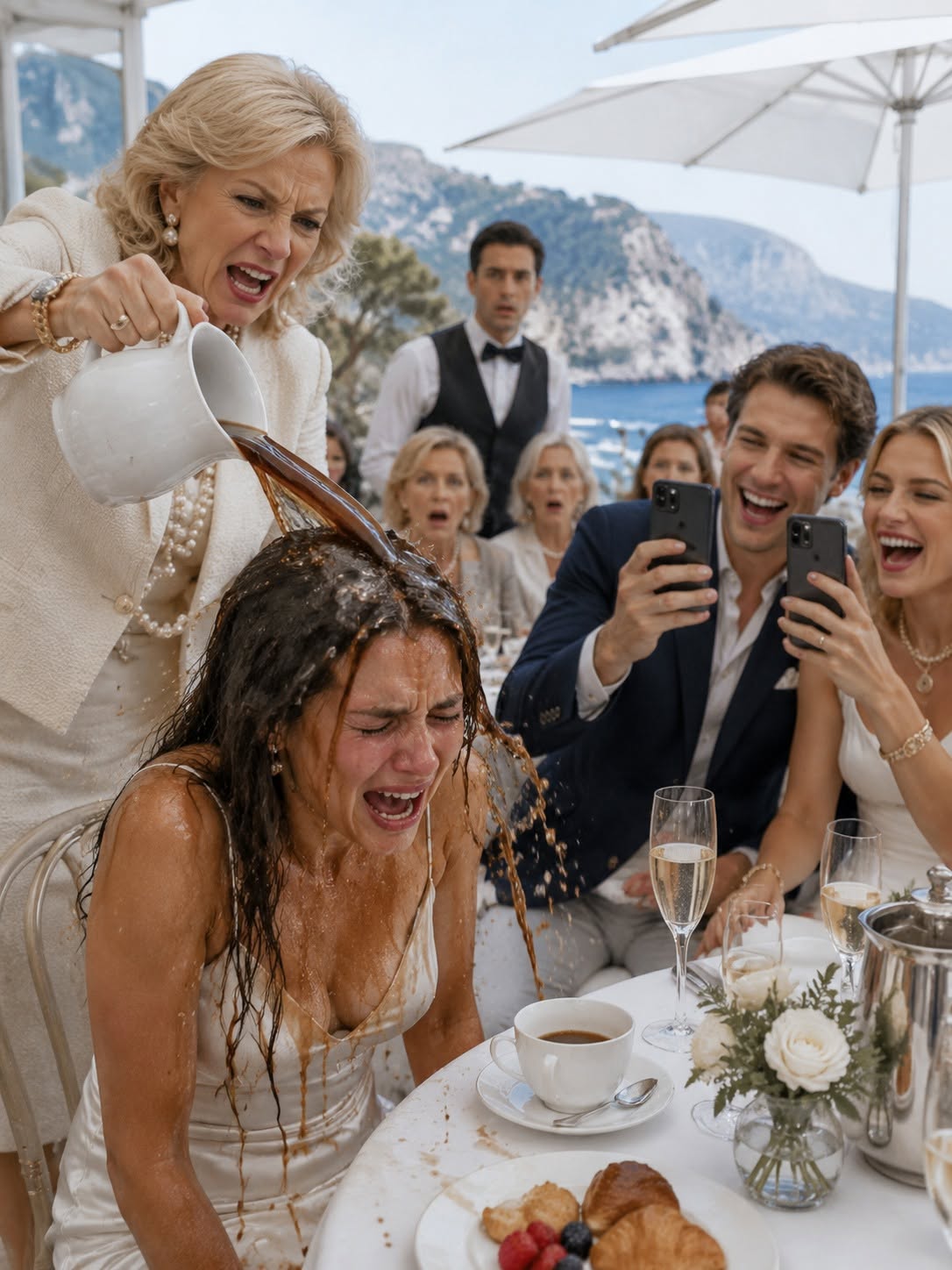
It opened with my mother’s voice.
“You selfish piece of trash.”
Then came the coffee.
The laughter.
Caleb zooming in on my burned face.
Maya making a theatrical little gasp behind her phone.
Beatrice standing above me like a queen after a public execution.
The caption read:
WHEN THE BROKE FAMILY DISAPPOINTMENT FINALLY GETS PUT IN HER PLACE.
Then came a laughing emoji, a coffee cup, and a string of hashtags.
Cabin loser.
Family drama.
Obsidian brunch.
I stared at the screen until the words blurred.
Cabin loser.
That was what they called me because I lived three hours north in a cedar cabin on twenty acres of pine, fog, and silence. They thought I lived there because I had failed. Because I drove an eleven-year-old truck when I came to family events. Because I wore old hoodies and let my hair air-dry. Because I never corrected them when they said I was “between things.”
I handed the phone back.
“How many views?”
“Seventy thousand.”
“When did he post it?”
“Twenty-two minutes ago.”
I almost smiled.
Caleb had always loved speed. Viral before verified. Damage before facts. He had never understood that the internet wasn’t a weapon.
It was weather.
Once released, nobody controlled where it moved.
“Do nothing yet,” I said.
Nora studied me. “Rowan.”
“No takedown request. No statement. Not today.”
“He publicly humiliated you after your mother physically assaulted you.”
“Yes.”
“And you want to wait?”
“I want them to climb higher before the ladder breaks.”
Something flickered in Nora’s eyes.
Approval.
“Understood.”
By the time I reached my cabin that evening, the video had crossed two million views.
By midnight, four million people had watched my family laugh while coffee burned my scalp.
And by Monday morning, the world found out I wasn’t broke.
It happened because of an article that had been scheduled weeks earlier.
VentureWire ran the headline at 8:00 a.m.
AI SECURITY STARTUP AURORA NINE ACQUIRED IN LANDMARK NINE-FIGURE DEAL.
The photo they used wasn’t glamorous. I had refused the glossy founder portrait with perfect lighting and forced smiles. Instead, they ran a candid shot from our old office in Seattle: me in black jeans, barefoot beside a glass wall covered in equations, security maps, and architecture diagrams. My hair was tied messily. My face looked tired, focused, and deeply uninterested in anyone’s approval.
The headline named me clearly.
Founder and CEO Rowan Vale exits Aurora Nine after acquisition estimated above $180 million.
By noon, someone connected that article to Caleb’s video.
The internet did what the internet does best.
It stitched.
It compared.
It hunted.
There was Caleb calling me the broke family disappointment.
Then the acquisition headline.
There was Maya laughing into her mimosa.
Then a financial analyst estimating my payout.
There was Beatrice saying, “That is exactly how trash gets treated.”
Then a commentator freezing the frame and saying, “This woman’s family poured coffee on her because they thought she was poor. She just sold a cybersecurity company for more than most of them can count.”
By three o’clock, Caleb deleted the video.
Unfortunately for Caleb, deletion was a fantasy from a more innocent time.
Screenshots multiplied. Reuploads spread. Reaction channels chewed through the footage frame by frame. Lawyers commented. Doctors commented. Domestic violence advocates commented. Former coworkers posted careful statements about my character. People I had not heard from since college suddenly appeared online claiming they always knew I was brilliant.
My phone became unusable.
By Monday night, the family group chat exploded.
Maya wrote first.
Rowan, please call Mom. She’s having chest pains.
Then Caleb.
This is being taken out of context.
Maya again.
People are threatening my brand deals.
Caleb.
Why didn’t you tell us about the company?
Then Beatrice.
You have humiliated this family.
I stared at that last message for a long time.
Then I typed one answer.
No. You did.
I turned off my phone.
The next morning, frost silvered my kitchen windows. Ravens hopped along the fence line outside like black punctuation marks. My burns throbbed beneath medicated gauze, and the doctor had told me to rest.
Instead, I made coffee.
I stood at the counter and watched the machine drip dark liquid into a ceramic mug. The smell hit me hard, bitter and sharp, and for a moment my stomach turned.
Then I forced myself to take one sip.
It burned my tongue a little.
I didn’t flinch.
At 9:12 a.m., Nora called.
“Are you sitting down?”
“No.”
“Sit down.”
I sat on the edge of the kitchen table.
“Caleb is being terminated from Halberd & Moss.”
Halberd & Moss was the marketing agency where Caleb worked as a senior strategist, which mostly meant he took credit for junior employees’ ideas and used phrases like “emotional conversion architecture” in meetings.
“What happened?” I asked.
“Their largest client is a women’s health nonprofit. They received approximately eight thousand messages overnight asking why their agency employed a man who filmed his injured sister for humiliation content.”
“Eight thousand?”
“Possibly more now.”
I closed my eyes. “Was that you?”
“No,” Nora said. “That was gravity.”
Ten minutes later, Maya accidentally sent me a screen recording of Caleb’s termination call. She was terrible with technology whenever it wasn’t filtered through an app, and panic always made her sloppy.
Caleb’s face appeared in one square, pale and sweaty. Two HR representatives occupied the top row. His manager looked like he would rather be trapped in an elevator with a tax auditor.
“This decision is effective immediately,” one HR woman said.
Caleb leaned toward his webcam. “This is insane. It was a private family joke.”
“A private family joke uploaded to a public platform with the resort tagged,” his manager said flatly.
“You’re ruining my career because my sister can’t take a joke?”
The HR woman’s expression hardened.
“Mr. Vale, the company reviewed the video. We also reviewed several public statements you made in comment replies before deleting them.”
Caleb froze. “What statements?”
She read from her notes.
“Quote: ‘She’s always been dramatic.’ Quote: ‘Coffee wasn’t even that hot.’ Quote: ‘She needed humbling.’”
Silence swallowed the call.
Then Caleb said the six words that summed up his entire life.
“You don’t understand who I am.”
His manager sighed.
“That appears to be the problem.”
The recording ended.
I sat in my quiet cabin while snow began falling beyond the windows.
I expected satisfaction.
Something hot. Clean. Righteous.
Instead, I felt nothing.
That should have worried me, but it didn’t.
At 11:30 a.m., Beatrice called from an unknown number.
I answered and said nothing.
For five seconds, all I heard was her breathing.
Then she said, “Are you proud of yourself?”
Her voice sounded thinner than usual. Less queen. More cornered animal.
“No,” I said.
“You destroyed your brother.”
“Caleb filmed my injury and posted it online.”
“He made a mistake.”
“You poured boiling coffee on me.”
A sharp inhale.
“You provoked me.”
“How?”
“You sat there with that smug little face while we discussed your grandmother’s house.”
There it was.
The real reason brunch had happened.
Not family.
Property.
My grandmother’s house sat on nineteen acres near Lake Alder, old money turned old wood, full of dust and secrets. Beatrice wanted it sold. Caleb wanted his cut. Maya wanted content from the renovation. They had already divided the money in their heads before checking whether they had any right to it.
Grandmother had left the house to me.
Not to Beatrice.
To me.
I had never told them I intended to restore it.
I had simply said I wasn’t selling.
Apparently, that was enough to deserve boiling coffee.
“You embarrassed me,” Beatrice said.
“I said no.”
“You always say no. No to helping family. No to selling that rotting house. No to acting like my daughter.”
I looked out at the pine trees.
“I stopped being your daughter on Sunday.”
Silence.
Then her voice dropped.
“You ungrateful little monster.”
There she was.
I almost missed her.
Almost.
“You think money makes you powerful now?” she whispered. “You think people won’t find out what you really are?”
A cold thread slid through me.
“What does that mean?”
She laughed once, softly.
“You have no idea what your grandmother kept in that house, do you?”
The line went dead.
I didn’t move.
Outside, snow thickened against the glass. Inside, the cabin seemed to lean closer around me.
My grandmother, Evelyn Vale, had been many things. Brilliant. Severe. Private. She smoked lavender cigarettes on the porch, solved crossword puzzles in ink, and once told a banker he had the moral courage of wet cardboard. She taught me how to split firewood, read contracts, and never apologize for being the smartest person in the room.
Secretive?
Absolutely.
I called Nora.
“Find out whether Beatrice has entered Grandmother’s property recently.”
“Why?”
“Because she knows something about the house.”
Nora didn’t waste time asking questions that wouldn’t change the answer.
“I’ll check.”
By Wednesday morning, the story had mutated again.
People online found Beatrice’s charity board positions, Maya’s sponsorships, Caleb’s old posts mocking service workers. Someone unearthed a podcast episode where Beatrice spoke about “raising resilient children” and “teaching accountability through consequences.”
The comments were merciless.
Maya lost three brand deals before lunch.
Beatrice resigned from two nonprofit boards by dinner.
Caleb posted an apology video in a black sweater, looking like a hostage held by bad lighting.
“I failed to understand how my actions may have appeared,” he said.
Not what they were.
How they appeared.
The internet noticed.
By Wednesday night, the apology had become a meme.
I stopped watching after the first thirty seconds.
Instead, I drove to Grandmother’s house.
Lake Alder Road twisted through dense forest, the trees forming a dark tunnel overhead. Snow clung to the branches. My headlights cut through the blue evening, catching flakes in white flashes.
The house appeared at the end of the drive like something waiting.
Three stories. Gray stone. Black shutters. A wraparound porch sagging slightly at the east corner. The windows were dark, but never empty.
As a child, I had loved that house because it felt honest. It creaked when it was cold. It groaned during storms. It never pretended to be prettier, kinder, or safer than it was.
My family hated it.
Too remote.
Too old.
Too quiet.
But Grandmother had chosen it for me.
There had to be a reason.
Inside, the air smelled of cedar, dust, and old paper. I flipped on the foyer light. It flickered twice, then steadied.
Everything looked untouched.
Almost.
I noticed the rug first.
The Persian runner near the staircase had shifted a few inches to the left. I knew because Grandmother had once slapped Caleb’s hand for dragging muddy shoes across one corner, then spent twenty minutes aligning the border precisely with the floorboards.
I crouched.
Fresh scratches marked the wood beneath a console table.
Someone had moved it.
Behind the table, the wallpaper showed a faint rectangular outline.
I pulled the table aside.
A small panel hid in the wall.
No handle. No lock. Just a seam.
My pulse quickened.
I pressed along the edges until something clicked.
The panel opened.
Inside was a narrow steel safe with a keypad.
Of course.
Grandmother loved theatrics as long as they served a purpose.
I tried her birthday.
Nothing.
My birthday.
Nothing.
Then I remembered something she used to tell me whenever I complained about being different.
“Lonely girls should learn numbers. Numbers don’t betray you.”
I entered the first six digits of pi.
The safe clicked open.
Inside were three things.
A stack of old legal documents.
A black ledger.
And a sealed envelope with my name written in Grandmother’s sharp, slanted handwriting.
ROWAN.
My fingers hovered over it before touching.
The paper felt thick. Expensive. Final.
I opened it carefully.
My dear Rowan,
If you are reading this, then your mother has likely become impatient.
I stopped breathing.
Beatrice was never able to tolerate locked doors, especially when she believed something valuable waited behind them. I left the Lake Alder house to you not because of sentiment, though I do have some despite what your mother says.
I left it to you because you are the only one in this family with enough discipline to understand what is hidden here before trying to use it.
Do not trust Beatrice.
Do not trust Caleb.
Do not trust Maya if she is frightened.
And above all, do not allow anyone to remove the ledger from the house until you understand the names inside it.
There are debts in this family older than you.
There are crimes dressed as favors.
There are people who will come smiling.
Call Adrian Voss only when the first threat arrives.
I read the name three times.
Adrian Voss.
Everyone in my industry knew that name. Former federal prosecutor. Private crisis negotiator. The kind of man billionaires called when money stopped being useful and fear entered the room.
At the bottom of the letter was a phone number.
Then one final sentence.
Your mother thinks she knows what I buried. She does not.
A floorboard creaked upstairs.
Soft.
Deliberate.
I froze.
The house held its breath around me.
Another creak followed.
Closer.
Someone was inside.
I folded the letter and slipped it into my coat. Then I picked up the black ledger and opened it just enough to see the first page.
Names.
Dates.
Amounts.
And beside several entries, initials I recognized from politicians, judges, developers, and one man who had sat on the board of the company that acquired mine.
My blood went cold.
This wasn’t inheritance.
It was evidence.
The floorboard creaked again.
I shut the safe, grabbed the ledger, and moved toward the kitchen, where Grandmother kept an old cast-iron poker beside the fireplace. My fingers closed around the handle just as a shadow crossed the hallway wall.
“Rowan?” a man’s voice called softly.
Not Caleb.
Not anyone I knew.
I stayed silent.
“I’m not here to hurt you.”
That was exactly what people said when hurting you remained an option.
A man stepped into the foyer.
Tall. Dark coat. Leather gloves. Calm face. Maybe forty-five. Maybe older. His black hair was threaded with gray at the temples, and he carried himself like someone accustomed to entering dangerous rooms without raising his voice.
His eyes moved to the poker in my hand.
Then to the ledger under my arm.
“You opened it,” he said.
“Who are you?”
“Adrian Voss.”
My grip tightened. “That’s convenient.”
His mouth twitched. “Rarely.”
“Why are you in my grandmother’s house?”
“Because your mother called someone she shouldn’t have. Because your brother is desperate. Because your sister is scared. And because by tomorrow morning, at least three people named in that ledger will know you have it.”
I raised the poker higher.
He didn’t move.
“Your grandmother asked me to watch the house after her death,” he said. “Specifically, to stay away unless the family started circling.”
“They started with coffee.”
“I saw.”
Something in his tone told me he had watched the video too. Not with pity. With assessment.
My phone buzzed.
Unknown number.
Then another buzz.
Nora.
I backed away from Adrian and answered.
“Rowan,” Nora said, voice tight. “Police are at your gate.”
“At my cabin?”
“Yes. Two county units. They say they’re responding to a report of stolen financial records and elder abuse.”
“My grandmother is dead.”
“The complaint alleges you manipulated her before death to obtain property and confidential documents,” Nora said. “Filed by Beatrice Vale.”
I laughed once.
Not because it was funny.
Because it was perfect.
My mother had burned me on Sunday.
Played victim on Monday.
Lost control on Tuesday.
Reached for the law by Thursday.
Adrian held out his hand.
“May I?”
I put Nora on speaker.
Adrian said, “Ms. Chen, this is Adrian Voss. Tell your client not to return to the cabin. Tell the police she is en route to meet counsel. Do not mention the ledger.”
Nora went quiet for half a second.
Then, carefully, “Mr. Voss. I wondered when you’d appear.”
I stared at the phone. “You two know each other?”
“Unfortunately,” Nora said.
Outside, headlights swept across the trees at the end of the drive.
Not police lights.
A black SUV.
Then another.
Adrian’s calm expression changed for the first time.
Not fear.
Recognition.
“Rowan,” he said, “we need to leave through the cellar.”
The front door handle turned.
Once.
Locked.
Then came a knock.
Slow. Polite. Almost gentle.
A voice called from the porch.
“Ms. Vale? We only want what belongs to us.”
Adrian looked at the ledger under my arm.
Then at me.
“Your grandmother didn’t bury money,” he whispered. “She buried leverage.”
The first heavy blow shook the door.
The second cracked the frame.
Adrian moved fast.
He crossed the foyer, pulled the runner back with one hand, and revealed a brass ring set into the floorboards near the staircase.
“Of course she had a secret cellar door,” I muttered.
“She had six,” Adrian said. “This is the least dramatic one.”
He lifted the hatch. Cold air rushed up from below, carrying the smell of damp stone and old wood.
Another blow hit the front door.
I glanced toward it.
My whole life, my family had taught me to freeze when they attacked. To calculate how to make myself smaller. To apologize before I understood the accusation.
Not anymore.
I slid the ledger beneath my coat, tucked Grandmother’s letter into my inner pocket, and climbed down into darkness.
Adrian followed, closing the hatch above us just as the front door gave way.
For a moment, we moved by the light of his phone through a narrow stone passage beneath the house. The ceiling was low. The floor was uneven. Water dripped somewhere in the dark.
Above us, footsteps thundered through the foyer.
Male voices.
Not police.
Not family.
Professionals.
“Did Beatrice send them?” I whispered.
“Beatrice opened the door,” Adrian said. “Someone else walked through.”
We reached a rusted metal door at the end of the passage. Adrian pushed it open, and freezing night air slapped my face.
The cellar exit opened behind the carriage garage.
We crossed through snow toward the tree line as voices shouted inside the house. A flashlight beam swept across the back porch. I ducked behind Adrian’s shoulder, my breath hard and white in the cold.
A black SUV idled on the narrow service road beyond the pines.
“Yours?” I asked.
“Mine.”
“Do I want to know why you parked it there?”
“No.”
“That seems to be a theme with you.”
He opened the passenger door. “Get in.”
We drove without headlights for the first quarter mile, then turned onto an old logging road that wound through the woods behind the property.
Only when the house disappeared behind the trees did I breathe again.
Adrian glanced at me. “Are you injured?”
“Burned, betrayed, and currently wanted for elder abuse against a dead woman,” I said. “But otherwise charming.”
For the first time, he smiled.
It vanished quickly.
“Your grandmother trusted you,” he said.
“She also hid a criminal ledger behind wallpaper.”
“She trusted you more than she trusted the institutions that should have handled it.”
That made me look at him.
“What is this?”
He kept his eyes on the road. “A record of payments, favors, blackmail, land transfers, judicial interference, charitable laundering, and political protection spanning almost thirty years.”
“And my grandmother kept it because…?”
“Because your grandfather started it.”
The words landed hard.
I had barely known my grandfather. He died when I was nine. The family version was that Thomas Vale had been a brilliant real estate developer with difficult manners and excellent taste. Beatrice worshiped him publicly and feared him privately. Grandmother never spoke of him unless absolutely necessary.
“Your grandfather built half of Lake Alder County,” Adrian said. “Resorts. private clinics, charter schools, luxury subdivisions, conservation scams dressed as public parks. He paid judges, bought commissioners, buried violations, and made friends with people who knew how to make problems disappear.”
“And Grandmother?”
“At first, she survived him,” Adrian said. “Then she documented him.”
Snow battered the windshield.
I pressed one hand over the ledger beneath my coat.
“Why didn’t she expose it?”
“She planned to. Then your grandfather died, and the network didn’t. Some of the people in that book became more powerful after he was gone. She knew if she released everything at once, they would destroy the evidence, discredit her, and possibly hurt you.”
“Me?”
“You were the only person she cared about who couldn’t protect herself yet.”
I looked out into the dark.
Memory came without permission.
Grandmother teaching me to shoot tin cans behind the shed. Grandmother making me memorize emergency numbers. Grandmother telling me, “Never trust a locked door just because you’re the one who locked it.”
I used to think she was eccentric.
Now I wondered how much of my childhood had been a security protocol.
“Where are we going?” I asked.
“To Nora.”
“She has an office in Seattle.”
“She also has a house on Mercer Island with better locks.”
By the time we reached Nora’s place, it was nearly midnight. Her house sat behind a gate, all glass and cedar and sharp angles overlooking black water. Lights glowed in the lower floor.
She met us at the door wearing jeans, a sweater, and the expression of a woman who had already drafted three lawsuits in her head.
Her eyes went straight to the ledger.
“Is that it?”
I nodded.
“Good,” she said. “Come inside.”
The next four hours were a blur of paper, scans, names, and consequences.
Nora’s dining table became a war room. The ledger lay open beneath a bank of white lamps. Adrian photographed each page with a scanner designed for archival evidence. Nora cross-referenced names with property records, campaign filings, court dockets, nonprofit boards, and corporate registrations.
I sat with a mug of tea I didn’t drink, my scalp throbbing beneath the bandage.
The deeper they went, the uglier it became.
There were payments to county officials before zoning changes.
Loans routed through shell companies.
Donations to charities Beatrice chaired, then payments out to consultants who appeared to do no consulting at all.
There were references to sealed custody disputes, vanished environmental complaints, and a private clinic where wealthy families sent “difficult” relatives when they became inconvenient.
And there, in Grandmother’s handwriting, was Beatrice.
Not as a victim.
As a participant.
She had signed documents. Approved transfers. Pressured staff. Used charity accounts to cover personal debts. She had spent years portraying herself as a refined philanthropist while quietly feeding from the same machine that made her powerful.
Caleb’s name appeared too, later and smaller.
Consulting payments.
Influencer contracts.
A media campaign designed to smear a county whistleblower as unstable.
Maya’s name showed up only once.
Brand placement fee.
Unaware? Maybe.
Careless? Definitely.
Terrified once she understood? Grandmother had predicted that too.
At 4:17 a.m., Nora leaned back and rubbed her eyes.
“This is enough for state charges, federal inquiries, civil suits, professional sanctions, and at least six careers ending before breakfast.”
“Can we prove it?” I asked.
Adrian placed a small encrypted drive on the table.
“Your grandmother did.”
I stared at it.
“She made copies?”
“She made systems,” he said. “The ledger is the map. The drive contains documents, recordings, emails, trust records, and video depositions. Evelyn spent the last twelve years building a case.”
“Then why leave it for me?”
“Because the final piece required ownership of the house,” Nora said.
She slid a trust document toward me.
The Lake Alder property was not just a house. It was the controlling asset of a private land trust that held conservation rights, mineral rights, and access easements across multiple development parcels. Whoever controlled the trust could stop several projects worth hundreds of millions of dollars.
Grandmother had left it to me.
Beatrice wanted it sold because people had promised her money if it moved out of my hands.
The coffee at brunch had not been a tantrum.
It had been pressure.
“You said no,” Nora said quietly, “and she lost control.”
At 6:03 a.m., Beatrice’s attorney sent the first formal demand.
I was to surrender all documents “improperly removed” from the Lake Alder property.
I was to cease making defamatory statements against my mother.
I was to agree to a psychiatric evaluation regarding alleged coercive influence over my grandmother.
And I was to sign a temporary agreement allowing Beatrice to act as administrator of the Lake Alder trust “until family matters could be resolved.”
Nora read it once.
Then she laughed.
I had never heard Nora laugh like that.
It was not happy.
It was surgical.
By noon, we filed for a restraining order against Beatrice, Caleb, and any agents acting on their behalf. We filed preservation notices with the resort, Caleb’s employer, Maya’s management company, and three county agencies. We filed a police report for assault. We filed a civil claim for intentional infliction of emotional distress, defamation, and conspiracy to interfere with inherited property.
Then Nora called the federal contact Adrian provided.
At 3:45 p.m., two agents arrived at Nora’s house.
One was a woman named Special Agent Dana Markham, with tired eyes and a voice that made nonsense sound unwelcome. The other was a younger man who said very little and took very careful notes.
They listened.
They watched the resort footage.
They reviewed my medical records.
They examined the ledger.
Then Agent Markham looked at Adrian.
“You sat on this?”
Adrian’s jaw tightened. “Evelyn controlled release conditions.”
“She’s dead.”
“And now the conditions have been met.”
Markham looked at me.
“Ms. Vale, do you understand what happens if you give this to us?”
I thought of Beatrice standing above me with the empty coffee pot.
I thought of Caleb laughing.
I thought of Maya recording.
I thought of Grandmother aligning that rug, hiding a safe behind wallpaper, trusting that someday I would be angry enough not to run.
“Yes,” I said.
“Your family will claim you fabricated it.”
“They already claim I abused a dead woman.”
“They’ll attack your character.”
“They’ve been doing that my whole life.”
“They may come after your company reputation, your acquisition, your employees.”
I met her eyes.
“Then they should be accurate. I hate sloppy work.”
For the first time, Agent Markham almost smiled.
“Fair enough.”
I signed the chain-of-custody forms.
By Friday, Beatrice had reinvented herself again.
She appeared on a morning news segment wearing pearls, pale makeup, and a tremble in her voice.
“My daughter has always struggled with anger,” she said, eyes glistening in practiced sorrow. “That morning at brunch was a painful family moment taken out of context. I reacted badly, and I regret that. But now Rowan is using her wealth to destroy us.”
The host nodded sympathetically until the network played the unedited resort footage.
Not Caleb’s shaky edited clip.
The full surveillance video.
It showed me sitting quietly while Beatrice berated me for refusing to sell Grandmother’s house. It showed Caleb smirking before the coffee was poured. It showed Maya lifting her phone before anyone could claim surprise. It showed Beatrice standing, grabbing the pot, and dumping it over my head while I did nothing to threaten her.
Then the network played audio from the terrace microphone.
Beatrice’s voice was clear.
“That is exactly how trash gets treated.”
The host’s expression changed.
Beatrice’s face went rigid.
The interview ended seven minutes early.
By nightfall, the clip had overtaken the original video.
The internet loves arrogance.
But it worships receipts.
Three days later, the court hearing took place in King County Superior Court.
Beatrice arrived in a black dress and a wool coat, leaning on Caleb’s arm like a grieving widow. Caleb looked smaller than usual without his office title wrapped around him. Maya followed behind in oversized sunglasses, face pale beneath too much foundation.
They expected cameras outside.
They got them.
They expected sympathy.
They did not get that.
Inside the courtroom, Beatrice’s attorney argued that I was unstable, vindictive, newly wealthy, and determined to punish my family over a “heated misunderstanding.”
Nora let him speak.
That was one of her gifts.
She allowed foolish people to build large, unstable structures from their own words. Then she removed one beam.
When it was her turn, she rose slowly.
“Your Honor, the respondent describes this matter as a family misunderstanding. We will submit medical records documenting first- and second-degree burns. We will submit hotel security footage showing the assault. We will submit the social media posting by Mr. Caleb Vale, including the caption mocking Ms. Vale’s financial status and injuries. We will also submit evidence that the petitioner’s mother filed a false police complaint within days of the assault in an attempt to obtain documents and control inherited property.”
Beatrice sat perfectly still.
Her attorney objected.
The judge overruled him.
Nora continued.
“At issue is not simply a mother-daughter disagreement. At issue is a coordinated effort to physically intimidate, publicly humiliate, defame, and legally harass my client in order to pressure her into surrendering control of the Lake Alder trust.”
She placed the documents before the court.
Beatrice’s face changed when she saw the trust name.
Not enough for strangers to notice.
Enough for me.
The judge reviewed the filings.
Then he looked at Beatrice.
“Mrs. Vale, did you pour coffee on your daughter?”
Her attorney touched her arm.
Beatrice’s lips parted.
For once, no perfect answer came.
“I was upset,” she said.
“That was not my question.”
The courtroom went silent.
Beatrice swallowed.
“Yes.”
The judge’s face hardened.
The restraining order was granted.
The false elder abuse complaint was referred for review.
The request to place Beatrice in control of the Lake Alder trust was denied so firmly that even Caleb stared at the table.
When we stepped into the hallway, Maya broke first.
“Rowan,” she whispered.
I turned.
She had removed her sunglasses. Her eyes were swollen and red, but I no longer trusted tears from anyone who had once filmed mine.
“I didn’t know about the ledger,” she said.
“No,” I replied. “You just knew I was hurt and kept recording.”
Her face crumpled.
“Mom said you were going to ruin everything.”
“And you believed her because it benefited you.”
Caleb stepped forward. “Don’t talk to her like that.”
I looked at him.
Really looked.
For years, Caleb had filled rooms with his confidence. He was the golden son, the clever one, the one Beatrice called “born for leadership” because he could lie without sweating. But now he looked stripped down. No job. No viral applause. No control.
“You filmed me while I was burned,” I said. “Then you posted it online for strangers to laugh at.”
His jaw flexed.
“You could have told us who you were.”
There it was.
Not sorry.
Not I hurt you.
Just outrage that the target had turned out to be expensive.
“I did tell you who I was,” I said. “For thirty-four years. You didn’t like the answer.”
Beatrice pushed between them, her eyes bright with hate.
“This isn’t over.”
“No,” I said. “It isn’t.”
And for the first time in my life, she looked afraid of me.
The federal raids began the following Thursday.
Not at my request. Not with my timing. Once the ledger entered official hands, the machine moved according to its own hunger.
Agents entered county offices, private clinics, a judge’s vacation property, and the headquarters of a development group that had spent fifteen years trying to turn Lake Alder into a private luxury enclave.
By noon, local news helicopters circled the county administration building.
By evening, three officials had resigned.
By the next week, Beatrice’s charity offices were closed pending investigation.
The story shifted again.
It was no longer about a wealthy woman whose family had mocked her.
It was about a dynasty rotting from the foundation.
Reporters camped near the Obsidian. Caleb stopped leaving his apartment. Maya posted a tearful video announcing she was “taking time to heal,” and the comments asked whether healing included returning sponsorship money connected to a laundering investigation.
Beatrice disappeared.
For twelve days, no one saw her.
Then she came to Lake Alder.
I was at Grandmother’s house when she arrived.
The snow had begun to melt, leaving the driveway slick with mud and thawing leaves. I was in the library, sorting through boxes with Nora on video call, when headlights swept across the window.
Nora saw my face change.
“Who is it?”
“My mother.”
“Do not open the door.”
“I won’t.”
But Beatrice didn’t knock.
She stood on the porch in a camel coat, hair perfect despite the wind, one hand resting against the doorframe like she still owned the house through sheer force of belief.
“Rowan,” she called. “I know you’re inside.”
I put Nora on speaker and set the phone on the hall table.
Then I opened the inner door but kept the storm door locked.
Beatrice looked older through glass.
Not weak.
Never weak.
But diminished.
“What do you want?” I asked.
“My life back.”
The honesty surprised me.
“Wrong house.”
Her mouth tightened.
“You think you’re so righteous. You think Evelyn chose you because you were better than us.”
“No,” I said. “I think she chose me because I was less likely to sell evidence to criminals.”
Beatrice’s eyes flashed.
“You know nothing about what it took to survive in this family.”
“Then tell me.”
For a second, she looked tempted.
Not to confess out of guilt.
To justify herself.
“Your grandfather was a monster,” she said. “A charming one, which made it worse. He controlled every dollar, every door, every person. Your grandmother acted like she was above it, but she stayed. She wrote things down while I lived inside them.”
The wind moved through the bare trees behind her.
“I was twenty-three when I married into this,” Beatrice continued. “By twenty-eight, I understood that goodness did not protect women like me. Beauty did. Money did. Silence did. I learned the rules because no one was coming to save me.”
I felt something twist inside me.
Not forgiveness.
Recognition.
Pain explained cruelty.
It did not excuse it.
“So you became him,” I said.
Her face hardened.
“I became someone who could not be thrown away.”
“You threw me away before I was old enough to understand why.”
“You were impossible,” she snapped. “Always watching. Always judging. Evelyn filled your head with contempt for us.”
“Grandmother taught me to recognize rot.”
Beatrice laughed bitterly.
“Evelyn used you. Don’t you see that? She made you her weapon.”
“No,” I said. “She made sure I survived long enough to choose.”
Beatrice’s gaze dropped to the bandage still visible near my hairline.
Something flickered across her face.
For one second, I thought it might be remorse.
Then she said, “If you drop the charges, I can still protect you.”
The last small thread between us snapped so quietly it almost felt peaceful.
“From what?”
She leaned closer to the glass.
“From what people will learn when this goes to trial.”
I studied her.
There had always been one weapon Beatrice believed she had over me. One old family shadow she hinted at whenever I became too confident.
“What people will learn,” I said, “is that you spent my whole life telling everyone I was unstable because Grandmother left proof that you and Caleb were stealing from her accounts.”
Her face went white.
Nora’s voice came through the phone behind me.
“Thank you, Mrs. Vale. That was helpful.”
Beatrice’s eyes snapped toward the speaker.
I smiled.
“You really should assume my lawyer is always listening now.”
For once, Beatrice had no line ready.
I closed the door.
The criminal case took months.
Real consequences are slower than viral outrage. The internet wants fire. The law wants paper. Dates. Signatures. Chain of custody. Jurisdiction. Motive. Pattern.
Nora taught me patience in the language of filings.
Adrian taught me threat assessment in the language of locked gates, changed routes, and never standing with my back to glass.
Agent Markham called every few weeks with careful updates she could barely give. Charges were being considered. Witnesses were cooperating. Records had been authenticated. More victims had come forward once the first wall cracked.
One of them was a former county clerk who had lost her job after refusing to alter land records.
Another was a nurse from the private clinic who had been forced to sign false reports.
Another was a retired contractor who had kept copies of unsafe building inspections buried in his garage for sixteen years because he thought no one would ever believe him.
Grandmother had known about all of them.
She had written their names carefully in the margins.
Not evidence.
People.
That changed something in me.
At first, I had wanted justice because my family hurt me.
Then I wanted it because I realized my family had helped hurt others.
By spring, the burns healed into faint marks hidden beneath my hair. The video still existed online, because the internet never buries what once fed it, but I stopped flinching when I saw a coffee pot.
I restored Grandmother’s house one room at a time.
Not to make it pretty.
To make it honest again.
The library came first. Then the kitchen. Then the porch, where I replaced the sagging boards myself on a bright April morning while Adrian sat on the steps pretending not to watch in case I dropped a hammer on my foot.
“You know,” he said, “most people with your net worth hire contractors.”
“Most people with my net worth don’t need to prove to a dead woman that they know how to use a crowbar.”
“Fair.”
He had become a steady presence without asking permission. Not soft. Not easy. Just there. A man who understood silence and did not try to fill it with comfort he could not prove.
Nora said he was dangerous.
Adrian said Nora was expensive.
They were both right.
In May, Caleb took a plea deal related to digital harassment, false statements, and his role in one of the smear campaigns listed in the ledger. He avoided prison but lost his career, his professional licenses, and every inch of the false importance he had built around himself.
He sent me one email.
No subject.
I thought Mom was protecting us.
That was all.
I never answered.
Maya cooperated with investigators. Her involvement had been shallow, stupid, and profitable, but not central. She lost her platform, then tried to rebuild it as an accountability journey until the comments became unbearable. Eventually she moved to Arizona and started working for a small event planner under her middle name.
She sent me a handwritten letter in July.
It was six pages long.
Most of it was still about her.
I kept it in a drawer, unanswered.
Beatrice fought the longest.
Of course she did.
She hired three attorneys, blamed my grandmother, blamed my grandfather, blamed me, blamed grief, blamed menopause, blamed the internet, blamed cancel culture, blamed “family trauma taken out of context.” She gave statements through spokespeople and leaked stories through friends.
But paper does not care how beautifully a person lies.
In September, Beatrice Vale was charged with fraud, obstruction, filing a false report, and conspiracy tied to the Lake Alder trust investigation. The assault charge from the Obsidian incident remained separate, smaller on paper but larger in my body.
She pleaded not guilty.
The trial began the following January.
The courtroom was packed.
Reporters filled the back rows. Former victims sat shoulder to shoulder. Caleb testified in a gray suit that did not fit him anymore. Maya testified with shaking hands and no makeup. Nora sat beside me, still as a blade.
Then Beatrice took the stand.
She looked smaller beneath fluorescent lights. Still elegant. Still composed. But the performance had worn thin at the edges.
Her attorney asked her about the brunch.
Beatrice cried.
She said she had been under unbearable stress. She said I had been cold, cruel, dismissive. She said the coffee had not been as hot as I claimed. She said she never meant to hurt me.
Then the prosecutor played the footage.
Again.
The full version.
The courtroom watched my mother lift the pot.
Watched her pour.
Watched me stand in silence.
Watched Caleb laugh.
Watched Maya record.
Watched Beatrice say, “That is exactly how trash gets treated.”
The prosecutor let the silence sit.
Then she asked, “Mrs. Vale, at what point in this video do you appear afraid of your daughter?”
Beatrice opened her mouth.
Closed it.
No answer could survive the screen.
The verdict came after two days.
Guilty on multiple counts.
Not all.
Enough.
Beatrice did not look at me when they read it.
She stared straight ahead, jaw tight, eyes dry, refusing the room the satisfaction of collapse.
I respected that, in a strange way.
Monsters do not always roar when they lose.
Sometimes they sit very still while the world finally names them correctly.
After sentencing, I returned to Lake Alder alone.
The house was warm when I arrived. The repaired porch light glowed gold against the snow. Inside, the library smelled of lemon oil, cedar, and old books. Grandmother’s portrait hung above the fireplace, her sharp eyes fixed on the room as if she still disapproved of everyone’s posture.
I made coffee in the kitchen.
Fresh.
Dark.
Hot.
Then I carried the mug to the porch and stood watching snow fall over the pines.
For a long time, I thought healing would feel like victory.
It didn’t.
It felt quieter than that.
It felt like waking up in a house where no one was waiting to insult me.
It felt like answering the phone only when I wanted to.
It felt like looking at my own reflection and no longer hearing my mother’s voice before my own.
The internet eventually moved on. It always does. There were newer scandals, newer villains, newer women for strangers to analyze. My family became a cautionary thread, then a podcast episode, then a reference people made when talking about what happens when cruelty meets receipts.
But for me, it remained simpler.
My mother poured coffee on me because she thought I was powerless.
My brother filmed it because he thought humiliation was harmless when it happened to me.
My sister laughed because she thought belonging required cruelty.
And my grandmother, difficult and secretive and impossible, had left me a house full of truth because she knew someday I would need more than money.
I would need proof.
One year after the brunch, I hosted dinner at Lake Alder.
Not for family.
For the people Grandmother had named in the margins. The former clerk. The nurse. The contractor. A teacher whose school had been poisoned by illegal dumping no one had wanted to document. A widow whose husband had died fighting a development company with better lawyers than conscience.
Nora came and complained about the wine while drinking two glasses.
Adrian repaired a loose hinge without being asked.
Agent Markham arrived late, brought store-bought pie, and dared anyone to comment.
We ate in the dining room my family had once wanted to stage for luxury real estate photos. No one wore pearls. No one recorded. No one performed their pain for strangers.
At the end of the night, after everyone had gone, I found Adrian on the porch.
He was looking out toward the dark lake.
“Do you ever miss them?” he asked.
I knew who he meant.
The answer should have been easy.
No.
But truth deserved better than pride.
“I miss who I kept hoping they would become,” I said. “That’s not the same as missing them.”
He nodded.
The porch boards creaked beneath us. Snow began falling lightly, softening the trees, the driveway, the roof of the old carriage garage.
I thought of Beatrice at the Obsidian, beautiful and furious, calling me trash while coffee burned my skin.
I thought of myself in that restroom mirror, drenched and shaking, saying yes for the first time.
Yes, I needed help.
Yes, something criminal had happened.
Yes, I was done protecting people who had never protected me.
That one word had changed everything.
Not because it saved me.
Because it made me stop lying.
I lifted my mug and took a slow sip of coffee.
It was hot.
I did not flinch.
THE END