Grandpa stopped eating the moment he realized I had been paying my parents eight hundred dollars a month to live in their basement, while my older sister, Claire, lived upstairs for free with her two children and somehow remained the one everyone claimed needed rescuing.
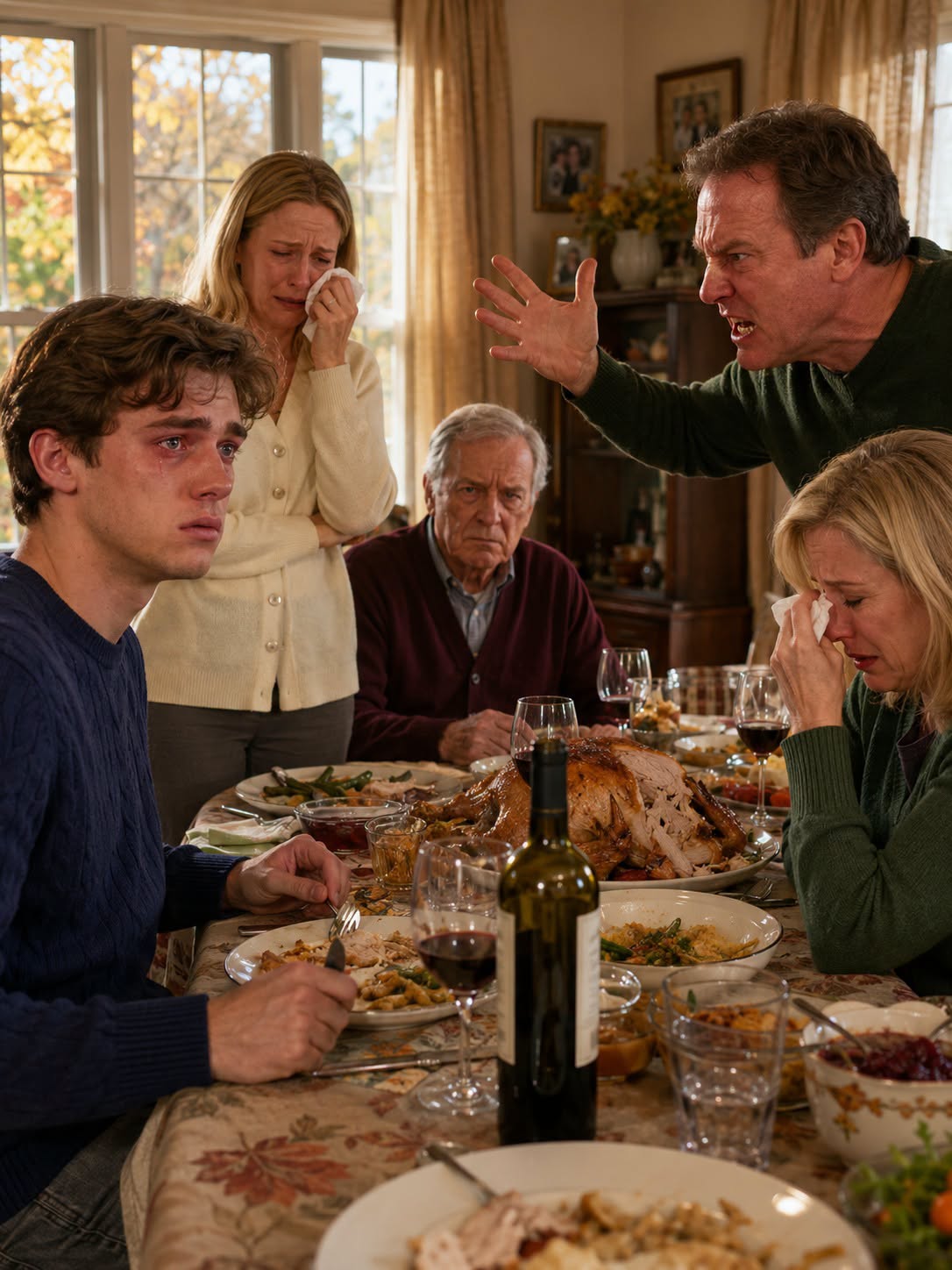
It happened on Thanksgiving, at the long dining room table my mother had decorated with orange candles, cloth napkins, and a centerpiece of plastic pumpkins she brought out every year, and until that moment, the only thing anyone had been worried about was whether the turkey was dry and whether Owen and Miles were getting cranberry sauce on the couch.
Grandpa Daniel had been lifting a forkful of stuffing toward his mouth when my father made the mistake of saying, in that careless voice he used when he wanted something unfair to sound practical, that Claire needed more help than I did.
Grandpa froze in the middle of that bite, his fork suspended in the air, his thick gray eyebrows pulling together as if he had just heard a sentence that did not belong in a decent family’s home.
“Wait,” he said slowly, lowering the fork until it rested against the edge of his plate, “Ethan pays you rent?”
Every face at the table changed at once, although nobody moved much at all, because some truths do not enter a room loudly; they arrive quietly, sit down among the mashed potatoes and dinner rolls, and make everyone afraid to breathe.
My mother’s lips pressed together so hard they nearly disappeared, my sister Claire looked down at her plate as though she had suddenly discovered something fascinating in the gravy, and my father waved one hand in the air with the lazy confidence of a man who believed the world would rearrange itself if he sounded annoyed enough.
“Claire has two kids,” Dad said, his voice dismissive, almost bored, as if he were explaining something obvious to a stubborn child. “She needs more help right now.”
The dining room went still, and the silence that followed was not the ordinary polite silence of a family pausing between conversations, but the heavy kind that settles over people when they realize somebody has just stepped too close to the truth.
Grandpa placed his fork down with the careful, deliberate motion of a man who had decided he was done pretending.
“No,” he said, his voice quiet but firm enough to make my father’s eyes sharpen. “I asked Ethan.”
My stomach dropped so suddenly it felt as though the floor had opened beneath my chair, because for seven years I had survived by making myself small, by answering questions vaguely, by never saying the full truth in front of the people who benefited from my silence.
Dad leaned back, jaw tightening. “Dad, don’t start this.”
Grandpa never looked away from me. “How much?”
I swallowed, feeling every eye on me, and even though I wanted to lie, even though some trained part of me wanted to protect my parents from the embarrassment they had built with their own hands, the truth came out before I could soften it.
“Eight hundred a month,” I said.
Grandma Ruth whispered, “Eight hundred?” in a voice so broken and astonished that my mother immediately reached for control, the way she always did when the room began drifting toward honesty.
“It isn’t rent,” Mom said quickly, folding and unfolding her napkin in her lap. “It’s just helping with household expenses, because everyone contributes when they live together.”
“I live in the basement,” I said, and my own voice sounded strange to me, steadier than I felt. “I buy my own groceries, pay my own phone bill, car insurance, gas, student loans, and half the utilities.”
Claire’s head snapped up, her cheeks already turning pink with offense, because Claire had always treated the truth like an attack if it revealed how much the rest of us carried for her.
“You make it sound like you’re being abused,” she said.
“I didn’t say that,” I replied, keeping my voice even even though my hands had started to tremble beneath the table.
“But you’re acting like it,” she said, leaning back as if she were the wounded one. “I have two children, Ethan, and unless you magically forgot, raising kids is expensive.”
I looked at her across the candles, across the turkey, across years of swallowed resentment. “You don’t pay for daycare, because Mom watches them five days a week.”
Claire’s mouth opened, then closed, and Dad slapped his palm lightly against the table, not hard enough to be frightening but sharp enough to remind everyone who usually controlled the volume in that house.
“That’s enough,” he said.
Grandpa was no longer eating, and his face had gone still in a way I had only seen once before, years earlier at my uncle’s funeral, when grief had carved him into stone.
“Claire,” he said, turning to her with a calm that was somehow more dangerous than shouting, “do you pay anything to live here?”
Claire looked toward Dad, then Mom, then back at her plate, because she was very good at demanding sympathy but very bad at answering simple questions.
Dad answered for her. “She’s rebuilding.”
Grandpa nodded slowly, and the motion made my father’s face harden because he knew that nod meant Grandpa had heard enough to understand more than anyone wanted him to. “How long has she been rebuilding?”
Mom’s voice came out thin. “That’s not fair.”
Grandpa looked around the table, taking in my father’s anger, my mother’s tears, Claire’s embarrassment, and me sitting there like a man caught stealing when all I had done was tell the truth.
“No,” he said, and this time there was steel in every word. “What isn’t fair is charging one child rent while giving the other a free room, free meals, free childcare, and then dressing it up as family.”
Dad’s jaw flexed. “Ethan is twenty-six years old, and he should contribute.”
“And Claire is thirty-two,” Grandpa replied, his voice never rising, “with two children she chose to have and a man she chose to marry, divorce, and keep going back to whenever he decided to knock on the door again.”
Claire shot to her feet so fast her chair scraped loudly across the floor. “How dare you talk about my life like that.”
Grandpa did not flinch, did not blink, and did not give her the dramatic fight she wanted. “Sit down, Claire.”
She sat, not because she wanted to, but because there was something in his voice that none of us had heard in years, something older than Dad’s authority and stronger than Mom’s tears.
Then Grandpa turned back to me. “Ethan, where does your money go?”
A laugh left my mouth, but it sounded hollow and bitter, because there was no humor in a question that simple when the answer had ruled my life for nearly a decade.
“To them,” I said.
Mom’s eyes filled with tears immediately. “We never forced you.”
“You told me if I moved out, I was abandoning the family,” I said, and there it was, the sentence I had kept buried under every paycheck, every canceled plan, every late-night microwave dinner eaten alone beside the basement desk.
Dad pointed at me, his face darkening. “Because family helps family.”
Grandpa pushed his plate away. “Then tonight, family is going to tell the truth.”
The words stayed suspended above the table like storm clouds gathering over a house that had always looked safe from the street, and in the living room, Owen and Miles laughed at cartoons, too young to understand that the adults ten feet away were finally stepping into a fight that had been waiting for years.
Dad stood up, his chair groaning against the hardwood. “I’m not doing this on Thanksgiving.”
Grandpa looked at him with the tired disappointment of a father who had spent too many years watching his son become less generous and more proud. “You’ve been doing this for years, Richard. Thanksgiving didn’t create it.”
Mom wiped beneath one eye with the corner of her napkin. “Ethan, tell your grandfather we never mistreated you.”
That hurt worse than almost anything else, because she did not ask if they had mistreated me, did not search my face with concern, did not wonder whether I had been carrying more than anyone noticed.
She only asked me to deny it.
“I don’t know what you want me to say,” I answered.
Claire crossed her arms. “Maybe you could start with the fact that you’ve had a roof over your head.”
“So have you,” I said.
“I have children,” she said, as if the words were a shield, a crown, and an invoice all at once.
“You keep saying that like it means I owe you my life,” I told her.
Dad’s voice cut across the room. “Enough, Ethan.”
Grandpa turned on him sharply. “Do not silence him.”
Dad looked stunned, because he was used to being the loudest man in every room, especially in his own house, although nobody at that table liked to mention that the house had only become his because Grandpa and Grandma had helped him buy it when he and Mom were drowning in debt twenty years earlier.
Grandpa looked at me again. “How long have you been paying?”
I drew in a breath, feeling as though every year of my life had suddenly become evidence. “Since I was nineteen.”
Grandma covered her mouth.
Mom spoke quickly. “He offered.”
I turned toward her, and for once I did not let her rewrite the scene into something gentler. “I offered two hundred dollars because Dad said the mortgage was tight, and then it became four hundred, then six hundred, then eight.”
Dad’s face hardened. “Because costs went up.”
Grandpa asked, “And Claire?”
No one answered, because silence had always been the preferred language when Claire’s name came near responsibility.
Claire rolled her eyes. “I was married then.”
“And after the divorce?” Grandpa asked.
“I had babies,” she said, her voice tight.
Grandpa nodded once. “So Ethan paid because he had no babies.”
“That is not what this is,” Mom insisted.
“Yes, it is,” I said, and my voice surprised me, because after years of keeping everything locked inside, the truth felt both terrifying and strangely clean.
I worked full-time at a logistics company, came home exhausted, ate microwave dinners in a basement that smelled faintly of concrete and laundry detergent, and listened while the people upstairs called me selfish whenever I wanted anything that belonged only to me.
I had missed friends’ weddings because Claire needed babysitting help, postponed applying for apartments because Dad said renting elsewhere would be foolish when I could help family, and watched my sister buy a newer SUV while I kept driving a twelve-year-old Honda with a heater that coughed out more noise than warmth.
Every month, without fail, I handed my father eight hundred dollars.
Grandpa’s fingers tapped once against the table. “Ethan, do you have savings?”
I looked down at my plate. “Not much.”
“How much?”
“About eleven hundred dollars.”
Grandpa closed his eyes, and that reaction hurt more than yelling would have, because it told me he understood the math immediately.
Dad scoffed. “That’s because he wastes money.”
I almost laughed. “On what?”
Dad pointed toward the basement door as if all my failures were stacked behind it. “Games, takeout, whatever you do down there.”
“I haven’t bought a new game in two years,” I said, feeling heat rise in my face. “And I eat takeout once a week because nobody saves dinner for me when I work late.”
Grandma’s eyes moved toward Mom, and Mom looked away.
Grandpa stood. “Get your coat.”
I blinked at him. “What?”
“You’re coming with us tonight,” he said.
Dad’s chair scraped backward again. “Absolutely not.”
Grandpa turned to him, and this time his voice had gone cold. “He is twenty-six years old.”
“He lives under my roof,” Dad snapped.
“And that roof,” Grandpa said, each word precise enough to cut, “was paid for with help from me, so do not test my memory, Richard.”
For the first time that night, Dad had nothing to say.
Grandpa looked back at me. “Pack what you need for a few days, and tomorrow we will talk about the rest.”
Mom began crying harder. “You are breaking this family apart.”
Grandpa looked at her sadly, and for a moment his anger softened into grief. “No, Linda. I am opening the basement door.”
I packed everything in fifteen minutes, and that was the part that wounded me in a way I had not expected, because twenty-six years of living, seven years of paying rent, and everything I truly needed fit into two duffel bags and one backpack.
A few clothes, my laptop, my work badge, a shoebox with my birth certificate, Social Security card, and car title, three books I had never found time to finish, and a framed picture of Grandma and Grandpa from my high school graduation were all I carried from the room where I had trained myself to expect less.
I stood in the basement doorway before going upstairs, looking at the gray walls Dad had never painted because, as he once said, white paint cost too much for a room nobody saw.
My bed sat against the far wall, my cheap desk was tucked beneath a tiny ceiling-level window, and each morning the sunlight entered in one narrow rectangle across the carpet, just enough to remind me there was still a world above me.
For years, I had called that life temporary.
Temporary had become seven years.
When I came upstairs, Mom was sitting on the couch with Owen asleep against her side, Claire was whispering angrily into her phone in the kitchen, and Dad waited by the front door with his arms crossed as if I were a rebellious teenager sneaking out after curfew.
“You walk out tonight,” Dad said, “do not come crawling back when you realize the real world costs more than eight hundred dollars.”
Grandpa stepped forward before I could answer. “The real world also lets him keep his dignity.”
Dad glared at him. “You always thought I was a bad father.”
Grandpa’s expression stayed steady. “I thought you were a proud man who hated being wrong, and tonight you are proving me right.”
Mom stood suddenly, her voice cracking. “Ethan, please don’t leave like this.”
For one second, I nearly folded, because that was how it had always worked in our house; Dad shouted, Claire accused, Mom cried, and I became the apology that allowed everyone else to continue.
Then I remembered every small request I had made and how every one of them had been turned into evidence against me.
When I asked to skip babysitting because I had a work presentation the next morning, Claire needed me more; when I asked to save less one month because my car needed repairs, the family needed me more; when I asked Dad to lower the rent so I could move out by spring, I was called ungrateful.
I adjusted the backpack strap on my shoulder and looked at my mother. “I’m not leaving because I hate you.”
Her eyes filled again, but this time I did not rush to comfort her before finishing what I needed to say.
“I’m leaving because I cannot keep paying to be treated like the least important person in this house.”
Claire came out of the kitchen with her phone still in her hand. “That is so dramatic.”
Grandma, who had stayed quiet longer than anyone expected, looked at her with a disappointment sharp enough to make Claire flinch. “Claire, hush.”
After that, nobody stopped us.
The ride to my grandparents’ house was quiet, and I sat in the back seat like I had when I was a child, watching streetlights slide across the windows while my phone buzzed three times before we reached the highway.
Dad texted that I had embarrassed my mother, Claire wrote that she hoped Grandpa enjoyed paying for me now, and Mom sent a message asking me to call when I had calmed down.
I turned the phone face down on my knee.
Grandpa noticed in the rearview mirror. “You do not have to answer tonight.”
“I don’t know what happens tomorrow,” I said.
“Tomorrow,” he replied, “you sleep in, and then we make a plan.”
Grandma reached back and patted my knee, her hand warm and steady. “And you eat breakfast at a table, not at a desk.”
That nearly broke me.
Their house was a small ranch in Ohio about thirty minutes away, with creaky floors, a narrow hallway, and the smell of lemon cleaner, old wood, and cinnamon candles Grandma lit in every room from October through January.
The guest room had a quilt folded at the foot of the bed and a lighthouse-shaped lamp on the nightstand, and somehow the quiet felt unfamiliar because nobody asked me to explain, defend, apologize, or promise anything before letting me rest.
I stayed awake for hours anyway.
The next morning, I woke to the smell of coffee and bacon, and for a few confused seconds I thought I was late for work before remembering I had requested the day off months earlier because Mom said Thanksgiving cleanup would be too much with the boys around.
When I walked into the kitchen, Grandpa was already seated at the table with a yellow legal pad in front of him.
He had drawn three columns across the top.
Income. Expenses. Plan.
“Sit,” he said.
Grandma placed a plate in front of me before I could touch the chair. “Eat first.”
So I ate, and then we talked.
I told them everything, not perfectly and not dramatically, but honestly, starting with my first full-time job, the two hundred dollars I had offered when Dad said the mortgage was tight, and the way that temporary help became a fixed payment that rose whenever my parents decided the family needed more from me.
I told them about Claire moving back in after her divorce, how she became the storm everyone else rearranged themselves around, and how I was expected to babysit, fix things, pick up groceries, pay utilities, work full-time, and still be grateful for a basement room.
Grandpa wrote every number down.
My monthly take-home pay, my student loan payment, my car insurance, gas, food, phone bill, and the eight hundred dollars I gave Dad went onto the page in his careful block handwriting, and when he finished, he circled the rent number so hard the pen almost tore through the paper.
“You could have moved out two years ago,” he said.
“I know,” I answered.
“Why didn’t you?”
I looked down at the coffee cup between my hands. “Because they made it sound like leaving would destroy them.”
Grandma sat beside me, her voice soft. “And what was staying doing to you?”
I did not answer because I did not have to.
By Monday, Grandpa had helped me schedule three apartment tours, nothing fancy or luxurious, just clean one-bedroom places near my job, in neighborhoods safe enough for me to come home late without feeling like I had made another bad bargain.
The rent was higher than what I paid Dad, but the difference was that a landlord came with a lease, privacy, and no emotional debt disguised as family loyalty.
On Tuesday evening, Dad called.
I almost ignored it, but Grandpa looked up from his newspaper and said, “Answer only if you want to, not because you are afraid.”
So I answered.
Dad did not say hello. “You have made your point.”
I stood in the hallway outside the guest room. “What point?”
“That you are upset.”
“I am not trying to make a point.”
“Your mother hasn’t slept.”
I closed my eyes. “I’m sorry she’s upset.”
“You should come home and talk.”
“We can talk,” I said, keeping my voice measured, “but I am not moving back tonight.”
There was a pause, and then Dad said, “You think your grandparents are going to save you, but they will not always be around.”
The old me would have panicked at that sentence, would have heard warning, abandonment, guilt, and obligation all tangled together in one threat.
The new me heard it clearly.
It was not concern.
It was bait.
“I know,” I said. “That is why I need to build my own life.”
Dad’s voice lowered. “After everything we did for you?”
A wave of exhaustion passed through me. “What did you do for me that you did not also do for Claire?”
“We raised you.”
“You raised both of us.”
“You had a home.”
“So did Claire.”
“You had food.”
“So did Claire.”
“You’re a man, Ethan,” Dad said, and there it was, the rule hidden beneath every excuse. “You are supposed to help.”
Claire’s mistakes were emergencies, my needs were selfishness, her comfort was family, and my exhaustion was duty.
“I did help,” I said. “For seven years.”
Dad exhaled sharply. “Fine, then I’ll tell your mother you are choosing money over family.”
“No,” I replied. “Tell her I am choosing my future over being used.”
He hung up.
My hands were shaking afterward, but not from fear exactly; it felt more like my body was catching up to a decision my mind had already made.
Two weeks later, I signed a lease.
Grandpa came with me, though he did not pay the deposit and I did not ask him to, because what I needed from him was not money but the steady presence of someone standing beside me while I learned to trust my own judgment.
The leasing manager explained the paperwork, and when my hand hesitated before I signed, Grandpa leaned close and said, “Read every line, then decide.”
So I read every line.
Then I signed.
My apartment was on the third floor of an old brick building with noisy radiators, narrow stairs, one bedroom, one bathroom, a small kitchen, and a living room just big enough for a secondhand couch I bought from a man named Marcus on Facebook Marketplace.
It was not impressive.
It was mine.
On moving day, Grandma brought cleaning supplies, Grandpa brought a toolbox, and my friend Noah helped carry the mattress while I apologized too many times and he finally told me to stop acting like friendship came with an invoice.
By sunset, I had a bed, a folding table, two chairs, and a blue-striped shower curtain Grandma insisted on buying because, in her words, a man still needed a proper bathroom even if he owned only three forks.
At eight that night, I sat on the floor eating pizza from a paper plate.
Nobody asked where the leftovers were.
Nobody told me to turn the volume down.
Nobody knocked on the door and handed me a child.
I slept for nine hours, and when I woke the next morning, the silence did not feel empty.
It felt like air.
The fallout arrived slowly, as most family consequences do, first through daily texts from Mom, then through sharp messages from Claire, then through the kind of cold distance Dad used whenever he wanted someone else to crawl back first.
Mom wrote that they missed me, that the boys asked about me, that my father was hurt, that Claire was under a lot of stress, and every message seemed designed to place the old responsibilities back into my hands without saying directly what she wanted.
I answered politely, but briefly.
I missed the boys too.
I hoped Dad felt better soon.
I was not available to babysit that weekend.
That last sentence caused the first explosion.
Claire called me at work, which she never did unless she needed something, and I stepped outside near the loading dock with my coat half-zipped against the December cold.
“I need you Saturday,” she said, not asking, not explaining, just assuming that my life remained a room she could enter whenever she wanted.
“I’m busy,” I said.
“With what?”
“My apartment.”
“That is not an answer.”
“It is.”
She laughed bitterly. “You get one little apartment, and now you think you are better than everyone.”
“No,” I said, looking across the parking lot at a gray winter sky. “I think I am unavailable.”
“Must be nice to abandon your nephews.”
“I am not their parent, Claire.”
For once, she went quiet.
Then she said, “You really are selfish.”
A month earlier, that would have worked, because guilt had been the leash everyone knew how to pull.
This time, it did not.
“I have to get back to work,” I said, and then I hung up.
The next message came from Mom a few minutes later.
Claire is crying. Was that necessary?
I typed three different replies and deleted all of them before finally writing the sentence Grandpa had helped me practice.
I am willing to have a respectful relationship, but I am not willing to be guilted into responsibilities that are not mine.
Mom did not answer for two days.
Christmas arrived wrapped in tension like ribbon.
I almost did not go, and Grandpa told me I did not have to, while Grandma promised she would support whatever I chose, but in the end I went because I loved my nephews and because I wanted to prove to myself that I could walk into that house without becoming the person I had been inside it.
The moment I stepped through the door, Owen ran toward me yelling my name, and Miles wrapped himself around my leg before I had even taken off my coat.
For ten minutes, everything felt simple.
Then Claire said from the couch, “Careful, boys, Uncle Ethan has a very busy independent life now.”
I set Owen down gently.
Dad watched from the recliner with an unreadable expression, Mom hovered in the kitchen doorway, and Grandpa, who had come with Grandma, cleared his throat once in the old warning sound that had once made even my father sit straighter as a boy.
Claire rolled her eyes, but she said nothing else.
Dinner was awkward, though not explosive, with Dad asking about work as if he were interviewing a stranger, Mom offering me food with too much sweetness in her voice, and Claire talking loudly about how expensive everything had become.
After dessert, Dad followed me onto the porch.
It was freezing outside, and I could see my breath drifting between us like smoke.
For a while, neither of us spoke.
Then he said, “Your mother says I should apologize.”
I looked at him. “Is that why you’re out here?”
His jaw shifted. “I don’t know.”
At least that was honest.
Dad leaned against the railing, staring out at the dark yard. “When you started paying, it helped, and I told myself it was normal because you were working and living at home, and then Claire came back and everything was chaos because the boys were little and she was falling apart.”
“I know,” I said.
“And you were stable.”
I laughed softly, but there was no humor in it. “I looked stable because I was not allowed to fall apart.”
He glanced at me then.
“You needed me to be fine,” I continued, “so I acted fine, but I was not fine.”
Dad rubbed his face with one hand. “I did not see that.”
“No,” I said. “You didn’t.”
The porch boards creaked beneath his shoes.
“I don’t know how to fix it,” he admitted.
“You can start by not asking me for money,” I said.
He nodded once.
“And not sending Mom or Claire to guilt me.”
Another nod came slower this time.
“And you can admit that what happened was not fair.”
That one took longer.
Dad looked out across the yard, and I could see his pride wrestling with him, the old instinct to argue and explain and defend rising in his face before something tired and human finally pushed it down.
“It was not fair,” he said.
The words came out rough, almost forced, but they were the words I had waited seven years to hear.
When I went back inside, Mom was standing near the hallway, pretending she had not been listening and failing badly.
She touched my arm. “Are you coming next Sunday?”
“For dinner?” I asked.
She nodded. “Just dinner, Ethan. No favors, no babysitting, no money talk.”
I looked toward the living room, where Claire was helping Owen assemble a toy truck and Miles had fallen asleep with frosting on his cheek.
“I’ll think about it,” I said.
And I meant it.
Not yes because I felt guilty.
Not no because I was angry.
I would think about it because, for the first time in years, I had enough space to choose.
Over the next year, things changed unevenly, which is probably how most real healing happens when a family has spent too long calling imbalance love.
Dad never paid me back, and I did not expect him to, because Grandpa once told me that some debts cost too much to chase when collecting them keeps you tied to the person who took from you.
Claire stayed Claire for a long time, making remarks, testing boundaries, and calling me selfish whenever I said no.
But the difference was that no became a full sentence.
No, I could not watch the boys that night.
No, I would not pay for her car repair.
No, I was not leaving work early because she forgot an appointment.
Sometimes she screamed, sometimes she cried, and sometimes she stopped speaking to me for weeks.
The world did not end.
My relationship with Mom took longer, because she had built so much of her life around keeping peace that honesty felt cruel to her, and in her mind I had always been the easy child, the steady one, the child who understood.
She did not know what to do when I stopped making myself easy.
One Sunday, almost eight months after Thanksgiving, she came to my apartment for the first time.
She brought soup, and I almost smiled when I saw the container because feeding people had always been her apology language.
She stood in my doorway, looking past me into the small living room, where I now had a real couch, a bookshelf, curtains, and a framed print of Lake Michigan hanging above the table.
Nothing in that apartment was expensive, but every object had been chosen by me.
“It’s nice,” she said quietly.
“Thanks.”
She walked in and placed the soup on the counter, then looked around as if she were meeting a version of her son she had never bothered to know.
After a few minutes, she said, “I’m sorry.”
I turned toward her.
Her eyes were wet, but she did not cry loudly this time, did not make me comfort her, and did not turn her apology into another burden I had to carry.
“I told myself you were okay because I needed you to be okay,” she said. “That was wrong.”
I leaned against the counter, unsure what to do with an apology that finally had weight.
She twisted her hands together. “I should have protected you from your father’s expectations, and from Claire’s expectations, and from mine.”
For a moment, I did not know what to say.
So I told the truth. “I needed you to notice.”
She nodded. “I know.”
That apology did not erase the past, did not return seven years of savings, and did not change all the nights I had eaten alone in the basement while my family laughed upstairs.
But it mattered.
Not because it fixed everything.
It mattered because, for the first time, she named what happened without asking me to soften it for her.
Grandpa died two years later.
It happened suddenly, a heart attack in his garden while he was trimming tomato plants, and by the time Grandma found him, the ambulance was already too late.
He was seventy-nine.
At his funeral, the church was full, because Grandpa had been the kind of man who spoke little but showed up often, and people I had never met shook my hand and told me stories about him fixing fences, lending tools, driving neighbors to doctor’s appointments during snowstorms, and quietly paying for repairs no one knew about.
Dad cried during the service.
So did I.
After the burial, Grandma handed me an envelope.
“Your grandfather wrote this after that Thanksgiving,” she said.
I opened it later, alone in my car outside the cemetery, while the sky hung low and gray over the rows of headstones.
Ethan,
You were never weak for staying. You were surviving the only way you knew how.
But I am proud that you left.
A family should be a place where a person grows stronger, not smaller. Remember that when you build your own.
Don’t become bitter. Become clear.
Love,
Grandpa
I read the letter three times before I could drive.
Years passed, the way they always do after a life-changing night, slowly at first and then all at once.
I got promoted, then promoted again, and eventually moved from the third-floor apartment into a small townhouse with a garage, a patch of grass out front, and enough room for a real dining table.
My Honda finally died at 214,000 miles, and I bought a used Subaru with heated seats, which felt like luxury every winter morning.
Claire eventually remarried a quiet electrician named Ben, who had kind eyes, practical hands, and absolutely no patience for her habit of blaming everyone else for the consequences of her decisions.
She still struggled with money sometimes, and she still made dramatic remarks at family gatherings, but she stopped asking me for cash after Ben once said in front of everyone, “Your brother is not your emergency fund.”
I liked Ben immediately.
Dad and I became careful with each other.
We were never the easy father and son from greeting cards, never fishing buddies, never men who sat for hours unpacking feelings over coffee, but he stopped treating me like a resource, and sometimes he asked my advice about taxes or his truck.
Sometimes I asked him about home repairs.
Once, while helping me install shelves in my townhouse, he looked around the living room and said, “You did good here.”
It was not a full apology.
From him, it was something.
Mom visited often, and over time she learned to ask before assuming, learned that invitations were not obligations, and learned that when I said I was busy, the conversation could continue without punishment.
Grandma, after Grandpa died, spent one Sunday a month at my place, where we cooked together, or more accurately, she cooked and corrected my chopping until she decided I was less dangerous with onions than before.
One autumn afternoon, five years after that Thanksgiving, my family gathered at my townhouse for dinner.
It was the first holiday meal I hosted.
The table was crowded, Grandma at one end, Dad at the other, Mom fussing over green beans until I gently took the serving spoon from her hand, and Claire arriving late with Ben, Owen, and Miles, who were now tall enough to raid my fridge without help.
Owen, twelve by then, wandered into the kitchen while I was carving the turkey.
“Uncle Ethan?” he asked.
“Yeah?”
“Mom said you used to live in Grandma and Grandpa’s basement.”
I looked toward the dining room, where Claire was laughing at something Ben had said, unaware of the question that had just entered my kitchen.
“I did,” I said.
“Why?”
The knife paused in my hand.
I could have said many things.
Because I was trapped.
Because adults made their problems mine.
Because nobody noticed until Grandpa did.
Instead, I looked at my nephew and chose the answer he could carry without being crushed by it.
“Because sometimes people stay in places longer than they should,” I said. “And sometimes they need help remembering they can leave.”
Owen considered that seriously. “Grandpa Daniel helped you?”
I smiled a little. “Yeah, he did.”
Owen nodded, stole a roll from the basket, and ran before Grandma could scold him.
At dinner, noise filled every corner of the house, with forks clinking, kids laughing, Claire telling a story too loudly, Dad complaining that turkey was impossible to carve evenly, and Mom asking whether anyone wanted more potatoes.
For a moment, I saw the old Thanksgiving table in my mind.
I saw myself frozen mid-answer, Dad waving his hand, Claire offended, Mom crying, and Grandpa setting down his fork as if that one small motion could split my life into before and after.
Then I looked at the table in front of me.
Different house.
Different rules.
My name on the mortgage.
My food on the plates.
My choice to open the door.
Grandma raised her glass of cider. “To Daniel.”
The room quieted.
Dad looked down, Mom wiped one eye, Claire’s expression softened, and even the boys stopped moving.
I lifted my glass.
“To Grandpa,” I said.
And silently, beneath all the noise and warmth and complicated love of the family I had finally learned how to stand inside without disappearing, I added the words I had carried for years.
Thank you for opening the basement door.
The End