The night my son stood on the graduation stage as valedictorian, I arrived expecting tears, applause, and that sweet, aching pride only a mother understands when she sees her child reach the place she once prayed he would survive long enough to touch.
I never imagined I would sit in a packed high school gymnasium, my daughter’s hand locked around mine, while Caleb stopped in the middle of his speech, folded his pages in half, looked directly at my husband, and turned the proudest night of his life into the night our family finally split open.
Until that moment, I believed I knew what my son was going to say, because I had watched him write and revise that speech for days at the kitchen table, his shoulders bent beneath a desk lamp while the rest of the house slept around him.
I thought he would thank his teachers, tell a harmless joke about cafeteria pizza, say something inspiring about the future, and maybe mention me in a way that would make me cry before I could stop myself.
I was wrong in a way that still makes my stomach tighten whenever I think about that gym, those bleachers, those rows of families holding flowers and balloons, and the terrible silence that fell when my son decided he could no longer pretend.
Caleb had been working toward that stage for years, not because I forced him, and not because I was one of those parents who measured love in trophies, test scores, or college acceptance letters.
If anything, I was the person constantly telling him to slow down, eat something that did not come out of a microwave, sleep longer than four hours, and remember that one B on a paper would not end his life.
But after his father died when Caleb was eleven, school became the one place where the world still made sense to him, because grief had taken away the shape of our home, our routines, our weekends, and the sound of his father laughing from the garage.
His father, Daniel, had been the kind of man who could make pancakes on a Saturday morning and somehow leave flour on the ceiling, the kind of man who took Caleb fishing even when the fish were not biting, the kind of man who never treated quiet emotions like they were something to be ashamed of.
When Daniel was gone, Caleb did not collapse loudly, and maybe that was why I missed how deeply the loss was carving him open, because he became useful, responsible, and almost frighteningly composed.
I was working double shifts at the pharmacy then, standing for ten hours under fluorescent lights, smiling at customers who snapped at me over insurance delays, and coming home so exhausted I sometimes sat in the car in our driveway because walking inside felt like climbing a mountain.
Most days, I was simply trying to keep groceries in the refrigerator, keep the lights on, keep my daughter Lily from noticing when I cried in the laundry room, and remember which bill needed to be paid before a red warning appeared in the mail.
Caleb made his own lunch, helped Lily with spelling words at the kitchen counter, took out the trash without being asked, and still somehow kept coming home with perfect grades tucked into his backpack like they were ordinary things.
He was not perfect in that polished, artificial way people sometimes praise children for being convenient, because he had his moods, his silences, and those moments when I would catch him staring at nothing with his father’s old sadness in his eyes.
But he was sincere, decent, gentle with his little sister, respectful to his teachers, and determined in a way that made me proud and afraid at the same time, because no child should have to become strong that early.
When I married Patrick four years after Daniel died, I convinced myself I was giving my children stability again, which was the word I used whenever doubt rose in my chest.
Patrick was orderly, steady, practical, and useful in ways that looked admirable from the outside, especially to a tired widow who had been holding a household together with coupons, overtime hours, and prayers whispered into dishwater.
He remembered appointments, handled paperwork, repaired cabinet hinges before I even realized they were loose, changed the oil in my car, balanced the household calendar, and always seemed to know what needed to be done.
People adored him for that, because from a distance Patrick looked like the kind of man who stepped into a damaged family and brought order where grief had left confusion.
For a while, I adored him too, or maybe I adored the relief of not having to make every decision alone, which is not always the same thing as love, though I did not understand that clearly then.
Caleb made an effort with him from the beginning, even though I knew no stepfather could replace the man whose old flannel shirts Caleb still kept folded in a drawer.
He was polite, respectful, and careful with his words, saying, “Thanks for the ride,” and “Yes, sir,” and never giving Patrick the kind of teenage attitude people warn you about when boys get tall enough to look adults in the eye.
For a long time, I mistook that politeness for acceptance, because it was easier to believe peace had settled over our house than to examine the quiet tension that sometimes moved beneath it.
Patrick never liked when Caleb mentioned Daniel, though he was too clever to make that dislike obvious.
It was never a shouted complaint or a cruel remark in front of everyone, but rather a pause at the table, a hardening of his jaw, a little shift in his expression, and then a smooth redirection that sounded reasonable if you were not looking closely.
If Caleb said his dad used to take him to the lake, Patrick would say, “Well, maybe we should focus on the future instead of living in the past.”
If Lily asked what Daniel’s laugh sounded like, Patrick would clear his throat and say, “Your mother has had a long day, sweetheart, so let’s not drag up painful things.”
At the time, those comments almost sounded protective, and because I was tired, grateful, and desperate for our home not to become a battlefield, I let myself accept that version.
I told myself Patrick was simply uncomfortable around grief, that some people did not know how to share space with the dead, and that maybe he was trying to help us move forward.
But moving forward is not the same as being quietly pushed away from everyone who remembers who you were before someone else took control of the story.
During Caleb’s senior year, something shifted in him, and I noticed it the way mothers notice things before they can name them.
He stopped putting college letters on the refrigerator, even though for years he had stuck every honor roll notice and scholarship invitation beneath the little apple magnet Lily made in second grade.
He stopped bringing up scholarships, stopped talking about campus visits, and stopped leaving his laptop open to application portals while he made coffee at midnight.
At dinner, whenever I asked about graduation plans, college deadlines, or whether he wanted to invite anyone from Daniel’s side of the family, he only said, “I’m handling it,” in a voice that sounded older than seventeen.
I should have pressed harder, but by then I had become dangerously good at accepting the simplest explanation, and the simplest explanation was that he was overwhelmed by school, by applications, by graduation, by the pressure everyone placed on children who are expected to turn their pain into achievement.
One afternoon in late April, I came home early from the pharmacy because the computer system crashed and our manager sent half the staff home, and I found Caleb in the garage with a torn envelope in his hand.
He was standing near the shelves where Patrick kept paint cans, old tax folders, spare batteries, and the kind of labeled storage bins that made him so proud of his own organization.
When Caleb saw me, he stiffened and shoved the torn envelope beneath a dusty stack of old paint trays so quickly that the movement itself told me it was not nothing.
I said, “What was that?”
He wiped his hands on his jeans and answered, “Nothing,” but the word came too fast, too flat, and too empty to be true.
I stepped closer, and for one second I saw something in his face that I still remember with shame, because he looked like he wanted me to ask again and terrified that I would.
I should have stayed in that garage, moved the paint cans, taken his hands, and told him whatever it was, he could trust me more than anyone.
Instead, I let exhaustion make the decision for me, because Patrick was due home soon, Lily needed to be picked up from dance, dinner had not been started, and my whole life felt like a list of urgent things shouting over important ones.
I said, “Okay, but if you need help, I’m here,” and Caleb nodded with a small, tired smile that did not reach his eyes.
That is the moment I keep returning to, because every family has a handful of seconds that look ordinary while they are happening, only to become unbearable later when you understand what they were trying to tell you.
I trusted the wrong person because I was exhausted, and I mistook my son’s silence for independence when it was really the sound of him trying to survive a truth he did not yet know how to bring into the light.
Graduation night was supposed to be simple and beautiful, the kind of evening people remember through photographs, flower bouquets, and the gold tassel hanging from a rearview mirror.
Lily was thrilled, dressed in a pale blue dress she had chosen herself, carrying a little bundle of grocery-store roses for her brother as if she were presenting flowers at the Oscars.
I had put on waterproof mascara because I knew I would cry the second Caleb walked across the stage, and I had chosen a navy dress Daniel once told me brought out my eyes, even though I did not tell anyone that was why I wore it.
Patrick drove us to the school, calm and composed, one hand on the steering wheel, the other resting near the console, making little remarks about traffic and parking like this was simply another event to manage.
The gym was crowded, hot, noisy, and packed with proud parents pretending they were not about to fall apart, while graduates shifted in folding chairs under bright lights that made their caps look sharper and their faces younger.
There were balloons tied to bleachers, grandmothers fanning themselves with programs, fathers holding cameras high above their heads, and teachers moving along the aisles with the tired, satisfied smiles of people who had carried these children to the finish line.
When Caleb’s name was announced as valedictorian, Lily squeezed my hand so hard my knuckles ached, and I laughed through the sting in my eyes because her pride was too pure to interrupt.
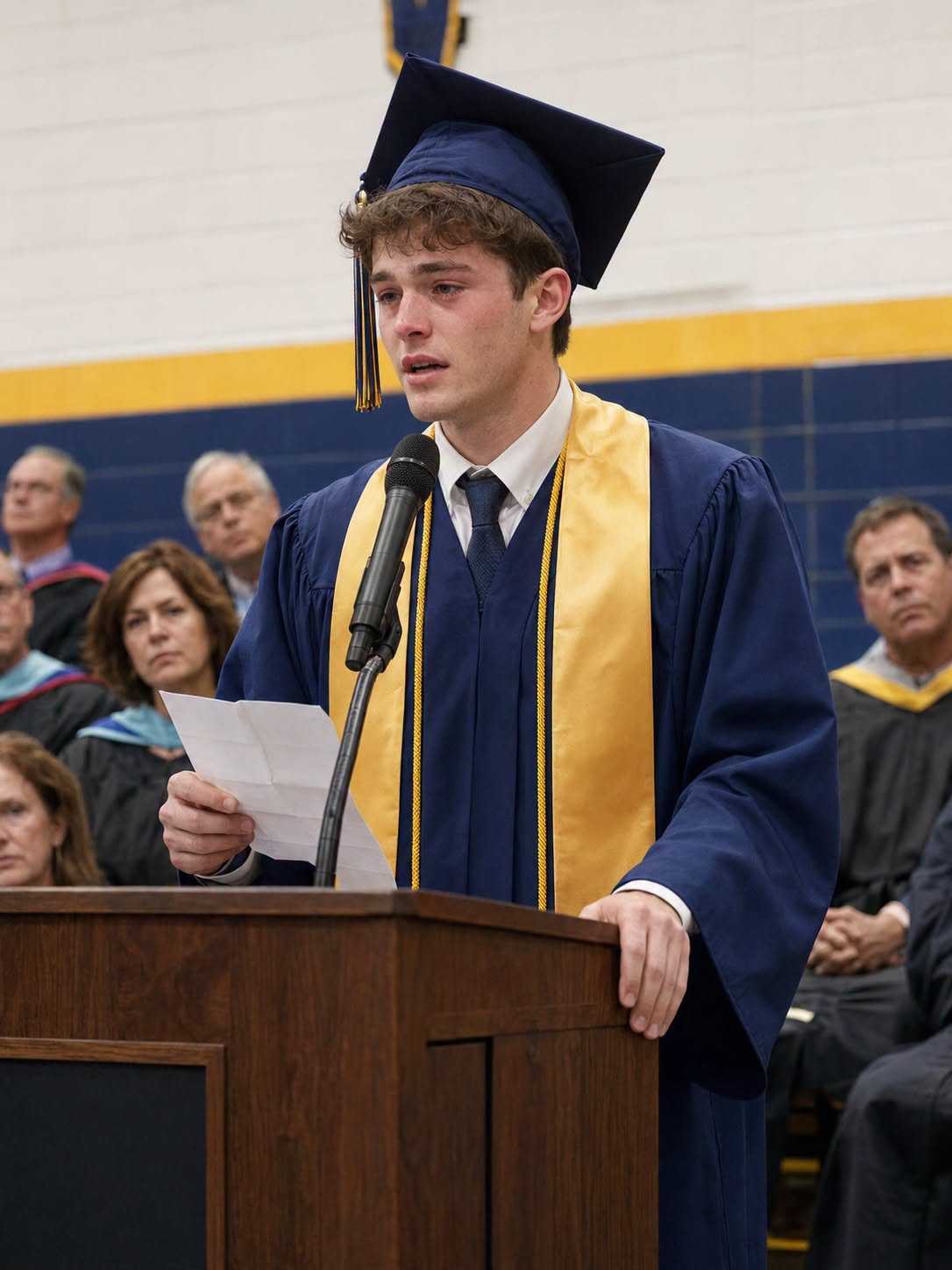
Then Caleb stepped onto that stage in his cap and gown, tall and straight, with the gold stole resting across his shoulders, and for one terrible second he looked so much like Daniel that I could not breathe.
It was the same posture, the same eyes, the same stubborn mouth that tightened when he was holding back emotion, and suddenly the years between Daniel’s funeral and that graduation stage collapsed inside me.
Caleb adjusted the microphone, glanced once at the rows of students behind him, and began his speech with a calmness that made every parent around me lean in.
He thanked the teachers who had stayed late, the counselors who had answered frantic emails, the custodians who kept the building running, and the classmates who had turned ordinary school days into memories they would not appreciate until much later.
He made one gentle joke about senior parking, and the whole gym laughed with relief, because everyone expected the speech to follow the safe path speeches always follow.
Then he thanked me.
He said, “My mom taught me what it looks like to keep going even when life throws you a curveball every single day, and if I have learned anything from her, it is that love is not always loud, but it always shows up.”
I started crying right there, not politely or prettily, but with one hand pressed to my mouth while Lily leaned against my shoulder.
Patrick sat beside me without moving, his hands folded over the printed program, his expression unreadable in the glare of the gym lights.
Caleb looked down at the pages in his hands, and I expected him to continue into the familiar ending about the future, courage, and chasing dreams.
Instead, he stopped.
Not a pause, not a stumble, not one of those moments when a teenager loses his place and laughs nervously into the microphone.
He simply stopped speaking, and the silence moved through the gym in a strange ripple, starting at the front rows and spreading backward until the restless shuffling of hundreds of people faded into something heavier.
I thought emotion had overtaken him, and my first instinct was to stand, to walk to the stage, to rescue him from whatever grief had caught in his throat.
Then he folded the pages in half with deliberate care.
He lifted his head, and he did not look at me, or at Lily, or at his teachers, or at the sea of classmates waiting behind him.
He looked straight at Patrick.
The shift in Patrick’s body was so small most people probably missed it, but I felt it beside me like a door slamming shut.
Caleb leaned toward the microphone and said, “Sorry, but I can’t pretend nothing has happened.”
Patrick went completely still.
Caleb reached inside his graduation gown and took out a sealed envelope, and even from where I sat, I could see that his hand was trembling.
Then he said, in a voice that broke the air cleanly in two, “Now everyone will find out what you did.”
The principal stepped once toward the stage, then stopped near the curtain as if some invisible line had appeared between ordinary school authority and whatever truth my son was about to release.
No one knew what to do with that sentence, because it did not belong in a graduation ceremony, did not belong beneath a banner that said congratulations, did not belong in a room where people were holding roses and filming on their phones.
Patrick muttered, low enough that only the people close to us could hear, “Caleb, sit down.”
Caleb did not sit down.
He opened the envelope and pulled out an old photograph, holding it carefully by the edges, and from the bleachers I recognized it before my mind was ready to understand why he had it.
It was Caleb as a little boy, perched on Daniel’s shoulders by the lake, both of them sunburned and laughing, while behind them stood Daniel’s mother, Grace, smiling with one hand lifted as if she had just called out to them.
My late husband’s mother.
I had not seen her in years.
Caleb held the photograph up and said, “I spent most of this year believing my dad’s family had stopped caring about me.”
No one moved, and even the graduates behind him seemed frozen, their faces turned upward toward him with the solemn attention of people realizing they were witnessing something that could not be undone.
“I was told they had moved on,” Caleb continued, his voice steadier now, though his hand still shook around the photograph.
“I was told they didn’t want contact anymore, that I needed to stop chasing people who didn’t want me, and that holding on to my dad’s family was only making things harder for everyone.”
He looked at Patrick again, and this time the entire gym followed his gaze.
“A month ago, I found the graduation invitation I had filled out for my grandmother,” he said. “I thought I’d misplaced it, but it had been opened, torn, and hidden in the garage before I ever got the chance to mail it.”
A cold feeling slid through me, so sharp and sudden I had to grip the edge of the bleacher.
“That made me start looking,” Caleb said.
Patrick’s voice came again, low and hard, through clenched teeth. “Enough.”
Caleb answered, “No,” and in that one word I heard every swallowed question, every lonely birthday, every letter that never arrived, and every time my son had been made to doubt his own memory.
Then he said, “Patrick never throws paperwork away. He keeps everything.”
My stomach dropped because that was true, and suddenly the labeled bins, the locked desk drawers, the careful stacks of folders, and the quiet pride he took in controlling records no longer looked responsible.
They looked like evidence.
Caleb reached back into the envelope and pulled out several pieces of paper, some folded, some flattened, some old enough to have soft creases at the corners.
“I found birthday cards from my grandmother in his desk,” he said. “They were already opened, and some of them still had the envelopes with my name on them.”
A sound moved through the gym, not quite a gasp and not quite a whisper.
“I found a check she sent for senior pictures,” Caleb continued. “I found letters asking why I never wrote back, why I didn’t call, why I had stopped answering her.”
He swallowed hard, and his eyes flicked toward me only once, so quickly it almost hurt more than if he had stared.
“And I found a graduation card that said, ‘I will be there whether you write back or not. Your father would want me there.’”
I turned toward Patrick.
For a few seconds I could not speak, because the man beside me was my husband, the person I had shared a bed with, the person I had trusted to pick up Lily from school, deposit checks, sort mail, and help hold our family together after grief had nearly broken it.
I said, quietly at first, “Tell me he’s lying.”
Patrick did not look at me.
That was when I knew, not because he confessed, and not because Caleb had finished explaining, but because silence has a shape when it is guilty.
Caleb drew a breath that seemed to take effort from his whole body.
“I wanted to tell my mom first,” he said. “I really did, but every private conversation in our house somehow became his version of the truth, and silence is how he got away with it.”
That line struck me almost as hard as the cards and letters, because I suddenly remembered every conversation Patrick had entered too smoothly, every question he had answered for me, every time he said, “I handled it,” before I had even understood there was something to handle.
Caleb said, “I couldn’t call from my own phone, because Patrick checks the phone records and asks about every number he doesn’t recognize.”
The gym had gone so quiet that I could hear someone crying three rows behind us, a soft broken sound that made the whole room feel human again.
“So two nights ago,” Caleb continued, “I borrowed a phone at a gas station and called my grandmother myself.”
His voice cracked on the word grandmother, and that crack nearly ended me.
“I asked her if she had really stopped writing to me,” he said, staring down at the photograph for a moment. “She cried so hard I could barely understand her.”
Then Caleb looked toward the back of the gym, beyond the rows of parents, past the folded chairs, all the way to the double doors near the lobby.
He said, “She’s here.”
Everyone turned.
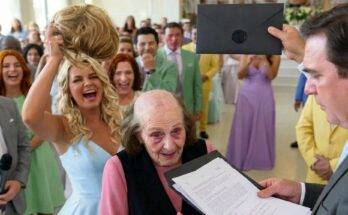
Grace stood by the doors with one hand covering her mouth, her white hair pinned neatly, her Sunday jacket buttoned even in the heat, her face already wet with tears.
For one terrible, beautiful second, she looked exactly like I remembered her from Daniel’s funeral, except smaller, older, and more breakable than anyone should become while waiting outside the life of a child she loved.
I broke down completely, and I did not care that people were watching, did not care that my mascara was running, did not care that a hundred phones were probably recording the collapse of my marriage and the exposure of my failure.
All I could see was Grace standing at the back of that gym, Caleb standing on the stage, and the invisible years between them filled with stolen letters, deleted messages, and a man’s need to own what grief had left behind.
That was when Patrick stood.
He did not stand like a man ashamed, or even like a man afraid, but like a man outraged that a room full of people had been allowed to see behind the curtain.
“You do not understand adult matters,” he said, trying to keep his voice low, though the words carried.
Caleb looked at him without flinching. “I understand enough.”
Patrick’s face tightened as he glanced around at the gym, at the principal, at me, at the rows of families who were no longer pretending not to listen.
“That side of the family always looked down on us,” Patrick said. “I was protecting this family. I was protecting our peace.”
For a moment, no one breathed.
Caleb stared at him, and the boy who had carried groceries, helped his sister, earned scholarships, and swallowed loneliness until it nearly became part of him suddenly looked older than every adult in that room.
“No,” Caleb said. “You were protecting your place.”
The whole gym seemed to feel those words, because they were not shouted, not dressed in drama, not delivered like revenge.
They were simply true.
Patrick looked around as if expecting someone to defend him, as if the principal might step in, as if I might soften the room, as if the years he had spent appearing reasonable would still protect him.
No one did.
Caleb stepped away from the microphone, still holding the old photograph and the opened cards, and for a second I thought the principal would stop him.
But the principal only moved aside.
My son walked down the steps from the stage and crossed the gym floor in his cap and gown while everyone watched him, and with every step he seemed less like the perfect valedictorian and more like the child he had been forced to hide.
At the back of the gym, Grace opened her arms before he reached her.
When Caleb fell into them, she held him as if she feared he might vanish if she loosened her grip, and he bent his head against her shoulder in a way that made him look eleven again.
Just like that, the calm, brilliant, composed young man everyone admired was gone, and in his place stood a wounded seventeen-year-old boy who had finally found his way back to someone who had never stopped loving him.
I got down from the bleachers on unsteady legs, with Lily clinging to my arm, and when Caleb brought Grace toward me, I could hardly look at her because shame had risen in my throat like smoke.
Grace took my hands before I could apologize.
“I tried,” she said, and her voice shook so badly I had to lean closer to hear her. “I called, I sent cards, I came by the house, and there was always some reason it wasn’t a good time.”
I closed my eyes.
“I left messages,” she continued. “I thought maybe you didn’t want me there, or maybe Caleb didn’t want to hear from me anymore, and I kept telling myself not to push because I didn’t want to make the pain worse.”
Every ugly thing lined up then with a clarity so cruel it almost felt physical.
Calls I never received.
Visits I had been told were canceled.
Messages I had never heard.
Birthday cards that never arrived.
The way Patrick said, “I handled it,” whenever Daniel’s family came up, and the way I had let those three words become a locked door because I was too tired to question who was standing behind it.
I had thought missed calls were spam, thought silence meant distance, thought grief had simply carried us all in separate directions.
I had never understood that Patrick had been answering, deleting, explaining, filtering, deciding, and quietly choosing for all of us.
I looked at him across the gym and realized, all at once, that he had not only wanted authority.
He had wanted control over who Caleb loved, who Caleb remembered, who could reach him, and who still had a claim on the boy Patrick had never truly accepted as belonging to anyone but the household he ruled.
The ceremony stumbled forward after that because ceremonies are stubborn things, and schools like order even when the truth has just shattered beneath the basketball hoops.
Students crossed the stage, names were called, diplomas were handed out, and applause rose and fell in uneven waves, but no one really cared about speeches anymore.
People kept glancing at us, at Patrick, at Grace, at Caleb sitting with his classmates again, his face pale and composed in a way that looked painfully familiar.
When it was over, the graduates threw their caps, the gym erupted, and families rushed the floor with flowers and cameras, pretending normal happiness could return if everyone moved quickly enough.
Outside the gym, under the harsh lights near the front entrance, Caleb came up to me with Lily on one side and Grace a few steps behind him.
“Mom,” he said softly, “come with us.”
Patrick appeared behind me before I could answer, his face controlled but his eyes furious.
“We are not going anywhere with those people,” he snapped.
Those people.
It was such a small phrase, but it landed with the weight of every hidden card, every intercepted call, every quiet correction he had made to our memories.
I looked at him, and for once I did not see the reliable man who fixed broken things before I noticed they were broken.
I saw the man who had broken something on purpose, then made himself necessary by pretending to repair it.
I picked up my purse.
Caleb gave me the smallest smile, and he knew before I said a word that it was my answer.
We left the school with Grace, Lily still holding the roses that were now crushed at the edges, while Patrick stood near the entrance calling my name in a voice sharpened by embarrassment rather than regret.
We went to the diner Daniel used to love, a small place near the highway with cracked red booths, chrome stools, and pie spinning slowly in a glass case by the register.
It was almost closing time, but the waitress recognized Grace and took one look at Caleb’s cap and gown, my ruined mascara, Lily’s tear-streaked face, and the silence between us before she said, “Sit anywhere, honey.”
We chose a booth near the window.
Patrick called three times before the menus came, and I watched his name light up my phone until the screen went dark.
I did not answer.
That first silence of my own felt frightening, but beneath the fear there was something else, something small and unfamiliar that might have been the beginning of freedom.
Grace ordered coffee with shaking hands, though she barely drank it, and Lily sat pressed against Caleb’s side as if afraid someone might take him too.
For a while, none of us knew how to speak, because some wounds are too large for conversation at first, and all you can do is sit near the people who have been hurt and let them breathe.
Then Grace reached into her purse and slid a small wooden box across the table toward Caleb.
“This was supposed to go to you when you turned eighteen,” she said. “Your father asked me to keep it safe.”
Caleb stared at the box for a long moment before touching it, and I understood that he was afraid of what it might open inside him.
When he lifted the lid, there was an old watch with a scratched face, several photographs bound with a rubber band, a fishing lure painted green and silver, and an envelope with his name written in Daniel’s unmistakable handwriting.
Caleb picked up the letter as if it were fragile enough to dissolve.
His fingers shook while he unfolded it, and for a minute he read silently, his eyes moving across the page while the rest of us waited in the warm diner light.
Then he stopped.
I said, “What did he write?”
Caleb looked up, and his eyes were wet.
“He said, ‘Don’t ever make yourself smaller to keep someone else comfortable.’”
No one said anything after that.
The words sat between us like a hand on the table, steady and unmistakable, and I felt Daniel there in a way I had not felt him in years.
It was not a ghostly feeling, not dramatic or supernatural, but something quieter, like the return of a voice I had let become too distant because Patrick had made remembering seem disloyal.
I thought about all the ways Caleb had made himself smaller in our house.
He stopped mentioning Daniel.
He stopped asking about Grace.
He stopped putting college letters on the fridge.
He stopped trusting his own sadness because someone had taught him that peace meant silence.
I thought about the ways I had made myself smaller too, shrinking around Patrick’s preferences, accepting his version of events, letting his order become the shape of our home.
The next few weeks were painful, but they were clear, and clarity, I learned, does not always arrive gently.
Patrick tried to frame what happened as if Caleb had torn the family apart, as if a seventeen-year-old boy standing on a stage with stolen letters in his hands were the problem instead of the man who had stolen them.
He told me Caleb had humiliated him.
He told me I was letting Daniel’s family manipulate my grief.
He told me Grace had always wanted control, that she had poisoned Caleb against him, that I was throwing away a stable marriage because of an emotional scene at graduation.
The old me might have argued until I was exhausted, trying to make him understand, trying to pull remorse out of a man who had mistaken exposure for injury.
Caleb did not argue with him.
That was the thing I admired most.
He stopped reacting and began moving.
He helped me collect documents, change passwords, copy important files, and carry birth certificates, bank statements, insurance papers, and Daniel’s old records to my sister’s house in a cardboard box.
He visited Grace every week, and he brought Lily with him, because my daughter deserved to know that her family was wider than the walls Patrick had built around us.
They came home with stories about Daniel, small stories and foolish ones, the kind of stories that make the dead feel human again.
Fishing trips where Daniel forgot the bait.
Burnt toast scraped over the sink.
A ridiculous song he made up while mowing the lawn.
The time he tried to build a treehouse and ended up with something that leaned so badly Grace refused to let Caleb climb it.
An entire side of our life had nearly been erased, not by death, but by a living man who had decided memory was competition.
Patrick kept trying.
One night, he came to the house after I had told him not to, standing in the kitchen like he still belonged there, his keys in his hand, his face stern with the authority he expected to work.
“You’re letting a teenager destroy this family,” he said.
Caleb looked up from his laptop at the kitchen table, where college forms were open beside a mug of cold coffee.
He did not raise his voice.
“I didn’t do that,” he said. “It was all your doing.”
Then he returned to filling out his forms, and Patrick looked almost startled by the absence of fear.
In the end, Caleb chose a college closer to Grace, a strong school with a good engineering program, redbrick buildings, old trees, and a campus that looked like a place where he could finally stop waiting for someone else to decide what parts of his life he was allowed to keep.
Patrick heard about it through Lily before I had the chance to tell him, and he called that evening with a bitterness I could feel through the phone.
“So this is about making a point,” he said.
Caleb was in the room when I put the phone on speaker, not because I wanted drama, but because I was finished letting Patrick conduct private versions of public truths.
Caleb leaned closer and said, “No. It’s about building something honest.”
For once, Patrick had no immediate answer.
A month after graduation, we went to the lake from the photograph.
It was a bright, clear Saturday, with white clouds moving slowly over the water and families scattered along the shoreline with coolers, folding chairs, and children shrieking near the dock.
Grace brought the original photograph in a protective sleeve, and she stood holding it with both hands as if comparing the past to the present required courage.
Caleb walked ahead of us to the place where he had once sat on Daniel’s shoulders, and I watched him stand there with his hands in his pockets, taller now than his father had been in my memory.
For a long time, he looked out over the lake without speaking.
I wondered what he was seeing.
Maybe he saw the day the old photograph was taken, the sun on Daniel’s shoulders, the water flashing behind them, Grace laughing from behind the camera.
Maybe he saw all the years that followed, the empty mailboxes, the missing calls, the birthdays when he thought someone had forgotten him.
Maybe he saw nothing at all, because healing is not always a vision; sometimes it is simply standing in the place where you were hurt and realizing the truth did not destroy you.
Grace lifted her phone and wiped her eyes with the back of her hand.
“All right,” she said, her voice trembling into a smile. “Everyone together.”
So we stood there.
Caleb, me, Lily, and Grace.
The same shoreline.
The same dock.
The same quiet water moving beneath the afternoon sun.
When Grace took the photo, Caleb did not smile widely, and I was grateful for that, because the moment did not need to pretend everything was simple now.
His expression was soft, tired, and real, the face of a young man who had been lied to and loved, wounded and found, forced to grow up and finally given permission to be someone’s child again.
After the photo, he looked across the water and said, “He tried to make me feel like I had no one.”
I stood beside him and answered, “Then you went and found everyone.”
Caleb nodded slowly, and the wind moved the hair across his forehead the way it used to when he was little.
For the first time in a long while, he looked like someone stepping into his life instead of making himself smaller inside it.
I do not pretend the damage vanished because we took a picture by a lake.
Families do not heal in one scene, and trust does not return simply because the truth has finally been spoken.
There were still hard nights, still legal papers, still Lily asking questions I could barely answer, still mornings when I woke with anger burning under my ribs because I had allowed Patrick’s control to hide in plain sight for so long.
But there were also Sunday dinners at Grace’s house, where Lily learned to make Daniel’s favorite cornbread, and Caleb laughed with his grandmother over stories that should have belonged to him all along.
There were college boxes stacked in the hallway, scholarship forms completed, photographs copied, and a new frame on our mantel holding the lake picture beside the old one.
In the old photograph, Caleb was small on his father’s shoulders, held high above the world by a man who loved him.
In the new one, Caleb stood on his own feet, surrounded by the people who had found their way back to him after someone tried to make love disappear through locked drawers and stolen mail.
Sometimes I still think about that graduation stage, the microphone, the stunned crowd, and my son’s trembling hand holding proof of what had been done to him.
I used to wish he had told me privately first, but now I understand why he could not.
In a house where truth had been managed, softened, redirected, and buried, Caleb needed a room full of witnesses before anyone could twist his pain into disobedience.
He did not ruin graduation night.
He rescued it from becoming another pretty photograph placed over a rotten secret.
And when I look back now, I no longer see only the moment our family broke open.
I see the moment my son refused to disappear, the moment Grace stopped being a ghost at the edge of our lives, and the moment I finally understood that peace built on silence is not peace at all.
It is only a locked room waiting for someone brave enough to open the door.
The End