Part 2
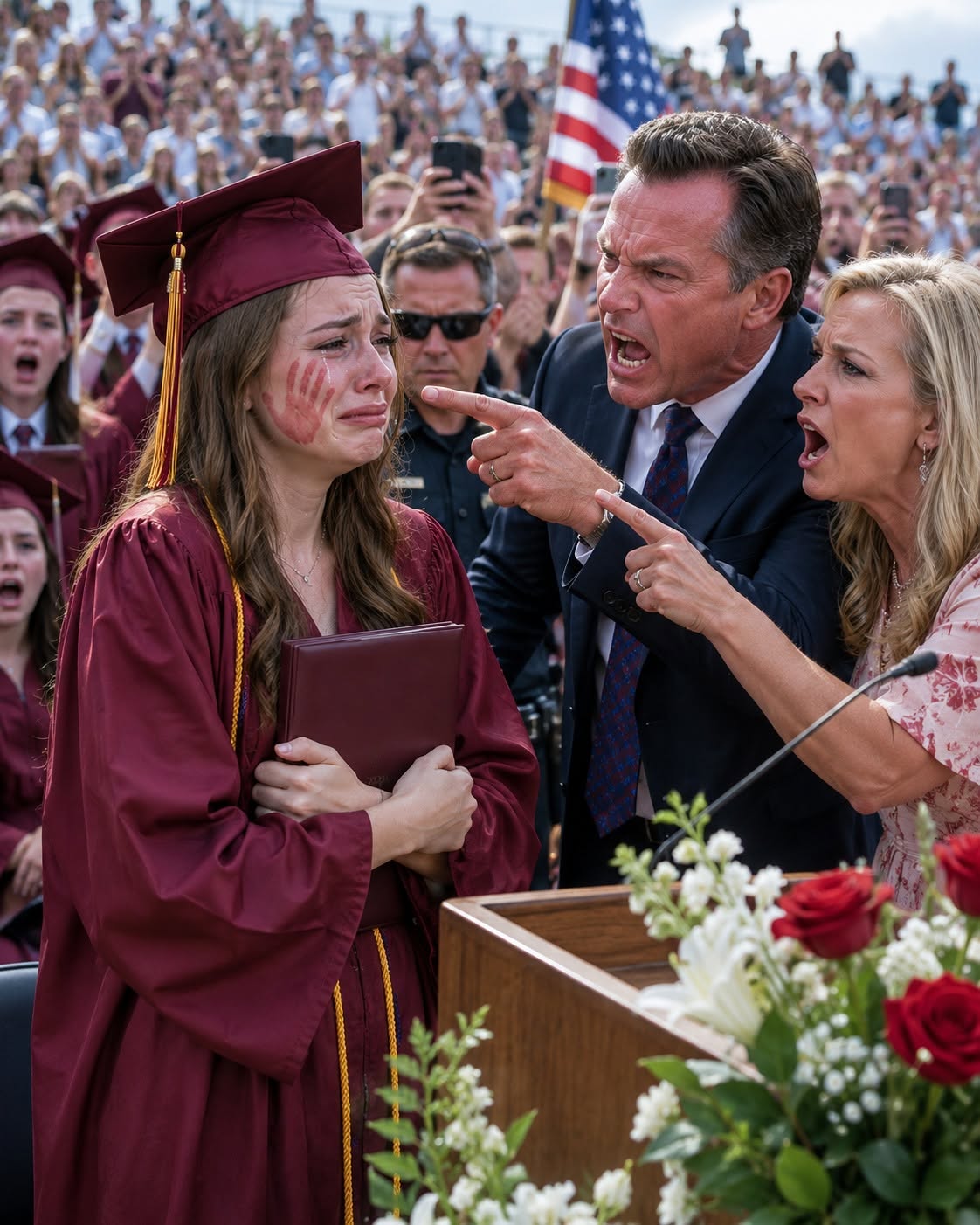
I carried the sealed envelope back to my apartment like it was something alive, something dangerous, something that had waited twenty-two years to breathe. Outside, the campus still looked painfully beautiful, with families laughing under the old stone arch and graduates posing with flowers while I walked past them with two red handprints burning across my face.
My apartment sat twelve blocks from Hamilton, above a bakery that smelled like cinnamon in the morning and burnt sugar after closing. It was small enough that I could stand between my thrift-store couch and my crooked desk and touch almost everything I owned without taking more than three steps, but it was mine in a way my parents’ house had never been.
I locked the door behind me, took off my cap, and stood in front of the bathroom mirror. My cheeks were swollen, my eyes were dry, and the girl staring back at me looked less like someone who had survived graduation and more like someone who had survived a public execution.
“You made it,” I whispered, and then I laughed once because those words should have sounded joyful. Instead, they came out like a rescue worker calling into wreckage, checking whether anyone inside was still breathing.
My phone began vibrating on the sink. Mom, Dad, Julian, Mom again, Dad again, Julian again, each name appearing like a fist knocking against glass.
I turned the phone off and placed it face down, because for the first time in my life, I did not want to hear their version of what they had done. I did not want their rage, their excuses, their command that I apologize for bleeding where people could see it.
In the bottom of my closet was a plastic storage box labeled EMERGENCY BACKUP. I had made it during sophomore year after my father threatened to “pull me out of college” even though he had no legal power over my scholarship, my enrollment, or a single dollar that kept me there.
Inside were copies of everything I had learned to save because love had never been reliable in my family. Scholarship letters, student employment contracts, research stipend confirmations, tax forms, award notices, tuition statements, lab assistant schedules, emails from professors, and the acceptance letter for the full-time cancer research position I was supposed to begin the next month.
I spread the papers across my floor until my apartment looked like a courtroom built by a desperate girl. Every page said the same thing in a different language: I had earned this, I had paid for this, I had carried myself.
Then I pulled down the second box from the closet. This one had a single word written across the lid in black marker: LEGAL.
That box held the documents my parents had pushed across their kitchen table a year earlier with smiles too smooth to trust. My mother had called it “just emergency planning,” and my father had said Julian was “too overwhelmed by paperwork,” which was the kindest way he had ever described my brother’s incompetence.
The forms named me as temporary emergency proxy over several family holdings and one retirement account if my parents became unavailable, incapacitated, or placed under financial review. At the time, I had felt a pathetic flicker of pride because they had finally trusted me with something important.
Now, sitting on my apartment floor with swollen cheeks and official university proof beside me, I understood it differently. They had not trusted me because they respected me; they had used me because I was careful, responsible, and easier to exploit than the son they worshiped.
I scanned every page. My printer wheezed, my laptop fan screamed, and the bakery downstairs began closing for the night while I built a digital fortress out of every receipt my parents had assumed I would never need.
At 10:43 p.m., I called the number printed at the bottom of the proxy agreement. The financial adviser answered on the fourth ring, sounding tired and cautious when he said, “Martin Hale speaking.”
“My name is Celia Monroe,” I said, holding the phone so tightly my knuckles hurt. “I’m listed as temporary emergency proxy on the Monroe family retirement account and related holdings.”
There was a pause just long enough to tell me he already knew my name. “Miss Monroe,” he said carefully, “your parents contacted me earlier today asking whether you could be removed from that authority.”
My stomach dropped, but not from surprise. It was the terrible confirmation of something I had already felt moving in the dark, because my parents never humiliated me without trying to make sure I could not defend myself afterward.
“Today?” I asked. “After graduation?”
“About an hour after the ceremony,” Martin said, and his voice tightened. “They claimed you had become unstable, that you had embarrassed the family publicly, and that they wanted Julian Monroe added in your place.”
Of course they did. Julian, who could not remember to pay his phone bill unless my mother reminded him, Julian who had called himself an entrepreneur because he sold sneakers online for three months, Julian who was always treated like a future king despite never learning how to stand on his own feet.
“Can they do that?” I asked. My voice was calm, but my heart had become a hammer.
“Not without full signatures, identity verification, and review,” Martin said. “And given certain irregularities connected to the accounts, I am not comfortable approving any changes without documentation.”
The word irregularities moved through me like cold water. I sat straighter, staring at the papers around me as if one of them might suddenly explain everything.
“What kind of irregularities?” I asked. Martin was quiet again, and in that silence I heard the old family machine turning—my father’s temper, my mother’s excuses, Julian’s endless need, and me being summoned only when responsibility became too heavy for everyone else.
“I can’t disclose the full details without a formal review,” he said at last. “But there have been repeated withdrawal attempts from linked accounts, some denied and some processed under questionable authorization.”
“Julian,” I said. It was not a question.
Martin did not answer, which was answer enough. For a moment, I saw my whole childhood from a new angle, not as a series of random cruelties but as a system designed to feed one child and drain the other.
“What can I do to protect myself?” I asked. My voice did not shake anymore.
“You can submit identification, copies of the proxy agreement, and a signed statement requesting a temporary freeze pending legal and account integrity review,” he said. “If there is evidence of coercion, fraud, or public defamation connected to the account holders, include it.”
I almost laughed at the word evidence. By midnight, the internet had already begun collecting evidence faster than any lawyer could.
I opened my laptop, found the first viral clip, and watched my father’s hand cross the screen. I watched my mother slap me, watched my own face stay still, watched hundreds of strangers rise to their feet after I finally told the truth into the microphone.
Then I attached the university payment records. Parent contribution: zero.
I attached the scholarship letters, my employment proof, the proxy agreement, and a short statement describing what had happened at graduation. At the end, I wrote, I believe my parents are attempting to remove me because I may be able to expose unauthorized account activity involving my brother, Julian Monroe.
I stared at that sentence for a long time before sending it. Once I did, there would be no pretending this was only a family argument.
At 2:17 a.m., Martin replied. Temporary freeze approved pending legal and account integrity review.
I read the words three times. Then I sat back on the floor, surrounded by proof, and realized I was not only defending my dignity anymore.
I was standing between my parents and whatever ugly thing they had helped Julian hide.
When I turned my phone back on, eighty-six missed calls flooded the screen. My mother had left fifteen voicemails, my father had left nine, and Julian had sent one text: You really had to make it about you today?
I stared at his message until something cold and clean settled inside my chest. Then I typed back, No, Julian. Today was the first day it stopped being about you.
I turned the phone off again, crawled into bed without changing out of my graduation dress, and listened to the bakery ovens start before dawn. For the first time in years, I slept without dreaming of home.
Part 3
The video reached one million views before the swelling in my cheeks had fully gone down. By Friday morning, strangers knew my name, my degree, my parents’ faces, and the exact second my father’s hand cut across the happiest day I had ever tried to claim for myself.
My inbox became a battlefield of interview requests, sympathy messages, legal offers, and cruel comments from people who thought every family wound needed two sides. I ignored most of them until I found a message from a woman in Arizona who wrote, I was slapped at my nursing school graduation too, and thank you for standing there instead of disappearing.
That was the message that finally made me cry. Not because it was cruel, but because it proved I had never been alone in the way my parents had made me feel alone.
There were daughters everywhere who were punished for succeeding too loudly. There were sons who had learned that becoming free could feel like betrayal when a family needed them small.
Dr. Voss called me that afternoon, her voice careful in the way people speak when they know the wrong word might break something fragile. “Celia, you do not have to turn your pain into a public service just because the world is watching.”
“I know,” I said, sitting at my desk with the tuition records beside my laptop. “But I think I’m tired of letting my parents be the only people who ever got to explain me.”
She was quiet for a moment, and I could hear papers shifting on her desk. “Then tell the truth carefully, and don’t give away more of yourself than they have already taken.”
That night, I agreed to one interview with a local reporter named Hannah Pierce. She met me in a quiet university office with no dramatic lighting, no ambush cameras, and no hunger in her eyes, only a recorder on the table and a question she seemed almost afraid to ask.
“What do you want people to understand?” she said. I looked down at my hands and thought about every version of myself that had apologized for taking up space in a house where Julian’s comfort mattered more than my breathing.
“I want people to understand that some families don’t hate failure,” I said slowly. “They hate the proof that their cruelty didn’t work.”
When the interview aired, I did not show every document I had. I was careful, just as Dr. Voss had warned me, but I gave Hannah the tuition records and let Hamilton University confirm the one line that shattered my parents’ lie: parent contribution, zero.
By morning, their story was dead. They had not paid for my degree, they had not carried me, and the whole country had watched them slap the daughter who had carried herself.
My mother’s first voicemail after the interview was not an apology. “You think papers make you smart?” she snapped, her voice shaking with fury. “Your father is humiliated, Julian is being harassed online, and you need to fix what you did to this family.”
My father’s voicemail came six minutes later, and it was even shorter. “Call Martin and release the account review now.”
There it was, clean and ugly. Not my face, not my pain, not the public humiliation they had caused, but the account review that might expose whatever they had protected Julian from for years.
A week after graduation, an email arrived from Daniel Rusk, founder of a biotech startup in Seattle. I nearly deleted it because it looked too polished to be real, but the subject line stopped me: Your Speech, Your Research, Your Next Step.
His message was short, direct, and impossible to read without holding my breath. He had watched the speech, read my published paper on early detection markers in pediatric leukemia, and wanted to offer me a research associate position at twice my expected salary, with housing assistance and a mentorship track.
For years, my parents had called my ambition arrogance and my exhaustion drama. A stranger looked at the same evidence and saw discipline, resilience, and a mind worth investing in.
I accepted within forty-eight hours. Two weeks later, I packed my apartment into seven boxes and left behind the bakery smell, the crooked window, and the little room where I had learned that survival could become strategy.
Before I flew west, I drove to my childhood house before sunrise. Julian’s car sat crooked in the driveway, my mother’s dead plants hung from the porch, and the house looked smaller than I remembered, as if my fear had been the thing making it large.
I went to the garage and found my old bedroom door leaning against paint cans and broken lawn chairs. My father had removed it when I was sixteen because he said privacy was something I had to earn, and I had never forgotten the sound of the hinges coming off.
I taped a copy of my diploma to the center of that door. Beneath it, I taped the tuition record showing parent contribution: zero.
Then I leaned it against the front porch, rang the bell, and walked away. I was halfway down the sidewalk when my mother opened the door and shouted, “Celia Monroe, don’t you dare walk away from me.”
That was the last command she ever gave me in person. This time, I did not turn around.
Seattle greeted me with rain, glass buildings, and air that smelled like coffee and salt. Daniel’s lab was smaller than Hamilton’s, but it was bright, sharp, and full of people who listened when I spoke instead of treating my intelligence like a personality flaw.
For the first time in my life, I worked in a room where nobody rolled their eyes when I had an idea. For the first time, I slept through entire nights without dreaming of my father’s voice coming through a locked door.
Then, one month after I moved, my father called from an unknown number. I answered because I was tired of being trained by fear, and because some part of me wanted to prove his voice could no longer reach all the way into my bones.
“We need the retirement login,” he said, without hello, without apology. “You are going to stop this nonsense today.”
I looked through the lab window at rain sliding down the glass. “It is under legal review, and you know why.”
“That money is ours,” he snapped. “You don’t get to punish this family because you got embarrassed.”
“You embarrassed me,” I said. “I told the truth afterward.”
My mother must have grabbed the phone, because her voice suddenly came through, sharp and desperate. “Your brother needs help, Celia, and you are acting like some stranger instead of family.”
I closed my eyes, and for one second I saw Julian at the dinner table, laughing while my parents told me to stop being sensitive. “I was family when you needed competence, silence, or clean paperwork.”
“You are punishing us over one bad moment,” she said. “One mistake.”
Twenty-two years became one bad moment when accountability knocked at the door. I hung up before she could shrink my whole childhood into a sentence small enough for her to survive.
Five minutes later, she texted: Your father is waiting on that password, don’t be difficult. I stared at the message until my reflection in the dark phone screen looked calm enough to frighten me.
That evening, I stood in an empty conference room with copies of the proxy papers in my hand and asked a coworker to film. I did not show account numbers, signatures, or private details, only enough for people to understand the shape of what had happened.
“My parents told the world I did not deserve my degree,” I said into the camera. “Then they demanded access to money connected to paperwork they only trusted me with because their favorite child could not manage it.”
I fed the copies into the shredder one page at a time. The blades chewed through them with a soft mechanical scream while I watched the paper vanish in strips.
“This is for every child who was called selfish for surviving,” I said. “I did not get here because of them; I got here in spite of them.”
I posted the video at 7:15 p.m. By morning, it had passed a million views, and by noon, Martin Hale called with a voice so grave I sat down before he finished saying my name.
“We completed the first stage of the review,” he said. “Your brother forged your father’s authorization on two withdrawal attempts.”
My stomach tightened so hard I could barely breathe. “And my parents?”
Martin exhaled slowly, and in that breath I heard the last wall of my childhood collapse. “Celia, they knew.”
Part 4
For a few seconds after Martin said my parents knew, I could not hear anything except the rain hitting the lab windows. It was strange how betrayal could still find a deeper floor beneath you, even after you were sure you had already fallen as far as a person could fall.
“What do you mean they knew?” I asked, though I understood exactly what he meant. My voice sounded calm, but my hand had tightened around the phone so hard my fingers ached.
“Your brother forged authorization on two attempted withdrawals,” Martin said carefully. “The records suggest your parents discovered it, then tried to move control away from you before a formal review could expose the pattern.”
I closed my eyes and saw my mother’s face at graduation, twisted with rage, not because I had failed them but because I had become inconvenient. They had walked onto that stage to shame me, and afterward, while my face was still swelling, they had tried to erase me from the one document that could reveal what they had hidden.
“Can this become criminal?” I asked. Martin hesitated, and the silence answered before he did.
“It can,” he said. “I strongly recommend you retain an attorney immediately and avoid direct communication with your parents or Julian.”
I thanked him, ended the call, and sat alone in the empty conference room until the motion lights clicked off. In the dark, I realized the family I had been grieving was not dying; it had never existed in the form I had spent my life trying to earn.
By the next morning, Daniel had connected me with an attorney named Rebecca Sloan, a sharp-eyed woman who listened without interrupting and took notes like every detail mattered. When I finished explaining the graduation video, the account freeze, Julian’s suspected forgery, and my parents’ pressure for passwords, she looked up and said, “Celia, this is not family drama anymore.”
Those words should have frightened me, but instead they steadied me. For years, my parents had hidden cruelty behind the word family, as if blood could turn threats into love and exploitation into obligation.
Rebecca sent formal notices within forty-eight hours. No direct contact, no account access requests, no attempts to pressure me through relatives, and no further public claims that they had funded my education unless they wanted a defamation response backed by Hamilton University’s records.
For three days, there was silence. I almost trusted it, which meant I should have known better.
On the fourth morning, I walked out of a strategy meeting with Daniel and saw my parents standing in the lobby beneath the glass staircase. My mother wore her church pearls, my father wore his navy jacket, and both of them looked painfully out of place among the clean white walls and security doors of the life they had never believed I could build.
“Celia,” my mother said, stepping forward with tears already shining in her eyes. “Sweetheart, please, we need to talk.”
The word sweetheart felt like a costume she had put on badly. I stopped six feet away and said, “Don’t call me that.”
My father’s jaw tightened, but he kept his voice low because people were watching. “You’ve made your point, now you need to stop this before your brother’s life is ruined.”
I almost laughed. Not because anything was funny, but because even in a lobby hundreds of miles from home, they still thought Julian’s consequences were my responsibility.
“Julian forged documents,” I said. “You knew, and instead of reporting it, you tried to remove me from the account review.”
My mother flinched, then glanced around as if my volume, not their actions, was the danger. “Keep your voice down,” she whispered.
That was when I finally understood the purest truth about them. They had never feared hurting me; they had only feared being heard.
Daniel stood beside me, quiet but present, and I looked toward the receptionist. “Mia, please call building security and ask them to wait nearby.”
My mother’s tears spilled instantly. She had always known how to cry once an audience appeared, but this time her tears reached me like rain against glass.
“We are still your parents,” she said. “You can’t treat us like criminals.”
“No,” I replied. “You treated me like property, then tried to use me to cover financial fraud.”
My father stepped forward, and for one flicker of a second, my body remembered every hallway, every slammed cabinet, every warning in his voice. Then I looked at his hand and realized it no longer had the power to decide who I was.
“You don’t get to discipline me anymore,” I said. “You lost that privilege when you slapped me in front of my university.”
My mother pressed a tissue under her nose. “Julian made mistakes.”
“He forged signatures.”
“He was desperate.”
“He was enabled,” I said, and the word landed hard enough to make both of them go still.
My father pointed at me, his voice rough. “You always hated your brother.”
“No,” I said. “I hated how you used him as a weapon against me.”
For a moment, the lobby went quiet except for rain ticking against the tall windows. Then my mother whispered the sentence that explained my entire childhood.
“He was easier to love.”
She seemed to regret it the second it escaped her mouth, but I did not break. The words entered me, searched for the old wound, and found scar tissue instead.
“Thank you,” I said softly.
My mother blinked. “For what?”
“For finally telling the truth.”
She shook her head, crying harder now. “That’s not what I meant.”
“Yes, it is,” I said. “And I am done spending my life trying to become easier for you.”
I opened my bag and removed the envelope Rebecca had prepared. Inside were copies of the tuition records, scholarship letters, proxy documents, Martin’s account review summary, and a formal notice warning them that any future contact outside legal channels would lead to a protective order.
My father stared at it. “You got a lawyer?”
“Yes,” I said.
“With what money?”
I smiled for the first time that morning. “The salary I didn’t deserve.”
Mia covered her mouth behind the desk, and my father looked away as if the small laugh wounded him more than any accusation. My mother reached for the envelope, but I held it back.
“I need you to hear this clearly,” I said. “I did not freeze the account to steal from you, and I did not expose you to punish you. I protected myself, and if protecting myself revealed what you were hiding, that is not my shame to carry.”
Security arrived near the elevators, two men in dark jackets who stopped at a respectful distance. My father saw them and seemed to shrink inside his navy coat.
My mother whispered, “We didn’t think you would actually leave.”
There it was, the closest thing to confession I would ever get. Not we hurt you, not we were wrong, only the stunned grief of people who had built their cruelty on the belief that I would always come back.
“You were wrong,” I said, handing her the envelope.
As security escorted them out, my father turned once. “You’ll regret this when we’re gone.”
Maybe he expected the words to haunt me, but all I felt was an old sadness without teeth. “I already grieved you while you were alive,” I said, and he looked away first.
In the months that followed, Julian’s forgery became a legal matter, my parents’ accounts stayed under review, and my name was removed from every family obligation Rebecca could untangle. Julian sent one message through his attorney that said only, I’m sorry, and though I did not forgive him fully, I saved the message because it was the first honest thing he had ever given me.
A year later, Hamilton University invited me back to speak at a scholarship gala for unsupported students. I stood beneath warm lights in the grand auditorium, facing students in borrowed suits, thrifted dresses, polished shoes, and nervous smiles, and I knew exactly which ones had come alone.
“Two years ago,” I began, “I was slapped on this campus for succeeding.”
The room went silent, but this silence did not feel like the stadium silence. This one felt like people holding space instead of holding judgment.
“I used to believe the worst thing that happened that day was public humiliation,” I continued. “I was wrong. The worst thing was realizing I had spent my whole life waiting for permission from people who benefited from my self-doubt.”
A young woman in the third row wiped her eyes. I looked at her and spoke the words I wished someone had given me when I was still studying under laundry room light.
“You do not need cruel people to understand your worth before your worth becomes real. You do not owe lifelong access to anyone who only calls you family when they need your labor, your silence, or your forgiveness.”
The applause began softly, then rose until the old auditorium seemed to breathe with it. This time, my body did not flinch.
Afterward, Dr. Voss hugged me in the hallway and whispered, “You built something beautiful out of what should have destroyed you.”
I looked at the students lined up to speak with me, at their tired eyes and brave smiles, and I finally understood that survival was not the end of the story. Survival was the foundation.
When I returned to Chicago, snow was falling outside my lab windows. My team had left a note on my office door that read, Welcome back, Dr. Monroe, and I stood there smiling at the name I had earned without permission.
I placed the gala program beside my diploma and my published research paper. One was proof of what I survived, one was proof of what I built, and one was proof that the girl they tried to humiliate had become a door for others to walk through.
Outside, the city moved forward. So did I.
THE END