Part 1
The snow beneath me turned crimson before I even understood that I was screaming, and for one terrible second, all I could see was the back of my husband’s truck disappearing down our street. Strapped into the bed of that truck was our baby’s crib, the same walnut crib my father had built with his own dying hands for the granddaughter he would never get to hold.
Three days before my due date, I had walked into the nursery expecting to fold tiny cotton onesies and calm the restless ache in my back. Instead, I found Evan on his knees with a wrench in his hand, dismantling the most precious thing left to me.
The nursery smelled faintly of fresh paint, baby powder, and the cedar blocks I had tucked into the closet drawers, but all I could hear was the harsh metal scrape of Evan loosening another bolt. One side of the crib already leaned against the wall, and the sight of it broken apart made something in my chest cave in.
“What are you doing?” I whispered, because my voice would not come out any stronger. Evan did not even look embarrassed when he lifted another carved panel from the frame.
“My sister needs it more,” he muttered, breathing hard through his nose as if I were the inconvenience. “Claire’s having twins, Mia, and we only have one baby coming.”
For a moment, I could only stare at him, one hand pressing against the underside of my swollen belly where our daughter had gone still. “That crib was built for our daughter,” I said, and my voice shook because every curve of it still carried my father’s fingerprints.
My father had worked on that crib during the last good weeks before cancer hollowed him out, sitting in his garage with a blanket over his knees and sandpaper trembling between his fingers. He told me that even if he never got to meet my child, she would sleep inside something made by love, not bought by money.
Evan finally looked at me then, but not with guilt, not even with hesitation. He looked annoyed, the way he always looked when my feelings required him to stop doing exactly what he wanted.
Before I could step closer, Patricia appeared in the doorway wearing her fur-lined coat and pearl earrings, as if she had come to supervise a delivery instead of a betrayal. Her lips curled when she saw my face, and I knew immediately that this had been her idea.
“Your daughter won’t even remember it,” she snapped, sweeping her eyes around the nursery like she owned the walls, the floor, and the air I breathed. “Stop acting dramatic before you upset yourself.”
I moved in front of the remaining crib pieces, clumsy and breathless, my slippers sliding against the rug as my body protested every step. “Put it back,” I said, and for the first time in months, I heard steel beneath my own fear.
Evan laughed under his breath, a short, ugly sound that made Patricia smile. “Or what, Mia?” he asked, rising to his feet with the wrench dangling from his hand.
There it was again, that tone he used when bills arrived in my name, when he called my remote job “cute,” when he told his mother I worried too much because I was pregnant and hormonal. He believed I was fragile because I cried quietly, and he believed I was weak because I had spent our marriage trying not to turn every cruelty into a war.
Patricia brushed past me as if my body were nothing more than furniture in her way, then grabbed the folded baby blanket from the rocking chair. My breath caught so sharply it hurt, because that blanket had belonged to my mother.
“That stays here,” I said, reaching for it with trembling fingers. Patricia pulled it back against her chest, her eyes narrowing into two hard slits.
“Don’t be selfish,” she said, each word dripping with disgust. “You married into this family, and it is time you learned that family helps family.”
I looked from her to Evan, waiting for my husband to correct her, to defend me, to remember that the child inside me was his too. He only turned away and carried another crib panel toward the hallway.
Something inside me cracked then, not loudly, not dramatically, but deeply enough that I knew I would never be the same woman again. I followed them through the house, one hand braced against the wall and the other cradling my belly as pain tightened low across my back.
Outside, the winter air slapped my face, and the porch boards were slick beneath a thin glaze of ice. Evan loaded the final piece into the truck bed while Patricia stood near the steps clutching my mother’s blanket like a trophy.
“Evan, please,” I begged, hating the sound of my own voice but unable to stop it. “That crib is all I have left from my dad, and our daughter is due any day.”
He slammed the tailgate shut, and the sharp metallic sound rang through the street. “Claire needs it now,” he said, as if need were something his family could claim and I was only allowed to endure.
Patricia turned toward me, triumph brightening her face in a way that made her look almost younger. “You have been spoiled long enough, Mia,” she said. “A good wife knows when to step aside.”
I was barefoot inside my thin slippers, wearing only my robe over my nightgown, and my belly felt impossibly heavy beneath the gray morning sky. Still, I took one careful step forward because I could not let them drive away with everything my parents had left me.
“Give me the blanket,” I said, and this time I did not beg. “And unload the crib before I call the police.”
Evan froze beside the driver’s door, and for half a second, I saw something dangerous flash across his face. Patricia saw it too, and instead of calming him, she lifted her chin as if my pain had finally entertained her.
“The police?” she repeated, almost laughing. “Over a crib?”
“Over theft,” I said, my voice quieter now. “And over whatever else you think you can get away with.”
Patricia’s expression changed so fast that it chilled me more than the snow. She stepped toward me, close enough that I smelled her expensive perfume, and hissed, “You do not threaten my family.”
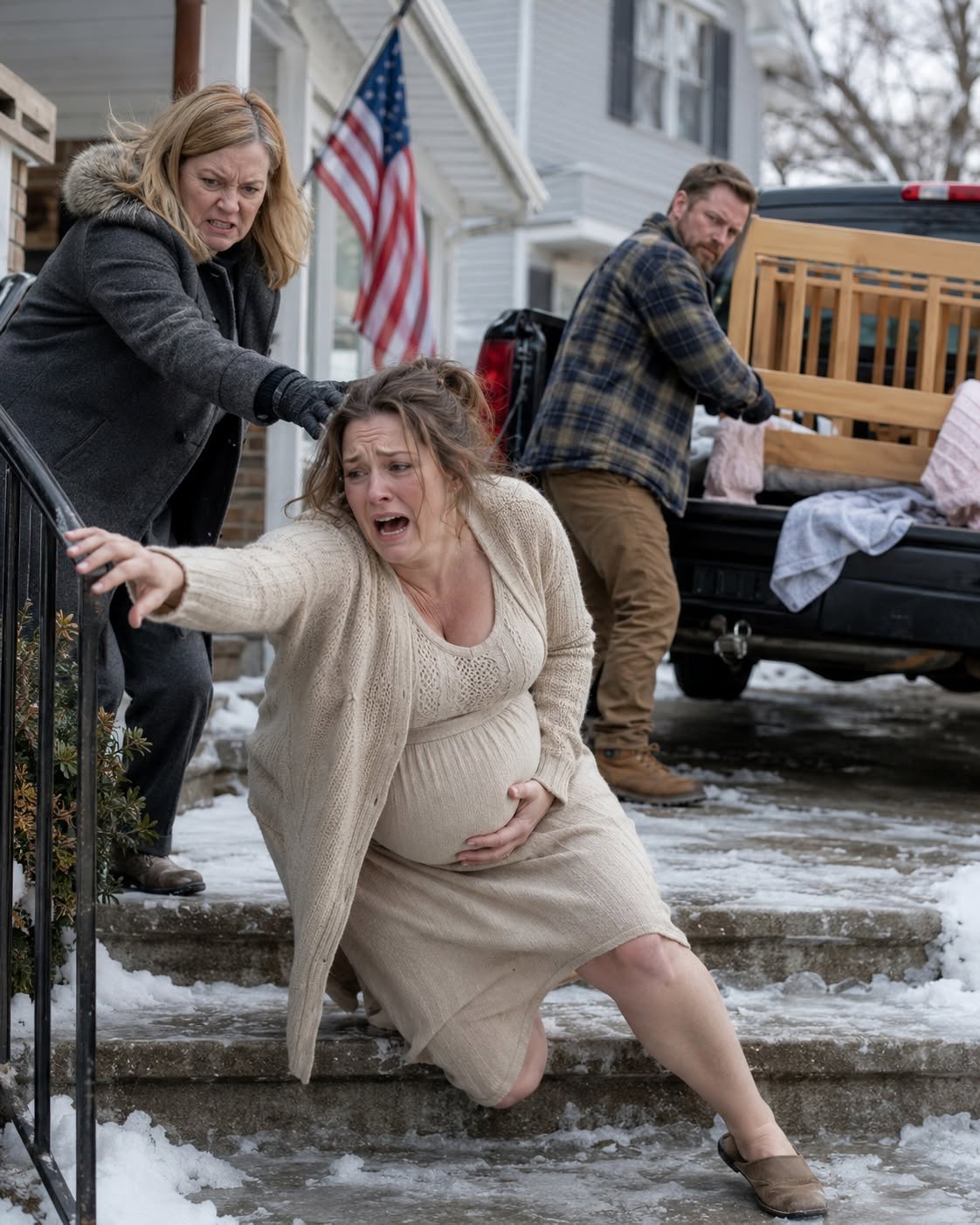
Then she pushed me.
My heel slipped on the icy top step, and the world tilted violently sideways before I had time to grab the railing. The sky spun white, the porch blurred gray, and then the concrete struck my side with a force so brutal that every sound in my body vanished except one broken scream.
Pain tore through me so sharply I could not breathe, and for one horrifying moment, I thought the baby had gone silent forever. When I looked down, dark red had begun spreading beneath me into the snow.
“Evan!” I screamed, reaching one hand toward the truck even though my fingers could barely move. He paused with his hand on the door, his face pale, his eyes fixed on the blood beneath me.
Patricia grabbed his arm before he could take a step. “She’s pretending,” she hissed, loud enough for me to hear.
The truck door slammed shut.
The engine roared, tires crunching over ice, and then they were gone, taking the crib, the blanket, and the last illusion I had that my husband would ever choose me when it mattered. I lay there shivering on the concrete, one hand pressed to my belly and the other clawing desperately at the pocket of my robe.
My phone was still there.
With trembling fingers, I dialed 911, and when the dispatcher answered, I could barely force the words past my teeth. “Please hurry,” I whispered, staring at the blood staining the snow around me.
Then something colder than fear settled inside my chest, and my voice became steadier than I felt. “And send the police,” I said. “I have cameras.”
Part 2
I woke beneath fluorescent hospital lights with my throat raw, my body heavy, and the strange hollow feeling that comes when pain has already happened but memory has not yet caught up. For several terrifying seconds, I did not know where I was, and then I heard the sound that pulled me back from the edge of every nightmare.
My daughter was crying.
Not whimpering, not struggling weakly, but screaming with furious life from somewhere beside my bed, as if she had arrived already offended by the world that had tried to hurt us both. I turned my head slowly, every muscle protesting, and saw a nurse holding a tiny pink bundle with a scrunched red face and fists no bigger than walnuts.
“She’s strong,” the nurse said softly, bringing her closer to me. “A little early, but strong.”
I started crying before the baby ever touched my chest, not quietly or prettily, but with the broken relief of a woman who had spent hours believing she might wake up empty. When the nurse placed her against me, my daughter stopped screaming for one breath, then opened her mouth again like she wanted the whole hospital to know she had survived.
“Nora,” I whispered, pressing my lips against her warm forehead. “Her name is Nora.”
I named her before Evan arrived, before his mother could twist her mouth around suggestions, before anyone could pretend they had earned a voice in my daughter’s first moment on earth. Nora had come through blood, snow, and betrayal, and I wanted the first thing she owned to be a name no one had taken from her.
The doctor came in later and explained things gently, using careful words and a calm voice, but I saw the truth in the way she watched me. The fall had been dangerous, the bleeding had been real, and if the ambulance had arrived any later, my story could have ended on that porch.
I listened with Nora asleep against my chest, my hospital bracelet scratching my wrist, and I kept seeing Evan’s face through the truck window. He had seen the blood, heard my scream, and still chosen the driver’s seat.
By late afternoon, I was drifting between exhaustion and shock when the door opened without a knock. Evan walked in carrying a cheap bouquet from the hospital gift shop, and behind him came Patricia in pearls, her fur-lined coat folded over one arm like she was visiting a difficult neighbor instead of the woman she had pushed down icy steps.
“Mia,” Evan said, his voice thick with performance, “God, you scared us.”
I stared at the flowers first because looking at his face felt too dangerous. The cellophane around them crackled in his hand, bright and cheerful and obscene beside the bruises blooming across my hip and arm.
He reached toward me, but I pulled my hand away before his fingers touched mine. His eyes flicked immediately toward the nurse near the monitor, and I understood then that he had not come to apologize; he had come to manage witnesses.
Patricia sighed like she was exhausted by my lack of manners. “She’s overwhelmed,” she told the nurse, lowering her voice in that sweet public tone I had always hated. “The hormones have made everything feel bigger than it is.”
I looked past her polished smile and fixed my eyes on Evan. “You left me bleeding in the snow.”
His expression tightened, not with shame, but with irritation at my refusal to stay quiet. “We didn’t know it was serious,” he said, as if the blood on the concrete had been a misunderstanding.
“You heard me screaming,” I said.
Patricia stepped closer to the bed, her perfume crawling over the antiseptic air. “Careful, Mia,” she said softly, and every word carried a threat beneath it. “Accusations destroy families.”
I looked down at Nora’s sleeping face, at the tiny pulse fluttering in her neck, and something inside me cooled into perfect clarity. “Not as quickly as evidence,” I replied.
For the first time since entering the room, Patricia blinked.
Evan forced out a laugh, but it came out dry and weak. “Evidence of what?”
“Of theft,” I said, my voice steady enough to surprise even me. “Of your mother assaulting a pregnant woman, and of both of you driving away after causing a medical emergency.”
His jaw hardened, and the man who had brought flowers vanished behind the man who had spent years teaching me to doubt my own anger. “Mia,” he said under his breath, “don’t be stupid.”
There it was again, the word he always reached for when charm failed.
Stupid.
Fragile.
Dramatic.
Convenient.
What Evan never bothered to understand was that my little remote job, the one he smirked about at family dinners, was not some harmless desk job with spreadsheets and polite emails. I was a forensic compliance attorney for a medical fraud division, the kind of person hired when charming people made money disappear and expected everyone else to be too overwhelmed to follow the trail.
I knew how lies were built.
I knew how paper protected truth.
Most of all, I knew how dangerous people behaved when they believed no one had been recording them.
So I looked at my husband, the father of my newborn daughter, and smiled faintly. “Leave.”
Patricia recovered first, lifting her chin as if I had insulted her in her own home. “You need us,” she said. “You just had a baby, and you are in no condition to make decisions.”
“No,” I answered. “I needed a husband, and instead I got a defendant.”
The nurse did not speak, but she moved closer to the door and pressed a button on the wall. Ten minutes later, hospital security escorted Evan and Patricia out while Evan hissed that I was making a terrible mistake and Patricia told anyone within earshot that I was unstable.
By morning, my phone held twenty-three messages from Evan.
The first five were apologies, carefully worded and useless. The next seven were excuses, and everything after that became the real Evan, the one who appeared whenever he could not charm his way back into control.
The crib belongs to my family too.
Mom barely touched you.
If you report this, I’ll tell them you fell because you were hysterical.
You think anyone is going to believe you over us?
I screenshotted every message, backed them up twice, and sent copies to an email Evan did not know existed. Then I called my cousin Lena, a detective in another county, not for favors, not for shortcuts, but for instructions on how to preserve evidence before anyone could claim it had been altered.
Lena’s voice changed the moment she heard me say “porch camera.” She told me to save the original files, download cloud copies, photograph the injuries in hospital light, request every medical record, and ask the responding officer for the report number before discharge.
I did exactly what she told me.
Doorbell footage.
Nursery camera.
Porch camera.
Cloud backups.
Photographs of the blood on the icy concrete before fresh snow buried it.
Evan had forgotten about the nursery camera because Evan had never cared about the nursery. He had never sat in the rocking chair testing its comfort, never folded the tiny socks, never run his fingers along the crib rail where my father had carved a small hidden heart beneath the corner.
The nursery camera captured him saying Claire needed the crib more.
It captured Patricia taking my mother’s blanket.
And the porch camera captured the shove.
Two days later, while Nora slept against my chest in the hospital room, Claire posted a picture online. The walnut crib stood fully assembled in her nursery, glowing beneath soft white curtains, with my mother’s blanket draped over one side.
So blessed by family generosity, the caption read.
Underneath it, Patricia had commented, Anything for our babies.
Our babies.
I stared at those words until they blurred, and then I looked down at Nora’s tiny fist curled into my hospital gown. My daughter had almost lost her life before taking her first breath, and Patricia was online pretending theft was love.
I called the officer assigned to my case before anger could turn hot enough to make me reckless. When he answered, I looked once more at the stolen crib on Claire’s page and felt my fear finally become something sharper.
“I know where the crib is,” I said. “And I have the proof.”
Part 3
A week after Nora was born, Evan returned to the house with Patricia and Claire as if the whole world had already agreed to forgive him. I saw them from the upstairs nursery window before they saw me, three figures moving up the front walk through the pale winter light, expecting tears, apologies, and a woman too tired to fight.
Instead, they found two police cruisers parked at the curb, a locksmith changing the front door hardware, and Daniel Cross, my attorney, standing on the porch with a leather folder tucked beneath one arm. I stood just inside the doorway with Nora asleep against my chest, my body still aching from the fall, but my hands steady for the first time in years.
Evan stopped so suddenly that Patricia nearly bumped into his back. Claire, hugely pregnant beneath a beige coat, looked from the cruisers to me, then to the officers, and all the color drained from her face.
“Mia,” Evan said slowly, forcing a careful smile that did not reach his eyes, “what is this?”
“It’s what happens when you steal from me, leave me injured, and then come back like I owe you a conversation,” I said. My voice sounded calm enough to frighten even me.
Patricia pushed past him, her pearls flashing at her throat. “This is absurd,” she snapped, pointing toward the police cars. “You called officers over a crib?”
Daniel stepped forward before I could answer. “Mrs. Vale, the crib is handcrafted property valued at over four thousand dollars, removed without the owner’s permission,” he said evenly. “But I assure you, the crib is the least serious matter being addressed today.”
Claire covered her mouth with one hand. “Mia, I swear I didn’t know,” she whispered, her eyes shining with horror. “Evan said you wanted us to have it because Dad made it sturdy enough for twins.”
I believed her immediately, not because she was innocent of enjoying what had been given to her, but because her shock did not look rehearsed. Claire had always been passive in Patricia’s orbit, spoiled perhaps, but not cruel in the practiced way her mother was.
“That’s why your name isn’t in the complaint,” I told her. Claire’s shoulders shook once, and she looked at Evan as if she were seeing him clearly for the first time.
Evan’s expression darkened. “Complaint?” he repeated.
Daniel opened the folder and handed him a stapled packet. “Theft, reckless endangerment, and pending domestic-related charges depending on district attorney review,” he said. “Your mother is also being reviewed for assault causing bodily injury.”
Patricia let out a sharp laugh, but it cracked in the middle. “She fell,” she said, turning to the nearest officer with the polished outrage of a woman used to being believed. “Pregnant women lose balance all the time, and she has always been dramatic.”
The officer did not move. “We have video,” he said.
Those three words changed everything.
Patricia’s lips parted, then closed again. Evan looked at me, and for the first time since I had known him, he seemed to understand that I had not been gathering courage; I had been gathering proof.
“This is my house,” he said suddenly, as if volume could rebuild the ground beneath him. “You can’t lock me out of my own house.”
“My house,” I corrected.
His mouth opened, then he gave a hard, nervous laugh. “You’re confused, Mia.”
Daniel handed him another page from the folder. “Purchased before marriage, titled solely to Mia Vale, with no marital refinance, no shared deed, and no ownership interest granted to you at any point,” he said. “Your legal status here has been revoked.”
Patricia snatched the document from Evan’s hand and scanned it quickly. “This is fake.”
“No,” I said, shifting Nora gently against my shoulder. “The fake thing was the story Evan sold all of you.”
A strange silence settled over the porch, and in that silence, I saw every lie Evan had stacked between us like bricks. He had told his mother he paid the mortgage, told Claire he bought the crib, and told me his paycheck delays were temporary while money kept vanishing from our joint account.
Claire turned on him first. “What does she mean?”
Evan’s jaw worked, but no answer came.
I nodded to Daniel, and he removed another packet from the folder, this one thicker than the first. Bank transfers, credit card statements, casino withdrawals, collection notices, and screenshots of messages where Evan had begged for more time from men whose names were saved only as initials.
Patricia’s face went rigid. “Casino withdrawals?” she said, barely above a whisper.
Evan’s head snapped toward me. “You went through my private accounts?”
“Our joint accounts,” I replied. “The ones you drained while telling me hospital bills were too expensive, while mocking my job, while letting your mother call me spoiled.”
He pointed at me with shaking rage. “You’re lying.”
Daniel looked at him over the top of the folder. “The documents came directly from bank records and credit statements, Mr. Vale, and several of them have already been provided to law enforcement.”
Patricia gripped the porch railing, her confidence visibly splintering. “Evan, tell me this isn’t true.”
For one bitter second, I almost laughed, because Patricia had spent years teaching him that consequences were things other people suffered. Now she looked betrayed by the monster she had polished and praised.
Evan took a step toward me. “Mia, listen to me,” he said, lowering his voice into the tone he used when he wanted to sound wounded instead of cornered. “We can fix this privately.”
“No,” I said. “You had private when I was bleeding in the snow, and you used it to drive away.”
His eyes flicked toward Nora, bundled against my chest. “That’s my daughter.”
“She is,” I said. “And that is exactly why this is happening.”
The officer stepped forward then, no longer patient. “Patricia Vale, we need you to come with us to answer questions regarding the incident on the porch.”
Patricia recoiled as if he had struck her. “I am not being treated like a criminal because this girl wants attention.”
Daniel gave her a cold, professional smile. “Would you like to watch yourself shove her again?”
Patricia stopped breathing.
Claire began to cry quietly on the walkway, one hand pressed to her belly as if protecting her own babies from the ugliness in front of her. “Mom,” she whispered, “what did you do?”
Patricia did not answer, and that silence became the first honest thing I had ever heard from her.
Evan looked from the officers to Daniel, then back to me, panic finally burning through his anger. “Mia, please,” he said, his voice breaking in a way that might have moved me once. “Please don’t do this.”
I looked through the open doorway toward the nursery, where the crib had been returned that morning by officers who documented every panel, every screw, and every scratch. The blanket was back too, washed clean and folded over the rocking chair, though I could not yet look at it without seeing Patricia’s hands.
“You did this,” I said. “I only stopped protecting you from it.”
By sunset, Patricia had been taken in for questioning, Evan had been ordered to leave the property, and Claire had sat in my kitchen sobbing into a paper towel while Nora slept in the next room. She apologized again and again, but I only told her to go home, rest, and decide whether she wanted to keep confusing obedience with love.
That night, after everyone left, I locked the new door, stood in the nursery, and watched Nora breathe beneath the soft glow of the lamp. Then my phone buzzed with a message from an unknown number.
Drop the charges, Mia, or you’ll lose more than a crib.
I stared at the screen, my heart turning slow and cold in my chest.
Then I forwarded the message to Daniel and whispered into the quiet nursery, “Now we finish this.”
Part 4
The message sat on my phone like a snake coiled beneath glass, and for a few seconds, I simply stared at it while Nora breathed softly in her crib. Drop the charges, Mia, or you’ll lose more than a crib.
A year earlier, that sentence would have made me panic, apologize, and wonder what I had done to deserve someone’s anger. That night, standing in my daughter’s nursery with stitches pulling beneath my skin and bruises fading along my side, it made me feel nothing but cold.
I forwarded the message to Daniel, sent a copy to Detective Lena, and placed the phone faceup on the changing table as if it were just another piece of evidence. Then I leaned over the crib, brushed my finger across Nora’s tiny cheek, and promised her the thing no one had ever promised me loudly enough.
“I will not teach you to survive by staying quiet.”
By morning, Daniel had traced the threat through enough digital breadcrumbs to confirm what I already suspected. Evan had not sent it himself, but it had come from a prepaid phone purchased near the casino where his debts had been piling up for months.
The man behind the message was one of Evan’s creditors, someone Evan had apparently told that I was the reason he could not pay. He had turned my name into currency, my house into a fantasy asset, and my silence into a plan.
When Daniel explained it, I sat at my kitchen table with Nora asleep in a bassinet beside me, watching winter light spill across the floor. I thought I would feel shock, but all I felt was the heavy, familiar exhaustion of realizing Evan’s betrayal had reached corners I had not yet opened.
“He told them you controlled the money,” Daniel said carefully. “He suggested that if pressure was put on you, you might settle things for him.”
I looked down at my daughter, at the soft rise and fall of her chest beneath her blanket. “Then he just gave us one more charge to discuss.”
Daniel’s mouth tightened into a brief smile. “Yes, he did.”
The next few weeks unfolded like a storm that had finally stopped pretending it was only weather. Evan’s messages changed from arrogant to desperate, then from desperate to pitiful, but by then every word he sent was routed through attorneys and added to a growing file.
Patricia tried to perform innocence for anyone who would listen, claiming I had exaggerated the fall, misunderstood the shove, and used motherhood to punish her family. Unfortunately for Patricia, the porch camera had no emotions to manipulate, no social standing to protect, and no reason to lie.
At the first hearing, she arrived in a cream suit with pearls at her neck and a face arranged into wounded dignity. She looked almost disappointed when no one rushed to comfort her.
Evan came separately, pale and restless, his hair uncombed and his wedding ring still on as if metal could prove devotion he had never shown. When he saw me holding Nora near the back of the courtroom, his expression crumpled into something that might have looked like love to anyone who had not been trained by pain to recognize fear.
“Mia,” he whispered when we passed in the hallway. “Please, just let me see her without all these people involved.”
I shifted Nora higher against my shoulder, and her tiny hand curled into the collar of my coat. “The people are involved because you made her unsafe before she was born.”
His eyes filled with tears, but I had learned by then that tears were not always remorse. Sometimes they were only frustration leaking out of a person who had run out of control.
The legal process was slower than rage wanted and steadier than fear expected. Patricia accepted a plea deal after her attorney watched the porch footage and advised her, very plainly, that juries did not usually enjoy seeing pregnant women pushed down icy steps.
She paid restitution for the damaged crib pieces, the medical costs not covered by insurance, and the emergency repairs I had needed after Evan tried to enter the house through the side door one night and triggered the alarm. She also became a local headline, the kind she could never gossip her way out of.
Evan’s case twisted through theft, reckless endangerment, financial misconduct, and the fallout from the threatening message tied to his debts. He avoided jail time only by agreeing to strict terms that stripped away every illusion he had used to protect himself.
Mandatory counseling.
Debt disclosure.
No unsupervised contact with Nora.
No contact with me outside the parenting app and court-approved communication.
The day the divorce became final, I walked out of the courthouse under a pale blue sky with my maiden name restored and Nora bundled against my chest. I expected to feel victorious, but what I felt was quieter and stronger than victory.
I felt free.
Claire wrote to me three times before I answered. Her first letter was full of apologies, the second full of shame, and the third finally stopped asking me to make her feel better.
That was the one I kept.
She admitted that she had loved being the protected daughter, the pregnant sister everyone rushed to serve, and she had accepted the crib without asking enough questions because it was easier to believe generosity than theft. She returned my mother’s blanket herself after having it professionally cleaned, then sent a new handmade quilt for Nora with a note that said, I know this does not fix anything, but I hope she is always warm.
I accepted the apology, not because Claire deserved my forgiveness on demand, but because she had done what Evan and Patricia never truly did. She told the truth without trying to make herself the victim of it.
Months passed, and the house slowly stopped feeling like a crime scene. The porch steps were repaired, the locks were new, and the nursery became less haunted every time Nora woke laughing instead of crying.
The walnut crib stood beneath the window, polished and restored until my father’s craftsmanship glowed again in the morning light. Sometimes, when I ran my fingers along the rail, I imagined his hands there before mine, sanding every edge smooth so my daughter would never be hurt by what he left behind.
Evan eventually earned supervised visitation after completing enough counseling to satisfy the court, though the first visit lasted only twenty minutes before Nora cried and reached back for me. I did not celebrate his discomfort, but I did not soften it either.
He had spent too long mistaking access for love.
Patricia never met Nora again during that first year, and when she petitioned for grandparent visitation, the court declined. The porch video, the hospital records, and her own recorded statements made sure of that.
One year after the fall, winter returned to our street.
Snow drifted down in soft white pieces over the roof, the lawn, and the porch where I had once lain terrified and bleeding. This time, I stood safely in wool socks with Nora balanced on my hip, both of us wrapped in the warm quiet of a house that finally belonged only to peace.
She reached one hand toward the falling snow, laughing when a flake landed on her nose. Her cheeks were round and pink, her eyes bright with the fearless wonder of a child who did not know how close the world had come to taking something from her.
Inside, the walnut crib waited for bedtime, complete and beautiful, with my mother’s blanket folded across the rocking chair beside it. On the dresser sat a small framed photograph of my father in his garage, smiling tiredly beside the unfinished crib he had built out of love.
I kissed Nora’s warm cheek and looked out at the clean white porch. For the first time in a very long time, I did not feel like a woman recovering from what had been done to her.
I felt like a mother building what came next.
“No one takes what belongs to you,” I whispered to my daughter. “Not your home, not your voice, not your peace, and never your worth.”
Nora laughed again, reaching for the snow as if the whole sky belonged in her tiny hand. And this time, when winter covered the ground around us, the snow remained white.
THE END